April 15 to October 31: how your Canadian course changes from soft spring to leafy fall
Most strokes lost in spring and fall come from the ground, not the swing. Read the provincial season, the local rules notice and the fairway under your tee, then adjust club, target and putting pace to match.
In brief
- Active handicap seasons run March 1 to November 15 in B.C., March 1 to October 31 in Alberta and April 15 to October 31 in Ontario and Quebec.
- Opening weeks: cold air and soft ground cost roughly a club; soft greens hold.
- Aeration relief under the Model Local Rule applies to a ball in or touching a hole, not to one on your line.
- In fall, hit a provisional near the leaves, and remember a ball that moves while you clear them costs a stroke.
- Press a tee into the fairway on the first hole: easy in means no run today.
Golf Canada publishes a short table that says more about playing golf in this country than most swing tips. It lists the active handicap season for each province: March 1 to November 15 in British Columbia, March 1 to October 31 in Alberta, April 15 to October 31 in Saskatchewan, Manitoba, Ontario, Quebec and Nova Scotia, April 21 to October 31 in New Brunswick, April 16 to November 14 in Prince Edward Island and April 1 to November 30 in Newfoundland and Labrador.
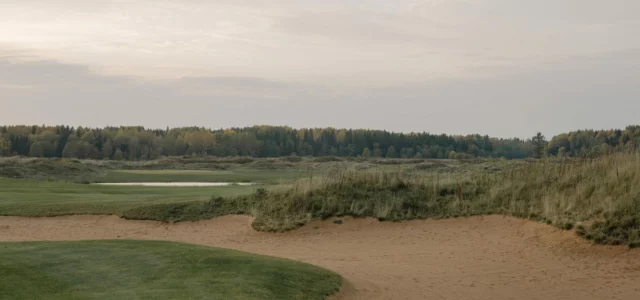
Inside those windows, your home course is not one course. It is a soft, slow, cold one in April, a firm and fast one in August, and a leaf-strewn, dewy one in October. Most of the strokes golfers blame on their swing in spring and fall are really the ground changing under them, and the fix costs nothing but attention.
Opening weeks: cold air, wet ground, no run
The first rounds after the snow goes are the longest the course will play all year, and for two reasons that stack on top of each other.
Cold air is denser, so the same swing carries the ball a little shorter than it does on a warm July evening. And the ground is soft, often saturated by melt, so the roll a drive picks up in summer simply is not there. Together that is easily a club on approach shots for many amateurs, and more than that off the tee. The hole that was a driver and a wedge last August is a driver and a seven iron now.
Adjust before the first shot rather than after the third one. Take an extra club on every approach, aim for the middle of greens, and stop expecting drives to scamper past fairway bunkers you normally clear on the bounce. The good news arrives on the green complex: soft greens hold, so a ball that lands pin high stays pin high.
Expect the course to protect itself in these weeks. Temporary tees, roped areas and cart restrictions are common while the turf recovers, and they are the price of a good course in July. Clubs can also bring in preferred lies, the Model Local Rule that lets you lift, clean and place within a set distance on a closely mown area. It is a rule when the committee adopts it, not a courtesy you take on your own, so read the notice at the pro shop.
The aeration window
At some point in the season your greens will be cored and top-dressed, and for a couple of weeks they will putt like a gravel driveway. It is the maintenance that keeps them alive through the heat and traffic of a Canadian summer, and courses usually announce the dates.
Two responses help. First, putt with more pace: a firmer roll holds its line better over sand and holes, while a dying putt wanders. Accept that a well-struck putt will sometimes hop offline. Second, check what the committee has adopted. The Model Local Rule for aeration holes gives relief when your ball lies in or touches one, but not for a hole that is merely on your line.
Then look ahead. Find the aeration dates before you enter a club championship qualifier or invite guests from out of town, and move the important round.
High summer: firm, fast and further than you think
By July the course has turned into its opposite. Dry, firm fairways add real distance through the bounce, so the bunker that was out of reach in May is exactly where a good drive now finishes. Check the carry and the run to every hazard again, because the yardage book was written for the average day, not this one.
Around the greens the order of shots reverses. The low chip that lands on the fringe and runs is the percentage play, and the high lob that sat down in May now skips through. On approaches, land the ball short of the flag and let the firmness take it back; a front-edge target is often right even to a back pin.
In Alberta there is a bonus on top. Downtown Calgary sits about 1,042 metres above sea level, and thinner air lets the ball fly a little farther than at the same temperature in Toronto or Halifax. Golfers who drive west to the mountains for a weekend should expect it and club down on full approaches.
Heat changes the greens too. On hot, humid stretches superintendents often manage the putting surfaces conservatively to protect the grass, and that can mean slower greens in August than you saw in June. Test the speed on the practice green rather than assuming.
September and October: the best golf, and the lost ball
Early fall is when many Canadian courses are at their finest: cooler days, greens recovered from summer stress, and tee sheets thinning as the leagues wind down. It also brings the two things that ruin fall scorecards.
The first is dew and wet mornings. The ball plugs on soft approaches, the rough is heavy, and the fairway gives no roll until the sun has worked on it. An early tee time in October plays like April for the first hour.
The second is leaves. A perfectly good drive can vanish under maples in the middle of a fairway, and the three-minute search limit comes around quickly. Hit a provisional ball whenever there is any doubt, announcing it as a provisional first, and choose lines that keep the ball away from the tree line. Leaves around a ball you have found are loose impediments you may remove, but if the ball moves as you clear them, it costs a penalty stroke and the ball goes back.
Frost delays belong here as well. Grass that is walked on while frozen is damaged, and the damage shows weeks later. The hour in the clubhouse on a late-October morning is part of the fee for good greens next spring.
Finally, keep the calendar in mind. Rounds after your province’s season closes cannot be posted for handicap, so the last Saturday in October in Ontario is the last card that counts until spring.
November to March: when the course is closed
For most of the country the course is simply shut, and it is often used for something else entirely. Toronto’s five City courses turn into snow loops from December, eight routes between 1 and 2.5 kilometres that you can walk or snowshoe. A mid-winter walk across a snow-covered fairway you know well is a good reminder of just how much the ground shapes the golf.
Winter in Canada is not uniform. In January, Environment and Climate Change Canada’s 1991 to 2020 normals put the mean temperature at -7.6°C at Calgary’s airport and -3.5°C in Toronto. Alberta also gets chinooks, the warm, dry föhn winds that can blow down the eastern side of the Rockies in winter and make a February afternoon feel like spring. Tempting as that feels, the Alberta handicap season does not start until March 1.
British Columbia’s active season runs the longest, to November 15, and on the coast many golfers keep playing on soft, wet ground well beyond that. There the lessons of spring apply all winter: an extra club, no run, and a lower ball flight under the wind and drizzle.
If you head south instead, keep posting. Golf Canada says rounds played where an active season is in force must be posted, and most of the southern United States treats the whole year as active. The winter golf trip counts.
A five-second test on the first tee
Whatever the month, the course shows you how it is playing before your first swing, if you look.
Press a tee into the fairway near the first tee box. If it slides in, the ground is soft and there will be little run. If you have to push, the ball will roll. Look across the practice green: a dull, damp surface is slow, a bright, dry one is quick. And watch where the first approach of your group lands and whether it checks or releases.
Those three observations set the day’s adjustment. A rangefinder gives you the distance; only the ground tells you what the distance means today.
Where to keep the feel over the winter
When the course closes, practice moves indoors or onto the few ranges that stay busy. In Calgary, the City’s driving ranges sell buckets of 25, 50 or 100 balls, with 47 two-level stalls at Confederation Park and 37 stalls, 20 of them covered, at McCall Lake. Around Toronto, the Markham Golf Dome opens every day from 7 a.m. to 11 p.m. with 40 bays over two levels, and in Calgary the National Golf Academy’s dome has 32 bays on two levels. Nerves on the first tee in April are easier when the swing has been kept moving.
Panxis Golf has no commercial relationship with any course, range or dome named here.
Your season on one card
- Opening weeks: one more club, no run, trust the soft greens, read the local rules notice.
- Aeration: firmer putts, relief only for a ball in or touching a hole, no important rounds.
- July and August: land it short, recheck which bunkers are reachable, club down at altitude.
- Fall: provisionals, clear leaves carefully, respect frost delays, post before the season ends.
- Every round: the tee test, the green’s sheen, the first approach of the day.