Three objects, two square metres: the home routine for wet Octobers and the southern winter
A putting mat, an alignment stick and a mirror in two square metres of floor: the twenty-minute routine for the weeks Australian golf takes away, from a wet Melbourne October to the heavy fairways of a Victorian and Tasmanian winter.
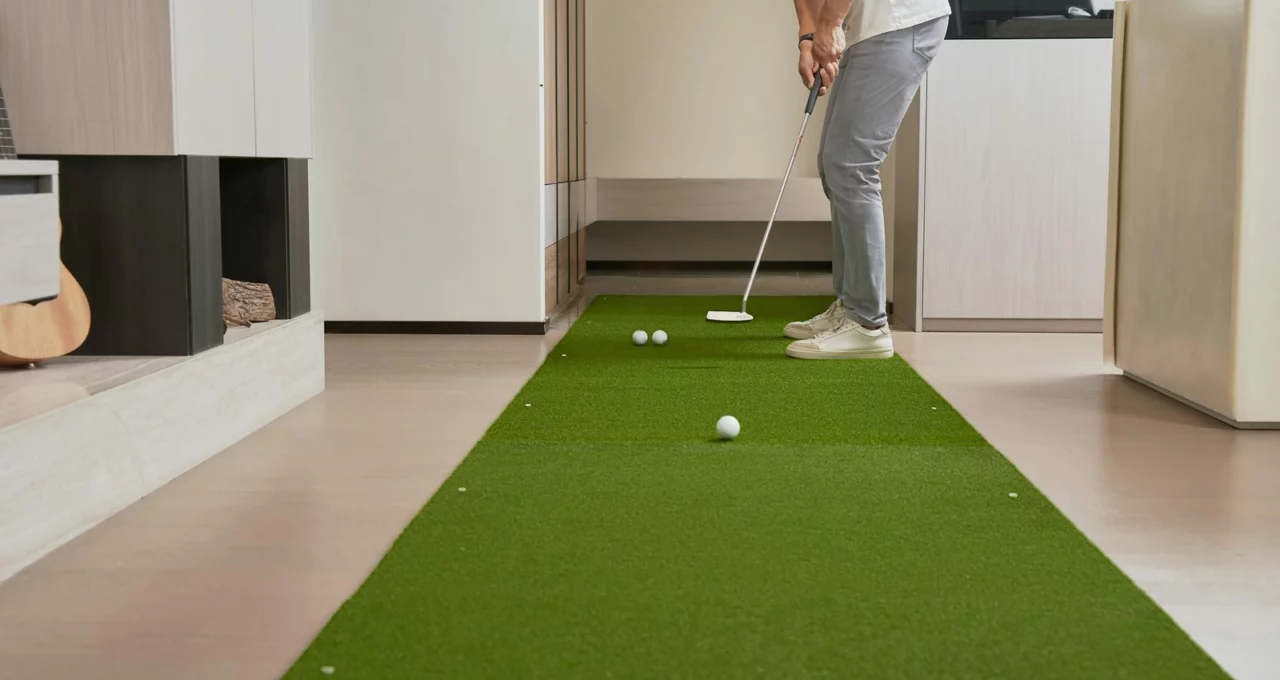
Daylight saving has been back since 4 October and the spring comps are under way, which makes this an odd week to talk about practising at home. It is also the right one. In Melbourne and Hobart, October is one of the wettest months of the year by rain days, and the weeks when an Australian golfer cannot get to the course are never stacked in one block. They turn up all year: a soaked Saturday in spring, a run of 38-degree afternoons in January, a fortnight away for work, and in Victoria and Tasmania a winter where the course stays open but plays long, heavy and under preferred lies. What survives all of that is a routine that needs no tee time: three objects, about two square metres of floor and twenty minutes, three evenings a week.
An off-season you have to build yourself
An Australian golfer never quite stops, which sounds like an advantage and is mostly a trap. Because there is always a next Saturday, there is never a stretch of the year set aside for the dull, repeatable work that moves a GA Handicap: the setup, the start line of the ball and the putts inside a metre and a half. Treat the lost weeks as that off-season instead, whether they are the wet weeks of a southern spring, the June to August winter, the January afternoons that trigger a club’s heat policy, which we covered in our guide to playing in the heat, or a fortnight on the road. A routine that lives in the spare room covers all of them.
Two square metres, and a ceiling you have measured
The room comes before the objects. The National Construction Code sets the minimum ceiling height of a habitable room at 2.4 metres, and that is what most Australian project homes and apartments give you. A driver is around 1.15 metres long, the Equipment Rules allow up to 1.22, and at the top of the backswing the clubhead of a golfer of average height sits well above 2.4 metres. A full swing in a living room is a full swing into plaster or a ceiling fan, and the routine below never makes one. It needs a strip of floor about two metres long and one wide, a wall to lean a mirror against, and nothing breakable within a club’s length. A hallway works; a garage with the car backed out works better.
The mirror, and the eyes-closed test
The mirror is the object you own already and the one that teaches the most, because the commonest faults in club golf are visible at address before the club moves. Stand side-on to it with a mid-iron and look for a forward tilt from the hips rather than a round-shouldered slump, arms hanging under the shoulders, and enough knee flex that you could hop. Then face it and check ball position, shoulder line and, with the driver, the lead shoulder sitting higher than the trail one. The drill that makes it worth more than a checklist is the eyes-closed test: take your setup by feel with your eyes shut, open them, and look at what the mirror shows. Shrinking the gap between the two is the real purpose of the whole routine. For putting, a hand mirror flat on the mat shows whether your eyes are over the ball.
The alignment stick and the rule it cannot follow you into
An alignment stick is a fibreglass rod, usually 117 centimetres long and sold in pairs, and it fixes the fault that costs club golfers more shots than any swing flaw: aiming somewhere other than where they think they are aiming. Lay it along your toe line, step in to an imaginary target across the room, and look down. Most golfers find their stance pointing well right or left of the picture in their head. A few weeks of stepping in against the stick rebuilds that picture; a few more of stepping in without it, then laying the stick down to check, makes the new picture hold.
That second half matters because of the Rules of Golf. Rule 10.2b(3), in force since January 2023, says a player must not set an object down to help with aim or in taking a stance, and the clarification published with it names an alignment rod as exactly such an object. Picking it up before the stroke does not undo the penalty. The habit you train at home has to work on the 1st tee on Saturday with nothing on the ground but the ball, so the stick is a practice tool with a built-in expiry date. Leaned against the wall at the angle of your shaft, it also gives slow half swings a line to follow.
The putting mat and the 108-millimetre hole
The mat is the one object worth buying if you do not already have low-pile carpet and a mug. What matters is a surface that rolls true, a length of at least two metres and a hole the size of a real one, 108 millimetres across. Two drills cover almost everything it is for. The first is the one-metre ladder: ten putts in a row from a metre, start the count again at the first miss, stop at ten. Putts of that length are where Saturday rounds leak shots, on bumpy winter greens in Melbourne and grainy couch greens in a Brisbane summer alike. The second is the gate: two tees or two coins set just wider than the putter head, thirty centimetres in front of the ball. A putter that passes through clean started the ball on line; one that clips a tee has told you what to work on. What the mat will never teach is speed: synthetic turf behaves like neither bentgrass in a Victorian winter nor couch in a Queensland summer, so lag putting waits for the practice green.
Twenty minutes, three nights, mat first
The order opens with the putting mat rather than the mirror, and the reason is motivation: the mat is the only block that gives you a score, and a routine that starts with a number you can beat is a routine you come back to. Monday, Wednesday and Friday, with the Saturday comp as the test, is the pattern that fits an Australian club week.
- Minutes 1 to 8, the mat: the one-metre ladder until you reach ten in a row, then twenty putts through the gate. If the gate stays clean, move the tees closer together.
- Minutes 9 to 14, the stick: five stances against the stick, five without it with the stick laid down afterwards to check, then ten slow half swings beside it.
- Minutes 15 to 20, the mirror: five setups with a 7-iron and five with the driver, side-on and face-on, the last two of each with your eyes shut. End on the one you got right.
Where the Australian calendar actually takes the course away
The Bureau of Meteorology’s long-term averages say where the lost weeks fall, and they differ from one capital to the next. At Melbourne’s Olympic Park station, October averages 9.1 days with at least a millimetre of rain, more than any month except August at 9.3, and October and November sit with April as the three wettest months by total rainfall. Hobart’s Ellerslie Road record, which runs back to 1893, has October as the wettest month of the year by rain days at 9.4, ahead of September and August. A southern spring is as likely to cost you a Saturday as the winter before it. Sydney is the reverse: its wettest months at Observatory Hill run from February to June, with March topping 130 millimetres, and Brisbane loses its weeks from January to March, at 140 to 176 millimetres a month.
The southern winter is its own case, because the course rarely shuts. What changes is the local rules board. As PGA Tour of Australasia referee Stuart McPhee set out in Australian Golf Digest, clubs adopt one of two R&A model local rules when the ground turns to mud: E-2, which lets you lift, clean and replace the ball in the general area, and E-3, preferred lies, which lets you place it within a set distance on the fairway, typically a scorecard length, a hand span or a club length. The round still counts. Played off mud, into wind, with a wet grip, it also tells you almost nothing about your setup or your start line. The home session in July is where that information comes from; the Saturday comp is where you spend it.
Then there is the growing alternative. Golf Australia’s 2024-25 participation report counted 1.6 million Australians at driving ranges, indoor simulators and golf entertainment venues, with an average age of 38 against 43 for golfers who only play on course. A covered bay or a simulator hour once a month tells you whether the work at home is transferring: take the stick, and watch the start direction on the screen rather than the carry. It is not the plan. The plan is the two square metres you can reach every night.
The two-square-metre checklist
- The room: a strip of floor about two metres by one, a ceiling you have measured, nothing fragile within a club’s length. A garage beats a living room.
- The objects: a putting mat at least two metres long with a 108-millimetre hole, one alignment stick, and a mirror you can take your setup in front of.
- The session: twenty minutes, mat then stick then mirror, Monday, Wednesday and Friday, with Saturday as the test.
- Left alone: full swings under a 2.4-metre ceiling, and any grip or swing-plane rebuild from videos without a coach, which is how a winter of changes becomes a spring of changing them back.
The Australian golf year has no off-season, so the Australian golfer has to build one, twenty minutes at a time, in the weeks the weather or the diary takes the course away. The one who does arrives at the next Saturday with the setup right, the ball starting where it was aimed and the one-metre putts going in, which on a heavy winter fairway is most of what a score is made of.
How this page was put together: rainfall and rain-day averages come from the Bureau of Meteorology’s climate statistics for Melbourne (Olympic Park), Hobart (Ellerslie Road), Sydney (Observatory Hill) and Brisbane; the ceiling height from the National Construction Code housing provisions; the alignment rule from Rule 10.2b(3) of the Rules of Golf and the R&A and USGA clarification 10.2b(3)/1; club and hole dimensions from the Equipment Rules and the Rules of Golf; the preferred lies explanation from Stuart McPhee’s article in Australian Golf Digest; participation figures from Golf Australia’s 2024-25 participation report as summarised by Golf WA. All sources were read in October 2026. The drills are standard coaching practice and are presented as such; nobody at Panxis Golf measured them. Panxis Golf has no commercial relationship with anything mentioned here, no retailer is named, and there are no commercial links on this page. If a page on this site is ever paid for by a brand, it will say so above its first line.