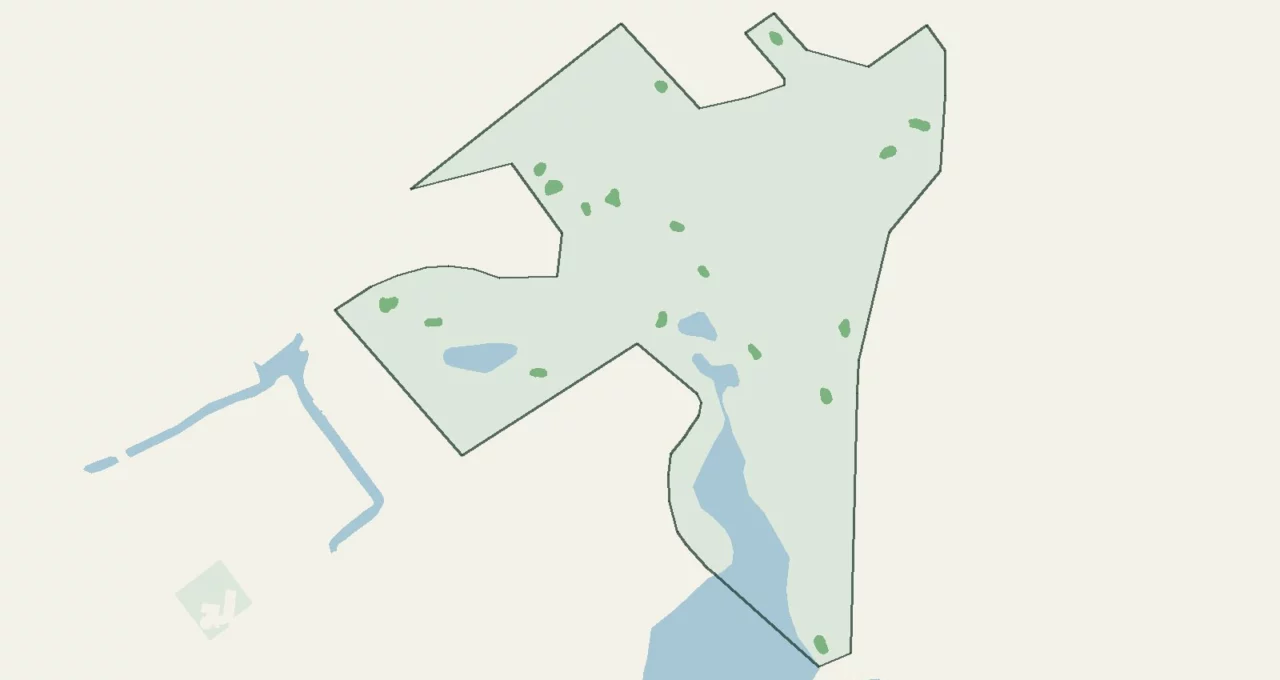
Layout of Bargara Golf Club from OpenStreetMap survey data (ODbL licence).
Bargara Golf Club
Holes
18
By
71 or 72 depending on the source
Length
5,629 to about 5,830 metres from the back tees, depending on the source
Green fee
—
Best season
All year
Bargara Golf Club sits in the middle of Bargara, a seaside town on Queensland’s Coral Coast about 13 kilometres east of the Bundaberg city centre. The club’s address is 120 Miller Street, at the junction with Baxter Street, and the clubhouse stands on a rise across the road from the beach, looking out over the Pacific. The 18-hole course spreads south of it over what the club describes as a 56-hectare site on the shoreline.
The club was formed in 1924, a year after golf first arrived in the town, and it marked its centenary in 2024. It is a members’ club that takes visitors seven days a week, with a busy weekly competition calendar, a pro shop, a driving range and a bistro open to the public. It also hosts a Legends Pro-Am on the PGA Legends Tour each winter and a three-day ladies’ classic each spring.
The course itself is a short to medium-length parkland and dune layout on sandy ground, with the Moneys Creek lagoon and several other stretches of water in play. The club does not publish its card online, and the sources that do disagree on the par and the length, as the next section explains.
The course in figures
Every independent listing agrees on 18 holes. Beyond that, two versions of the card circulate. Course databases that draw on one set of data give a par of 71, with 35 on the front nine and 36 on the back, and a length of 5,629 metres from the blue tees, the longest set listed there; the same listings give a course rating of 69.9 and a slope of 117 from those tees, and 5,455 metres from the white tees. Other scorecard sites give a par of 72 and about 5,820 to 5,830 metres from the white tees, with a slope of 127 from that set. The ladies’ card on the par 72 version adds up to 73.
We cannot tell from public sources which card is current, and the club’s own pages do not say. What can be said with confidence is the order of magnitude: from the back tees this is a course of a little under 5,900 metres at most, with a par of 71 or 72. That is short by championship standards.
The surfaces are better documented. The greens are Bermuda 328, a fine-leafed couch hybrid, and the fairways are couch. The club’s own history records that all the greens were converted from blue couch to 328 Bermuda during the 1980s, which gave a much smoother putting surface, and that the local native green couch later invaded some greens and proved hard to remove. Golf Australia’s course directory describes the course as sand-based, which fits the history: the original course was laid out on sand dunes and swampy ground behind the beach.
The course is maintained to a published schedule. In 2026 the club’s programme of events closed the course for light coring of the greens on 9 and 10 February and for green coring from 7 to 9 September. Anyone planning a trip around those weeks should check the programme first.
A century of reshaping
The club has set down the history of its course in detail in its centenary brochure. It matters because the current routing is the product of a hundred years of land deals, road building and weather.
Jam tins and road reserves
According to the club, golf came to Bargara in 1923, when a group of young men spending weekends at a beach shack put jam tins down in the middle of the town’s unformed road reserves and started to play. A meeting of local property owners formed the club in 1924. Land was bought from several owners, more was donated, and a nine-hole course was laid out along the old road reserves. Unlike other clubs in the district, Bargara had grass greens from the start rather than sand.
The early holes all had names. The first, “Dingley Dell”, was a par 4 of about 380 metres. The second, “Sahara”, had a high sand dune in front of the tee and a ladder beside it so players could see when the fairway beyond was clear. The fifth, “Turkeys Nest”, had a green modelled on a famous green at Gleneagles in Scotland. A tramway serving a local juice mill cut across three holes, and until that section closed in 1948 trains crossed the course four times a day.
Eighteen holes, then fourteen
In the late 1940s the club looked south, to rough land between the beachfront dune and the Moneys Creek lagoon. With the help of a leading professional of the day, five holes were designed for that land and three more added to the existing layout. The club records that the new 18-hole course was officially opened by the president of the Queensland golf body on 10 December 1950.
It did not last. Heavy rain made much of the course unplayable, a couple of years of drought then turned the new southern fairways back into sand dunes that horse-drawn gang mowers could not cut, and the land facing the ocean was later sold to a developer. For three years the club played a 14-hole course. In 1955 it decided to return to 18 holes, using a horse paddock for three extra holes. Wikipedia’s article on Bargara dates the return to a full 18 holes to 1954; the club’s own history describes the decision to restore 18 holes as having been taken in 1955.
Roads, land and a practice fairway
In the early 1970s the local council built Miller Street through the course. To win back a hole, the club swapped the two nines and brought in land between the houses on Miller Street and the lagoon, building a new par 5 third. The 12th, the old “Road Hole”, became a par 5 at the same time.
In 1988 the club bought part of an old cane farm bordering the 14th and Davidson Street, and brought in course architects to fit a practice fairway and three new holes onto the course. The lake on the new land was dug to provide fill for elevated greens. Part of the lagoon beside the 6th was reclaimed, the fairway moved right and a new championship tee built behind the old one, giving a longer carry over water. The new 14th, with a right-angle turn after the drive, was controversial from the start, and a third architect was brought in to replace it with what the club calls the present layout of a par 3 followed by a par 4. Wikipedia also dates the new layout to 1988.
The clubhouse
The first clubhouse, in 1924, was a single room with a verandah. A new clubhouse was built in 1930 on land on top of a hill overlooking the ocean, which is still the site today. During the Second World War, with Australia under threat of invasion, army intelligence had the word “Bargara” removed from the inscribed entry steps. It was largely rebuilt in 1997 and reopened that August with a function room and a large deck facing the sea.
What it asks of you
A course of 5,600 to 5,800 metres does not ask for length. What it asks for is a straight ball and a sense of where the wind is coming from. Reviewers who have played it after rain describe it as tight and lush, and one tee-time listing calls it a social course with enough edge to reward sharp iron play and a steady putter. The club itself calls it not too easy and not too tough.
The details that are public come mostly from the local rules the club published in September 2026, which say a good deal about where the trouble is.
Water on the 6th and the 16th
The 6th is the hole the history keeps returning to. It runs alongside the reclaimed edge of the lagoon, and since 1988 its back tee has demanded a longer carry over water. The local rules confirm a penalty area directly in front of the 6th tee and provide a dropping zone on the far side of it, for a one-stroke penalty, for balls that do not make the carry. On the par 72 scorecard the 6th is a par 5 and the longest hole on the course.
The 16th has water down the left from the tee. The club treats it as enough of a problem for pace of play to have written a specific local rule: if you think your tee shot may have gone into the penalty area on the left and you did not see it go in, you must hit a provisional ball from the tee. The 1988 history describes the 16th of that time as a slight dogleg left around the lake dug for fill, which appears to be the same water.
The 14th and its drain
The 14th has a drain in front of the green and water on the left, with rocks at the water’s edge, and the local rules spell out that bare ground around the drain, in front of the rocks and to the right of the cart path is not fairway: you play it as it lies. Behind the 15th green, near the 16th tee, another drain has been dug out, and that is not ground under repair either. This is the small print of a course built on low, wet coastal land.
Call-up holes
The 3rd and the 14th are designated call-up holes: once a group is on the green, it is expected to stand aside and let the group behind hit if two or three groups are waiting. Call-up rules are normally used on par 3s, which fits the par 3 at the 3rd that every card lists. It also suggests the 14th now plays as a par 3, as the club’s history implies, although one widely copied scorecard still lists it as a par 4. On the 3rd, the rules ask players waiting on the green to stand at the back in the middle so the tee can see them.
Greens and flags
Reviewers disagree on the pace of the greens: some find them quick, others medium and very consistent. The local rules mark the greens’ surrounds with blue lines that carts must stay outside, and set out the club’s flag colours: blue for a front pin, yellow for the middle and red for the back. On the elevated greens built on the 1988 land, that tells you whether to take one club more.
What this means for your game
Leave the driver in the bag where the fairway narrows towards water, and think about the wind before you think about the distance. On a low coastal course the breeze off the sea changes the club, and the club’s history records that one of its old holes almost always played into the wind. The good news for a visiting player is that the length is manageable from any tee, so a steady game off the tee and a reliable short game will get round in a respectable score. A long hitter will find few holes that reward power alone.
Practice and facilities
The club has a driving range, a practice putting green and a chipping and bunker green, all open to members and the public. At the back of the range is a club-fitting and coaching studio with a launch monitor, run by the PGA professional who also runs the pro shop. Lessons are by appointment, and the club runs junior clinics and the national MyGolf junior programme in five-week blocks.
Electric carts and pull buggies can be hired, as can sets of clubs. Cart drivers must hold a car driver’s licence. Carts must stay outside the blue lines around the greens and off the tees, and the club’s code of conduct expects carts to follow the directional signs on the course.
The clubhouse opens from 10 am seven days a week, and the bistro serves from 11.30 am to 8 pm daily, with tea, coffee and desserts all day. The deck looks over the course to the ocean. The clubhouse runs a members’ draw and raffles on Friday nights, has gaming machines, and hosts weddings and functions.
Competitions and the club calendar
The weekly programme shapes when visitors can get a tee time. The club runs a nine-hole group for learners and newer players on Monday mornings, veterans’ golf on Tuesdays, a 12-hole competition on Wednesday afternoons that has run for more than 50 years, men’s and women’s competitions on Thursdays and Saturdays, a nine-hole competition on Friday afternoons and junior golf on Sunday mornings.
The big events are spread through the year. The Bargara Legends Pro-Am, an event on the PGA Legends Tour, was played on 20 and 21 July 2026, with professionals playing 36 holes of strokeplay alongside amateur partners. The Bargara Ladies Classic runs over three days and, according to the club, draws more than 250 players from across Queensland and beyond; the 2026 edition is scheduled for 26 to 28 October. The club championships take the course over in late July and early August, and the club also hosts rounds of regional pennant matches. In recent years it has hosted the Queensland State Junior championships, and in 2019, by the club’s account, it won the national final of the PGA’s pro-am scramble.
The club says it has more than 750 playing members, with over 400 men and more than 150 women, and more than 270 members in its veterans’ section.
What players say about it
Public reviews of Bargara are spread across golf apps, travel sites and restaurant listings, and many of them are about the bistro rather than the course. The points below summarise what recurs. These are other people’s opinions, not ours: we have not played the course, and we name and quote no one.
What comes up in its favour
- The setting comes first in almost every account: the ocean views from the clubhouse deck and from parts of the course.
- Course condition is widely praised, particularly the greens, which reviewers describe as true and as holding a well-struck shot.
- Several accounts note that the course stayed playable and in good shape after heavy rain, which on a coastal sand base is not a given.
- The staff and members are repeatedly described as friendly to visitors, and the club’s community feel comes up often.
- Players find it challenging without being punishing, with a handful of genuinely testing holes.
- Visitors appreciate that it is easy to get on: the club takes walk-ins and online bookings.
What comes up against
- The food in the bistro divides opinion sharply. Some find it good value with friendly service; others describe poor meals, and several reviewers note that quality depends on the caterer at the time.
- Some reviews describe the clubhouse decor as dated.
- Opinions differ on the greens’ pace, and one account found the fairways cut short.
- Lush, tight conditions after rain make it harder for a high handicapper than the length suggests.
- The competition calendar is full, and tee times for social golfers vary with it; the club itself advises phoning ahead to avoid a wasted trip.
Who it suits
Bargara suits a holiday golfer who wants a well-kept course by the sea without a long or brutal test. The length makes it playable for mid and high handicaps from the forward tees, while water, wind and tight lines keep it interesting for a low handicapper. It is a sensible choice for a group trip to the Bundaberg region, and the club says it welcomes social groups and will put packages together. For a first-time visitor the best advice is to check the competition programme before choosing a day, avoid the coring weeks and the big tournament days, and book.
Anyone thinking of joining should know that the club has two large building projects under way on paper. It holds an approved development application for a new single-level members’ clubhouse and 48 seniors’ apartments on the site of the cart sheds at the northern tip of the course, and has lodged a second application to redevelop the current clubhouse site with a new licensed club and short-stay accommodation on six levels. The club’s 2026 brochure says it hopes construction will be completed sometime in 2027.
Getting there and when to go
Bargara is about 13 kilometres east of the centre of Bundaberg and roughly 300 kilometres in a straight line north of Brisbane. Bundaberg’s airport is about 17 kilometres from the club in a straight line. The club is on the northern edge of the town centre, on Miller Street at the corner of Baxter Street, with on-site parking.
Visitors are welcome seven days a week. Book online through the club’s public booking system after registering for free, or phone the pro shop. The club’s code of conduct asks every player to report to the pro shop to register before going onto the course, including to practise, and to arrive 15 minutes before the tee time. Metal spikes are not allowed, the club expects players to play ready golf, and it gives the average time for 18 holes as about four and a quarter hours. Practice on the course itself is limited to two balls per player.
The course plays all year. From November to March the Mon Repos turtle rookery just north of the town, about ten minutes’ drive from the club according to the club, runs ranger-guided turtle encounters. Bundaberg’s distilleries, brewery and botanic gardens are a short drive away. Before you go, check the programme of events for coring closures and major tournaments.
Green fees
Rates are set by the club and differ between nine and 18 holes, members and visitors, with separate charges for cart hire. See the club’s own site.
How this page was made
The factual frame comes from public sources. OpenStreetMap gives the location. The club’s own website gives the address, visitor arrangements, practice facilities, cart rules, weekly competitions, opening hours and membership figures; its centenary brochure (2024) gives the history of the course and clubhouse, the conversion of the greens and the 1988 changes; its 2026 brochure gives the development projects and the visitor arrangements; its local rules (September 2026), code of conduct (May 2026) and 2026 programme of events give the hazards, playing conditions, coring dates and tournament dates. Wikipedia’s article on Bargara gives the distance from Bundaberg and its own dates for the course’s history. Golf Australia’s course directory, as excerpted in search results, describes the course as sand-based; course databases give the grass types. Distances to Brisbane and to the airport are straight-line distances we calculated from coordinates.
Several sources disagree, and we have said so in the text. The par is given as 71 in some course databases and 72 on other scorecard sites, and the back-tee length ranges from 5,629 to about 5,830 metres; the club publishes no card online, so we give both. One widely copied scorecard lists the 14th as a par 4, while the club’s history and its call-up rule point to a par 3; that card may predate the last change. Wikipedia dates the return to 18 holes to 1954, the club’s history to a decision in 1955. The website address recorded in OpenStreetMap no longer works; the club now uses bargaragolfclub.com.au. In keeping with our rules, we name none of the architects, founders or staff mentioned in the club’s history, and we give no prices.
The opinion section summarises public reviews read in October 2026 on golf apps, travel sites and restaurant listings; we report recurring themes rather than individual voices, and we reproduce no quotations. We have not played this course, and this page is no substitute for a round. The club has not paid for this page, has not seen it before publication and has no say over its content. If you know the course and something here is wrong or out of date, write to us and we will correct it.
Other courses nearby
Closest to this one in our Australian directory:
- Coral Cove Golf Course — 7 km
- Bundaberg Golf Club — 14 km
- Palmer Coolum Resort Golf Course (formerly Hyatt Regency Coolum) — 203 km
- Ashgrove Golf Club — 296 km