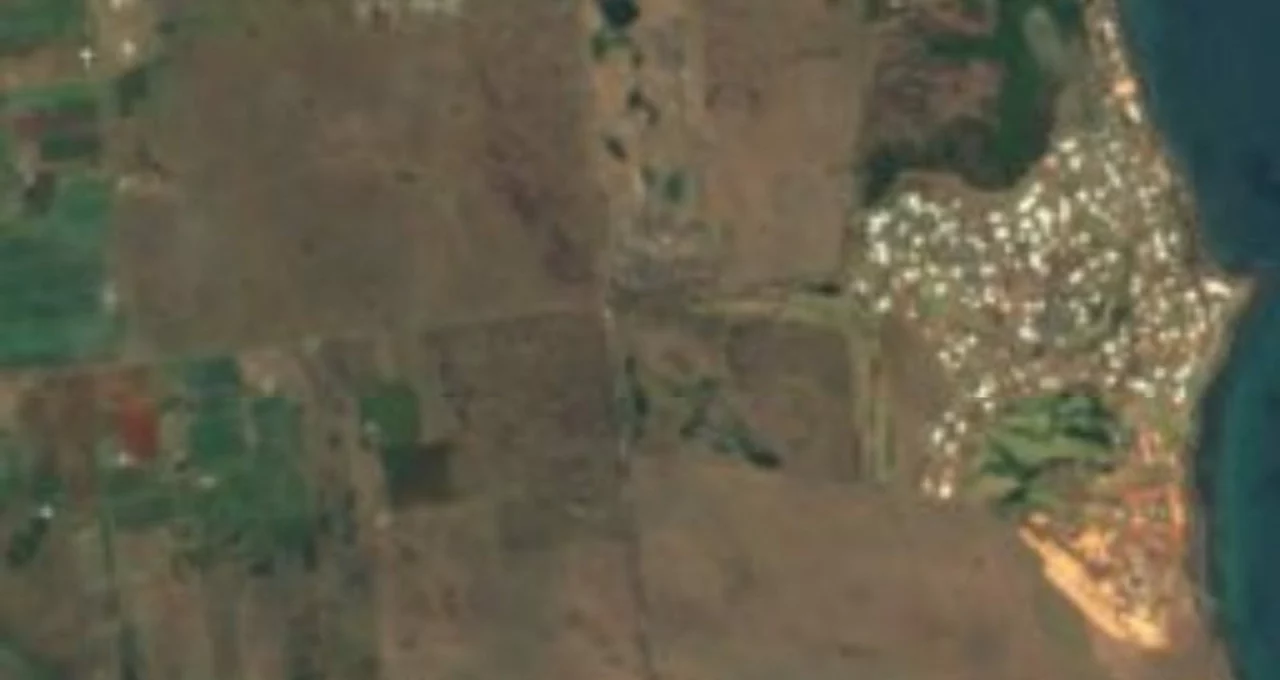
Coral Cove Golf Course from space. Sentinel-2 cloudless 2016 by EOX IT Services GmbH (contains modified Copernicus Sentinel data), CC BY 4.0.
Coral Cove Golf Course
Holes
18
By
72
Length
5,924 to 5,989 metres from the back tees and about 5,016 to 5,018 metres from the women's tees, depending on the source
Green fee
—
Best season
All year
Coral Cove Golf Course is an eighteen-hole course on the coast of the Bundaberg Region, in Queensland, run today under the name Coral Cove Golf Club. It lies in the small coastal locality of Coral Cove, between Innes Park to the north and Elliott Heads to the south, and the club gives its address as 1 Pebble Beach Drive, Coral Cove QLD 4670. In a straight line, the middle of the course is about 13 kilometres east-south-east of central Bundaberg and about eight kilometres south of Bargara. The Pacific shoreline runs along its eastern edge: the first two holes play close to the beach, and the rest of the course spreads inland behind them.
The course is known above all for one hole. The club describes its 18-hole championship layout as featuring the longest hole in Australia and calls it one of only two par 6s in the country. Wikipedia gives that hole a length of 635 metres. The club adds that the course is open to the public seven days a week, that all golfers with a Golf Australia handicap may enter its competitions, and that the ever-present winds and the undulating greens test golfers of all abilities.
Coral Cove is not to be confused with two other courses nearby. Bargara Golf Club is a separate eighteen-hole course about seven kilometres to the north, behind Bargara beach, and Bundaberg Golf Club is in the city itself. The three are often listed together on golf directories, and it is easy to land on the wrong page when searching.
A course inside a coastal estate
Coral Cove is a planned settlement as much as a golf course. According to Queensland Places, a Bundaberg-based development company launched the Coral Cove residential and country club estate in about 1993; the source does not name the company. The Wikipedia article on the locality records a population of 1,462 at the 2021 census, up from 1,127 in 2011, on an area of 2.3 square kilometres, and describes the resort alongside the course as offering accommodation, bars, restaurants, function rooms and swimming pools.
The history of the course itself is thinly documented, and the sources we found disagree. The Top 100 Golf Courses guide says it opened in 1993 as a nine-hole course and was gradually extended to its present eighteen holes, and it credits the design to Robert Johnson Snr. The Planet Golf directory gives 1996 as the opening year and names no designer. We found no other source for the architect, nor any record of when the second nine opened, so these dates and the designer’s name should be read as those two directories’ claims only.
What is clear from the map is that the course and the houses grew up together. On OpenStreetMap, the holes wind around two blocks of housing, and the Top 100 guide notes that houses line the relatively narrow fairways at the start and the end of the back nine. A report published by Bundaberg Regional Council’s news service in March 2019 describes a 28-home site on Pebble Beach Drive, inside the resort, bounded by fairways on its north, west and south sides; a second report, in September 2019, records the approval of a golf-side unit complex on that site, first given preliminary approval in 2012.
The club’s old web address, the one recorded on OpenStreetMap, no longer resolves. The club now has its own site, which gives the Pebble Beach Drive address, a pro shop telephone number and an online booking link.
The course in figures
Every scorecard we found gives a par of 72, split 36 on each nine, and OpenStreetMap records the same par. The GolfNow listing is the only exception: its summary box gives 71, while its own tee table gives 72 for every tee. We follow the majority.
On the card published by the Hole19 app and by AllSquare, the course has five par 3s (the 2nd, 8th, 10th, 14th and 16th), nine par 4s, three par 5s (the 6th, 9th and 15th) and one par 6, at the 12th, which adds up to 72.
Lengths vary with the source and the tee. Hole19 and GolfNow give 5,924 metres from the blue tees. AllSquare gives a longer championship total of 5,989 metres, then 5,596 metres for its men’s tees and 5,018 metres for its women’s tees. GolfNow gives 5,591 metres from the white tees and 5,016 from the red. The difference between the two back-tee figures comes from two holes: AllSquare has the 3rd at 344 metres and the 17th at 346, where Hole19 has 295 and 330. Hole19 labels its total in yards in one place and in metres in another; the figures match the other metric listings, so we read them as metres.
From the back tees, on the AllSquare card, the front nine measures 3,007 metres and runs: a short par 4 of 235 metres at the 1st, a par 3 of 203 at the 2nd, par 4s of 344, 345 and 312 metres from the 3rd to the 5th, a par 5 of 483 at the 6th, a par 4 of 400 at the 7th, a par 3 of 145 at the 8th, and the 9th, a par 5 of 540 metres and the hardest hole on the front nine by stroke index. The back nine, 2,982 metres, opens with the shortest hole on the course, a par 3 of 120 metres, then a par 4 of 354 metres, the par 6 of 635 metres at the 12th, a par 4 of 363, a par 3 of 192 at the 14th, a par 5 of 476, a short par 3 of 121 at the 16th, a par 4 of 346 and a closing par 4 of 375 metres.
The stroke indexes are not identical from one app to the next. Both put the 9th at index 1 and the 18th at index 2, and both rank the 10th and 16th, the two short par 3s on the back nine, among the easiest holes. Elsewhere they differ by a few places: Hole19, for instance, ranks the 4th as index 10 and AllSquare as index 7. The club does not publish a card online, so the card in the pro shop is the one to trust.
For ratings, AllSquare labels its tees 70/129 (championship), 68/128 (men’s) and 71/118 (women’s) without saying what the figures are; they look like a course rating and a slope. GolfNow gives a rating of 70.0 and a slope of 124 in its summary, and slopes of 117 to 130 in its tee table, with no ratings. We could not open Golf Australia’s listing for the course, which is the authority on ratings in this country, so golfers who need an exact figure for handicap purposes should check there.
The par 6
The 12th is the reason most visitors come. At 635 metres from the back tees on the Hole19 and AllSquare cards, it is about 95 metres longer than the longest par 5 on the course, the 9th, and 635 is the figure Wikipedia, the club and most directories repeat. From the shorter tees, AllSquare gives 600 metres for the men’s tees and 563 for the women’s.
Two points about it are not settled. The first is its number. Hole19 and AllSquare both place the par 6 at the 12th, and the line OpenStreetMap draws for the 12th is the longest on the course; the Top 100 guide, however, calls it the 13th. We follow the two scorecards, but the order of holes may have changed at some point, and the card in the pro shop will tell you. The second is how rare it is. The club says it is one of only two par 6s in Australia, a regional travel guide calls it the country’s only par 6, and Wikipedia repeats the club’s version. We have not been able to establish which other course, if any, the club has in mind.
On the cards, the 12th is not the hardest hole: both apps give it stroke index 8. Its difficulty is mostly a matter of keeping three good shots in play, and of the wind, which on an open coastal site can turn it into a very long hole indeed.
What it asks of you
Wind first
The club’s own description puts the wind first, ahead of the greens, and it is the factor that shapes the course most. Coral Cove sits a few hundred metres from the shoreline, on flat ground: elevation data for the site put it between about 9 and 15 metres above sea level across the holes. There is no ridge or hill to shelter behind. A hole that plays into the breeze one morning may play downwind the same afternoon, and club selection on the par 3s in particular will change from round to round.
Water on the front nine
According to the Top 100 guide, the 1st and 2nd touch the shoreline, and the holes from the 3rd to the 9th weave around several sizeable ponds. The club’s own hole illustrations, published on its course page, show ponds and bunkers close to several of the front-nine greens, without giving lengths. The front nine is therefore where accuracy matters most, with the 7th, a par 4 of 400 metres, and the 9th, a par 5 of 540, the two holes the cards rank hardest.
Houses on the back nine
The back nine heads inland. According to the Top 100 guide, the 11th and 12th, and then the 13th and 14th, run side by side in opposite directions, and the guide describes the course as feeling restrictive in places, with houses close to the fairways at the start and the end of the back nine. For a golfer, that means out of bounds is closer than the open setting suggests, and a sliced drive near the houses is a costly one.
Greens and turf
GolfNow lists the greens as 328 couch and the fairways as couch, a warm-season grass suited to the Queensland coast. Couch greens usually play firmer and grainier than the bent greens of the southern states, and the club calls its greens undulating. One public review from 2016 noted that the greens had slowed to a playable speed, which suggests they can be quick.
What that means for your game
Check the wind direction before you leave the clubhouse, and expect to hit one or two clubs more or less than the card suggests on the exposed holes. On the front nine, play to the safe side of the ponds; a par on the 7th and 9th is a good result. On the back nine, keep the ball away from the houses even at the cost of length. On the par 6, plan three shots rather than two big ones and a hope. And spend a few minutes on the putting green to judge the pace of the couch greens before you start.
For club golfers, the moderate length of the shorter tees, the five par 3s and the short par 4 at the 1st make it a manageable round. Better players will find the scoring holes few if the wind is up, and a rare chance to play a par 6.
A course about to change
Anyone planning a visit should know that the land around the course is being redeveloped. In 2025, according to property and trade press reports from May of that year, Bundaberg Regional Council approved DevCore Property Group’s masterplan for Coral Cove Ocean Estate, a community of about 1,600 homes valued at about 1.1 billion dollars and covering more than 220 hectares, to be built over about ten years. The same reports present the established 18-hole championship golf course as one of the estate’s attractions and announce a future clubhouse and tavern.
An article on the estate published in August 2025 goes further: it says the first precinct, a tourism and coastal club precinct with a new golf clubhouse, function rooms, a 40-unit hotel and holiday cabins, will be developed where the 1st hole of the existing course currently sits, and that replacement golf holes will be relocated within the southern part of the property. We have found no source saying when the work on the course will begin, how many holes will be moved, or how the course will be played while it is done. The layout described above is the one on the published cards; it may not be the one you find on the day.
Facilities
The club’s membership page lists a putting green and a chipping green among the facilities open to members, and the restaurant and bar are in the clubhouse. GolfNow also lists a driving range and a teaching professional; the club’s own site mentions neither, so we cannot confirm them. Carts are available, and the club’s tee time page sells most social rounds with a cart.
The clubhouse restaurant, according to the club, serves breakfast every day from 7am to 11am, lunch from Friday to Sunday and dinner from Thursday to Saturday evenings, and the bar is open seven days a week, with takeaway at all opening times. The resort that gave the course its first name still appears in directories, which list villas, condos, pools and tennis courts; we have not been able to confirm what is currently available, and the resort’s old website no longer exists.
What golfers say
Written comment on Coral Cove is thin. The golf apps carry ratings but very few written reviews, and the local directories we read contain one or two short comments each. The points below are what recurs across those reviews, directory descriptions and the few longer comments we found. They are other people’s opinions, not ours: we have not played the course, and we name and quote no one.
What comes up in its favour
- The par 6 is what everyone mentions first, as a hole worth playing at least once.
- The coastal setting, with the ocean beside the opening holes and sea air throughout, is praised in reviews and in every description of the course.
- The overall rating on the golf apps is high, and short reviews describe it simply as a great course.
- Course condition is described as good overall, and the fairways and greens as well kept.
- The clubhouse draws comments on friendly staff and good-value meals.
- Several descriptions stress the lack of crowds and the relaxed atmosphere.
What comes up against, or should be weighed
- The wind is described as ever present, which makes the open holes hard work on a blustery day.
- At least one review asks for better maintenance of the tee boxes, and notes that a front-nine par 4 had been shortened to a short par 3 without a tee of its own.
- Houses close to several fairways make parts of the back nine feel tight.
- With so few written reviews, a visitor has little independent information to go on, and much of what is online repeats the club’s own description.
- The redevelopment of the estate means that what is said about the layout today may not hold in a few years.
Who it suits
Coral Cove suits golfers on holiday in Bargara or Bundaberg who want a round by the sea, anyone curious to play a par 6, and mid and high handicappers who will appreciate the moderate length from the shorter tees. Members of the Veteran Golfers Association and golfers with a Golf Australia handicap can join the club’s competitions. Low handicappers will find the course short on paper, but the wind, the ponds of the front nine and the par 6 give them enough to think about. For a second round nearby, Bargara Golf Club and Bundaberg Golf Club are within a short drive.
Getting there and when to go
The course is reached by road. Coral Cove is about 13 kilometres from central Bundaberg in a straight line, and the regional tourism site puts it at about 20 minutes’ drive from the city and a short drive from Bargara. Wikipedia places the locality about 370 kilometres north of Brisbane. Bundaberg Airport is about 16 kilometres west of the course in a straight line. We have not checked bus services and give none.
Social golf is available seven days a week, with tee times from 7am according to the club. Tee times can be booked online through the club’s booking system, or by calling the pro shop on (07) 4159 3333. Saturday mornings are reserved for competitions and times are restricted; call the pro shop for those. The club’s competitions are open to visitors with the right handicap: a veterans’ competition on Tuesdays for members of the Veteran Golfers Association of Australia, an open medley single competition on Thursdays for golfers with a current Golf Australia handicap, and men’s and women’s fixtures on Saturdays. The club’s home page lists competition days as Monday, Tuesday, Thursday, Friday and Saturday, its tee time page gives details only for Tuesday, Thursday and Saturday, and an older directory listing gives a different set of days, so check before you plan to play in one.
Golf is played all year on this part of the Queensland coast. The winter months are usually the most comfortable, with mild days and less rain; summer brings heat, humidity and storms. On an exposed coastal course, an early tee time is the best way to avoid both the heat and the strongest wind of the afternoon.
How this page was made
The factual frame comes from public sources. The club’s website provided the address, the description of the course, the par 6 claim, the wind and greens, public access, the competition days and eligibility, the putting and chipping greens, the restaurant and bar hours, the booking link and the telephone number, read in October 2026. The scorecards, hole by hole, come from the Hole19 and AllSquare apps; the tee lengths, grasses, rating, slopes and facility list from GolfNow. The history, the designer, the routing and the description of the ponds and houses come from the Top 100 Golf Courses guide; the alternative opening year from Planet Golf; the estate’s origins from Queensland Places. Wikipedia’s article on Coral Cove, Queensland provided the population, area, distances and the length of the par 6. The 2019 housing developments come from two reports by Bundaberg Regional Council’s news service. The Coral Cove Ocean Estate comes from reports by The Urban Developer and Property Markets of May 2025 and an article of August 2025. OpenStreetMap provided the outline of the course, the hole lines and the coordinates from which we calculated straight-line distances; elevations come from the SRTM terrain model.
Several sources disagree, and we have said so in the text. The par 6 is the 12th on two scorecards and the 13th in one guide; the club calls it one of two par 6s in Australia, a travel guide the only one. Back-tee lengths range from 5,924 to 5,989 metres. Par is 72 everywhere except in one summary box. The course opened in 1993 according to one guide and in 1996 according to another. Stroke indexes differ between the two apps, and competition days differ between the club’s own pages and older listings. The hole lines on OpenStreetMap for the 1st and 2nd are much shorter than the scorecard lengths, which may reflect a changed layout or simply approximate mapping. We could not read Golf Australia’s listing, which blocked our requests, so no rating is confirmed by it. We give no green fees or membership prices, and we did not use the driving range or the teaching professional as confirmed facilities, since only one directory lists them.
The opinion section summarises public reviews and directory descriptions read in October 2026; we report recurring themes rather than individual voices, we reproduce no quotations and we give no ratings or review counts. Written reviews are few, and the picture they give is necessarily partial.
We have not played this course, and this page is no substitute for a round. The club has not paid for this page, has not seen it before publication and has no say over its content. If you know the course and something here is wrong or out of date, write to us and we will correct it.
Other courses nearby
Closest to this one in our Australian directory:
- Bargara Golf Club — 7 km
- Bundaberg Golf Club — 16 km
- Palmer Coolum Resort Golf Course (formerly Hyatt Regency Coolum) — 195 km
- Ashgrove Golf Club — 289 km