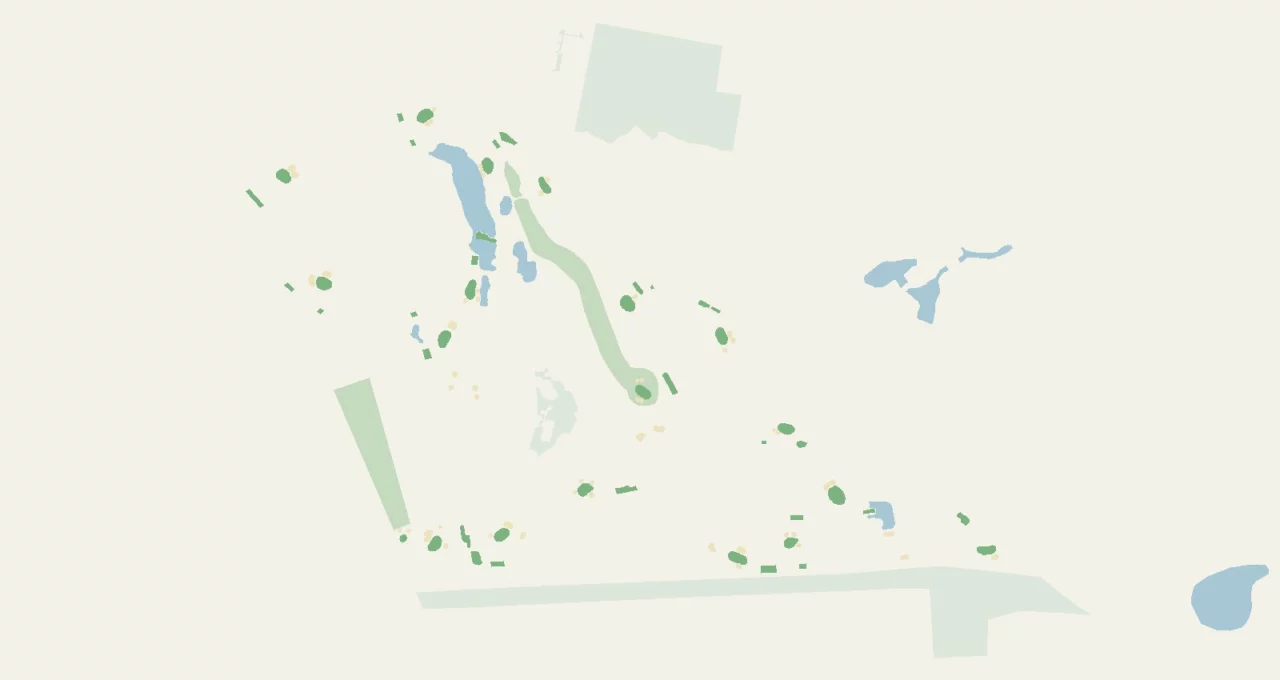
Layout of Bundaberg Golf Club from OpenStreetMap survey data (ODbL licence).
Bundaberg Golf Club
Holes
18
By
71 (men), 72 (women)
Length
5,872 metres from the main men's tees (club figure); 5,267 metres from the ladies' tees, according to golf apps
Green fee
—
Best season
All year
Bundaberg Golf Club is the eighteen-hole members’ club of Bundaberg, the sugar and rum town on the Burnett River in the Wide Bay-Burnett region of Queensland. The club gives its address as 22 One Mile Road, North Bundaberg, QLD 4670, and describes its course as a championship layout just five minutes from the city centre. In a straight line, the middle of the course is about 2.7 kilometres north-west of the Bundaberg CBD on the other side of the river, and about 14 kilometres inland from the beaches at Bargara.
It is a par 71 of 5,872 metres from the main men’s tees, according to the club, which presents the course in a few simple lines: wide, flat fairways that are easy to walk or ride, well-kept greens, and ponds and waterways that make the layout a challenge for golfers of every standard. Visitors are welcome, with clubs, pull buggies and electric carts for hire, and the club runs a practice fairway, a junior program and a full week of competitions. Bookings for visitors are taken online through the club’s booking system or through the pro shop.
This page is about the course on One Mile Road. Two other names come up when you search for golf in Bundaberg, and they should not be confused with it. Oakwood Park Golf Club is a separate, smaller course on the western edge of North Bundaberg, one to two kilometres away according to the directories. Bargara Golf Club and Coral Cove are separate eighteen-hole courses on the coast, east of the city. Bundaberg Golf Club is the one in town.
A flat course on the north bank
The course occupies a block of land in the suburb of Bundaberg North, which Wikipedia describes as the developed area north of the Burnett River, opposite the CBD, and which names the golf course and the hockey ground as the suburb’s two main sports facilities. Its rough outline on OpenStreetMap covers a little under 50 hectares, with a small residential pocket cut out on the southern side. The property runs about 1.2 kilometres from west to east and under 800 metres from north to south, with houses along most of its edges.
The ground is flat. Elevation data from the SRTM terrain model put most of the course between about 10 and 20 metres above sea level, with the higher readings towards the north-west corner. The SRTM model is accurate only to a few metres, but it agrees with the club’s own description of wide, flat fairways and with what every directory says about the course: this is an easy walk, without the climbs that make some coastal Queensland courses hard work in the heat.
The flatness also has a downside that matters in Bundaberg. The Burnett River has flooded the town badly several times in recent memory, most notably in January 2013. A golf news report that appears in search results, which we could not open, says the club came through one of those floods with little damage to the course, because it sits on higher ground than the worst-hit parts of North Bundaberg, and that its problems came from heavy rain rather than from the river. We have not been able to confirm the date of that report, and we give it only as an indication. A golfer’s review from March 2026 mentions playing the course in good condition a week after the town had been flooded.
The club and its history
The history of golf in Bundaberg is older than the course, and the sources do not agree on when the present club and course began. Wikipedia’s article on Golf Queensland, drawing on a published history of the game in the state, lists Bundaberg among the clubs formed in 1898, after Townsville, Toowoomba, Brisbane and Ipswich and in the same year as Rockhampton and Victoria Park in Brisbane. It does not tell us where that first club played or whether today’s club descends from it.
The golf directories give three other dates for the present course: one says it was built in 1929, another that it opened in 1950, and a third that the club was established in 1925. None of them cites a source, and the club’s own website, as we read it in October 2026, gives no founding date. The same directories disagree on the design. One names the designer simply as “club members”, which is common for country courses that grew hole by hole; another credits the Australian architect Dan Soutar with an eighteen-hole design dated 1973, which cannot be right as it stands, since Soutar died in the 1940s; a third names a different architect. We have not been able to confirm any of these attributions and we do not give a designer for the course.
What is on record today is a member club with a full program. Its website lists competitions on four days a week: juniors, social and charity days on Sundays, a veterans’ competition on Tuesdays, the sporters’ and ladies’ competitions on Thursdays, and the main club competition on Saturdays. The club has reciprocal arrangements with other clubs. Its news page in 2026 asked for volunteers for a Monday morning working bee on the garden beds: part of the presentation of the course still depends on its members.
The club also asks every player, member or visitor, to register at the pro shop before going out to play or practise, so that it has a record of who is on the course. That is worth knowing if you arrive with a booking made online.
The course in figures
The club publishes its length and par, 5,872 metres and par 71, but not a full scorecard. The hole-by-hole figures below come from the Golfify and 18Birdies golf apps, which publish the same card for the main men’s tees, labelled the Bundy tees. Its hole lengths add up exactly to the club’s 5,872 metres and its pars to 71. 18Birdies labels the card in yards; since the total matches the club’s figure in metres, and the hole lines drawn on OpenStreetMap measure within a few per cent of the same numbers in metres, we read it as metres.
On that card the front nine is 2,789 metres and par 35, and the back nine 3,083 metres and par 36. There are five par 3s, four par 5s and nine par 4s.
- Front nine: the 1st, a par 4 of 395 metres; the 2nd, a par 3 of 145; the 3rd, a par 5 of 457; the 4th, a par 3 of 155; the 5th, a par 4 of 329; the 6th, a par 4 of 357; the 7th, a par 4 of 349; the 8th, a par 3 of 136; and the 9th, a par 5 of 466.
- Back nine: the 10th, a par 4 of 378 metres; the 11th, a par 4 of 354; the 12th, a par 5 of 477; the 13th, a par 4 of 332; the 14th, a par 3 of 141; the 15th, a par 4 of 354; the 16th, a par 4 of 385; the 17th, a par 3 of 180; and the 18th, a par 5 of 482.
The stroke index on the Golfify card, which three other sources repeat, puts the 1st as index 1, the 10th as index 2, the 11th as index 3 and the 17th as index 4. The easiest holes on the card are the 14th and the 9th, at index 17 and 18. Not all sources agree: 18Birdies publishes a second version of the card with a slightly different index, and the Hole19 app gives a different order again, with the 16th as index 1. Players in a competition should use the card from the pro shop.
Other sets of tees appear in the apps. A white set measures about 5,740 to 5,800 metres depending on the app, slightly shorter than the main tees. The women’s card, from the ladies’ tees, measures 5,267 or 5,268 metres for a par of 72; the difference in par comes from the 1st, which is a par 5 for women at 374 metres. On that card, the women’s par 3s are between 111 and 157 metres and the stroke index 1 is the 12th, a par 5 of 464 metres.
The course rating and slope are less clear. 18Birdies gives a rating of 71.7 and a slope of 123 for men from the main tees, and 69.9 and 121 for women from the ladies’ tees; Golfify gives a rating of 69 for the main tees, with a slope figure that is plainly a data-entry error. Golf Australia’s course listing, which would settle the question, blocked our requests, and as it appears in search results it is headed as a nine-hole course, which is presumably an error in its title. We give no rating as confirmed. Golfers who need the figure for handicap purposes should check Golf Australia’s rating information or ask the club.
OpenStreetMap maps the course in some detail: eighteen holes, tees, greens, two fairways, 51 bunkers, six water hazards, the clubhouse and the practice area. Its pars match the card except on the 18th, which carries no par on the map. The hole lengths we measured from the map total about 5,780 metres, close to the white tees rather than the main ones, which is what one would expect if the hole lines were drawn from the middle of the tee complexes.
What it asks of you
A course of par 4s and par 5s
At 5,872 metres and par 71, Bundaberg is a course of ordinary length for a country championship layout, neither short nor long. What stands out on the card is the balance of the holes. Four par 5s, all between 457 and 482 metres, give a long hitter four genuine chances to reach a green in two, while the par 4s are mostly in the 330 to 390 metre range, long enough to need a proper drive but rarely so long that a club golfer is out of reach in two.
The round starts with what the card rates as its hardest hole, a par 4 of 395 metres. That is an unusual choice for a first hole and it means there is little time to warm up: a few minutes on the practice fairway before the round is worth more here than on most courses. The other long par 4s are the 10th, at 378 metres and stroke index 2, and the 16th, at 385 metres, both on the back nine.
The short holes
Four of the five par 3s are between 136 and 155 metres, a mid or short iron for most players. The exception is the 17th, at 180 metres, which the card ranks as the fourth hardest hole on the course. Coming late in the round and followed by a par 5 of 482 metres, it is the hole where a card can slip or be saved.
Water, sand and trees
The club highlights the ponds and waterways, and OpenStreetMap shows six areas mapped as water hazards spread around the property, so water will come into play on several holes rather than one or two. The map also shows 51 bunkers, a substantial number for a course of this size. A golf magazine feature from November 2025, as it appears in search results, describes a traditional layout with tree-lined fairways; the trees, more than the length, punish a wide drive.
Turf and weather
The club does not say which grasses are used on its greens and fairways, and we have not found a reliable source for them, so we do not name them.
Bundaberg has a subtropical climate. The Bureau of Meteorology normals reproduced on Wikipedia give average maximums of about 30 degrees from December to February and about 22 to 23 degrees in June and July, with most of the year’s rain, about a metre in total, falling between December and March. In summer, the heat and humidity are the main challenge, and storms can stop play; from May to September the days are mild, dry and well suited to golf.
What that means for your game
Warm up properly before the 1st, which plays as the hardest hole on the course. On the par 5s, decide early whether you are going for the green in two, and lay up short of the water if you are not sure where it is: the hazards are part of the layout and a sensible lay-up costs less than a penalty drop. On the par 4s, accuracy off the tee between the trees matters more than distance. Use the short par 3s, the 2nd, the 8th and the 14th, as scoring chances, and take one more club than you think on the 17th.
Practice and facilities
The club has a practice fairway, open daily to members and guests of members, normally from 8am to 4.30pm and subject to the light. Buckets of balls are bought at the pro shop, and the last buckets are sold at 4pm. The rules are strict and worth reading before you start: only clubs up to a 5-iron may be used, with no woods, long irons or rescue clubs unless under the supervision of a professional, and the practice fairway closes for clinics and group lessons. A chipping green and practice bunkers are also available and are not subject to those restrictions.
The pro shop sells equipment, hires out clubs, pull buggies and electric carts, and organises lessons with a PGA professional. The club also runs a junior program, with competitions on Sunday mornings, group coaching on Wednesday afternoons during the school term and six divisions, from players with a full handicap down to four-hole beginners playing from 150 metres. The club also arranges corporate golf days and social functions.
The dress code is the usual one for an Australian club: smart casual shorts or slacks and a collared shirt, tailored skirts or skorts for women, enclosed shoes or golf shoes with socks on the course. Beach wear, singlets and rubber thongs are not accepted.
What golfers say
Public comment on Bundaberg Golf Club consists mainly of star ratings on golf apps, with a modest number of written reviews spread over the last ten years. The points below summarise what recurs across Hole19, 18Birdies, Planet Golf and the directories that reproduce reviews. These are other people’s opinions, not ours: we have not played the course, and we name and quote no one.
What comes up in its favour
- Course condition is the point most often praised, and several reviews from 2024 to 2026 describe the course as being in very good shape.
- The greens come in for particular praise, described in several comments as above average for a country course, and one app rates their speed as fast.
- Reviewers describe it as a proper country course, open and pleasant rather than punishing, with little heavy rough.
- The staff are described as friendly, and visitors appear to be made welcome.
- The app ratings put value for money close to the top of the scale, and they rate the course as a demanding test rather than an easy one.
What comes up against, or should be weighed
- Green conditions vary with maintenance: one visitor in 2024 arrived to find the greens freshly sanded, and the apps record a range of opinion on pace of play, from fast to middling.
- There are few detailed written reviews, and many of the ratings are bare stars, so the overall picture is less solid than for a course with a large tourist following.
- Basic information is scattered. The club publishes no scorecard, and the length, the stroke index and the rating vary from one app to the next.
- Some directories still list an old web address and old details for the club, which can mislead a visitor planning a round.
- Summer brings heat, humidity and storms, and the course, in a river town, can be affected by heavy rain and flooding.
Who it suits
Bundaberg Golf Club suits visitors to Bundaberg who want a full-length eighteen holes close to town without driving to the coast and club golfers from elsewhere in Queensland who want a fair test on a member course. Its length and four par 5s will interest low handicappers; its flat ground and wide fairways make it manageable for higher handicappers, older players and juniors. Those who prefer sea views and a resort feel will find them at the coastal courses near Bargara; Bundaberg’s course is a town course, among houses and trees.
Getting there and when to go
The club is at 22 One Mile Road, North Bundaberg, and gives a postal address of PO Box 107, Bundaberg. From the CBD it is a short drive across the Burnett River; the club puts it at five minutes, and the straight-line distance from the middle of town is under three kilometres. Wikipedia lists a local bus route, the 3B, running from the city to North Bundaberg by way of the Botanic Gardens and the golf club; we have not checked the current timetable and give no times. Bundaberg Airport is about five and a half kilometres south of the course in a straight line, and Bundaberg is about 360 kilometres north of Brisbane by Wikipedia’s reckoning.
Visitors book online through the club’s public booking page, or by phoning the pro shop on 07 4151 6706. The clubhouse can be reached on 07 4152 6765. Saturday is the main competition day, and Tuesday and Thursday are taken by the veterans, sporters and ladies; check with the pro shop before setting out. Remember to register at the pro shop before you tee off, even with a booking.
Golf is played all year in Bundaberg. The dry, mild months from May to September are the most comfortable; from December to March, play early in the morning or late in the afternoon, carry water and keep an eye on the forecast for storms.
How this page was made
The factual frame comes from public sources. The club’s website, read in October 2026, provided the address, telephone numbers, the length and par, the description of the course, the competitions, the practice fairway rules, the junior program, the dress code, the registration rule and the booking link. The hole-by-hole card for the main tees comes from the Golfify and 18Birdies apps, the women’s card from Golfify, AllSquare and 18Birdies, and the alternative cards and stroke indexes from 18Birdies, AllSquare and Hole19. OpenStreetMap provided the outline of the course, the hole lines we measured, the pars, the bunkers, water hazards and practice area, and the coordinates from which we calculated straight-line distances. Elevations come from the SRTM terrain model. Wikipedia’s articles on Bundaberg North, Bundaberg and Golf Queensland provided the description of the suburb, the bus route, the distance from Brisbane, the climate normals of the Bureau of Meteorology and the date of 1898 for golf in Bundaberg. The golf magazine feature of November 2025 and the report on flood damage were read only as they appear in search results, because the publisher’s site could not be reached.
Several sources disagree, and we have said so in the text. The directories give 1898, 1925, 1929 and 1950 as starting dates for golf, the club or the course, and none of them can be confirmed from the club. They name three different designers, one of them in an attribution that cannot be correct, so we name none. The stroke index differs between apps. Ratings and slopes differ from one app to the next, Golf Australia’s listing could not be read and is headed as a nine-hole course in search results, and we give no rating as confirmed. 18Birdies labels a card in yards whose figures match the club’s length in metres. OpenStreetMap gives no par for the 18th and its hole lengths are closer to the white tees than to the main ones. We found no source for the grasses used on the course, nor for its opening hours, and give neither.
The opinion section summarises public reviews and ratings on golf apps and directories, read in October 2026; we report recurring themes rather than individual voices, we reproduce no quotations and we give no ratings or review counts. We have not played this course, and this page is no substitute for a round. The club has not paid for this page, has not seen it before publication and has no say over its content. If you know the course and something here is wrong or out of date, write to us and we will correct it.
Other courses nearby
Closest to this one in our Australian directory:
- Bargara Golf Club — 14 km
- Coral Cove Golf Course — 16 km
- Palmer Coolum Resort Golf Course (formerly Hyatt Regency Coolum) — 204 km
- Ashgrove Golf Club — 295 km