Golf in the Australian heat: BoM heatwave warnings, UV from 3 and your club’s 36°C rule
The first hot Saturday of summer usually arrives before the sunscreen in your bag has been replaced. Here is how to plan a round that holds together to the 18th, using the Bureau's warnings, SunSmart's advice and the heat rules your club is likely to apply.
In brief
- The Bureau of Meteorology calls it a heatwave when maximum and minimum temperatures are unusually high for three days or more, and warns up to four days ahead for severe and extreme ones.
- SunSmart says to protect your skin whenever the UV Index reaches 3 or more, with SPF50 or 50+ sunscreen reapplied at least every two hours: before the round and again at the turn.
- Golf Australia's hot weather guidelines suggest about 250 ml of fluid every 15 to 20 minutes and rate 36°C and above as extreme risk.
- Clubs such as Curlewis on the Bellarine limit competitions to tee times on or before 9 am when the Bureau forecasts 36°C or more.
Nobody in Melbourne or Hobart is sweating through a round this week. October in the south is jumper-in-the-morning, short-sleeves-by-lunch weather, and that is exactly why now is the time to sort out how you play in the heat. The first properly hot Saturday usually turns up before anyone has refilled the sunscreen in their bag, and the golfers who struggle on it are rarely beaten by the opening holes. They come undone somewhere past the 12th, when the water bottle is empty, the neck is pink and the short putts start sliding by. What follows is a plan for the whole Australian summer, built on what the Bureau of Meteorology, the Cancer Council and healthdirect actually tell you, and on the rules your club is likely to apply when the forecast tips over 36°C.
Spring is the honest starting point
Let’s be clear about the calendar. In the southern states, early October rarely brings dangerous heat, and plenty of mornings still call for a vest. The months that test golfers are December, January and February, when heatwaves become a regular feature of the news. But two things are already true in spring.
The first is UV. In Victoria, the Cancer Council’s SunSmart program says sun protection is usually needed from mid-August to the end of April, whenever the UV Index reaches 3 or more. A cool, breezy day in October can easily reach that threshold, and because UV cannot be felt, the mild temperature tricks you into leaving the hat in the car.
The second is that the Top End plays by a different clock. October is the heart of the build-up in Darwin, and the Bureau’s long-term figures for Darwin Airport put the mean maximum for the month at 33.4°C, with a mean minimum of 25.0°C. Nights that warm give the body little chance to recover, and the humidity climbs as the wet season approaches. If you are heading north for a golf trip this month, treat it as a summer round, not a spring one.
For everyone else, spring is the time to build habits while the stakes are low: how much you drink, when you reapply sunscreen, which tee times you go for. By the time the first 38°C day arrives, those habits should run on autopilot.
A heatwave is three days, not one
The Bureau of Meteorology uses the word heatwave in a precise way. A heatwave is when both the maximum and minimum temperatures are unusually hot for three days or longer. A single scorcher followed by a cool change is a hot day, not a heatwave. That distinction matters for golfers, because the danger builds when nights stay warm and you start each round already a little depleted.
The Bureau sorts heatwaves into three levels of intensity:
- Low-intensity: frequent in summer, and most people can cope with them.
- Severe: harder going for vulnerable people, such as older Australians.
- Extreme: rarer, and a problem for anyone who does not take steps to keep cool.
The Bureau issues heatwave warnings for severe and extreme heatwaves, and those warnings look up to four days ahead, naming the expected temperatures, how long the heat will last and which towns will be affected. You can find them on the Bureau’s warnings page or in the BOM Weather app. In Victoria, a new Bureau warning also triggers a heat health warning from the state health department.
One detail is worth remembering. The heatwave threshold depends on where you live and what the last 30 days have been like. The Bureau’s own example: a 37°C day feels hotter to people in Hobart than to people in Darwin, because Hobart is not used to it. The same logic applies to your own body. A hot day in early December, before you have adapted, is harder on you than the same temperature in late January. Golf Australia’s hot weather guidelines note that golfers arriving from cooler places can take three to five days to start adapting, and full acclimatisation may take 10 to 14 days or longer. Keep that in mind if you fly from Hobart to a Queensland resort in January.
UV is the threat you cannot feel
A round of golf is close to the worst case for sun exposure: four hours or more, mostly in the open, much of it in the middle of the day. SunSmart’s advice is the five-step routine every Australian learned at school, and each step has a golf version.
- Slip on clothing that covers as much skin as possible. A collared, long-sleeved shirt in a close-weave fabric beats a short-sleeved polo. SunSmart rates clothing labelled UPF50+ as excellent protection.
- Slop on SPF50 or 50+ sunscreen, broad-spectrum and water resistant, 20 minutes before you go out. Most adults need about seven teaspoons for one full-body application, which is far more than the quick smear most of us give our forearms in the car park.
- Slap on a hat. SunSmart is blunt about caps and visors: they leave large parts of the face, neck and ears exposed. A wide-brim hat for adults should have a brim of at least 7.5 cm. Bucket and legionnaire hats are the other good options.
- Seek shade between shots, under a tree on the tee, under the cart roof, under your own umbrella.
- Slide on sunglasses that meet the Australian Standard AS 1067, category 2 or higher, ideally in a close-fitting wrap-around style.
The part golfers forget is reapplying. SunSmart says to reapply at least every two hours, and a full round lasts longer than that. In practice, that means sunscreen before you leave the house and again at the turn, plus a touch-up for the nose, ears and back of the neck on the 14th or 15th tee if you sweat heavily. Keep a small tube in the side pocket of the bag and check its expiry date once a season. The free SunSmart Global UV app shows the sun protection times for your suburb, and the Bureau and ARPANSA publish current UV levels.
Drink to a timetable
Golf Australia’s hot weather guidelines are adapted from Sports Medicine Australia, and they spell out the numbers. Before play, drink around 500 ml of fluid no more than two hours before you start. During play, aim for roughly 250 ml every 15 to 20 minutes, or 500 to 750 ml an hour, adjusted to how much you sweat. For activity lasting longer than an hour, which every round does, the guidelines suggest sports drinks to replace carbohydrates and electrolytes as well as water.
Turned into a course routine, that becomes simple: a decent drink at every second tee, a refill at the turn and something salty to eat at the halfway hut. A frozen bottle in the bag on a summer morning will still be cold on the back nine.
There is a ceiling too. The same guidelines warn against over-hydrating, because drinking far more than you lose can lead to hyponatraemia, a dangerous drop in blood sodium. The aim is to replace what you sweat out, not to flood yourself. And healthdirect’s advice on heat illness includes avoiding caffeine and alcohol, which makes the beer at the turn a poor choice on a 35°C day. Save it for the clubhouse.
Play the closing holes with your head
Heat changes the course as well as the golfer, and a few adjustments keep your scoring intact when your energy dips.
- Distances. Hot air is less dense, so the ball carries a little farther than it does on a cool morning. If your 7-iron usually flies 140 metres, watch whether it is landing beyond the flag before you blame your swing. Club down when the evidence says so, not before.
- Firm ground. A dry spell bakes the fairways and the ball runs out. Lay-ups that end in the rough on a soft day can end in a fairway bunker on a hard one, so think about where the ball stops, not just where it lands.
- Decide in the shade. Work out the club and the shot under the tree or the cart roof, then walk out and hit it. Every extra minute over the ball is a minute in full sun.
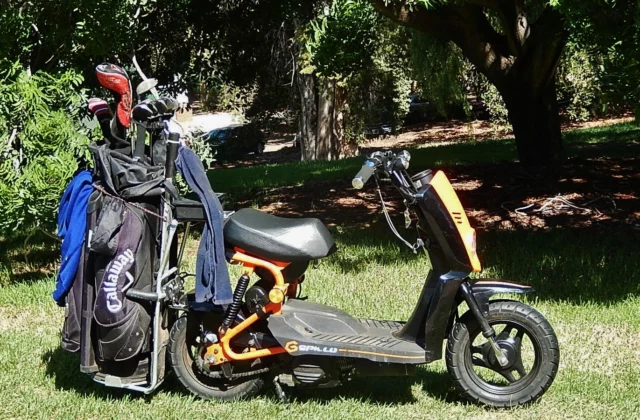
- Cart or buggy. Carrying a bag for several kilometres adds load you do not need on an extreme day. A push buggy keeps the walking rhythm without the strap on your shoulder; a cart is fine if you use the time in it to drink.
One rule to know before you borrow a mate’s umbrella. Under Rule 10.2b(5) of the Rules of Golf, you may hold your own umbrella or wear protective clothing while you play, but you must not make a stroke while your caddie, another person or an object deliberately placed is protecting you from the sun. Shade between shots is fine; shade during the swing costs two strokes in stroke play, or the hole in match play.
If the day turns nastier than forecast, cut the round short. Nine-hole scores count towards your handicap under the World Handicap System, so walking in at the turn does not have to mean a wasted day.
Heat exhaustion or heatstroke: know which is which
healthdirect, the national health advice service, draws a clear line between the two.
Heat exhaustion feels like weakness and dizziness, sometimes with a headache or nausea, and the skin may be clammy. Stop playing, find a cool place to rest, drink cool water, a sports drink with electrolytes or an oral rehydration solution, take off any tight or heavy clothing, and use cold packs or a cool shower once you are back at the clubhouse. Have someone stay with you until you feel better. healthdirect says to call triple zero (000) for an ambulance if someone with heat exhaustion feels faint or confused, cannot drink, has a seizure or has a body temperature of 40°C.
Heatstroke is a medical emergency. Signs include red, hot or dry skin, a sudden rise in body temperature above 40°C, reduced or no sweating, slurred speech, poor coordination and confusion. Call 000 straight away. While you wait, move the person into shade, loosen excess clothing, sponge or spray them with cool water or cover them with wet towels, and give them sips of cool fluid only if they are conscious. If they are unconscious, lay them on their side.
On a golf course, the ambulance has to find you. Before you tee off, save the pro shop number in your phone. If something happens, ring 000 first, then the pro shop, and give the hole number: staff know which service road reaches the 13th green, and the paramedics will not. Agree on the first tee that anyone in the group can stop without explaining themselves. Golf Australia’s guidelines also flag those who need extra care: children, older players, anyone unwell or unacclimatised, and anyone on medication that affects how they handle heat.
Where Australian clubs draw the line on hot days
There is no single national rule that closes golf courses in the heat. What exists is guidance, and clubs build their own policies on top of it.
The reference point is Golf Australia’s Hot Weather Guidelines, a document adapted from Sports Medicine Australia’s heat policies and still available on Golf Australia’s archive site. It reproduces a risk table that rates ambient temperatures of 31 to 35°C as high to very high risk, and 36°C and above as extreme, where postponement to a cooler part of the day or cancellation should be considered. The guidelines point out that the table was written for activity more strenuous than golf, so it is a guide rather than a hard limit. They also recommend scheduling summer competitions in the morning, and playing 18 holes rather than 36 on hot days.
That 36°C figure is the one you will see quoted in club policies around the country. Three examples, read on the clubs’ own websites in October 2026:
- Curlewis Golf Club, on the Bellarine Peninsula in Victoria. When the Bureau’s 5 pm forecast for Geelong on the day before predicts 36°C or more, competitions are only open to players starting on or before 9 am. Carts, buggies and other ride-on options may be restricted, and a significant event such as a quarterly medal is postponed.
- Pelican Waters Golf Club, on the Sunshine Coast in Queensland. When the Bureau’s forecast for the Sunshine Coast reaches 36°C or higher, the club recommends playing in the morning or evening, staying hydrated, considering a cart, wearing loose, light clothing and stopping if you feel unwell. The course stays open, but the decision to play is the player’s own, and competitions may be cancelled or amended.
- Buninyong Golf Club, near Ballarat in Victoria. A similar 36°C trigger based on the Bureau’s local forecast, with published guidance to play early or late, keep hydrated, consider a cart and stop if unwell. Again, the course remains open and the choice is yours.
Two patterns stand out. First, the trigger is almost always the Bureau’s forecast for the nearest town, read the evening before, so check the same forecast your club uses. Second, an open course is not a recommendation to play. Several policies say plainly that the decision and the risk belong to the player, and some warn that there may be no drinks cart or staff out on the course on extreme days.
Your own club almost certainly has a policy of this kind, often filed under extreme weather alongside lightning and wind. Look for it on the club website or ask in the pro shop before summer, not on the morning of a 40°C medal round.
Before your first hot round of the summer
- This week: find your club’s extreme weather policy and note its temperature trigger and cut-off tee time.
- The evening before: check the Bureau’s forecast for your club’s town and any heatwave warning in the BOM Weather app. Above the mid-30s, book the earliest tee time you can, or plan nine holes.
- In the bag: SPF50+ sunscreen within its expiry date, a wide-brim hat, category 2 or higher sunglasses, a frozen bottle and a full one, electrolytes, two towels and a spare glove.
- Before you leave home: about 500 ml of water and a first coat of sunscreen, 20 minutes before you are outside.
- On the first tee: save the pro shop number and agree that anyone can stop without explanation.
- During the round: roughly 250 ml every 15 to 20 minutes, decisions made in the shade, no umbrella held over you during the swing.
- At the turn: sunscreen again, something salty, refill both bottles, no beer.
- Any time: dizzy, confused or no longer sweating means stop, cool down and, if it is heatstroke, call 000.
How this page was put together: the heatwave definitions, intensity levels and warning lead time come from the Bureau of Meteorology’s heatwave explainer, and the Darwin October averages from the Bureau’s climate statistics for Darwin Airport. The sun protection steps, UV threshold, sunscreen, hat and sunglasses advice come from the Cancer Council’s SunSmart program, the heat exhaustion and heatstroke signs and first aid from healthdirect, and the hydration figures and temperature bands from Golf Australia’s Hot Weather Guidelines. The club policies were read on the websites of Curlewis Golf Club, Pelican Waters Golf Club and Buninyong Golf Club, and the umbrella rule comes from Rule 10.2b(5) of the Rules of Golf. All sources were consulted in October 2026. This page is general information, not medical advice: if you have a heart condition or take medication that affects how you cope with heat, talk to your doctor before playing in hot weather. Panxis Golf has no commercial relationship with any organisation mentioned here.