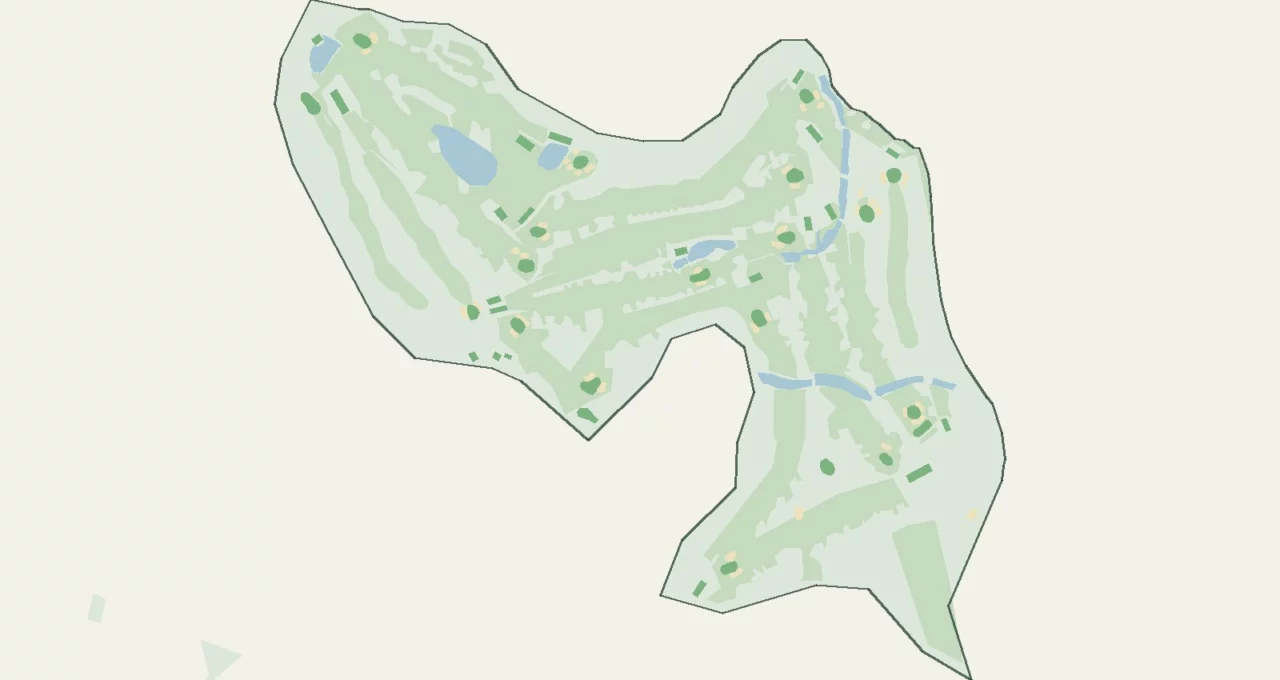
Layout of Dunheved Golf Club from OpenStreetMap survey data (ODbL licence).
Dunheved Golf Club
Holes
18 (club course tour; Golf Australia; GolfNow; OpenStreetMap course outline with 18 hole lines); a raw open data count of 27 is not supported by any source
By
72 for men, 36 on each nine (club course tour; GolfNow; AllSquare; OpenStreetMap); 74 for women, with the 6th and 9th as par 5s (AllSquare; GolfNow)
Length
6,259 metres (club course tour, sum of the holes); 6,260 m for men and 5,380 m for women (GolfNow; GolfPass); GolfNow also gives 6,324 m and 6,916 yards, 18Birdies 6,837 yards; men's rating and slope 72.1/134 (18Birdies), 72/134 for men and 73/130 for women (AllSquare)
Green fee
—
Best season
All year (GolfNow); course open 6am to 6pm every day (club website)
Dunheved Golf Club is an eighteen-hole members’ club in western Sydney that also takes social players seven days a week. It sits on Links Road at St Marys, in the City of Penrith, a short distance north of the Western railway line and the Great Western Highway. The club gives its address as 176 Links Road, Saint Marys NSW 2760, and its contact page adds Dunheved Circuit to that line. The course occupies a block of about 58 hectares, by our calculation from the boundary drawn on OpenStreetMap, between the Werrington and Dunheved areas, and South Creek, the stream that gave St Marys its first name, runs through the property.
The club is active in 2026. Its website was showing the course as open with carts available when we read it in early November 2026, it publishes a fixture book and a veterans’ fixture for the 2026/2027 season, and its competition results page lists rounds played up to the first week of November 2026, including a club championship in October. The board listed on the club’s site is the one for 2025/2026.
Dunheved is not a resort course and does not present itself as one. It is a suburban club course with a bistro, a golf shop, a practice fairway and a full calendar of competitions, several of them open to visitors with a handicap.
Eighteen holes, not twenty-seven
One open data summary of the site counted 27 holes. We found no source that supports that figure. The club’s own course tour describes eighteen holes, Golf Australia lists the course as an eighteen-hole course, and every directory and golf app we consulted (GolfNow, GolfPass, AllSquare, Hole19, 18Birdies) does the same. On OpenStreetMap itself, the outline of the course is tagged as an eighteen-hole course with a par of 72, and exactly eighteen hole lines, numbered 1 to 18, lie inside it. The extra holes in the raw count most likely come from mapping features picked up outside the course boundary, not from a third nine. Dunheved has eighteen holes, and that is what this page describes.
A club with a post-war story
The written history of the club is thin online. The Penrith City Library catalogue, as it appears in search results, lists a 22-page manuscript written in 1999 by Ken Cross, described as a history of the formation of Dunheved Golf Club at St Marys after the Second World War. We were not able to open the catalogue record itself, and we have not read the manuscript, so we cannot give a founding year. None of the directories we read gives one either: GolfPass and GolfNow leave the year built blank.
The name is older than the club. According to Wikipedia’s article on St Marys, Dunheved was the name of a land grant made in 1807 to Anna Josepha King, and the property later passed to Phillip Parker King; today Dunheved is also the name of the industrial and commercial area north of St Marys. The same article notes that the area hosted munitions works during the Second World War.
On the question of who designed the course, we found a single claim: a GolfPass page, read only as a search excerpt because the site blocked our requests, names James Wilcher as the architect. No other source we read names a designer, and the club does not mention one. We report the name as GolfPass’s claim and nothing more.
The course in figures
The club’s course tour gives a par of 72, with 36 on each nine, and one length per hole. Adding them up, the front nine measures 3,171 metres and the back nine 3,088 metres, for a total of 6,259 metres. GolfPass and GolfNow give 6,260 metres for the men’s tees, which is the same card rounded. The AllSquare card displays the same hole lengths as the club, although the page labels them ambiguously.
On the club’s card there are five par 3s (the 4th, 8th, 11th, 13th and 17th), eight par 4s and five par 5s (the 2nd, 5th, 12th, 15th and 16th). The front nine runs: a par 4 of 346 metres at the 1st, a par 5 of 474 at the 2nd, a par 4 of 344 at the 3rd, a long par 3 of 192 at the 4th, a par 5 of 512 at the 5th, par 4s of 400 and 326 metres at the 6th and 7th, a par 3 of 174 at the 8th and a par 4 of 403 metres at the 9th. The back nine opens with a par 4 of 397 metres, then a par 3 of 164, a par 5 of 489, the shortest hole on the course, a par 3 of 145 metres at the 13th, a par 4 of 361, par 5s of 484 and 519 metres at the 15th and 16th, a par 3 of 160 and a closing par 4 of 369 metres.
For women, the course plays longer in par terms. AllSquare and GolfNow give a women’s par of 74, and AllSquare’s card shows the 6th and the 9th as par 5s from the women’s tees. GolfNow and GolfPass give 5,380 metres for those tees, and AllSquare’s women’s card adds up to the same figure.
Other lengths circulate. GolfNow’s quick facts give 6,916 yards and its description 6,324 metres, neither of which matches its own tee table; 18Birdies gives 6,837 yards for the blue tees, which is close to 6,250 metres. We follow the club’s card, which is also the one most directories repeat.
For ratings, 18Birdies gives a course rating of 72.1 and a slope of 134 for men off the blue tees, and AllSquare gives 72 and 134 for men and 73 and 130 for women. GolfNow’s summary gives 71.0 and 130, while its own tee table gives a men’s slope of 134. Golf Australia’s listing, which is the reference for handicap purposes, refused our requests, so golfers who need an exact figure should check it there or ask the golf shop.
What it asks of you
Creeks and hazards
Water decides much of the round at Dunheved. On the club’s course tour, a creek crosses the fairway of the 2nd, the 9th and the 18th, and penalty areas sit beside the 3rd, 4th, 5th, 8th, 11th, 12th and 14th. OpenStreetMap shows South Creek passing through the property, and the club’s local rules note that paths crossing the creeks are part of the penalty area. On several holes, the question is not how far you can hit it but where you choose to stop short.
The 9th, the hardest hole
The club calls the 9th easily the most difficult hole on the course, and it carries stroke index 1. It is a par 4 of 403 metres with a creek running across the fairway about 180 metres from the green, so most golfers lay up short of the water from the tee and are then left with a long second shot. The green is raised, slopes from back to front and has a bunker short left. From the women’s tees, AllSquare lists the 9th as a par 5.
Sloping and tiered greens
The greens are the other defining feature. The course tour describes back-to-front slopes on most of them, two tiers on the 5th, 6th, 15th and 17th, raised greens on the 4th, 9th, 10th and 14th, and greens that fall away steeply at the back on the 11th and 13th. On the 17th, a par 3 of 160 metres played uphill, the club’s own advice is to land the ball on the same tier as the flag. Being above the hole on these greens is the costly miss, and the course tour returns to that point more than once.
Doglegs and trees
The routing has plenty of shape. The 2nd and the 3rd turn, the 10th and the 12th dogleg right, the 18th doglegs left, and the 16th, the longest hole at 519 metres, drifts right before turning sharply left near the green, so a drive down the left side leaves no clear look at the flag. Trees line the 15th on both sides and overhang the approach on the 5th and the 12th. Out of bounds applies on the 1st, along the left, and on the 10th, along the right, according to the local rules.
What that means for your game
Read the course tour before you go, because the club wrote it for first-time visitors and it says plainly where the trouble is. Take less than driver where the creeks cross, especially on the 9th and the 18th. Aim for the front half of the greens, and on the two-tiered ones, think about the tier before the distance. The 15th, a par 5 of 484 metres and stroke index 18, and the 2nd, index 17, are the holes the card offers as chances to score. On the other hand, the 6th, the 9th and the 10th, three long par 4s ranked among the four hardest holes, are where a bogey is no disaster.
Practice and facilities
According to the club, Dunheved has its own self-serve driving range, measuring 180 metres from the back teeing area, for members and playing guests; you bring your own balls. A putting green sits between the 18th green and the clubhouse, and chipping is not allowed on it. The membership page also mentions a chipping green. The golf shop sells equipment and clothing, offers club repairs such as regripping and reshafting, and has a head professional who gives lessons, along with a weekly junior clinic on Tuesday afternoons outside school and public holidays and day clinics during school holidays.
Motorised carts can be hired, and the club posts a course and cart status on its website, which read open with carts on when we checked. Directories also list pull buggy hire, club hire and locker rooms; the club’s own pages do not mention those, so ask before relying on them. The clubhouse has a bistro, whose menu the club publishes as an image without opening hours, and the club organises corporate and charity golf days for up to 120 golfers and guests.
What golfers say
Dunheved has a fair number of ratings on golf apps and directories, but few written reviews that can be read in full; most of what we found are short comments and category scores. The points below are themes that recur across those sources. They are other golfers’ views, not ours: we have not played the course, and we name and quote no one.
What comes up in its favour
- Value is the point most often made: reviewers describe it as an affordable full round in western Sydney, particularly on weekday afternoons.
- Course condition is generally praised, with greens and fairways described as well cut and in good shape, and recent ratings in the golf apps are high.
- The greens are seen as a real test, with several challenging slopes, which reviewers present as part of the appeal.
- Staff are repeatedly described as friendly and welcoming to social players.
- Golfers like that it is a full-length par 72 with genuine hazards, and that social golf is available every day of the week.
What comes up against, or should be weighed
- The course is rated hard by app users, and the creeks and sloping greens can punish a high handicapper.
- Green speed and firmness vary: some describe the greens as very hard and fast on certain days, others mention occasional inconsistencies.
- Opinions on pace of play are mixed, rated quick on one app and as one of the weaker points on another.
- The setting, close to the industrial area of St Marys, is practical rather than scenic, and at least one review called the presentation functional rather than premium.
- Weekend access is limited by member competitions, and the low-lying areas near the creek are said to be sensitive to heavy rain.
Who it suits
Dunheved suits golfers in western Sydney looking for a full-length eighteen holes close to home, club golfers with a handicap who want to play an open competition, and visitors staying around Penrith who want a round without a long drive into the city. Mid and high handicappers will find the par 5s on the back nine reachable in three and the shortest par 3s manageable, but the creeks and the slopes of the greens will test their course management. Better players have the long par 4s, the 192-metre 4th and the 9th to deal with. Juniors and beginners have a weekly clinic and a practice fairway.
Getting there and when to go
The club is at 176 Links Road, St Marys. OpenStreetMap and Golf Australia record the address as Lot 1 Links Road; it is the same site. Wikipedia places St Marys 46 kilometres west of the Sydney central business district. In a straight line from the middle of the course, Werrington station is about 1.7 kilometres away, St Marys station about 2.5 kilometres and Penrith station about 5.8 kilometres, all on the Western line. Dunheved Road and Werrington Road are the nearest main roads. We have not checked bus services and give none; driving is the simplest way in.
The club’s website gives opening hours of 6am to 6pm every day. Social times are available every day outside competition tee times, social club bookings and corporate events. Tee times can be booked online through the club’s booking page on GolfNow, linked from the club’s own site, or by calling the golf shop on (02) 9623 0239.
Visitors can enter several competitions. According to the club, there are open medley competitions on Monday, Wednesday, Friday and Sunday, an open veterans’ competition for golfers over 50 on Wednesday, and an open individual and four-ball Stableford on the last Saturday of the month; the first three Saturdays are closed members’ competitions, and Tuesday and Thursday are given over to social play. Non-members must have played three of their last 20 rounds at a club where they are members to be eligible to win a competition, which the club checks through GolfLink.
Golf is played all year here, and GolfNow lists the season as year round. Western Sydney summers can be very hot, so an early tee time is the comfortable choice from December to February; autumn and spring are the most pleasant seasons. After heavy rain, check the club’s course and cart status page before leaving home.
Green fees
We do not reproduce green fees, which change. The club publishes its current social rates on its website, and the golf shop will confirm them when you book.
How this page was made
The factual frame comes from public sources read in November 2026. The club’s website provided the address, opening hours, course tour and hole-by-hole card, local rules, practice facilities, golf shop and clinics, social golf conditions, competition days and eligibility, membership benefits, course and cart status, the 2026/2027 fixtures and the latest competition results. Golf Australia’s listing was read only as a search excerpt, for the number of holes and the Lot 1 address. GolfNow and TeeOff provided tee lengths, ratings, the season and a list of facilities; AllSquare and 18Birdies provided alternative cards, ratings and recent rating dates; GolfPass, which blocked our requests, was read through search excerpts for the architect and review themes; Hole19 and a review site provided further player views. OpenStreetMap provided the course outline, the hole lines, South Creek and the coordinates from which we calculated straight-line distances and the area of the site. Wikipedia’s article on St Marys provided the origin of the Dunheved name, the distance from the city and the wartime history; the Penrith City Library manuscript is known to us only from a catalogue excerpt.
Several sources disagree, and we have said so. The raw data count 27 holes; every source, and OpenStreetMap’s own course outline, gives 18. The address is 176 Links Road on the club’s site and Lot 1 Links Road on OpenStreetMap and Golf Australia. Lengths range from 6,259 metres on the club’s card to 6,324 metres and 6,916 yards on GolfNow. Ratings and slopes differ between apps, and the women’s par is 74 in the directories while the club’s card shows only the men’s par of 72. Two versions of the club’s course tour place the creek on the 2nd at 150 metres and at 100 metres from the green; we have used neither figure in the text above. OpenStreetMap lists the site as open around the clock, the club gives 6am to 6pm; we follow the club.
We could not establish a founding year, confirm the designer, read Golf Australia’s rating for the course or find hours for the bistro, and we have left those out or flagged them as single-source claims. The opinion section summarises public ratings, short reviews and directory comments; we report recurring themes, reproduce no quotations and give no ratings or review counts.
Nobody from Panxis has played or visited this course, and this page is no substitute for a round. The club has not paid for this page, has not seen it before publication and has no say over its content. This page contains no commercial link and earns us no commission. If you know the course and something here is wrong or out of date, write to us and we will correct it.
Other courses nearby
Closest to this one in our Australian directory:
- Bankstown Golf Club — 30 km
- Asquith Golf Club — 34 km
- Barnwell Park Golf Club — 36 km
- Canterbury Public Golf Course — 37 km
The hole to know
A par 4 of 403 metres and stroke index 1, called the most difficult hole on the course by the club: a creek crosses the fairway about 180 metres from the green, forcing a lay-up, then a long second shot to a raised, back-to-front green with a bunker short left (club course tour). A par 5 from the women's tees (AllSquare).