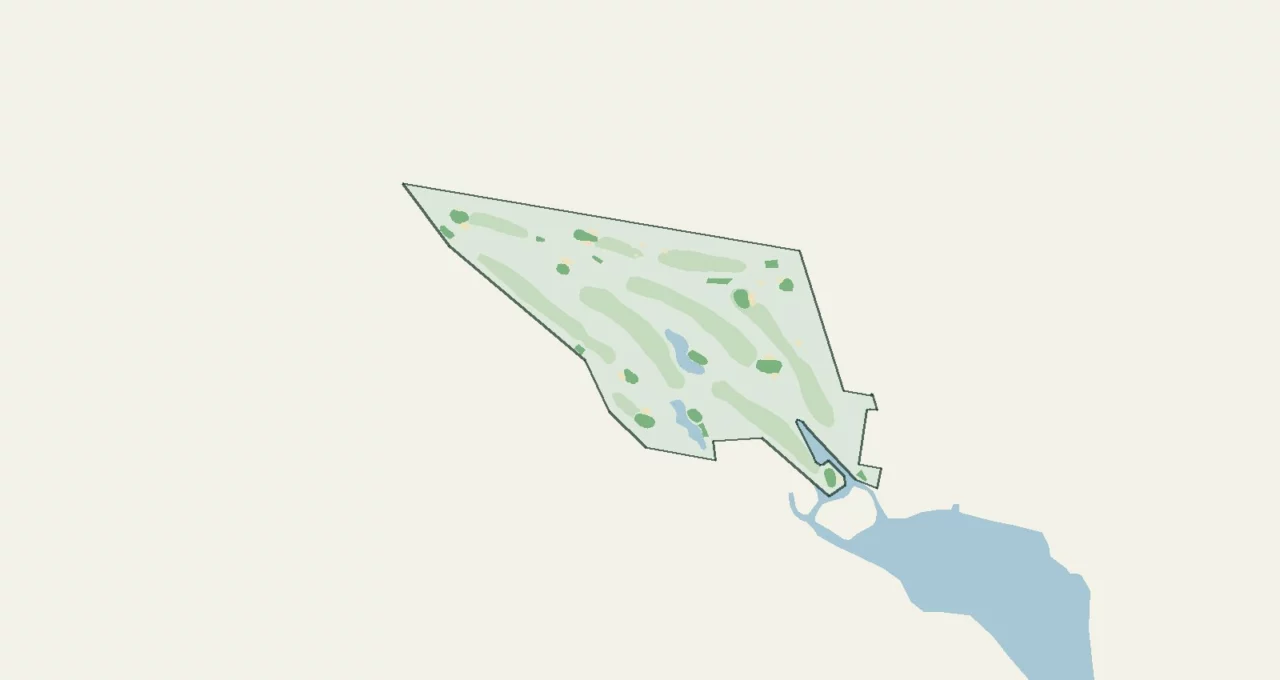
Layout of Breakers Country Club from OpenStreetMap survey data (ODbL licence).
Breakers Country Club
Holes
9 (alternate tees for 18)
By
33 for nine holes
Length
2,523 metres for nine holes, according to golf directories; the club does not publish a card
Green fee
—
Best season
All year
Breakers Country Club is a members’ club at Wamberal, on the New South Wales Central Coast, with a nine-hole golf course of par 33 laid out beside its clubhouse on Dover Road. The course sits on the north-western shore of Terrigal Lagoon: OpenStreetMap places the edge of the lagoon about 40 metres from the course boundary at its closest point, and the beach town of Terrigal is a few minutes away by road. Wikipedia puts Wamberal about 88 kilometres north-north-east of Sydney, 4 kilometres north of Terrigal and 12 kilometres east-north-east of Gosford; the club itself describes the trip from Sydney as about 90 minutes via the M1 Motorway.
The club was known for most of its life as Terrigal Memorial Country Club, a name that still turns up on golf apps and directories, and it has been part of Mounties Group since an amalgamation completed in early 2022. Golf is one activity among several: the same building houses bars, a brasserie, a pizza bar, entertainment and function rooms, and the club is also home to two bowling clubs, a darts club and the Terrigal Wamberal RSL Sub-Branch.
On the card, the course measures 2,523 metres for nine holes, with six par 4s and three par 3s. Golf Australia, which included it in its 2019 list of the country’s best nine-hole courses, describes it as a pretty layout with thickly tree-lined fairways, small, slightly raised greens and water in play on six of the nine holes. Alternate tees allow members and visitors to play eighteen holes.
From a memorial club to Mounties Group
The club’s roots are in the local returned servicemen’s community. A Coast Community News article on the eightieth anniversary of the Terrigal Wamberal RSL Sub-Branch, which we could only read through search excerpts, reports that the sub-branch committee decided to build a small golf course on the land it already held and to apply to Gosford Council for a lease on adjoining land, and that Terrigal Memorial Country Club Ltd was incorporated on 23 September 1970 with 270 members. The history page of the Breakers bowling club gives a related date: the club, it says, grew from humble beginnings in a tin shed and was licensed on 18 September 1973 under the name Terrigal Memorial Country Club. The two dates are not in conflict, as one refers to the company and the other to the licence, but they are the only early dates we could find, and neither source gives the year the first holes were played.
Wikipedia’s article on Wamberal notes that the club commemorates the efforts of the ANZACs, which is where the word Memorial in its old name comes from. The bowling side grew in the 1980s, with two greens officially opened in July 1985 according to the bowling club. According to the same anniversary article, the trading name Breakers Country Club was adopted in 2008. The club’s own pages still describe it as formerly Terrigal Memorial Country Club.
The amalgamation
In June 2021 Mounties Group, the Sydney-based club group that had just absorbed Club Wyong and Halekulani Bowling Club, confirmed that it was in amalgamation talks with Breakers. Its media release at the time described Breakers as one of the larger clubs on the Central Coast, sitting over two levels on the edge of Terrigal Lagoon, and quoted the Mounties chief executive as saying that it was not a struggling club. Lockdowns interrupted the member information sessions, and the vote was held on the evening of 17 November 2021, when Breakers members voted in favour. Mounties’ own members still had to vote, and the regulator, Liquor and Gaming NSW, had to approve; ClubTIC, a trade publication for the club industry, reported the amalgamation as complete in March 2022.
The golf course was part of the deal. Mounties committed to an 11 million dollar master plan for the venue and, specifically for the course, to an investment of 200,000 dollars a year for five years. We have not found a public account of how that money has been spent, so we cannot say which works on the course date from the amalgamation; the title of the club’s golf page refers to golf course improvements, and Golf Australia wrote in 2021, before the deal was completed, that the condition of the layout had improved markedly in recent years.
The course in figures
The club’s website gives only the basics: nine holes and a par of 33. For the hole lengths we have to rely on golf apps and directories, which do not all agree, and we could not find the course’s listing on the Golf Australia or Golf NSW sites. The figures below are the ones that several independent sources support.
The most consistent card, published by GolfingRecord and Hole19 and matching the yardages listed by 18Birdies once converted, runs as follows: the 1st, par 4, 343 metres; the 2nd, par 3, 127 metres; the 3rd, par 4, 322 metres; the 4th, par 3, 161 metres; the 5th, par 4, 370 metres; the 6th, par 3, 153 metres; the 7th, par 4, 380 metres; the 8th, par 4, 372 metres; and the 9th, par 4, 295 metres. That makes 2,523 metres and par 33. Hole19 labels these figures as yards, but they are metres: 18Birdies lists the same holes at 375, 138, 352, 176, 404, 167, 415, 406 and 322 yards, which are the same distances, and Golf Australia gives the 3rd as 322 metres.
The stroke indexes given by Hole19 make the 5th the hardest hole, followed by the 8th, the 7th and the 1st; the 2nd is the easiest. 18Birdies gives the same order on an eighteen-hole card, with the odd numbers on the first loop and the even numbers on the second. In other words, the hardest holes are the long par 4s in the middle and at the end of the nine, and the short holes are the easiest on paper.
Nine holes or eighteen
Golf Australia writes that the course offers alternate tees for those who want to play eighteen holes, and that the closing hole, whether played as the 9th or the 18th, is shaped by water. From the alternate 18th tee, it says, the hole is a par 4 of 347 metres with a drive over a lake to a narrow fairway, which is about 50 metres longer than the 295 metres on the nine-hole card.
The eighteen-hole cards in the apps do not reflect that. GolfingRecord shows 18 holes and a par of 66 next to the same 2,523-metre total, and 18Birdies simply repeats the nine holes twice, for 5,510 yards. On that eighteen-hole card it lists a men’s course rating of 66.8 and a slope of 117 from the blue and white tees, and a women’s rating of 71.2 and slope of 124 from the same tees; for a shorter black and red set of 5,106 yards it gives 68.2 and 117 for men and 69.1 and 115 for women. A second 18Birdies listing for the same club gives a nine-hole card of 2,280 yards with ratings of 32.8 for men and 33.1 for women. These figures cannot all be right: a men’s rating that is higher from the shorter tees than from the longer ones points to an error somewhere. We could not check any of them against Golf Australia’s official course ratings, so we give them as published and do not rely on them. A search summary of another directory, which we could not open, gave 2,339 metres for a red women’s tee; we could not confirm it either.
What the map shows
OpenStreetMap maps the course in detail: nine holes, nine greens, ten teeing areas, seventeen bunkers and three ponds inside the course, plus Terrigal Lagoon on its south-eastern side. Its pars match the card. The hole lines drawn on the map are generally 20 to 70 metres shorter than the card, which is normal for lines drawn from the middle of a tee to the middle of a green and not along the playing line, and the map is not a substitute for the card.
The whole course fits inside a block of roughly 740 metres from east to west and 480 metres from north to south. That is compact for nine holes of more than 2,500 metres, and it explains why so much of the round goes back and forth: according to the map, the 1st and the 7th play towards the north-west, the 3rd and 4th towards the west, and the 5th, 6th, 8th and 9th towards the south-east, with the 2nd the only hole running due east.
What it asks of you
Trees, water and narrow targets
The common thread in every description of Breakers is that it asks for accuracy rather than length. Golf Australia writes of thickly tree-lined fairways and water on six of the nine holes, and both of the golf apps we consulted carry comments along the same lines: the fairways are narrow, the tree lines challenging and the driver often better left in the bag. With par 4s between 295 and 380 metres, few holes demand a long drive, and a tee shot that finds the trees will usually cost more than one that is a club shorter but on the fairway.
The greens are described by Golf Australia as small and slightly raised. That matters for the approach: a ball that comes up short of a raised green or runs off its edge leaves an awkward chip, and on a short course the score is usually made or lost around the greens. The same article and the app reviews praise the putting surfaces, so once on the green, the work is easier.
The 3rd
Golf Australia singles out the 3rd as typical of the course. It is a par 4 of 322 metres crossed diagonally by a creek, and the player has to choose on the tee between laying up short of the creek and trying to carry it. The shortest carry is down the right edge of the fairway, but it leaves a complicated approach around tall trees to a narrow green with a bunker on each side. On a hole of this length, the lay-up and a mid-iron to the green is a perfectly sound way to make four.
The long par 4s
The heart of the course is the run from the 5th to the 8th. The 5th, at 370 metres, is the hardest hole on the stroke index; the 7th, at 380 metres, is the longest; and the 8th, at 372 metres, is the second hardest. Between them sits the 6th, a par 3 of 153 metres. For a club golfer, these three par 4s are where a round at Breakers is most likely to unravel, and a bogey on any of them is no disaster.
The short holes
The three par 3s are all short to medium: 127 metres at the 2nd, 161 at the 4th and 153 at the 6th. The 2nd is rated the easiest hole on the stroke index and is the best chance of a birdie on the card. The 4th, the longest of the three, will need a mid or long iron for most club golfers.
The finish
The 9th, at 295 metres, is the shortest par 4 on the card, but Golf Australia notes that water plays a major part on the closing hole, with a pond short and left of the green and a thick semi-circle of trees and shrubs behind it and on its sides. Played as the 18th from the alternate tee, the hole becomes a 347-metre par 4 with a tee shot over a lake. In both cases, missing the green on the left is the mistake to avoid.
Conditions and weather
The club publishes a course status page, which said the course was open at our last check, and asks golfers to contact the pro shop. One recent app review mentions a number of areas under repair; given the investment programme announced in 2021, works on the course are likely from time to time, and a call before a visit is worth making.
The Central Coast has a warm, humid climate. Wikipedia’s climate table for Gosford, based on Bureau of Meteorology data, gives average maximums of about 28 degrees in January and 17.6 in July, with the wettest month in February, at about 190 millimetres, and the driest in August, at about 60. Expect soft ground after the heavy late-summer rain and firmer, faster conditions in the drier months of late winter and spring.
What that means for your game
Take less club off the tee on the par 4s and play to the wide side of the fairway. Treat the 3rd as a two-shot hole and decide before you tee off whether you are laying up or carrying the creek. Accept that the stretch from the 5th to the 8th is where the course defends itself, and use the par 3s and the short 9th to make up ground. On the small raised greens, aim for the middle and do not short-side yourself.
The club around the course
Breakers is a large club venue as much as a golf course. Its information page lists alfresco dining, a children’s play area, a large outdoor screen, cafes and bars, and describes the building as fully air-conditioned, with more than 250 parking spaces, 84 of them under new solar panels, as well as reserved parking, toilets and ramps for people with a disability. From the first floor, the club says, you can see the Terrigal Skillion, the headland that is the best-known landmark of the area. The dining offer includes the Skillion Brasserie, a pizza bar and a buffet.
The golf side has a pro shop, a men’s golf club and a ladies’ golf club, each with its own committee, honour boards and blog. The club’s timetable shows social golf every day of the week, with competitions on top: a men’s competition on Tuesdays and Sundays, a ladies’ competition on Thursdays and a mixed competition on Saturdays, with social golf after each competition. The 2026 fixtures book shows a busy calendar of club events, from the Memorial Cup and the Terrigal Cup to club championships, foursomes and pennant matches against other Central Coast clubs.
The club also lists reciprocal arrangements with a number of golf clubs elsewhere in New South Wales and the ACT, from Murrumbidgee in Canberra to South West Rocks, Nambucca Heads, Wentworth Falls, Bowral, Murwillumbah, Orange, Macksville and Narrandera. Members of those clubs should check with Breakers what the arrangement covers before they visit.
What golfers say
Public comment on Breakers is limited. The golf apps we consulted show star ratings that are generally favourable, but very few written reviews, and the longest descriptions come from Golf Australia and from the club itself. The points below are what recurs across those sources; they are not our opinion, we have not played the course, and we name and quote no one.
What comes up in its favour
- The setting: a tree-lined course beside a coastal lagoon, a few minutes from the beaches of Terrigal and Wamberal.
- The greens, described as small but good to putt on, and in one review as forgiving.
- The condition of the course, which Golf Australia describes as markedly improved in recent years, with manicured fairways.
- A real test for its length: water on six holes, narrow fairways and a 3rd hole that makes you think.
- Value and pace of play, which the app ratings score well, and the convenience of a club with food and drink on site.
What comes up against, or should be weighed
- It is short: at 2,523 metres for nine holes, it will not stretch a long hitter, and an eighteen-hole round goes round the same nine holes a second time, from alternate tees.
- The narrow, tree-lined fairways punish wayward driving, which can make for a frustrating round for a high handicapper who sprays the ball.
- One recent review mentions several areas under repair.
- Written reviews are scarce, so a visitor has little independent information to go on, and the course data published online is inconsistent.
- The golf course is part of a large entertainment club, which will suit some visitors more than others.
Who it suits
Breakers suits holidaymakers on the Central Coast who want a quick nine holes close to Terrigal, local golfers looking for a members’ club with an active competition calendar and a full clubhouse, and mid and high handicappers who value accuracy over power. Beginners will find the short par 3s manageable, but the water and the trees on the par 4s may test their patience. Low handicappers looking for a long test will find it short; they may still enjoy the 3rd and the closing hole, and the challenge of keeping the ball in play.
Getting there and when to go
The club is at 64 Dover Road, Wamberal NSW 2260, on the north-western side of Terrigal Lagoon. By car from Sydney, the club gives about 90 minutes via the M1 Motorway, and the large car park makes driving the obvious option. By train, Gosford station, on the main northern line with services to Sydney Central, is about 8.4 kilometres west of the course in a straight line; we have not checked local bus routes or timetables and give none. The club runs a courtesy bus, but only for its members living in nearby suburbs, and only in the afternoons from Wednesday to Sunday.
The course is open all year, subject to the weather and to course works. Competitions take place on most days, including both days of the weekend, so a social round is easiest to fit in on Mondays, Wednesdays and Fridays, or after the day’s competition. Bookings are made by telephone with the pro shop, on (02) 4384 5691; the club’s reception is on (02) 4384 2661. The club’s website also has a login portal for golf members. The club’s golf page gives the current timetable, and its course status page whether the course is open.
How this page was put together
The factual frame comes from public sources. The club’s golf page provided the number of holes, the par, the weekly timetable, the pro shop’s telephone number and the reciprocal clubs; its club information page the former name, the facilities, the parking and the distance from Sydney; its course status and courtesy bus pages the state of the course and the bus service; and its 2026 fixtures book the club events. Golf Australia’s articles on Australia’s best nine-hole courses (December 2019) and on golf on the NSW Central Coast (May 2021) provided the description of the course, the 3rd hole, the closing hole and the alternate 18th tee. The hole-by-hole card comes from GolfingRecord and Hole19, cross-checked against the yardages and stroke indexes published by 18Birdies; the course ratings and slopes come from 18Birdies alone. Mounties Group’s media releases of June and November 2021 and a ClubTIC article of March 2022 provided the amalgamation, the vote and the investment commitments. The early history comes from a Coast Community News article on the Terrigal Wamberal RSL Sub-Branch, which we could read only through search excerpts, and from the history page of the Breakers bowling club. Wikipedia’s articles on Wamberal and Gosford provided the distances, the ANZAC link and the climate. OpenStreetMap gave the location, the address, the hole lines, the bunkers and the water; straight-line distances are calculated from its coordinates.
Some sources disagree. Hole19 labels the card’s distances as yards; they are metres. GolfingRecord gives 18 holes and par 66 alongside a nine-hole total, and 18Birdies duplicates the nine holes for its eighteen-hole card, while Golf Australia describes an alternate 18th tee about 50 metres longer than the 9th. The course ratings published by 18Birdies are internally inconsistent, and we found no official Golf Australia rating to check them against. A women’s length of 2,339 metres appeared only in a search summary of a directory we could not open. The club’s company dates to 1970 and its licence to 1973; we found no date for the first golf holes, and no source for the course’s designer. We could not open GolfPass, Golfshake, 1Golf or the Central Coast tourism site, which blocked our requests.
The opinion section summarises the few public reviews and descriptions we could read in October 2026 on golf apps and in Golf Australia’s articles; we report recurring themes rather than individual voices, we reproduce no quotations and we give no ratings or review counts. We have not played this course, and this page is no substitute for a round. The club has not paid for this page, has not seen it before publication and has no say over its content. If you know the course and something here is wrong or out of date, write to us and we will correct it.
Other courses nearby
Closest to this one in our Australian directory:
- Avalon Golf Course — 25 km
- Terrey Hills Golf & Country Club — 35 km
- Asquith Golf Club — 41 km
- Chatswood Golf Club — 48 km