A putting mat, a stick and a mirror: winter practice at home while British courses go to mats
Twenty minutes on three dark evenings with a putting mat, an alignment stick and a wardrobe mirror, plus what the British winter really does to the course: preferred lies from 1 October to 30 April, two temporary greens at most for a card to count, mats, winter wheels and a handicap that never switches off.
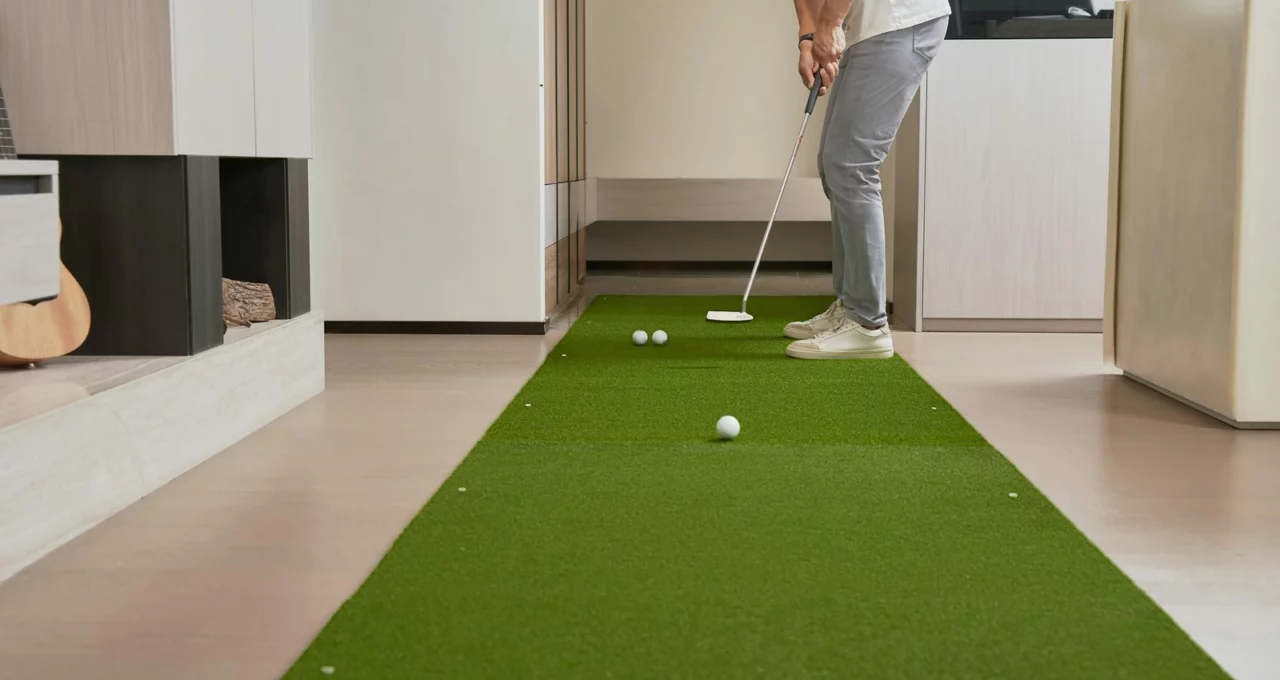
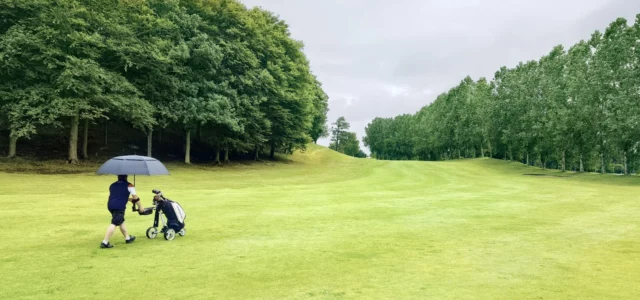
Nobody shuts a British golf course for the winter. That is the problem. The clubs go in the loft not because the ground is iron but because it is dark at four, the car park is a bog, the greens have moved to a circle of rough forty yards short of the real one, and the Saturday roll-up has become a wet trudge off mats. Most members stop playing between November and March, and the ones who do not are surviving rather than practising. The useful part of the winter happens on a landing or in a spare room, with a putting mat, an alignment stick and a mirror, for twenty minutes on three evenings a week. Here is the set-up, and what the winter actually does to the course you will go back to.
The British winter is a daylight problem before it is a weather problem
On the winter solstice the sun goes down in London at about seven minutes to four, and it has been setting before four o’clock since the start of December; further north it is earlier still. For anyone with a job, that removes the weekday round. What is left is the weekend, and the weekend is where the rain lives: the Environment Agency’s figures for the eighteen months from October 2022 to March 2024 made it the wettest such period in England since records began. A winter like that does not freeze the course; it waterlogs it, and a waterlogged course is open in name only. What survives is the slow, boring part of the game: where the feet point, where the putt starts, what the body looks like at address. None of them needs daylight or a dry fairway, and three objects that fit under the stairs cover all three.
The mat: six feet of carpet with a proper hole
The mat is the one item worth choosing with care. It should be flat, at least six feet long so you can putt from four feet with room behind the ball, and the hole should be the real size, 4.25 inches across, which is what the Rules of Golf define a hole as.
Two drills do nearly all the work. The first is the four-footer ladder: ten in a row from four feet, back to zero on any miss. That is the distance British winter greens turn into a lottery. The second is a gate: two tees or two coins a putter head’s width apart, a foot ahead of the ball. If the putter swings through clean, the face was square. If it clips a tee, you have found your winter project. What the mat cannot do is pace. Carpet is not a green, and lag putting on it teaches almost nothing that transfers; save speed for the first dry Sunday on the practice green.
The stick: a fibreglass rod against the skirting board
An alignment stick is a fibreglass rod a little over a yard long, and it fixes the most common fault in club golf: aiming right of where you believe you are aiming. Lay it along your toe line, pick a spot on the far wall as the target, take your stance, then look down. A few weeks of stepping in against the stick, then stepping in without it and checking afterwards, rebuilds the picture. Leaned against the wall at the angle of your shaft at address, it becomes a plane guide for slow half swings, a reference in the corner of your eye.
One rule to carry with you: under Rule 10.2b(3) of the Rules of Golf, you may not set an object down to help you aim or take your stance, and picking it up again before the stroke does not undo the breach. Train the habit, then train it without the stick, because that is the only version allowed on the course.
The mirror: the wardrobe door will do
Most houses already contain the third object. A full-length mirror on a wardrobe door, or a cheap one propped against a wall, shows your set-up from the side and the front, which the course never does. Side on, check a forward tilt from the hips rather than a slump from the shoulders, arms hanging under the shoulders, and knees with enough give that you could hop. Front on, check ball position for a wedge, a 7-iron and a driver, and whether the lead shoulder sits higher with the big club. A hand mirror flat under the ball shows whether your eyes are over it for putting. The real exercise is not the checklist but the comparison: set up by feel with your eyes shut, open them, and see how far you have drifted. By March that gap should be small, and the gap closing is the winter’s whole return.
Twenty minutes, three evenings: the shape of a session
The order is fixed, because each block depends on the one before. The research on motor learning favours short, frequent sessions over one long one, which is why this is three evenings and not a Sunday marathon.
- First five minutes, mirror and stick. Five set-ups with a mid-iron, five with the driver, checked side on and front on. Eyes shut for the last two of each, then open and compare.
- Next ten, the mat. The four-foot ladder to ten in a row, then twenty putts through the gate. When the gate stays clean for a week, narrow it.
- Last five, slow swings. Half swings beside the stick, no ball, feeling the club stay on the line you set up to. A folded towel under the trail arm for the final few keeps the arms with the body.
Monday, Wednesday and Friday from the clocks going back to the clocks going forward is twenty-two weeks and roughly twenty-two hours of work. Our piece on twenty minutes before work covers the same discipline in daylight.
Where winter really closes the British course, and what it leaves you
The course does not close. It changes, hole by hole, under local rules, and the changes decide whether anything you score counts.
Preferred lies have a season again. England Golf’s adverse-weather guidance, revised in the autumn of 2025, lets clubs apply the preferred-lies local rule (Model Local Rule E-3) and its companions E-2 and E-12 between 1 October and 30 April, and only where absolutely necessary. Outside that window a club needs its county’s permission; the year-round freedom clubs briefly enjoyed is gone. Scores returned with preferred lies in force still count for your Handicap Index.
Temporary greens have a limit. Under the same guidance, a round on an 18-hole course is acceptable for handicap purposes with no more than two temporary greens in play; on a nine-hole course, one. Beyond that the card is a social round. The course may be up to 100 yards longer or shorter than its measured length before a temporary rating is needed, and the front of each tee should sit within 10 yards of its permanent marker. That is why a winter league played off winter tees to greens cut into the fairways is a league, not a handicap event.
Mats and wheels. Roughly from November to April many clubs require shots from fairway-height turf to be played off a carry mat, and move the teeing areas onto artificial mats to spare the tees. Trolleys follow the ground: a ban when the course is soft, then winter wheels only, the open-tread or spiked kind, then nothing once it dries. Carrying is the one option no club restricts; before you carry all winter, read our piece on backs and winter physio first.
There is no inactive season. Unlike the American state associations, which switch handicaps off for the winter, the World Handicap System in Great Britain and Ireland runs all year. An acceptable round counts in January as in June, within the limits above, for a club member and an iGolf subscriber alike.
What that leaves is a strange, useful course. Winter greens, mats and soft ground take away the two skills the room cannot teach, pace and ball flight, and leave the ones it can: alignment, start line, set-up. Use the real green whenever it is cut, because a cold, slow, true surface is the only place to learn speed, and play the winter round for the start direction. The yardages on winter tees are wrong anyway.
What the room is not for
The full swing. A standard British ceiling is around eight feet, and the top of a driver swing by a six-foot golfer passes closer to it than the plaster can afford. If you must hit something at home, foam balls into a blanket in a garage with the door up is the version that does not end in a lampshade. The other trap is the swing rebuild: the mirror and the stick are for set-up and alignment, which you can see and correct yourself, while a grip, a plane or a sequence needs a coach and a ball flight to confirm it. If the winter has to include a lesson, book it for March, so what you build has a course to land on.
The winter kit, in one list
- Room: a strip of flat floor about seven feet by three, a measured ceiling, nothing you love within a club’s length.
- Kit: a putting mat at least six feet long with a 4.25-inch hole, one alignment stick, one mirror you can take your stance in front of.
- Diary: twenty minutes, three evenings, same order each time: set-up, putting, slow swings. Clocks back to clocks forward.
- Scorecard: ten four-footers in a row, a clean gate, and a set-up that looks the same with your eyes shut as open.
- On the course: the real green whenever it is cut, and a count of the temporary greens before you pre-register a card.
- Leave alone: full swings under a ceiling, swing changes from videos, lag putting on carpet.
Spring in Britain does not arrive on a date. It arrives the weekend the mats come in, the greens go back to the proper surface and the trolley ban is lifted, with no warning and a queue on the first tee. The golfer who spent the dark months on a landing with a mat, a stick and a wardrobe mirror steps onto that tee aiming where they think they are aiming and holing the four-footers the winter greens made a lottery of. The swing is no longer than it was in October. The score, more often than not, is lower.
How this page was put together: the hole size and the alignment rule come from the Rules of Golf (definition of “hole” and Rule 10.2b(3)); the preferred-lies window, the temporary-greens limit and the length and tee tolerances from England Golf’s adverse-weather guidance as reported in October 2025; the rainfall record from the Environment Agency’s water situation report for March 2024; the sunset time from the Royal Observatory Greenwich, all read in October 2026. The drills are standard coaching practice and are presented as such; nobody at Panxis Golf has measured them. Panxis Golf has no commercial relationship with any product or facility mentioned, and no retailer is named. If a page is ever paid for by a brand, it will say so above its first line.