October 31 and the garage problem: closing out a Canadian golf season properly
The two weeks after your province's handicap season closes are the most useful of the golf year. Post the last scores, let the season's worst number pick the winter project, keep the clubs out of a freezing garage and book the bench work before the spring queue.

In brief
- Active handicap seasons end October 31 in most provinces, November 15 in British Columbia; winter-trip rounds in the southern U.S. must still be posted.
- Your Index uses your best eight of the last 20 scores, so a missing good round costs you more than a missing bad one.
- Wash the grips as well as the heads: much of the slickness is dirt and sunscreen, not wear.
- A garage near Calgary's -7.6°C January mean freezes and thaws clubs all winter; store them inside the house.
- Take three weeks off, then give one change four months at a dome, a simulator or the range.
In Ontario, Quebec, Manitoba, Saskatchewan and Nova Scotia, the active handicap season ends on October 31. Alberta stops the same day, British Columbia on November 15. For most Canadian golfers, the handicap season and the playing season end within a fortnight of each other, and what you do in that fortnight decides how April goes.
The job is small: post the last scores, add up the season, clean and store the clubs properly, book the repair work while benches are quiet, and pick one thing to work on until spring. Call it two evenings. Most golfers skip all of it, leave the bag in the garage and start next season in the same place they finished this one.
Know your province’s handicap calendar
Golf Canada publishes the active seasons for rounds played in Canada, and they are not the same everywhere:
- British Columbia: March 1 to November 15
- Alberta: March 1 to October 31
- Saskatchewan, Manitoba, Ontario, Quebec and Nova Scotia: April 15 to October 31
- New Brunswick: April 21 to October 31
- Prince Edward Island: April 16 to November 14
- Newfoundland and Labrador: April 1 to November 30
A round played at home outside those dates isn’t posted. A round played somewhere else is judged by that place’s calendar, so a February week in Arizona or Florida counts: most of the southern United States treats the whole year as active, and Golf Canada says those scores must be posted. You don’t have to work it out yourself, because the Score Centre sets the active season from the course you enter.
Before the close, clear the backlog. Golf Canada asks for scores to be posted on the day of play, before midnight local time, and the ones golfers “forget” are rarely the good ones. Your Handicap Index is the average of your best eight differentials from your last 20 scores, so a missing blow-up round barely helps you, while a missing good round costs you straight away. A nine-hole score counts too, as long as all nine holes were played.
Add up the season before the memory fades
October memory is generous. It keeps the 40-foot putt that dropped and quietly loses the four penalty strokes at the 7th.
If you tracked your rounds, whether in the Golf Canada App or on the back of the card, total five numbers across the season: fairways hit, greens in regulation, three-putts, up-and-downs and penalty strokes. Compare them with a scratch or bogey benchmark if you like, but the useful comparison is between your own five. One of them will be clearly worse than the rest, and that is next winter’s plan.
The app helps because it covers winter too. Since a December 2025 update, practice sessions and simulator rounds at Golf Canada member facilities can be logged in the same place as your outdoor rounds. A January of wedge work then sits next to the summer’s up-and-down count, and you can see in May whether the work changed anything.
Wash the grips, not just the heads
Clubs put away dirty stay dirty for six months. Wet sand and grass dry into the grooves, and whatever moisture is trapped under a headcover has all winter to work on the ferrules.
Fill a bucket with warm water and a squirt of dish soap. Scrub the heads with a soft brush and use a wooden tee on the grooves, since a wire brush scratches the face. Dry everything with a towel, shafts included.
Then do the grips, which almost nobody washes. Much of the slick feel on an old grip comes from sweat, sunscreen and dirt rather than worn rubber. A scrub with soapy water and a non-scratch pad, a rinse, and a full day upright to dry will often get another season out of grips you were about to replace. If they are still shiny and hard afterwards, they really are worn out, and now you know before spring.
Empty every pocket. The finds are always the same: old balls, a stiff glove, a scorecard from 2023, a pencil stub and a banana that should not be discussed.
Why the garage is the wrong place
Environment and Climate Change Canada’s 1991 to 2020 normals put Calgary’s January mean at -7.6°C and Toronto’s at -3.5°C. An unheated garage or a car trunk follows those numbers closely, then warms on every sunny afternoon and every chinook. That repeated freeze and thaw is what a club does not need: the epoxy that holds the head to the shaft goes through a cycle each time, and rubber grips and glove leather stiffen in the cold.
A closet or a basement corner inside the heated part of the house is enough. Bring the balls in too. A golf ball kept below freezing all winter is not ruined, but a cold ball flies shorter until it warms up, and there’s no reason to start April with a sleeve that has spent five months in a snowbank’s worth of cold.
Leave the headcovers off for the first few days so any damp can escape, and store the bag standing up rather than lying under boxes.
Book the bench work while it’s quiet
The things you noticed in August are still there in November: the wedge that no longer checks up, the grip that turned in wet weather, the gap between your 5-iron and hybrid that cost you on every long par 3.
In late autumn, repair benches and fitting bays are quiet, so the work gets done faster. By April the queue is back and you’ll be waiting on your clubs just as the courses open. Your own club’s pro shop is the obvious first call, because the money stays at the place you play. Indoor academies do the same work through the winter: the National Golf Academy in Calgary lists regripping, club repairs and fittings for drivers, wedges, putters and full sets alongside its dome.
For bigger decisions, such as new irons or a driver, a fitting in the off-season lets you hit the test clubs indoors now and confirm the numbers on grass in May, before you pay for a custom order. If you’re replacing clubs, sell the old set before the spring rush, when every second listing on the Canadian classifieds sites is a golf bag.
Three weeks off, then one project
Do nothing golf-related for three or four weeks. The elbow that ached in August calms down, the swing thoughts you were carrying fade, and you come back wanting to practise instead of feeling you have to. If something has hurt for most of the season, see a physiotherapist or your doctor before you start any winter programme. That’s not a swing problem.
Then pick a single project. A new grip, a putting stroke, a set of wedge distances, or a winter of strength and mobility work. A change that feels odd for the first month has four more to become normal before the courses open. Make the same change in May and it costs you the summer. Make it in December and it costs you nothing.
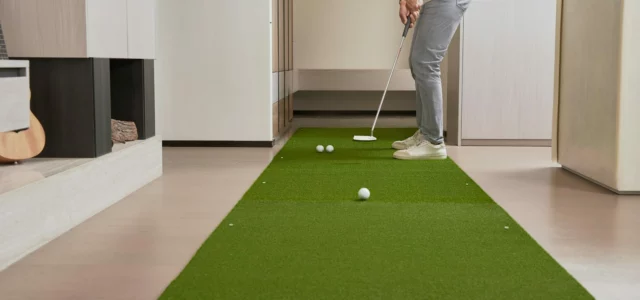
Where Canadians keep swinging until April
Indoor golf in Canada is not a fringe option any more. Here are a few places that publish their details:
- Markham Golf Dome (Markham, Ontario): a 53,000 square foot indoor range with 40 stalls on two tee decks, open daily from 7 a.m. to 11 p.m., plus a 100-stall outdoor range when the weather turns.
- The Golf Dome at the National Golf Academy (Calgary): 32 double-decker stalls in a climate-controlled dome 350 feet long, drop-in at 60 cents a minute per station with unlimited balls, up to four players per station.
- FORE! Indoor Golf (Toronto): three Trackman simulator locations, member access 24 hours a day, and coaching with PGA of Canada professionals.
Golf Canada’s facility finder lists member simulator facilities by city, with the number of bays and booking links, and those are the sessions the app can log. If you’re weighing a launch monitor for the basement, a few paid hours in a bay will show you which numbers you would actually use.
Panxis Golf has no commercial relationship with any facility named here and earns nothing from them.
Write it down in November
Take ten minutes with a notebook before the season blurs into one long memory. Answer three questions:
- What improved, and what’s the evidence? Fewer three-putts, a driver you trusted, a 60-yard wedge you can now hit on demand.
- What cost the most strokes, according to the numbers rather than the stories you tell?
- What did you plan to work on last spring and never start?
The third answer is the honest one. Then write down the winter project with a start date and a place: “Tuesdays at the dome, from December 2, 50-yard to 100-yard wedges.” A plan with a day and an address survives January. A vague good intention doesn’t make it past the holidays.
When spring gets close, the six weeks before opening day are the time to check whether it worked.
Before the first snow
- Post every outstanding score before your province’s season closes, and keep posting winter-trip rounds.
- Total the season’s five numbers and let the worst one choose the winter project.
- Wash heads and grips, dry them properly, and store clubs and balls inside the heated house.
- Book regrips, repairs and fittings now, while the benches are empty.
- Take three weeks off, then give one change four months.