Build your wedge card this winter: nine yardages for inside 100
Club golfers lose more shots between 40 and 110 yards than off the tee, because nobody knows how far a half swing goes. A Canadian winter is the ideal time to find out, as long as you remember that the mat and the heated room both flatter you.

In brief
- Lead arm at nine o'clock, at ten thirty and full: three lengths with three wedges give nine carry numbers.
- Keep the tempo fixed and let the backswing length set the distance.
- Measure indoors over the winter, but test contact, because a mat forgives heavy strikes.
- Expect the card to come up short on cold April and May mornings, and correct it after three rounds on grass.
- Calgary's altitude adds carry; adjust when you travel to the coast, and the reverse when you head to the Rockies.
Stand on any first tee in Ontario in late April and listen to the chat about drivers. Then watch the same foursome on the fourth hole, 70 yards out, each player taking a full swing with a sand wedge and flying the green or dumping it in the front bunker. The scoring is lost from inside a hundred yards, and it is lost for one reason: nobody in the group knows how far their shorter swings go.
The remedy is a small card with nine numbers on it. Three wedges, three swing lengths, each distance measured rather than guessed. A Canadian golfer has an advantage here that golfers in warmer places do not: five or six months of winter in which there is nothing better to do with a simulator bay than build that card properly.
Why the full swing is the wrong tool at 70 yards
A full wedge is a club you already know. Anything shorter is a feel shot, and feel is the part of your game that disappears when the match is tight or the group behind is waiting. Ask a 15-handicap how far their sand wedge goes with a half swing and the honest answer is “it depends”, which is another way of saying “I don’t know”.
The typical round puts you between 40 and 110 yards from the flag several times. Most club golfers turn those chances into a chip and two putts, because the first shot finishes 20 yards from the hole on the wrong side. A golfer who can land a wedge within 20 feet from those distances saves shots without adding a single yard off the tee.
The clock system, in plain terms
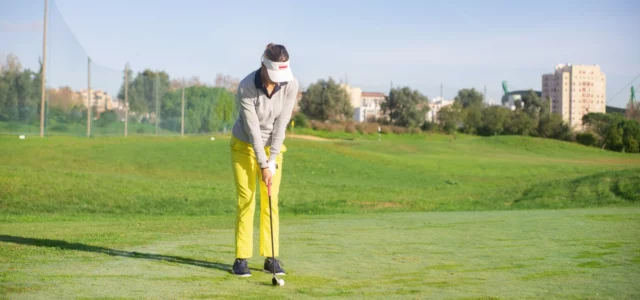
Picture yourself from the front, with your lead arm as the hand of a clock. Three stopping points are enough:
- Short: lead arm at nine o’clock, level with the ground.
- Medium: lead arm around ten thirty, halfway to the top.
- Full: your normal full wedge swing, nothing more.
With a pitching wedge, a gap wedge and a sand wedge, that makes nine carry distances, and for most players they fill the space from about 40 to 110 yards with no hole big enough to matter. You are not learning a new motion. You are attaching a number to motions you already make.
One rule holds all nine together: the rhythm never changes. The backswing length sets the distance, the tempo stays the same, and the arms do not speed up to “add a bit”. A pendulum travelling further in the same time is the picture. Speed is a judgment and judgment fails under pressure; a position is something you can see and repeat.
Winter is when to measure
From November to April, most of the country cannot hit a wedge onto real grass, and that is precisely when the card should be built. Indoor centres with launch monitors are now common in every large Canadian city. In Toronto, for example, FORE! Indoor Golf runs Trackman bays around the clock at three locations, with summer 2026 rates listed at $20 an hour in Mimico, $25 in Leaside and $30 in Leslieville. Rates change with the season, so check before you book.
An hour is enough if you work to a plan:
- Warm up with ten easy shots. They do not count.
- For each wedge and each swing length, hit ten balls. Cross out the longest and the shortest.
- Write down the carry that shows up most often, not the average of your best three.
- Note the date, the ball and the setting. You will need them in the spring.
Use carry, never total distance. Roll depends on the ground, and in a simulator the roll is a software estimate anyway. What you are choosing on the course is a landing spot.
Bring your own ball if the centre allows it. A launch monitor measures the ball it sees, and a card built with a softer or firmer model than the one in your bag is a card for somebody else’s game.
The mat will flatter you
This is the catch with a winter card. A hitting mat lets the club bounce into the ball even when you strike the ground an inch early. On a soggy May fairway at a parkland course in southern Ontario, the same strike digs and the ball comes up 15 yards short. So the numbers from the bay are honest about distance, but they say nothing about whether your contact holds up on turf.
Two checks while you are still indoors help. Place a towel a hand’s width behind the ball and make your nine swings without touching it. And look at the launch data: if the monitor shows your attack angle climbing on the short swings, you are trying to lift the ball, which on grass means fat and thin shots from the same intention.
The fix for both is the same setup: ball just behind centre, a little more weight on the lead foot, and a club that bottoms out after the ball. On real turf that leaves a thin divot in front of where the ball sat.
Recalibrate for the first rounds in spring
A card measured in a 20°C room will not match an 8°C morning at the end of April. Cold air is denser and a cold ball rebounds less. Trackman has published data in which the same 9-iron carried about seven yards differently across sessions at 55°F, 70°F and 95°F (roughly 13°C, 21°C and 35°C). Wedges fly shorter distances than a 9-iron, so the gap is smaller, but on the first cold rounds of the season expect every number on your card to come up a few yards short, and favour the longer swing when you are between two.
Altitude pushes the other way. Calgary sits at roughly 1,050 metres above sea level, and the thinner air there lets every shot carry a few percent further than it would in Halifax or Vancouver. A golfer who builds a card at home in Calgary and then plays a week on Vancouver Island should expect wedges to come up short; the reverse is true for a coastal golfer on a trip to Kananaskis or Banff. The difference on a 90-yard shot is only a few yards, but a few yards is the width of the front bunker.
After two or three rounds on grass, note which of the nine numbers were wrong and correct the card. Canadian golf seasons are short, and the golfers who take the time in May to adjust their numbers get four good months out of them.
Lies and weather that break the card
The card assumes a clean lie on short grass. Three situations change that:
Rough. Grass trapped between clubface and ball removes spin, and the ball can fly and run well past the card’s number. When the ball sits down in thick grass, pick the shorter swing and plan for release.
Wind. A wedge hangs in the air a long time for its distance, which gives the wind more to work with. Into a breeze off Lake Ontario or Georgian Bay, move up one swing length and keep the same tempo. Swinging harder adds spin, and spin is what the wind grabs.
Slopes. From a downhill lie the loft effectively drops and the ball comes out lower and further. From an uphill lie it climbs and stops short. Change the club or the swing length rather than trying to manipulate the strike.
Bounce, the rounded sole under the leading edge, is what keeps a slightly heavy strike from digging in soft spring or autumn turf. Players who push the shaft well forward at address to “trap” the ball take that bounce away. On partial shots, a shaft closer to vertical lets the sole skim, and the ball lands softer.
Practise the awkward numbers
Nobody needs to practise a full sand wedge. The course will not give you 90 or 100 yards on the dot; it gives you 63, 77 and 84. Once the card exists, spend sessions on the numbers in between.
A simple routine for a simulator bay or an outdoor range with marked flags: choose three targets at odd distances, hit one ball to each in rotation, and never hit the same shot twice running. It feels worse than hitting 30 balls to one target, and it transfers far better to the course, where every shot is a first attempt.
Where to build your numbers in Canada
Indoors, November to April. Simulator centres with launch monitors are the quickest option in Toronto, Ottawa, Calgary, Edmonton, Winnipeg and Vancouver. Book off-peak, weekday mornings or late evenings, when rates are lower and nobody is waiting behind you.
With a fitter. Many specialty golf stores offer custom fitting with launch monitors. A wedge session with a fitter is also the right moment to check lofts and gaps, since a pitching wedge from a modern iron set is often much stronger than the sand wedge that came from somewhere else.
Outdoors, from May. A grass range beats mats for wedge work because it punishes the heavy strike that mats forgive. Take a rangefinder to confirm flag distances, which on many ranges are only approximate.
On the course, all season. Shot-tracking systems such as Arccos and Shot Scope log real wedge distances from real lies, which is the most honest check of the card over a summer. For more on the technology, see our guide to launch monitors, and for the irons that sit above your wedges, our page on iron fitting.
Panxis Golf has no commercial relationship with any retailer, facility or system mentioned here.
The card, in five steps
- This winter, book one hour in a launch monitor bay and record nine carry distances: three wedges, three swing lengths.
- Keep the tempo fixed; only the length of the backswing changes.
- Test contact with a towel behind the ball, because the mat hides heavy strikes.
- In the first cold rounds, expect the numbers to come up short, and correct the card after three rounds on grass.
- Adjust for altitude when you travel between the coast and the Prairies or the Rockies.
Nine numbers cost one hour and no new equipment, and they turn the most wasted shot in club golf into a real chance at par.