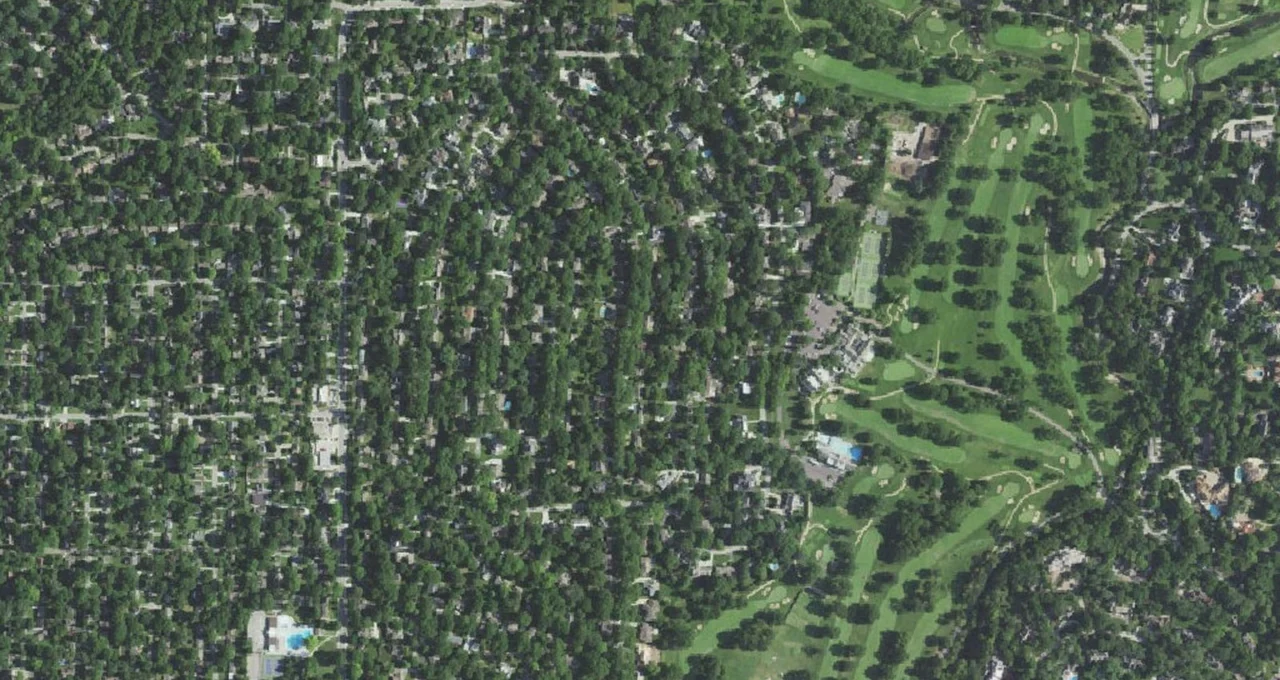
Kansas City Country Club from the air. Aerial imagery USGS, domaine public.
Kansas City Country Club
Holes
18
By
70
Length
—
Green fee
—
Best season
Roughly April to October (Midwest season)
The Kansas City Country Club is a private club in Mission Hills, Kansas, just across the state line from Kansas City, Missouri, on the banks of Brush Creek. It was founded on May 1, 1896, with 127 founding members, and it presents itself as one of the oldest country clubs west of the Mississippi; encyclopedic entries note that it claims to be the third oldest. The club’s address is 6200 Indian Lane, Mission Hills. It is best known to golfers as the home club of Tom Watson, the five-time Open Champion and eight-time major winner, who learned the game there.
The golf course is an 18-hole design by A. W. Tillinghast, on the site where the club moved in the mid-1920s. It is a par 70. Later redesign work is credited to the Jones family: encyclopedic entries name Robert Trent Jones, and the firm of Rees Jones lists redesigns of the course in 1978 and 1988. Most recently, the architect Andrew Green carried out a complete renovation that closed the course from the fall of 2024 through the whole 2025 season, with a reopening for members planned for June 2026 and a full reopening announced for 2027.
The club publishes no scorecard on its public website, and we found no current, verifiable figure for the length, the course rating or the slope of the renovated course. This page therefore gives none.
A club older than its course
The club began on an informal course in the Hyde Park neighborhood of Kansas City, Missouri. In 1896 a group of local businessmen incorporated the Kansas City Country Club and leased a pasture at what is now Loose Park, a tract belonging to the family of Seth E. Ward, a pioneer who had made his fortune outfitting settlers on the Oregon Trail. The ground was historic: it had been part of the battlefield of Westport, fought during the Civil War in 1864. According to the club, it paid one dollar a year to lease the land, plus property taxes, for some thirty years.
The club shaped the city around it. From 1907 the developer J. C. Nichols bought land around the course to build what became the Country Club District, and later the Country Club Plaza, both named after the club. In 1901 the club hosted the first Trans-Mississippi Amateur, won by John Stuart, the beginning of a championship that would return to the club many times.
When the land was sold in the mid-1920s, the club moved a mile west to Mission Hills, and its old grounds became Loose Park. Encyclopedic entries date the move to 1925 and the club dates the relocation to 1926. A feature published in 2020 by a golf weekly reports that board minutes record the hiring of Tillinghast on December 10, 1925, that a receipt for his services survives, and that a duplicate of his design drawing, dated February 1927, turned up in the superintendent’s office. Tom Bendelow had laid out the club’s earlier golf; the Mission Hills course is Tillinghast’s.
Polo was once a large part of club life. The club says interest faded in the 1940s, and that the abandoned polo grounds were brought into the golf course and practice facilities decades later. According to the 2020 feature, that is why the 4th and 5th holes now run along the edge of the property, on the former polo field, and cannot be returned to their original positions.
What it asks of you
Because the course has just been rebuilt and no new scorecard is public, a hole-by-hole guide would be guesswork, and this page does not attempt one. What the public record does say about the character of the course is consistent.
It is a Golden Age course of modest length. A par of 70 on about 125 acres along Brush Creek, the figure given by a golf writer who attended a presentation of the restoration, leaves little room for long holes, and the course has always been defined by its ground rather than by its yardage. Course guides describe it as hilly and tree-lined, and a specialist ranking site, which places it among the top courses in Kansas, says it keeps most of its original routing and much of its Golden Age feel. On a course like this, the questions are about angles, slopes and the greens, not about carrying the ball 300 yards.
The renovation was designed to make that character clearer. According to reports on the project, Andrew Green removed trees, rebuilt the bunkers, recontoured the greens, built new tees, installed new irrigation and replaced the Zoysia fairways with bentgrass. He also reversed the direction of the 10th and 18th holes, which run parallel to each other, to restore the order of Tillinghast’s original plan; the 2020 feature had described the old arrangement as awkward, with the 18th green moved closer to the clubhouse over the years. The 5th hole was changed from a dogleg right into a shorter, straighter hole. The 2020 feature also records that the 2nd, a par 3 of about 125 yards, once had a continuous bunker across the front of the green, which had since been opened.
With new greens, new bunkers and a new fairway grass, the course members find in 2026 is in many respects a new one, and how it actually plays will only become clear once members and guests have had a full season on it.
Tom Watson and the club
Watson was born in Kansas City and was introduced to golf by his father, Ray. His early teacher was the club’s long-time professional, Stan Thirsk, to whom the club credits much of Watson’s success. Encyclopedic entries report that Ray Watson holds the amateur course record of 64 and that Tom Watson holds the professional record of 60; those records were set on the course as it was before the renovation.
The club’s history also has a darker page, and Watson is part of it. The club did not admit Jewish members until 1990. That year, after its leaders rejected the application of Henry Bloch, the founder of H&R Block, Watson, whose wife at the time and children were Jewish, resigned his membership in protest. The club then admitted Bloch, in December 1990, as well as other members from minorities, and Watson rejoined. Encyclopedic entries list him as a member today.
What tournaments have shown
The club has concentrated on amateur golf. After the first Trans-Mississippi Amateur in 1901, played on the old grounds in Missouri, the championship came back to the Mission Hills course in 1953, 1965, 1975, 1983, 1993, 2001 and 2011. The winners there were Joe Conrad in 1953, George Boutell in 1965, Tim Wilson in 1975, Greg Chapman in 1983, David Ojala in 1993, Chip Stewart in 2001 and Kelly Kraft in 2011; Brandel Chamblee, later a tour player and television analyst, lost the 1983 final. The club also says it has hosted many other regional and national tournaments.
What golfers are saying
This is a private club with limited guest play, and the public record is very thin: a few entries on course-ranking sites, local press coverage of the renovation and occasional mentions in golf media. There are almost no guest reviews to summarize, and none yet of the renovated course. The points below are what that small body of material says. They are other people’s opinions, not ours; nobody from Panxis has played the course, and we name and quote no one.
What comes up in its favor
- Specialist reviewers regard it as the best classic course in the Kansas City area, and one that would stand among the best in most American cities.
- They value the preserved Tillinghast routing and the Golden Age atmosphere, and describe the course as having kept its charm through successive renovations.
- Golf writers following the project have welcomed a restoration that looks back to Tillinghast’s plan rather than away from it.
What comes up against
- The public record contains no substantial criticism of the course itself.
- Local coverage of the renovation reported the costs of the long closure for members and staff, with a shortened season, fewer hours for pro shop staff and construction noise for neighbors.
- Access is closed: without a member, there is no way to play.
How to play it
The Kansas City Country Club is a private, member-owned club and does not sell public tee times. Guests play with a member, and the club states that members are responsible for their guests’ attire. The club’s dress code for golf is traditional: collared shirts tucked in, slacks or shorts of appropriate length, and soft spikes; jeans, tank tops, t-shirts and cargo shorts are not allowed on the course. A PGA professional staff profile of the club gives about 575 members and some 17,500 rounds a year, with no caddie program and a fleet of about 60 carts.
The facilities
The renovation extended to the practice areas. According to a golf range industry association, the driving range tee was doubled in size to take 24 players at once, a new short-game area with bunkers was built behind the range, and a larger, more practical putting green replaced the old one near the 1st tee. The club also has tennis courts, rebuilt in 2024 and reopened in early 2025, a pool and several dining rooms, from casual grill rooms to more formal spaces with their own dress code.
Getting there and when to go
The club is at 6200 Indian Lane in Mission Hills, Kansas, a short distance west of the Missouri state line. The club’s directions describe a front entrance reached from Ward Parkway, State Line Road or Shawnee Mission Parkway, and a back entrance from 63rd Street and Reinhardt Drive used in bad weather. The golf season runs roughly from April to October or November; after the renovation, the club’s calendar governs when the course is fully open.
Green fees
The Kansas City Country Club is a private club and publishes no public green fees. Guest conditions are set by the club. See the club’s own site.
How this page was made
The factual frame comes from public sources: OpenStreetMap for the location; the club’s website for the founding date, the founding members, the lease of the first grounds, the move, the polo history, the address, the directions and the dress code; encyclopedic entries for the founders, the Country Club District, the par, the design credits, the course records and the 1990 membership dispute, backed by press reports of the time; the championship’s record book for the Trans-Mississippi Amateur; a 2020 golf-weekly feature for the Tillinghast documents and the changes to the 2nd, 4th, 5th, 10th and 18th holes; and reports by a golf range association, a golf-architecture website and local student press for the renovation and its timetable. The architect’s firm portfolio gives the Rees Jones redesign years.
No current length, course rating or slope could be verified for the renovated course, and none is given. The opinion section summarizes the few rankings and reports available in September 2026; we report recurring themes rather than individual voices, and we reproduce no quotations. Nobody from Panxis has played or visited this course, and this page is no substitute for a round.
The club has not paid for this page, has not seen it before publication and has no say over its content. This page contains no commercial link and earns us no commission. If you know the course and something here is wrong or out of date, write to us and we will correct it.
Other courses nearby
Closest to this one in our United States directory:
- Mission Hills Country Club — 1 mi
- Indian Hills Country Club — 1 mi
- Crow Valley Golf Club — 280 mi
- Rich Harvest Farms — 373 mi