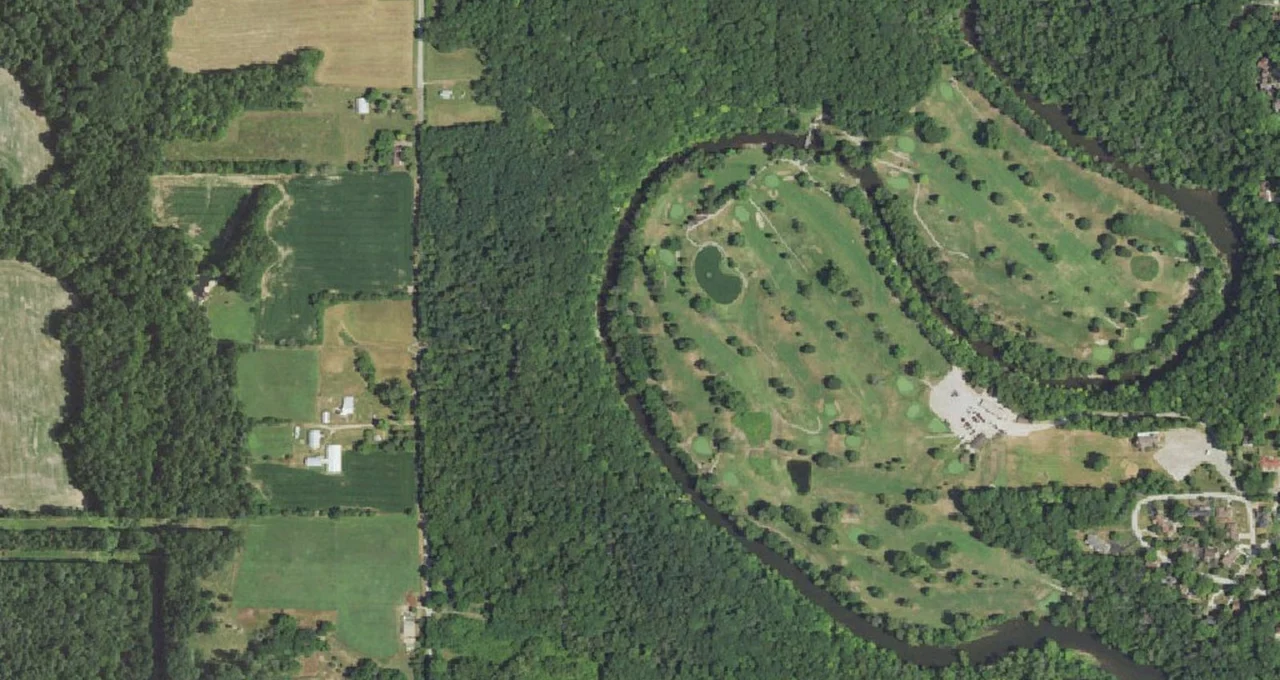
Harrison Park Golf Course from the air. Aerial imagery USGS, domaine public.
Harrison Park Golf Course
Holes
18
By
71
Length
6,148 yards from the Blue (championship) tees on course directories; the club publishes no yardage
Green fee
—
Best season
—
Harrison Park Golf Course is the municipal course of Danville, Illinois, an 18-hole par 71 that runs over the hills and bottomland along the North Fork of the Vermilion River, on the west side of the city near the Indiana line. The club’s website gives its address as 1300 West Voorhees Street and says the property covers 235 acres. It is owned by the City of Danville, which operates it as a public course, and it carries the name of John Higgins Harrison, the newspaper editor who bought the grounds of the old Danville Country Club in the late 1920s and handed them to the city. According to a history published by the Vermilion County Trail Alliance, the first nine were built here around 1910 for a private club, and the second nine came in the 1930s through the Works Progress Administration.
This is a modest course on paper. The longest tees listed by golf course directories measure 6,148 yards, and the club itself publishes no yardage, no hole descriptions and no course rating on its website, only the par of 71 and a set of hole images. The figures on this page therefore come from directories and scorecard apps, which agree on the hole-by-hole card but not on the ratings or on every tee. We say where they diverge and which source we follow.
From a private club to a city park
The golf on this land predates the park. A local history article in the Commercial-News, republished by Yahoo Sports, says the Danville Country Club was first organized in 1904 and moved several times between 1910 and 1926. The Vermilion County Trail Alliance gives the details of the move that matters here: in 1910, the Danville Golf Club closed its course on North Vermilion and leased 65 acres from Carol Williams, on land that had passed down through the family of Amos Williams, one of the founders of Danville. The clubhouse and the first nine holes of the present course were built on that lease, and the organization later became the Danville Country Club. A new clubhouse opened in 1911, with eleven bedrooms, screened porches, a bowling alley and lounging rooms, according to the same source; members sometimes stayed for long periods.
The country club eventually left for a new course of its own. The Trail Alliance dates that new club to 1925; the Commercial-News history says the moves continued until 1926 and places the permanent club on Denmark Road. Either way, the old grounds became available, and John H. Harrison, then editor of the Commercial-News, bought them. The Trail Alliance says he purchased several tracts in 1928, including the country club grounds and the old Williams land, and gave them to the city on two conditions: that the land be held in trust by the city for public recreation forever, and that it always be called Harrison Park. The club’s website tells the story slightly differently. It says Mr. and Mrs. John Higgins Harrison, part owner and editor of the Commercial News, bought the Danville Country Club in 1929 and that Harrison gave it to the city in memory of his mother, Minta, for a nominal sum. According to the Trail Alliance, the country club then sold its clubhouse to the city at a steep discount in 1929, and the city formally accepted the park with a celebration in May 1929.
Sources disagree on the founding year. Wikipedia gives 1928 as the year the course was established, the club’s website says 1929, and some directories give 1910 or even 1900; GolfNow lists 1929 as the year built. This page follows the club for the date of the gift to the city, while noting that the first holes on the site are older. We found no reliable date for 1900.
The New Deal nine
The course became an 18-hole layout during the Depression. According to the Vermilion County Trail Alliance, between 1935 and 1937 the federal Works Progress Administration built nine additional golf holes on the western portion of the park, along with nine miles of trails, rustic bridges, picnic areas, playgrounds and stairs. Much of that western park later fell out of use: the Trail Alliance describes a cleanup of the picnic grounds, trails and bridges in 1973 and a slide back into ruin within a few years, and it is now working to restore the remaining WPA structures and add hiking and biking trails there. Those plans concern the park around the course, not the golf holes themselves.
We could not establish who laid out the holes. Two course directories, OpenGolfAPI and GolfN, name the Wisconsin architect Bob Lohmann as the designer, but we found no mention of Harrison Park in material from Lohmann’s firm or in the trade press, and the club does not name an architect. One scorecard app lists John Higgins Harrison as the designer, which confuses the donor with the architect. Given that the first nine dates from around 1910 and the second from the 1930s, a credit to Lohmann, if accurate, would most likely concern later work, but we have no source to confirm it, so this page names no designer.
The clubhouse and the river
The 1911 clubhouse still stands. According to the Trail Alliance, it was nominated as a local landmark in 1993 and received that status in 1994, and the Old Town Preservation Group began renovating it in 1996, concentrating on the most urgent and visible work because a full restoration was out of reach. A News-Gazette article describes it as a city-owned building on a hill overlooking the golf course, off West Williams Street, and quotes city public works officials on a phased restoration. In March 2025, the Commercial-News reported that the course had unveiled a new logo, drawing on the City of Danville’s own, and linked the rebranding to major renovations of the Harrison Park Clubhouse. We could not find the current state of that work.
The North Fork is both the course’s scenery and its main nuisance. The Trail Alliance records that in 1994 severe flooding submerged seven greens and 18 sand traps. A later News-Gazette report describes a mid-August flood that closed the course for three days, from August 14 to 17; the course manager, AJ Shannon, called it the worst condition the course had been in for years and estimated that more than 540 rounds were lost. When it reopened, carts were kept off and only walkers were allowed, on the front nine only, because the back nine holds water longer and drains more slowly. The year of that flood is not visible in what we could read of the article. A separate Commercial-News report quotes city officials saying that heavy rain and standing water had kept carts off the course at other times.
What it asks of you
Harrison Park is short by modern standards, and the card shows why it can still be awkward. The par of 71 is made up of four par 3s, eleven par 4s and three par 5s, with 36 on the front nine and 35 on the back. Course directories describe bentgrass greens and bluegrass fairways. Foretee calls it a traditional, older course on rolling terrain with some uneven lies and fairways that vary from narrow to wide, and says the river meanders through a couple of holes. Hole19 describes a layout on rolling hills alongside the Vermilion River. A GolfPass reviewer, as shown in search results, mentions tee shots over the river; we could not identify which holes those are, and the club does not say.
The ratings depend on the source, and none of them comes from a source we could check at the root. The USGA course rating database blocked our requests. GolfPass and OpenGolfAPI give the 6,148-yard Blue or championship tees a men’s rating of 69.3 with a slope of 119. GolfNow lists 69.0 and 117 for men and 74.3 and 129 for women from the same tees. 18Birdies gives 69.6 and 121 for men and 74.6 and 131 for women. Foretee lists a maximum of 6,111 yards with a rating of 70.3 and a slope of 119. The shorter tees vary too: the White tees measure 5,840 yards on GolfPass, OpenGolfAPI and 18Birdies but 5,850 on GolfNow; GolfNow lists Yellow tees at 5,341 yards and Red tees at 4,767, while 18Birdies lists Gold tees at 5,346 and Red tees at 5,252, and GolfPass lists Red tees at 4,991. These figures probably reflect re-ratings over the years. This page uses 6,148 yards for the Blue tees, the length on which every source except Foretee agrees, and gives no single rating.
The stroke index also varies. 18Birdies and Hole19 publish the same handicap order for all 18 holes, with the 7th as the hardest hole and the 16th second; OpenGolfAPI agrees on the front nine but gives a different order on the back nine, with the 15th second and no figure for the 18th. This page follows 18Birdies and Hole19. Yardages below are from the 6,148-yard Blue tees on the directory card shared by 18Birdies and OpenGolfAPI; Hole19 shows the same card converted to meters.
The front nine
The opening hole is a par 4 of 393 yards and ranks third on the stroke index, so the round starts with one of the harder holes on the card. The 2nd is the shortest hole on the course, a par 3 of 145 yards, followed by the 3rd, a par 4 of 382 yards. Then comes the most unusual stretch of the routing: two par 5s back to back, the 4th at 458 yards and the 5th at 473 yards. Both are short for the par, and the 5th is ranked 17th on the stroke index, the second easiest hole on the course; on the card, at least, these are the best chances to make up a shot.
The 6th is a par 3 of 164 yards, seventh on the index. The 7th is the hole the card treats with the most respect: a par 4 of 441 yards, the longest two-shot hole on the course and number one on the stroke index. The 8th swings the other way, a par 4 of only 268 yards that a long hitter may be tempted to attack from the tee. The 9th, a par 4 of 399 yards and fifth on the index, closes a front nine of 3,123 yards and a par of 36.
The back nine
The back nine starts with a par 3 of 155 yards, which 18Birdies and Hole19 rank as the easiest hole on the course. Three par 4s follow: the 11th at 386 yards, the 12th at 374 yards, ranked fourth, and the 13th at 361 yards. The 14th is a short par 4 of 326 yards. The 15th is the longest hole on the card, a par 5 of 510 yards, and the only three-shot hole on the inward nine.
The closing stretch is the part of the course that reviewers single out. The 16th, a par 4 of 372 yards, is second on the stroke index in 18Birdies and Hole19. The 17th is a par 3 of 164 yards, and the 18th a par 4 of 377 yards. The back nine measures 3,025 yards for a par of 35. Several reviews, as shown in search results, describe the back nine as harder than the front and find the last five or six holes the most interesting part of the layout. The back nine is also the part that drains more slowly after heavy rain, according to the course manager quoted by the News-Gazette.
The club has published no hole descriptions that we could read, and the hole images on its course information page carry no text. We have not described hazards, doglegs or green shapes hole by hole because no source we could verify does so.
What golfers are saying
The material behind this section is the user reviews on golf review, booking and scorecard sites (GolfPass, FairwayFinder, 18Birdies and Hole19) and a general business review site, as shown on those pages or in search results. The points below are other people’s opinions, not ours; nobody from Panxis has played the course, and we quote no one.
What comes up in its favor
- The setting: reviewers mention river views, wooded hills and a calm atmosphere close to town.
- The layout, called interesting, with particular praise for the closing holes and for tee shots over the river.
- Value for money, which scores well on the review sites that rate it separately.
- Greens that some reviewers find forgiving, and a course they describe as walkable and approachable for improving players.
- Conditioning that some reviewers describe as very good on the day they played, and pace of play rated fast on one scorecard app.
- Helpful staff, according to some reviews.
What comes up against
- Staff behavior: several reviews on different sites describe rude treatment in the golf shop, including a beginner group told it was too slow.
- Turf quality that some reviewers find uneven, and a sense among a few regulars that the course has declined under changes in management.
- Wet conditions after rain and the damage left by floods, which older reviews describe on fairways and greens.
- Water and woods that can make the course hard going for beginners, despite its short length.
- Greens on the back nine that one reviewer found dated.
How to play it
Harrison Park is open to the public. According to the club’s rules, tee times are optional but strongly encouraged; they are booked online up to seven days in advance, for groups of two to four, and a card is required to hold them. Players should check in at the golf shop 15 to 20 minutes before their time, and tee times are spaced ten minutes apart. Groups are limited to four golfers, singles and twosomes may be paired during busy periods, and play may not start on the 10th tee. The club charges a fee for a late cancellation or a no-show; its website gives the details.
Carts are rented to holders of a valid driver’s license, with a maximum of two golfers per cart, and renters are responsible for any damage. Non-golfers riding along are charged, and the course is otherwise closed to non-golfers: the club says runners, walkers, dog walkers and cyclists are no longer allowed on the course or range. GolfNow states that walking is allowed and metal spikes are not; the club’s rules page does not address either point. Personal alcohol is not allowed on the property, and coolers are checked. The club does not publish a dress code that we could find.
The practice area includes a driving range of 250 yards with a grass tee and artificial mats used when the grass needs rest, and two practice greens for chipping and putting, according to the club. A PGA Professional on staff gives private and group lessons, and the club runs a summer golf camp with professional instruction, season passes, leagues and outings. In 2025 it ran a Thursday evening two-person league over 14 weeks, playing scramble and then alternate shot. The course has hosted the Commercial-News men’s amateur tournament, high school matches, a charity golf classic, and the American Legion state golf tournament, a four-player scramble that Danville’s American Legion Post 210 and the city stage at Harrison Park and Turtle Run. This page lists no green fee; rates are on the club’s website.
The facilities
The golf shop handles check-in, and outside staff help golfers find their carts. The club organizes events for groups ranging from small getaways to large charity tournaments, with contest setup, rule sheets and cart signs. 18Birdies lists club rental, a restaurant and changing rooms, and GolfNow lists club rental; the club’s own website does not describe food service, so we cannot confirm what is offered at the moment. The historic clubhouse, under renovation according to the 2025 reports, sits in the park above the course. Wikipedia lists a course record of 61 by Andy Bott, with no date and no source, which we could not confirm elsewhere.
Getting there and when to go
The course is at 1300 West Voorhees Street, Danville, IL 61832, according to the club; one directory gives 1 Mulligan Drive instead. The phone number of the golf shop is 217-431-2266. In peak season the golf shop is open every day from 7:30 a.m. to 8 p.m., and the club says hours vary in spring and fall; it does not publish opening and closing dates for the season. GolfNow describes the course as open year round, which we could not confirm with the club. Given the course’s history with the North Fork, it is worth calling after heavy rain to check whether carts are allowed. Contact details and online booking are on the club’s website.
The park around the course is a destination in its own right. Enjoy Illinois, the state tourism site, mentions bird watching, fishing and hiking, and the Trail Alliance records a bird sanctuary established in 1933 and rededicated in 2002. The club notes that non-golfers are not allowed on the course itself, so visitors on foot should keep to the park.
How this page was made
The factual frame comes from public sources consulted in October 2026: OpenStreetMap for the location; the club’s website for the address, the par, the acreage, the history of the gift, the rules, the range, the league, the events and the shop hours; the Vermilion County Trail Alliance for the 1910 lease, the 1911 clubhouse, the 1928 purchase, the WPA nine, the 1994 flood and the clubhouse landmark status; the Commercial-News, through Yahoo Sports and search excerpts, for the country club’s moves, the 2025 logo and the clubhouse renovation; the News-Gazette, through search excerpts, for the clubhouse restoration and the August flood; Wikipedia and Wikidata for the founding year and the course record; GolfPass, GolfNow, 18Birdies, Hole19, OpenGolfAPI and Foretee for the tees, ratings, scorecard, stroke index and grasses; Enjoy Illinois for the park activities. Where sources disagree, as they do on the founding year, the year the country club left, the designer, the tee lengths, the ratings, the stroke index and the address, we say so and name the source we follow.
Several sources could not be read directly: the USGA course rating database, GolfLink and GolfPass, which blocked automated requests, and the Commercial-News and News-Gazette articles, which returned errors; for those, we relied on the excerpts shown by search engines and say so above. We could not confirm the designer credit, the course record, the year of the August flood or the year-round season with a second source, and the club publishes no hole descriptions. The opinion section summarizes public reviews; we report recurring themes rather than individual voices, and we reproduce no quotations. Nobody from Panxis has played or visited this course, and this page is no substitute for a round.
The club has not paid for this page, has not seen it before publication and has no say over its content. This page contains no commercial link and earns us no commission. If you know the course and something here is wrong or out of date, write to us and we will correct it.
Other courses nearby
Closest to this one in our United States directory:
- Crooked Stick Golf Club — 79 mi
- Olympia Fields Country Club — North Course — 95 mi
- Flossmoor Country Club — 96 mi
- Ravisloe Country Club — 98 mi
The hole to know
A par 4 of 441 yards from the Blue tees on the directory card, the longest two-shot hole on the course and first on the stroke index.