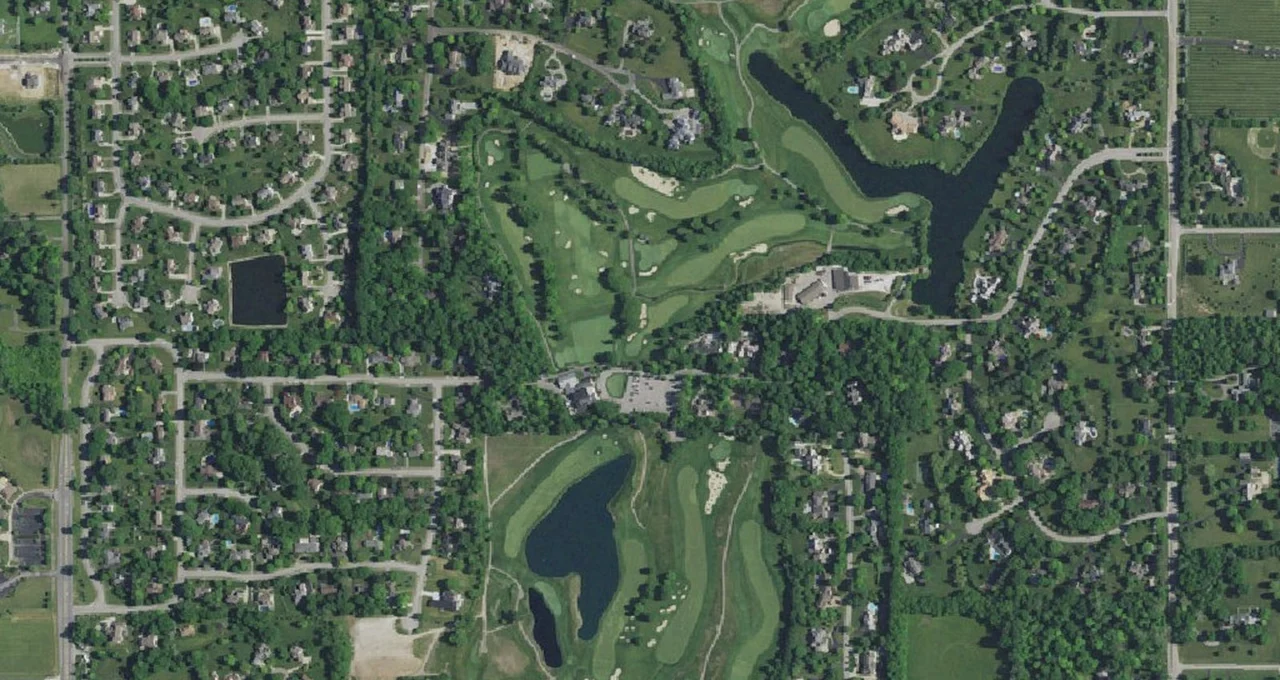
Crooked Stick Golf Club from the air. Aerial imagery USGS, domaine public.
Crooked Stick Golf Club
Holes
18
By
72
Length
7,567 yards from the Black tees (rating 77.7) on the pre-renovation scorecard reproduced by Wikipedia; a 2026 reviewer gives 7,149 yards (rating 77.5, slope 150) after the 2024 to 2025 renovation
Green fee
—
Best season
—
Crooked Stick Golf Club is a private golf club in Carmel, Indiana, a suburb in Hamilton County just north of Indianapolis. The club gives its address as 1964 Burning Tree Lane, Carmel, IN 46032, a street number that echoes its founding year. Its single 18-hole course was laid out by Pete Dye with his wife Alice Dye, and the club calls it the couple’s “firstborn golf course.” It is a par 72. The scorecard reproduced on Wikipedia, drawn from the club’s own course tour, gives 7,567 yards from the Black tees with a course rating of 77.7, but the course has since been renovated and newer figures are shorter, as we explain below.
Crooked Stick holds a particular place in American golf. It was one of Dye’s first major commissions, the place where, by several accounts, he tried out ideas before using them elsewhere, and the course where a ninth alternate named John Daly won the 1991 PGA Championship. It has since hosted a U.S. Women’s Open, a Solheim Cup, a U.S. Senior Open and two BMW Championships, and the USGA has scheduled the 2028 U.S. Senior Open there. The club describes its membership as limited and by invitation from current members, and it puts the accent on the course rather than the clubhouse: its home page speaks of a world-class course, a modest facility, fellowship among members and responsibility to the community. This page is a portrait built from public sources; most readers will only see the course on television or as a member’s guest.
From a meeting downtown to a club named after a stick
The club’s history page dates the project to February 17, 1964, when about sixty people gathered at the Indianapolis Athletic Club. Five local men, all members of the Country Club of Indianapolis, led the effort: the publisher Eugene S. Pulliam, the banker Robert E. Sweeney Jr., the attorney William A. Wick, the insurance executive J. I. “Ike” Cummings and Paul “Pete” Dye Jr., then a golf course designer with ten courses to his name. Their stated goal was to build “the finest golf course in this area.” The plan, according to the club, was to raise capital through pledges from at least one hundred subscribers in order to buy about 400 acres of undeveloped land in Hamilton County, near 106th Street and Ditch Road.
A booklet circulated by Pulliam, titled The Golf Club of Indianapolis, set out the design principles: holes that were fair but demanding, greens sized and sloped to suit the length of each hole, consecutive holes of different types, and a course that would call for nearly every club in the bag. The club also traces its unofficial motto, later printed on scorecards and stationery, to a passage by the British golf writer Pat Ward-Thomas in Country Life in January 1964 describing a golf club as a haven of seclusion and peace.
The name nearly stayed “The Golf Club of Indianapolis.” The club says members voted on a name in June 1964 and that this option appeared to have won. The story that changed it is one the club tells itself and that Top100GolfCourses.com repeats as folklore: walking the unfinished back nine with Bill Wick, Dye picked up a gnarled stick and swung it at some stones. “Crooked Stick Golf Club” was ratified by the members on April 8, 1965, according to the history page.
Pete and Alice Dye’s first canvas
The land was not promising. The club describes mostly flat fields of corn and wheat, with some natural relief around the 13th to 16th holes and woods where the clubhouse now stands. Top100GolfCourses.com notes that Dye had visited Scotland the year before and was struck in particular by Cruden Bay, and that pot bunkers, wooden sleepers, small greens, blind shots and rolling fairways came home with him and appear at Crooked Stick and in his later American work.
According to the club, Dye worked without drawings. He staked the routing with colored stakes, red for tees, blue for landing areas and white for greens, and relied on instinct and on his knowledge of the great courses. He told the club he had borrowed heavily for the greens, adapting ideas from Donald Ross, Alister MacKenzie and Seth Raynor; a bunker on the 11th draws on Oakmont, and the railroad ties on the 6th recall Old Prestwick. Construction began by stripping topsoil and digging the lake between the 10th and the 18th, and the spoil was used to build up landing areas. A Philadelphia golf blog, Golfadelphia, adds that Dye adapted Ross’s drag-pan technique with a broken wheel disc pulled by small dozers and hired inexperienced operators to get a rougher look.
The course opened in stages. The club’s history page says the first nine holes, which are today’s back nine, were finished in 1965 and the other nine about two years later, around 1967. Several sources simply date the course to 1964, the year the club was founded and the date carried by Wikipedia; Golfadelphia gives 1967 as the opening year. Both are defensible depending on whether one counts from the founding or from the completion of 18 holes.
The club’s hole-by-hole notes give a sense of how Dye built. On the 6th he used railroad ties in the banks to control erosion, and the club recalls that people thought he was “nuts.” On the 8th he set the fairway tight to the lake and made the green effectively an island, with no alternative route for the second shot. On the 9th Alice moved the green into the woods to make the par 5 the right length. On the 12th, short of dirt for a hill to separate it from the 11th, the crew followed a worker’s suggestion and put a hole through the middle of it. On the 13th, Dye stabilized a landslide in 1968 with telephone poles from the local power company. On the 14th he followed a ravine and moved no dirt for the fairway, modeling the par 4 on the 13th at Augusta National. The 15th has a horseshoe-shaped green about 60 yards from front to back. And on the 18th he built one large green combining the hole and a practice green, with a lake in play from the tee.
Dye never stopped working on the course. The club notes that fairway bunkers and a pit bunker were added to the 5th more than twenty years after it opened, that upright railroad ties were added around the 8th green in the same period, and that the lake beside the 16th green, turned into a bunker at one point, was restored as water for the 1991 PGA Championship, with spectator mounds added. The Fried Egg, a golf architecture site, describes Crooked Stick as Dye’s testing ground, a course he tinkered with constantly, and notes that he and Alice lived along the left side of the 18th hole. In May 2014, for the club’s fiftieth anniversary, a bronze statue of Pete and Alice Dye was unveiled; the club quotes Pete as saying that Crooked Stick “has surpassed anything I’ve ever worked on.” Recent reviewers mention the statue at the entrance.
A championship record
Crooked Stick’s list of championships is long for a course built on farmland by a designer who was then little known. The USGA came first. Wikipedia’s championship records and the club’s own tournament page give the following amateur events:
- 1982 U.S. Junior Amateur, won by Rick Marik, 4 and 3 over Tim Straub. The club’s page says the course was stretched to 6,955 yards, the longest setup in the event’s history at the time, and that a 13-year-old Gary Nicklaus qualified for match play.
- 1983 U.S. Senior Amateur, won by Richard Runkle, 1 up over Bill Hyndman.
- 1988 U.S. Mid-Amateur, won by David Eger, 2 and 1 over Scott Mayne.
- 2007 U.S. Women’s Amateur, won by Mariajo Uribe of Colombia, 1 up over Amanda Blumenherst.
- 2020 Western Amateur, won by Pierceson Coody, 3 and 2 over Rasmus Neergaard-Petersen.
The club also lists the 2021 Big Ten men’s championship and hosts an annual junior event named for Pete and Alice Dye.
The 1991 PGA Championship, played August 8 to 11, made the course famous. According to Wikipedia, John Daly, 25 and the ninth alternate, got into the field only after withdrawals, including Nick Price’s for the birth of his first child. He shot 69, 67, 69 and 71 for 276, 12 under par, and won by three strokes over Bruce Lietzke; it was his first PGA Tour victory. The course played as a par 72 of 7,289 yards. The week was also marked by tragedy: a spectator, Thomas Weaver, was killed by lightning during a weather delay in the first round, and Daly later gave money to his family for a college fund.
Two years later, from July 22 to 25, 1993, the U.S. Women’s Open came to Carmel. Lauri Merten, five strokes behind going into the final round, shot 68 to finish at 280, 8 under par, one ahead of Donna Andrews and Helen Alfredsson, who had led after 54 holes. Wikipedia reports a course of 6,311 yards, then the third-longest in the event’s history. The club’s history page also highlights Merten’s closing 68.
In September 2005 the Solheim Cup was played at Crooked Stick. The United States, captained by Nancy Lopez, beat Catrin Nilsmark’s European team 15½ to 12½, with Meg Mallon clinching the winning point, according to Wikipedia. In 2009 Fred Funk won the U.S. Senior Open at 268, 20 under par, six strokes ahead of Joey Sindelar.
The PGA Tour returned with the BMW Championship, the penultimate event of the FedExCup playoffs. In 2012 Rory McIlroy won at 268, 20 under, two ahead of Phil Mickelson and Lee Westwood. In 2016 Dustin Johnson won at 265, 23 under, three ahead of Paul Casey. The club calls Johnson’s total “record breaking”; Wikipedia’s tournament records show that lower totals have been posted since at other venues. An Indianapolis Business Journal column titled “Crooked Stick may be too small for today’s pro golfers” argued that Daly’s length off the tee in 1991 would look merely average to modern professionals. The next big date is set: Wikipedia lists the 2028 U.S. Senior Open at Crooked Stick from June 29 to July 2, 2028.
The Doak renovation
The course members play today has just been rebuilt below the surface. According to the Current, a local newspaper, and to The Fried Egg, the course closed in early June 2024 for a project led by Tom Doak’s Renaissance Golf Design, with Eric Iverson running the work on site and MacCurrach Golf Construction as contractor. Doak was a former Dye protégé, and The Fried Egg reports that he said it would likely be his last consulting job. An article in Golf Course Architecture magazine, published in January 2025, lists the aims:
- Rebuild the greens, the most significant part of the work, to fix drainage and bring back hole locations that had become unusable, without making the greens harder overall. The magazine notes that green speeds had climbed from about 8 on the Stimpmeter originally to 12 or 13.
- Bring the bunkers, a mix of mounded, flat and pot styles, into one family while keeping their variety.
- Improve and stabilize the watercourses, replacing or adding railroad tie features, most visibly along the creek on the 9th according to The Fried Egg.
- Make minor adjustments to the lines of play, including a tee moved slightly to the right on the par-3 13th for a clearer shot to the green.
The Fried Egg adds regrassing of fairways with a newer bentgrass, a few widened fairways and the rebuilding of 19 greens, practice green included, mostly to their original shapes with the help of green mapping. The club’s director of golf told the Current that it was “not a design change,” and Doak told Golf Course Architecture that he hoped people would not be able to remember what he did five years later. Sources written during the work expected a 2025 reopening; recent reviewers on Top100GolfCourses.com describe playing the renovated course in 2025 and 2026.
What the course asks of you
The site is flat. One recent reviewer writes that there is no land movement “except for a few manufactured raised greens or tees,” and several others make the same point: Crooked Stick does not announce itself the way later Dye courses do, and its difficulty comes from angles, water and greens rather than scale. Water is in play on many holes, from the lakes on the front nine to Spring Mill Run on the back.
The pre-renovation scorecard on Wikipedia gives a par 36 out and par 36 in, with the following lengths from the Black tees:
- Front nine: 1st, par 4, 358 yards; 2nd, par 4, 442; 3rd, par 3, 205; 4th, par 4, 483; 5th, par 5, 621; 6th, par 3, 201; 7th, par 4, 454; 8th, par 4, 456; 9th, par 5, 530. Out: 3,750 yards.
- Back nine: 10th, par 4, 445; 11th, par 5, 595; 12th, par 4, 424; 13th, par 3, 194; 14th, par 4, 497; 15th, par 5, 523; 16th, par 4, 470; 17th, par 3, 212; 18th, par 4, 457. In: 3,817 yards.
The same card lists six sets of tees, down to 5,201 yards from the forward tees, and rates the 8th as the hardest hole on the stroke index and the 13th as the easiest. A reviewer who played in September 2026 gives 7,149 yards from the back tees, with a rating of 77.5 and a slope of 150, and 6,486 yards from the next set. Treat individual yardages as approximate.
The holes most often described in the sources:
- The 1st, a short par 4 that Dye wanted as a gentle opener, with a fairway bunker at the inside of the dogleg. Reviewers describe it as tight, with bunkers and trees on the right, and one finds that it sits awkwardly beside the practice range.
- The 3rd, a par 3 that a recent reviewer describes as a redan-style green with water short left.
- The 6th, a par 3 played entirely over water, which fronts the green and runs down the right. Behind the left of the green stands a half circle of vertical railroad ties about five feet tall, a Dye trademark that one reviewer says can produce random bounces.
- The 8th, the hardest hole on the card, a long par 4 that turns left with water along the whole left side and a green that slopes toward it.
- The 9th, a par 5 with a creek, railroad ties and bunkers, where one writer’s advice is to stay right; this is where the renovation’s tie work is most visible.
- The 13th, a short par 3 over a winding stream to a green with strong slopes. Top100GolfCourses.com notes that Dye left a mound that hides part of the green from the tee, a shot players complain about but remember; the renovation moved the tee slightly right for a clearer view.
- The 15th, a par 5 to the long, horseshoe-shaped green, where the hole location changes the whole approach.
- The 16th, a par 4 with two fairway bunkers pinching the landing area and a pond on the right of a two-tiered green; one recent reviewer calls it his favorite par 4, while another ranks it last on the back nine.
- The 17th, a long par 3 to a deep green angled against water, which one reviewer compares to famous water-guarded par 3s elsewhere.
- The 18th, a par 4 of about 457 yards with water down the right and pot bunkers around the green, where Daly walked up to win in 1991.
For club golfers, the forward tees make the course playable, and one writer who played it as a guest describes it as demanding for professionals yet engaging for amateurs. But the greens are the main event, and a first-time visitor can easily misread a putt by several feet, according to one recent review.
What golfers say
Because Crooked Stick is private, public opinion is limited. The material summarized here comes from the reviews posted on Top100GolfCourses.com, dated between 2012 and September 2026, which we read in October 2026; from the descriptions on that site; from a detailed account by a Philadelphia golf blogger who played as a guest; and from discussions on the Golf Club Atlas forum. These are other people’s opinions, not ours. Nobody from Panxis has played the course, and we name no reviewer.
What comes up in its favor
- History: reviewers describe a visit as a pilgrimage for anyone interested in Pete Dye, and several mention the statue and the Dyes’ long presence at the club.
- Strategy and fairness: reviewers praise holes that offer real options, hazards that nearly all affect play, and a course they find difficult but fair.
- Variety: one recent reviewer calls it the most varied course in the Midwest, and others praise risk-and-reward holes that long hitters can shorten.
- Greens: the putting surfaces and their surrounds are singled out repeatedly, both before and after the renovation, and the stretch from the 13th to the 17th is described as the most natural on the property.
- The atmosphere: reviewers like a club that is “all about golf,” understated compared with Dye’s louder later work, with excellent conditioning and a relaxed pace.
What comes up against
- The flat site: several writers note that there is little natural movement and that the course is less visually striking than many top-ranked peers; one forum contributor finds it a little simple, with flat greens, level bunkers and few hazards from the tee.
- Repetition: a forum poster found the par 3s too alike and the amount of water excessive, a complaint he says he often has about Dye’s work, while still praising several holes as world class. A recent reviewer questions the number of holes bending left.
- Bunkering: one reviewer finds some fairway bunkers pointless and one greenside bunker on the 12th much wider than necessary.
- The 1st and 4th are named by different reviewers as weaker holes.
- Dye’s constant changes: some members reportedly felt he tweaked the course too much, and one forum contributor wonders whether the greens were better before later work removed some of their Ross-style character.
- Ratings and length: one forum contributor says the slope rating overstates how hard the course plays, and a local columnist argued that it may be too small for today’s professionals.
Getting there and playing
Crooked Stick is a private club, and the club says membership is limited and by invitation from current members. There is no public tee-time booking; golfers from outside the club play as a member’s guest. A recent reviewer notes that the club does not use set tee times. The club runs a caddie program and says caddies, trained on the course, can be requested by phone through the club. It does not publish a cart policy or a season; like any course in central Indiana, it is subject to winter weather and to the club’s decisions.
The club sits on the southwest side of Carmel, near 106th Street and Ditch Road according to its history page. It says it is about 20 minutes from downtown Indianapolis and 35 minutes from the airport. In a straight line, measured on the map rather than by road, the course lies about 13 miles north of downtown Indianapolis and about 17 miles northeast of Indianapolis International Airport. As a private club, Crooked Stick publishes no green fees or membership rates, and we do not report any. For anything practical, the reference is the club’s website.
How we built this page
The factual frame comes from public sources: OpenStreetMap for the location; the club’s website, crookedstick.org, for its address, its history, its founders, the naming story, Dye’s construction notes, its 1982 U.S. Junior Amateur page, its membership principles and its caddie program; Wikipedia for the scorecard, the course rating, the 1991 PGA Championship, the 1993 U.S. Women’s Open, the 2005 Solheim Cup, the 2009 and 2028 U.S. Senior Opens, the BMW Championship results and the USGA amateur championships; Wikidata for the identifiers; Golf Course Architecture magazine, The Fried Egg and the Current for the 2024 to 2025 renovation; the Indianapolis Business Journal for the debate about the course’s length; and Top100GolfCourses.com, Golfadelphia and the Golf Club Atlas forum for descriptions and opinions.
Where sources disagree, we say so. The opening year is 1964 in Wikipedia and Top100GolfCourses.com, while the club says the first nine was finished in 1965 and the full course around 1967, and Golfadelphia gives 1967. Top100GolfCourses.com dates the Solheim Cup to 2006 and the U.S. Senior Amateur to 1984; Wikipedia gives 2005 and 1983, and we follow Wikipedia. Golfadelphia lists the U.S. Mid-Amateur in 1989; Wikipedia gives 1988. For length, Wikipedia’s infobox gives 7,567 yards with a rating of 77.7 and a slope of 148, while the scorecard on the same page gives a slope of 146 for that tee; a 2026 reviewer gives 7,149 yards, 77.5 and 150 after the renovation; Golfadelphia gives 6,647 yards and a slope of 135 from the Blue tees, a figure close to Wikipedia’s 6,647 for that tee but with a different slope. Tournament setups differed again: 6,955 yards in 1982, 7,289 in 1991, 6,311 for the 1993 Women’s Open. The club calls Dustin Johnson’s 2016 total record breaking; it has since been bettered elsewhere. Top100GolfCourses.com ranks the course second in Indiana, and the club cites a 2014 Golfweek ranking of 80th among modern U.S. courses; we could not open Golf Digest’s current list.
Some details will age: the reviews read in October 2026, the rankings, the tee ratings, which are revised periodically, and anything tied to the renovation. The opinion section reports recurring themes rather than individual voices. Nobody from Panxis has played or visited this course, and this page is no substitute for a round.
The club has not paid for this page, has not seen it before publication and has no say over its content. This page contains no commercial link and earns us no commission. If you know the club and something here is wrong or out of date, write to us and we will correct it. The club’s history page tells the founding story and walks through Dye’s construction hole by hole.
Other courses nearby
Closest to this one in our United States directory:
- Avon Fields Golf Course — 106 mi
- Losantiville Country Club — 107 mi
- Olympia Fields Country Club — North Course — 134 mi
- Ravisloe Country Club — 136 mi
The hole to know
A par 3 of about 180 to 200 yards from the main tees, depending on the source, played entirely over water that fronts the green and runs down the right. Pete Dye lined the banks with railroad ties, and a half circle of upright ties stands behind the left of the green.