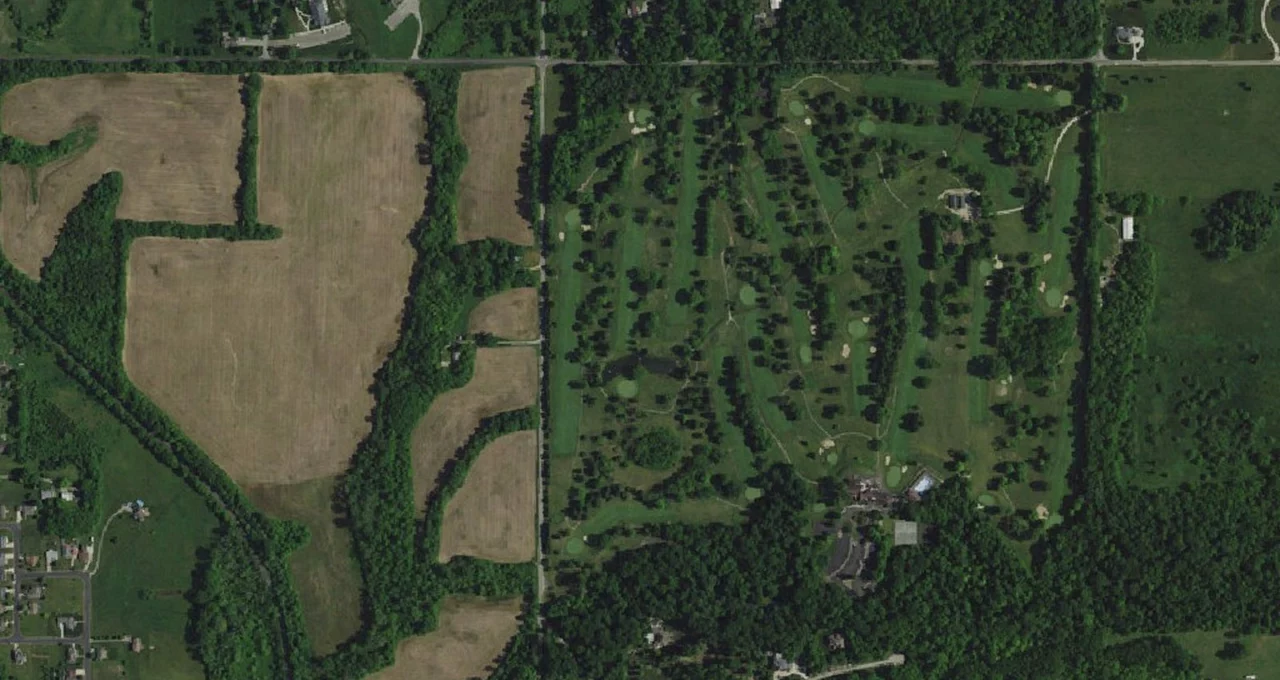
Forest Hills Country Club from the air. Aerial imagery USGS, domaine public.
Forest Hills Country Club
Holes
18
By
71
Length
6,427 yards from the Black tees on the club's card (rating 71.9, slope 134); the club's golf page and older directories give 6,328 yards
Green fee
—
Best season
—
Forest Hills Country Club is a private club at 2169 South 23rd Street in Richmond, Indiana, on the southeast side of the city, in Wayne Township, Wayne County. Several clubs in the United States carry the same name, including a well-known public course in Augusta, Georgia; this page is only about the one in Richmond, a few miles from the Ohio state line. The club says it sits on more than 162 rolling acres, and the National Register of Historic Places nomination gives 161. Its 18-hole course was laid out by the Indiana architect William H. (Bill) Diddel: a first nine in 1927, then a second nine in 1931. The Tudor Revival clubhouse, designed by the Dayton, Ohio, firm of Schenck and Williams, opened in 1927. The clubhouse, the course and several smaller structures were listed together on the National Register of Historic Places on December 15, 2015, under reference 15000892, according to Wikidata and the National Park Service.
The club’s own card gives a par of 71 for men and 72 for women from four sets of tees, with 6,427 yards from the Black tees, a course rating of 71.9 and a slope of 134. The club’s golf page, the 2013 nomination form and several course directories quote an older figure of 6,328 yards from the championship tees. The details, and the places where sources disagree, are set out below.
From a four-hole course to South 23rd Street
The club tells its story on its website. Golf arrived in Richmond in the 1890s, when a local man back from a trip to Scotland described the new game to his friends, who ordered clubs from New York and built a course of four holes. As the group grew, a new course was built south of E Street, with a one-room shanty as a clubhouse. According to the club, the golfers organized the Richmond Country Club on November 21, 1900, and opened its first official clubhouse on June 4, 1901, on what is now the site of Earlham Cemetery. The club says it hosted its first Indiana State Golf Association tournament in 1904.
A fire destroyed that clubhouse in 1915. The club says a new one opened on St. Patrick’s Day 1916 on the land now occupied by the Hayes Regional Arboretum on Elks Road; the nomination form describes a new clubhouse and a course on 55 acres on the northeast side of Richmond, near Glen Miller Park. In 1923 a realty company formed by club members bought 162 acres southeast of the city, and in 1926 the club sold its existing property to the Richmond Elks. The club dates its move to South 23rd Street, and its new name of Forest Hills, to July 2, 1927.
The two main accounts do not match on every date. The nomination form says a group of residents laid out a nine-hole course and formed the Richmond Golf Club in 1898, and that by 1901 its members had formed the Richmond Country Club; the club’s page gives November 21, 1900, for the founding. The form itself gives both 1926 and 1927 for the change of name. This page follows the club for its own dates and notes the form’s version where it differs.
According to the nomination, the club added a swimming pool in 1946, a tennis court in 1967 and irrigation in the late 1960s. The realty company that had held the land since the 1920s became Forest Hills Country Club, Inc. in 1961.
A Diddel course on unusually rolling ground
Bill Diddel was one of the most prolific course architects in Indiana. The nomination form describes him as a five-time Indiana Amateur champion who learned course design by playing, and it names the Kokomo Country Club and Hillcrest Country Club in Indianapolis among his earlier work; both are also on the National Register. In 1927 Diddel routed nine holes up and down the hills behind the new clubhouse. When the club brought him back in 1931 to add nine more, the original nine became holes 10 to 18. The form says the 18 holes he completed in 1931 are essentially the course played today.
What makes the site unusual, according to the form, is the ground. In much of central Indiana, Diddel had to build up greens on flat land; here he had valleys and hills to work with. Teams of mules pulling pans shaped the greens, and the sand and grass bunkers he built are still visible in the same places as on aerial photographs from 1940. The form describes his bunkers here as rounded, irregular shapes, closer to those at Hillcrest than to the flat-bottomed ones at Kokomo, and says the course does not betray that it started as a nine-hole layout.
Changes since then have been modest. The form lists the growth and planting of trees along the fairways, with 35 trees planted in 1959 alone; the lengthening of the 3rd hole in 1959 by moving the tee back (the form says 40 feet, while the headline of the 1959 newspaper article it cites says 40 yards); a larger 10th tee; new drainage tile; bentgrass introduced after 1965; a stream that widened after irrigation was installed; and two cart bridges. A practice area was added by 1959 through the rough of the 16th. The form concludes that Forest Hills is one of the few Diddel courses that retain a high degree of integrity.
What it asks of you
The club’s golf page describes rolling terrain, bentgrass fairways that are narrow and lined with trees, and undulating greens with a quick pace. The nomination form, quoting the general manager and superintendent of the time, says the course is known for its punishing greens, with severe slopes that demand careful placement of the approach. It also cites an older directory entry that put water in play on eight holes. Shot accuracy matters more than length here: at 6,427 yards from the back tees, the course is not long by modern standards, but the slope of 134 from the Black tees reflects how much trouble it can cause.
The card published by the club lists four sets of tees, all with the same men’s rating table: Black at 6,427 yards (71.9, slope 134), Bronze at 6,177 yards (70.8, 131), Yellow at 5,614 yards (67.8, 121) and Red at 5,587 yards. The card prints 72.8 and 133 next to the Red tees in the men’s row; a booking platform lists the same figures as the women’s rating from the Red tees, which fits the yardage better, so this page reads them that way. The front nine is a par 36 of 3,231 yards from the Black tees; the back nine measures 3,196 yards and is a par 35 for men and 36 for women, because the 12th is a par 4 for men and a par 5 for women.
That detail explains a discrepancy between sources. The club’s golf page and the nomination form say the course has four par 3s and four par 5s, which would make a par of 72; the hole-by-hole card shows four par 3s and three par 5s for men, for a par of 71, and four par 5s only from the women’s tees. Some directories list the course as a par 72, others as a par 71. This page follows the club’s card.
On the men’s stroke index printed on the card, the 2nd is the hardest hole, followed by the 17th, the 6th and the 18th. The 15th, the shortest hole on the course, is ranked the easiest.
The front nine
The yardages below are from the Black tees, as printed on the club’s card. Play starts just west of the clubhouse, and according to the nomination form most holes, like the 1st, are lined with trees on both sides. The 1st is a par 4 of 351 yards. The 2nd, a par 4 of 446 yards, is first on the stroke index; the older directory quoted in the nomination called it the signature hole, with a severely undulating green, at 406 yards, a figure that matches none of the current tees. The 3rd is a short par 4 of 297 yards, the hole whose tee was moved back in 1959. The 4th, a par 5 of 492 yards, plays north with old arborvitae along the west side of the fairway. The 5th is a par 3 of 149 yards.
The 6th, a par 4 of 401 yards, is third on the stroke index. The 7th, a par 5 of 538 yards, is the longest hole on the front nine; the nomination text places a very large tree and a pond from the original course on this hole, while the caption of the matching photograph in the same form places them on the 6th. The 8th is a par 4 of 415 yards, with one of the two old open-sided shelters on the course. The 9th, a par 3 of 142 yards, is played south toward the clubhouse.
The back nine
These are Diddel’s original 1927 holes. The 10th opens with the longest par 3 on the course, 235 yards from the Black tees and 218 from the Bronze. The 11th, a par 4 of 323 yards, uses the topography fully, according to the nomination form, with a marked climb as the player hits north to the green. The 12th measures 450 yards from the Black tees; the card prints 453 yards from the Bronze tees, slightly longer than from the Black, and we reproduce the figures as published. The 13th is a par 4 of 354 yards. The 14th, a par 4 of 400 yards, keeps a grass bunker and sand bunkers from the original design, and the form uses it as an example of a hole that asks the player to think around its hazards.
The 15th is the shortest hole on the course, a par 3 of 126 yards. The 16th is a par 4 of 347 yards. The 17th, a par 4 of 426 yards and second on the stroke index, doglegs left to a green that, according to the form, has several slopes and undulations that can carry the ball away from the hole and off the putting surface. The 18th, a par 5 of 535 yards, closes the round; two maintenance buildings from the 1930s to 1950s stand between the 17th and 18th.
What golfers are saying
Because Forest Hills is private, public reviews are very scarce. The material behind this section is a handful of short user reviews on golf course listing sites, the course summaries of two of those sites and the nomination form’s account of the course’s reputation. One listing site shows three reviews whose text we could not read, and we do not rely on it. The points below are other people’s opinions, not ours; nobody from Panxis has played the course, and we quote no one.
What comes up in its favor
- The greens are what players remember: very quick and sloping, they reward a precise approach.
- A reviewer describes it as their favorite course in Richmond, and the user ratings shown on the listing sites we consulted are high.
- Listing sites describe the fairways and greens as well groomed and the course as difficult but friendly.
- The strategic bunkering and the rolling ground are singled out as giving the course character, unusual in a flat part of the state.
- The history, from Diddel’s design to the 1927 clubhouse and the National Register listing, appeals to fans of classic courses.
What comes up against
- Missing the green on the wrong side, especially long, makes par very hard to save, because the greens run away from the player.
- Narrow, tree-lined fairways punish a crooked drive; straight driving is described as a requirement rather than a bonus.
- Recovery shots around the greens are described as treacherous when the approach misses on the wrong side.
- Access is the obvious limit: outside guests can play only with a member, and only a few times a year.
- The number of public reviews is too small to say anything about consistency of conditioning over time. None of the reviews we could read criticized the conditioning or the service.
How to play it
Forest Hills is a private club. According to its membership page, full memberships include golf along with the pool, tennis and pickleball, the fitness center and dining; social memberships allow golf three times a year with fees. The club offers family, individual, junior (ages 18 to 29), senior (65 and over) and non-resident categories, the last for people living outside Wayne County, and a corporate program. Membership works on monthly dues, sometimes with a minimum monthly spend. The club does not publish dues on that page.
Members are encouraged to bring guests. Under the published guest policy, each guest may play three rounds of golf a year, a limit that does not apply to out-of-town family. Lessons with the club’s PGA professional are open to members and non-members alike, according to the club. The club also hosts college golf: Earlham College, based in Richmond, holds its Forest Hills Invitational there, a visiting team reported playing an Earlham College Invitational at the club in 2016, and a college tournament directory lists a men’s event called The Indy at Forest Hills there in 2024 and 2026. The club says it has twice hosted the Indiana Open in recent years; we could not confirm the years with the state association, so this page does not give them. Membership inquiries go through the club’s membership page.
The club’s dress code requires collared shirts or mock collars for men, bans denim, cargo shorts and athletic wear for all players, and prohibits metal spikes; the pro shop fits non-metal cleats. The pro shop offers range memberships, bag storage, club repairs, lessons, leagues and junior programs. Course directories list carts, rental clubs, a driving range and a putting green.
The facilities
Besides the course, the club lists a heated swimming pool with a children’s pool, a splash pad, a pool house opened in 2022 with a bar and snack service, a fitness center, renovated tennis and pickleball courts with lights, and an indoor golf simulator that members can book all year. The pool is open from Memorial Day weekend to Labor Day, according to the club. The 1927 clubhouse has dining rooms, a ballroom and a patio over the course, and the club hosts weddings and other events. A Forest Hills Historical Foundation, set up to maintain and preserve the property, accepts tax-deductible donations and lists public tours on the club’s website.
Getting there and when to go
The club is at 2169 South 23rd Street, Richmond, IN 47374, and its property runs north to Wernle Road. According to the nomination form, the entrance is a turn off 23rd Street past a pond, followed by a winding lane through the woods to the clubhouse on the rise. Richmond lies on Interstate 70 near the Ohio border, between Indianapolis to the west and Dayton, Ohio, to the east; Dayton International Airport and Indianapolis International Airport are the nearest major airports. The club does not publish its golf season; a booking platform lists the course as open from February 1 to December 31, but winters in east-central Indiana are cold, and the schedule is the club’s call. Contact details are on the club’s website.
How this page was made
The factual frame comes from public sources consulted in October 2026: OpenStreetMap for the location; the club’s website for the address, the acreage, the club’s history, the course description, the hole-by-hole card with yardages, pars, ratings, slopes and stroke index, the dress code, the membership categories, the guest policy, the lessons, the facilities and the Indiana Open claim; Wikidata and the National Park Service for the National Register listing; the National Register nomination form, dated 2013 and available from the National Park Service, for the Diddel design, the 1927 and 1931 dates, the clubhouse architects, the changes to the course, the history of the Richmond Country Club and the hole descriptions; Wikipedia for a summary of the same; a booking platform and course directories for the 6,328-yard figure, the women’s rating, the season and services; and college athletics sites and a tournament directory for the college events. The full nomination is on the National Park Service’s NPGallery.
Where sources disagree, as they do on the par, the length, the number of par 5s, the founding date, the year of the name change and the hole with the old pond, we say so and name the source we follow. Some points could not be verified: we could not reach the USGA course rating database to confirm the ratings, we found no source from the Indiana Golf Association naming the years of the Indiana Open at Forest Hills, two review sites refused our requests, and we relied on the excerpts shown by search engines for those reviews. The opinion section summarizes public reviews; we report recurring themes rather than individual voices, and we reproduce no quotations. Nobody from Panxis has played or visited this course, and this page is no substitute for a round.
The club has not paid for this page, has not seen it before publication and has no say over its content. This page contains no commercial link and earns us no commission. If you know the club and something here is wrong or out of date, write to us and we will correct it.
Other courses nearby
Closest to this one in our United States directory:
- Losantiville Country Club — 49 mi
- Avon Fields Golf Course — 49 mi
- Crooked Stick Golf Club — 71 mi
- Inverness Club — 142 mi
The hole to know
A par 4 of 426 yards from the Black tees, second on the men's stroke index, that doglegs left to a green with several slopes and undulations that can carry the ball away from the hole and off the putting surface.