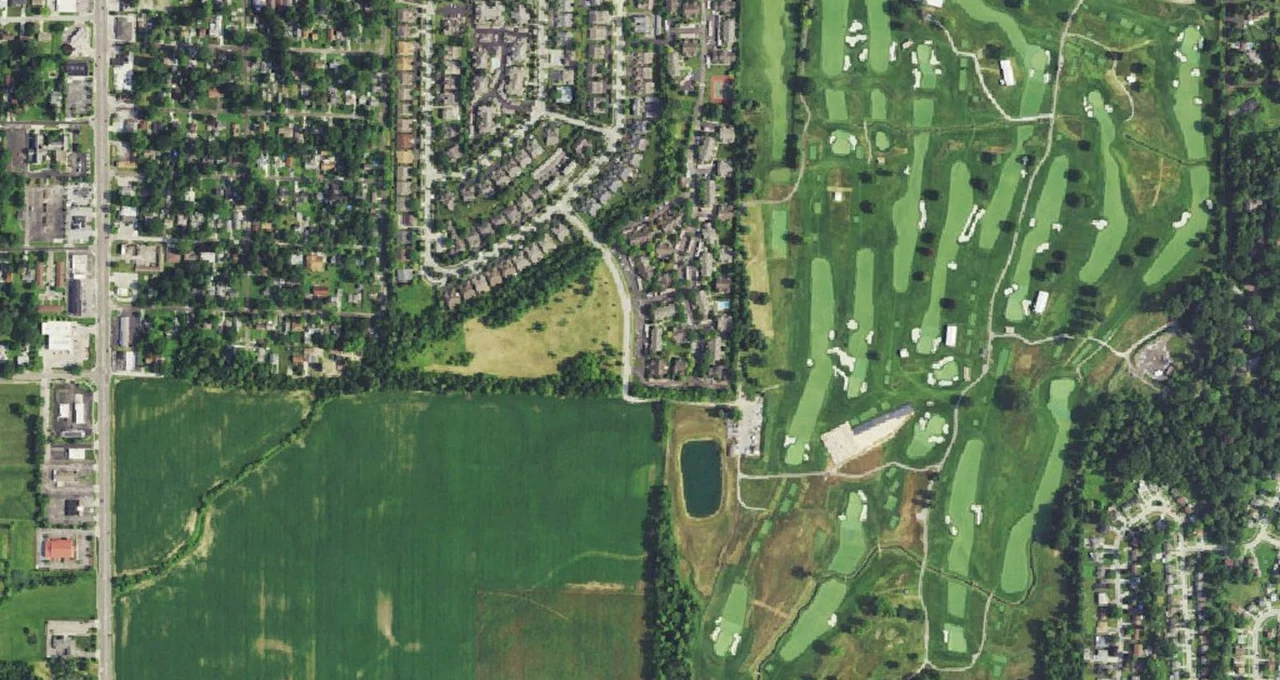
Inverness Club from the air. Aerial imagery USGS, domaine public.
Inverness Club
Holes
18
By
71
Length
7,741 yards from the Black tees on the club's 2025 scorecard (rating 78.5, slope 146); the club's golf page and Wikipedia give 7,730 yards (78.4 and 151)
Green fee
—
Best season
—
Inverness Club is a private golf club on Dorr Street in west Toledo, Ohio, about six miles west of downtown in a straight line. It was incorporated on February 23, 1903, its present 18-hole course was laid out by Donald Ross between 1916 and 1918, and it has hosted four U.S. Opens, two PGA Championships, two U.S. Senior Opens, a U.S. Amateur, a U.S. Junior Amateur, two NCAA men’s championships and the 2021 Solheim Cup. The USGA has more on its calendar, beginning with the U.S. Women’s Open in June 2027.
The course is a par 71. On the scorecard the club currently publishes, printed in 2025, it measures 7,741 yards from the Black tees, with a course rating of 78.5 and a slope of 146. It is ranked 62nd in the United States by Golf Digest, according to both the club and Wikipedia, and the club also cites a 41st place in America and 67th in the world from Golf.com and an 81st place in the world from the Top 100 Golf Courses website. Those figures, and the places where the sources disagree, are set out below.
Inverness also holds a small place in the social history of the game. The club and the Top 100 Golf Courses site both describe it as the first club in the United States to open its clubhouse to professional golfers, at the 1920 U.S. Open, at a time when professionals were usually kept out of members’ rooms. The players thanked the club with a clock that still stands in the clubhouse.
From a nine-hole course to a Donald Ross layout
According to the club’s own history, six Toledo men led by S. P. Jermain signed the letter of incorporation in 1903, and Jermain became the first president. He had already founded Ottawa Park, a public course that the club describes as the oldest public course west of New York City. The first Inverness course had nine holes. The Top 100 Golf Courses site credits that first layout to Bernard Nicholls; neither the club nor Wikipedia names its designer.
In 1916 the club hired Donald Ross to design an 18-hole championship course, and the club states that it was finished in the fall of 1918. The Ohio Open came in 1919 and the U.S. Open the following year. Ross worked on a property that The Fried Egg describes as mostly flat farmland cut by glacier-carved gullies, and that the GolfBlogger site describes as crossed by two streams: on the front nine, eight holes play across a gully formed by one of them, and three holes on the back nine are affected by a second.
The course did not stay as Ross left it. The Top 100 Golf Courses site lists a succession of architects who altered it for later championships: A. W. Tillinghast in 1931, Dick Wilson in 1957, George and Tom Fazio in 1978 and Arthur Hills in 1999. The Fazio work, done before the 1979 U.S. Open, was the most controversial. It replaced several of Ross’s holes with new ones that critics, according to GolfBlogger, never felt belonged to the rest of the course.
A century of championships
The club’s championship history page lists every event it has staged. A few of them have entered golf folklore.
- 1920 U.S. Open: won by Ted Ray of England with 295. This was the championship at which the professionals were welcomed into the clubhouse, and it was, according to the club, the first U.S. Open held at a private club.
- 1931 U.S. Open: won by Billy Burke with 292 after a playoff. The club calls it the first U.S. Open won with steel shafts, and the longest major in history, because the playoff went to 72 extra holes, which made 144 holes in all.
- 1944 NCAA men’s championship: won by Notre Dame, shortly after D-Day, with players using refurbished golf balls, according to the club.
- 1957 U.S. Open: won by Dick Mayer after a playoff. The club notes that it was Jack Nicklaus’s first U.S. Open.
- 1973 U.S. Amateur: won by Craig Stadler.
- 1979 U.S. Open: won by Hale Irwin with 284. In the first round Lon Hinkle drove from the 8th tee onto the 17th fairway to cut the corner of the par-5 dogleg, and, as Wikipedia records, the USGA planted a tree beside the 8th tee overnight to close the shortcut.
- 1986 PGA Championship: won by Bob Tway with 276. Greg Norman led by four strokes going into the final round; on the 72nd hole Tway holed his bunker shot for a birdie and won by two, according to Wikipedia.
- 1993 PGA Championship: won by Paul Azinger, again over Norman, in a playoff.
- 2003 and 2011 U.S. Senior Opens: won by Bruce Lietzke and Olin Browne.
- 2009 NCAA men’s championship: won by Texas A&M, the first played with a match play final, according to the club.
- 2019 U.S. Junior Amateur: won by Preston Summerhays.
- 2021 Solheim Cup: won by Europe, 15 points to 13, the second European win on American soil, according to Wikipedia. The club reports more than 130,000 spectators over the week.
The club lists the U.S. Women’s Open in 2027, the U.S. Amateur in 2029, the U.S. Girls’ Junior in 2033, the U.S. Women’s Amateur in 2036 and the U.S. Open in 2045. Several outlets that cover the championship give June 3 to 6, 2027, for the Women’s Open; tickets and volunteer registration were already open in 2026.
The Andrew Green restoration
The course that will host those events is the result of a restoration by the architect Andrew Green. Working from Ross’s original drawings and from historic photographs, as the club and Wikipedia describe it, Green rebuilt the bunkers and greens in a period style, restored the small mounds known as chocolate drops on several holes and removed a large number of trees. The Fried Egg and GolfBlogger both report that he replaced the Fazio holes, the 3rd, 4th and 5th, with two par 3s and a par 4 inspired by Ross originals, and that he built new back tees to stretch the course toward 7,800 yards for championships. The Top 100 Golf Courses site adds that the 2nd green was pushed back by about 100 yards, using laser survey data.
The club says the work earned Golfweek’s Restoration of the Year award and that Green, now an honorary member, returned in 2024 to carry the master plan further, with work on irrigation and bunkers that touched every hole in some way. The dates of the first phase vary from source to source, as explained in the method section at the end of this page.
What it asks of you
The writers who have described the course agree that Inverness is above all a test of the second shot. The Top 100 Golf Courses site calls approach accuracy the key to scoring. The greens are small, according to several reviewers, with angular drop-offs at their edges and subtle ripples inside them, in the words of The Fried Egg. GolfBlogger describes the fairways as wide but often tilting and the bunkers as not especially steep but very cleverly placed. The Fried Egg, for its part, finds the fairways narrow for a modern championship course, at about 35 yards at their widest. The last five holes have long been nicknamed Murderers’ Row.
The club’s 2025 scorecard gives the following holes, pars and Black tee yardages. The front nine is a par 35 of 3,891 yards and the back nine a par 36 of 3,850 yards.
- 1st: par 4, 399 yards.
- 2nd: par 4, 487 yards. The hole whose green Andrew Green moved back, according to the Top 100 Golf Courses site.
- 3rd: par 3, 274 yards. One of the three holes rebuilt in the restoration, and the longest short hole on the card.
- 4th: par 4, 516 yards. The par 4 of the restored trio.
- 5th: par 3, 172 yards. The other new par 3.
- 6th: par 4, 491 yards.
- 7th: par 4, 481 yards. Described by one reviewer as a long hole without bunkers, with a rolling fairway and an uphill finish to the green; the card makes it the hardest hole for men.
- 8th: par 5, 607 yards. The dogleg of the Hinkle tree, and the longest hole on the course.
- 9th: par 4, 464 yards.
- 10th: par 4, 387 yards.
- 11th: par 4, 378 yards. Seen by one reviewer as a birdie chance.
- 12th: par 3, 229 yards.
- 13th: par 5, 573 yards. The only par 5 on the back nine, with an elevated green ringed by bunkers, according to one review.
- 14th: par 4, 482 yards. The second hardest hole for men on the card.
- 15th: par 4, 472 yards.
- 16th: par 4, 451 yards.
- 17th: par 4, 483 yards.
- 18th: par 4, 395 yards. A short closing hole that runs along a small depression to a raised green surrounded by deep-lipped bunkers and, for GolfBlogger, one of the most complex green complexes anywhere; this is where Tway holed out in 1986.
Four other sets of tees make the course playable for members. On the same card the Gold tees measure 7,048 yards (rating 75.4, slope 139), the Silver 6,622 yards (72.9 and 135) and the Blue 6,052 yards (70.9 and 130). The White tees, rated for women, measure 5,177 yards, with a rating of 71.7 and a slope of 126. The card also lists combinations of tees between those sets.
The length is not where most of the difficulty lies for a club golfer. The danger is in missing on the wrong side of a small green, where the ball can run away down a steep slope, and in the long par 4s of the closing stretch. With only two par 5s and three par 3s, the par 71 is built on thirteen par 4s, most of them long.
What golfers are saying
As a private club, Inverness has fewer public reviews than a daily-fee course, but it has been described by architecture websites, golf bloggers, rating panels and app users, many of them after the restoration. The points below summarize what recurs in that material. They are other people’s opinions, not ours; nobody from Panxis has played the course, and we name and quote no one.
What comes up in its favor
- History comes first in almost every account: the four U.S. Opens, the Tway bunker shot, the 1920 welcome for professionals and the memorabilia displayed in a clubhouse that reviewers find impressive.
- The restoration is widely praised for bringing back a course that feels like Ross again, even if it is not purely original, with vintage bunkering, chocolate-drop mounds and the trees cleared.
- The green complexes, small and full of subtle movement, are seen as the real defense of the course, demanding but not unfair.
- The par 4s are described as varied and distinct from one another, and the short 18th as an unusually clever finishing hole.
- The course is described as an easy walk, and the caddie tradition is part of the appeal.
What comes up against
- One architecture site finds the fairways too narrow to make players choose a line, and regrets that the mostly north-south routing limits changes in wind direction.
- The same site suggests that the demands of championship golf hold the course back from what it could be for everyday play.
- One reviewer considers the design relatively plain for a course of its reputation, and finds the opening holes of each nine too similar.
- Before the restoration, the Fazio holes were the main complaint; that criticism now refers to the past.
- Access is the underlying limit: the club is private, and most golfers will only see it on television.
Who can play
Inverness Club is a private members’ club. Its website has a member portal and refers to guests, but publishes no visitor policy, no tee time system and no green fees; play is as the guest of a member. Apart from golf, the club lists dining rooms, a fitness center and racquet courts.
The club runs a caddie program that it traces back almost to its founding, with around 400 caddies a year, and says that golf carts are used only in very limited circumstances. It also supports the Evans Scholars Foundation, which funds university scholarships for caddies. Walking with a caddie is the normal way to play the course.
Getting there
The club’s address is 4601 Dorr Street, Toledo, OH 43615. The course lies in the western part of the city, about six miles west of downtown Toledo in a straight line. The nearest commercial airport is Toledo Express, about nine miles away in a straight line; Detroit Metropolitan Airport, the region’s main hub, is about 42 miles to the north. These distances are measured on the map and not by road.
Green fees
The club publishes no green fees, and none are given here. The course is open only to members and their guests.
How this page was made
The factual frame comes from public sources: OpenStreetMap for the location; the Inverness Club website for the founding, S. P. Jermain, the hiring of Donald Ross, the 2025 scorecard, the hole yardages it lists on its golf page, the championship history and the future championships, the caddie program, the rankings it cites and Andrew Green’s work; Wikipedia for the address, the 1920 clubhouse story, the Golf Digest ranking, the 1979 U.S. Open, the 1986 PGA Championship and the 2021 Solheim Cup; the Top 100 Golf Courses site for the list of architects, the 2nd green and its rankings; The Fried Egg and the GolfBlogger site for the terrain, the restoration and the 18th hole; the Golf Course Gurus review site for some hole descriptions; course directories for the rating listings; news and ticketing pages for the dates of the 2027 U.S. Women’s Open; Wikidata for the identifiers.
Where sources disagree, we say so. The club’s 2025 scorecard gives 7,741 yards from the Black tees, with a rating of 78.5 and a slope of 146, while its own golf web page lists hole yardages that add up to 7,730, the figure also used by Wikipedia and course directories, which give a rating of 78.4 and a slope of 151. The difference comes from three holes: 491 yards for the 6th on the card against 534 on the web page, 573 against 556 for the 13th, and 395 against 358 for the 18th, the figure The Fried Egg and GolfBlogger also give. This page follows the printed card. An older review gives 7,323 yards, from before the new back tees. The restoration is dated 2016 by Wikipedia, 2017 by GolfBlogger, 2018 by the club and The Fried Egg, and 2019 by the Top 100 Golf Courses site; the work probably ran over several of those years. The Fazio changes are dated 1978 by the Top 100 Golf Courses site and The Fried Egg, and 1979 by GolfBlogger, which also says they replaced four Ross holes where other sources speak of three. Only the Top 100 Golf Courses site names Bernard Nicholls as the designer of the first nine holes. The ranking figures depend on the year and the publication. The club’s guest policy is not public.
The opinion section summarizes reviews by architecture websites, golf blogs, rating panels and app users, read in October 2026. We report recurring themes rather than individual voices, and we reproduce no quotations from reviewers. Nobody from Panxis has played or visited this course, and this page is no substitute for a round.
The club has not paid for this page, has not seen it before publication and has no say over its content. This page contains no commercial link and earns us no commission. If you know the course and something here is wrong or out of date, write to us and we will correct it.
Other courses nearby
Closest to this one in our United States directory:
- Eagle Crest Resort — 40 mi
- Dearborn Hills Golf Course — 49 mi
- Plum Hollow Country Club — 59 mi
- Detroit Golf Club — 60 mi
The hole to know
A short par 4 of 395 yards from the Black tees on the 2025 card (358 yards on the club's golf page), running along a small depression to a raised green ringed by deep bunkers, where Bob Tway holed his bunker shot to win the 1986 PGA Championship.