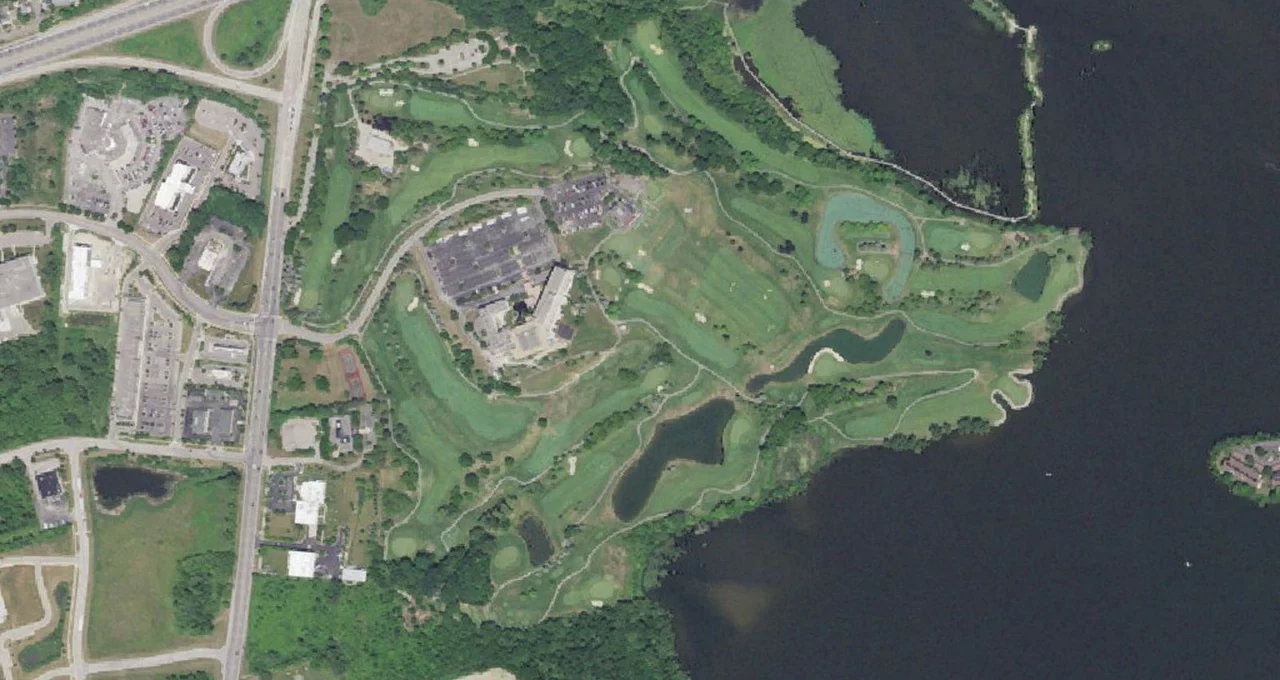
Eagle Crest Resort from the air. Aerial imagery USGS, domaine public.
Eagle Crest Resort
Holes
18
By
72
Length
7,186 yards from the NCAA tees according to the club (rating 75.1, slope 143); older listings give 6,750 to 6,926 yards
Green fee
—
Best season
Seasonal: March to November according to Wikipedia, April 1 to November 30 according to GolfNow; indoor Trackman bays year-round
Eagle Crest is the golf course of the Eagle Crest Resort in Ypsilanti Township, Michigan, beside Ford Lake and just off Interstate 94, between Ann Arbor and Detroit Metro Airport. The course is owned by Eastern Michigan University, serves as the home course of its men’s and women’s golf teams, and is open to the public. The resort around it, about 137 acres according to Wikipedia, also includes the Ann Arbor Marriott Ypsilanti at Eagle Crest, a hotel run by Marriott, and the university’s Eagle Crest Conference Center. The golf club gives its address as 1201 S. Huron Street, Ypsilanti, MI 48197; the hotel and several golf listings use 1275 S. Huron Street, the address of the resort as a whole.
The course opened in the summer of 1989, according to the club, to a design by Karl Litten, an architect based in Boca Raton, Florida. In 2012 it went through a major renovation directed by the architect Jim Lipe, who has long worked as a lead designer for Jack Nicklaus’s firm. On October 1, 2013, the university’s Board of Regents passed a resolution naming the course the Roy E. Wilbanks Eagle Crest Golf Club, a decision the club’s outing brochure attributes to his vision and commitment in making the resort a significant part of the university and of Ypsilanti. Most players and most listings still simply call it Eagle Crest.
The course is a par 72 and, by its own figures, stretches to 7,186 yards from the championship tees, labeled NCAA on the scorecard, with a course rating of 75.1 and a slope of 143. That is a serious number for a public course: a slope above 140 puts Eagle Crest in the upper range of difficulty for golf open to anyone with a tee time. Shorter combinations bring the course down to about 5,000 yards, as the card below shows.
A university course on a reservoir
Ford Lake, the water that defines the course, is not a natural lake. It is a reservoir on the Huron River, formed when the Ford Lake Dam, first known as the Rawsonville Dam, was built in the early 1930s; the lake was first flooded in 1931 and is named after Henry Ford, according to Wikipedia. It covers about 975 acres across the city of Ypsilanti and Ypsilanti Township. Eagle Crest occupies a stretch of its shore, and the club points out that several holes run along the banks of the lake.
That setting is unusual for a college course. In a 2021 article published by the university, the course’s director remarked that it is rare to find a university course on a body of water with no homes on the shore or along the fairways. The same article reported that the course had been ranked 16th among college golf courses in the United States in the GolfPass Golfers’ Choice list, up nine places on the previous year. The club now states that it ranked ninth nationally in the 2025 edition of that list. It also cites a four-star rating in Golf Digest’s Best Places to Play guide, which Wikipedia dates to 2006, and a place among the top five public courses in Metro Detroit in a Detroit Free Press ranking, for which the club does not give a year.
The university uses the course for competition as well as practice. According to the same 2021 article, Eagle Crest hosts the Shirley Spork Invitational, a Division I women’s college event played in the fall, and plans were then under way for a men’s invitational.
What changed in 2012
The 2012 renovation was not a single project but the start of a master plan drawn up by Jim Lipe, with the stated aim of making Eagle Crest one of the leading resort courses in Michigan. The university’s 2021 article lists the work carried out in the years that followed: cart paths removed and rebuilt, drainage improved, trees taken out to make the holes more playable and easier to see, new tee complexes built to lengthen the course to 7,186 yards, bunkers renovated and additions made to the greens.
That lengthening explains why older sources describe a shorter course. Wikipedia still gives a total of 6,750 yards, a golf blog review first published in 2013 lists 6,735 yards from the back tees, and booking and review listings give 6,911 or 6,926 yards from what they call the championship tees, with ratings around 73 and a slope of 142. These figures most likely reflect the layout before the new back tees were added, and this page follows the club’s current 7,186-yard card.
What it asks of you
Eagle Crest is a parkland course with bentgrass fairways, according to Wikipedia, on two distinct levels. A golf blogger who reviewed it describes five holes set on a plateau overlooking Ford Lake, with the rest of the course on lower ground in the river’s flood plain, where ponds and waterways come into play. The course description on a booking platform speaks of five water hazards, on top of the lake. Another review site describes rolling terrain, frequent water and medium-sized, undulating greens.
The par 72 is made of four par 3s, ten par 4s and four par 5s, split evenly between the two nines. Here is the card from the NCAA tees, with the Green tees in brackets, as published by a golf handicap app and matching, hole for hole, the NCAA yardages on the 18Birdies app:
- 1st: par 4, 475 yards (414).
- 2nd: par 4, 504 yards (426).
- 3rd: par 4, 322 yards (308).
- 4th: par 3, 252 yards (194).
- 5th: par 5, 555 yards (522).
- 6th: par 3, 165 yards (151).
- 7th: par 4, 362 yards (346).
- 8th: par 4, 318 yards (302).
- 9th: par 5, 581 yards (512).
- 10th: par 5, 519 yards (494).
- 11th: par 4, 435 yards (362).
- 12th: par 4, 444 yards (406).
- 13th: par 4, 418 yards (384).
- 14th: par 3, 218 yards (198).
- 15th: par 4, 473 yards (412).
- 16th: par 5, 531 yards (488).
- 17th: par 3, 248 yards (162).
- 18th: par 4, 366 yards (340).
From the NCAA tees the front nine measures 3,534 yards and the back nine 3,652; from the Green tees, 3,175 and 3,246, for 6,421 yards in all. The club itself confirms the 14th at 218 yards in a photo caption on its scorecard page.
The back tees ask a great deal of a club golfer. The round opens with a par 4 of 475 yards and continues with one of 504, longer than some par 5s elsewhere, and two of the four short holes, the 4th and the 17th, measure close to 250 yards. From the Green tees the same holes play at 194 and 162 yards, which shows how much the choice of tee changes the course. With twelve sets of tees by the club’s count, there is no reason to play it longer than your game allows.
The front nine has the longest hole on the card, the 9th, a par 5 of 581 yards, and two short par 4s, the 3rd and the 8th, both under 325 yards. Published stroke indexes do not agree from one source to another (see the method box below), but both of the cards we found rank the 5th, a par 5 of 555 yards, among the two hardest holes on the course.
The back nine is where most reviewers find the character of the course. A Michigan golf review site describes the 10th, a par 5 of 519 yards, as a risk-and-reward hole with trees to avoid and a bunker in front of the green, and the 11th as a particularly demanding par 4, with a hollow on the right and a raised green protected by a large tree. The golf blogger names the 10th and the 11th as the two strong doglegs of the layout. The same review site describes the run from the 13th to the 17th as a stretch of ponds, marsh carries and elevated tees close to Ford Lake.
The 16th is the hole the club puts forward. It is a par 5 of 531 yards from the NCAA tees that runs along the lake to a green on a peninsula, and the club reports that USA Today cited it as one of Detroit’s most memorable holes. The golf blogger, writing from an older card, gives it 520 yards and calls the green an island; the club describes it as a peninsula, and both stroke index cards rank it first or second on the course. Whoever goes for the green in two has the lake to think about; whoever lays up still has a shallow target to hit with the third shot. The 17th, a long par 3 from the back tees, gives no time to recover.
What golfers are saying
As a public course near Ann Arbor with a hotel on site, Eagle Crest has a steady body of online reviews, on booking platforms, golf apps, course directories and golf blogs. The points below summarize what recurs in that material. They are other people’s opinions, not ours; nobody from Panxis has played the course, and we name and quote no one.
What comes up in its favor
- The setting is the first thing most reviewers mention: views of Ford Lake from several holes and an atmosphere closer to a resort than to a municipal course.
- The greens get strong praise. Reviewers describe them as fast, true and well kept, and some compare them favorably with the best courses they have played.
- Overall conditioning is rated highly on the review platforms, and at least one reviewer who came back after an earlier, less convincing visit found the course much improved.
- The layout is described as challenging but fair, rewarding good shots and good strategy, while remaining playable for bogey golfers who choose the right tees.
- Service comes up favorably, and one review site singles out the support the club gives to junior golf.
- Value is rated well on the review platforms, and some reviewers consider the course good value for its quality.
What comes up against
- Pace of play is the most frequent complaint. Some reviewers report slow rounds, put down to the difficulty of the greens and hazards, and at least one wished for a marshal on the course.
- The difficulty itself does not suit everyone. Rating apps describe the layout as hard, and reviewers mention thick rough and sloping greens that take time to read.
- Geese are part of the lakeside setting, and at least one reviewer complained of droppings across the course.
- One reviewer found that the holes, although adequately spaced, lack a sense of isolation, and another noted that on many holes the tees sit close to greens, which makes a stray shot unnerving.
- One reviewer compared the style of the course to resort golf in Myrtle Beach or at Disney World, a point some will take as praise and others as a reservation.
How to play it
Eagle Crest is open to the public; you do not need to stay at the hotel or have any link to the university. Tee times can be booked online through the club’s TeeItUp booking page or by phone at the golf shop, (734) 487-2441. The club’s outing brochure states that it takes tee times two weeks in advance for groups under 24 players, and one month ahead for larger groups, which can book shotgun starts or tee time packages for the season.
Cart rental is mandatory on Saturdays, Sundays and holidays until noon, according to the club’s rates page; outside those times, a booking listing states that walking is permitted. The outing brochure mentions electric carts with a touch-screen GPS system. The same booking listing notes that metal spikes are not permitted.
The season follows the Michigan weather. Wikipedia gives March to November, while a booking listing gives April 1 to November 30; the club does not publish fixed dates, and the course depends on conditions at either end of the year.
The facilities
The practice facility is one of the course’s strong points. The club lists a three-tiered driving range looking out over Ford Lake, a short game area and two practice putting greens. Lessons are given by PGA professionals through the club’s PGA Teaching Academy and by the Craig Piscopink Golf Academy. Inside the clubhouse, four Trackman simulator bays keep the club open through the winter, and the club offers a monthly indoor and outdoor practice membership.
The clubhouse, named after Roy E. Wilbanks, contains the golf shop, locker rooms with showers, a restaurant and bar with an outdoor patio, which the club lists as open daily from 11 a.m. to 8 p.m., and a banquet room overlooking the course and the lake that is used for outings, weddings and other events. Club rental and club fitting are listed by the 18Birdies app. For a longer stay, the Marriott hotel on the same grounds offers stay-and-play packages with the course.
Getting there
Eagle Crest lies in Ypsilanti Township, in Washtenaw County, just south of Interstate 94. From the interstate, take exit 183, Huron Street, and head south toward the lake; the resort is a short drive from the exit. The club puts the course 17 miles west of Detroit Metro Airport, and downtown Ann Arbor is a short drive to the west. Use 1201 S. Huron Street for the golf club, or 1275 S. Huron Street if you are going to the hotel first.
Green fees
The club does not publish a greens fee schedule on its website. Prices appear when you search for a tee time on the booking page, and the golf shop gives them by phone. The only prices on the club’s rates page, dated March 24, 2026, are for practice: $12 for a small bucket of range balls, $17 for a large bucket, and $250 a month for the indoor and outdoor practice membership. See the club’s own rates page.
How this page was made
The factual frame comes from public sources: OpenStreetMap for the location; the Eagle Crest Resort website for the ownership, the opening year, the architect, the 2012 renovation, the length, rating and slope from the NCAA tees, the number of tee sets, the 16th hole, the rankings it cites, the facilities, the addresses, the cart rule and the practice prices; the club’s golf outing brochure, dated November 2025, for the naming of the course after Roy E. Wilbanks, the carts and the booking windows; a January 2021 article by Eastern Michigan University for the details of the renovation work, the Golfers’ Choice ranking of that year and the Shirley Spork Invitational; Wikipedia for the resort, the bentgrass fairways, the Golf Digest rating and Ford Lake; Wikidata for the identifiers; the 18Birdies app and a golf handicap app for the hole-by-hole yardages and the tee ratings; the GolfNow booking platform for the walking rule, the spikes, the season and the five water hazards; the Two Guys Who Golf review site and the GolfBlogger blog for the hole descriptions and the terrain.
Where sources disagree, we say so. The club, the university and Wikipedia date the opening to 1989, while GolfNow and another course directory give 1987. One golf directory credits Gary Player alongside Karl Litten; the club names only Litten, and so do we. Lengths vary widely: 7,186 yards on the club’s card, 6,911 or 6,926 on booking listings and 6,750 on Wikipedia, which most likely reflects the course before its new back tees. The club counts twelve sets of tees on its website, its own brochure says ten in one place and four in another, the university said ten in 2021, and GolfNow lists eighteen combinations. The stroke indexes differ between the two hole-by-hole cards we found, so we do not list them hole by hole. The club gives 1201 S. Huron Street for the golf course, while the hotel and several listings use 1275. The 16th green is a peninsula for the club and an island for one blogger. The season runs from March for Wikipedia and from April for GolfNow.
The opinion section summarizes reviews on booking platforms, golf apps, course directories and golf blogs, read in October 2026. We report recurring themes rather than individual voices, and we reproduce no quotations from reviewers. Nobody from Panxis has played or visited this course, and this page is no substitute for a round.
The course has not paid for this page, has not seen it before publication and has no say over its content. This page contains no commercial link and earns us no commission. If you know the course and something here is wrong or out of date, write to us and we will correct it.
Other courses nearby
Closest to this one in our United States directory:
- Dearborn Hills Golf Course — 18 mi
- Plum Hollow Country Club — 24 mi
- Oakland Hills Country Club — South Course — 28 mi
- Detroit Golf Club — 28 mi
The hole to know
The signature hole: a par 5 of 531 yards from the NCAA tees that runs along Ford Lake to a peninsula green, cited by USA Today among Detroit's most memorable holes, according to the club.