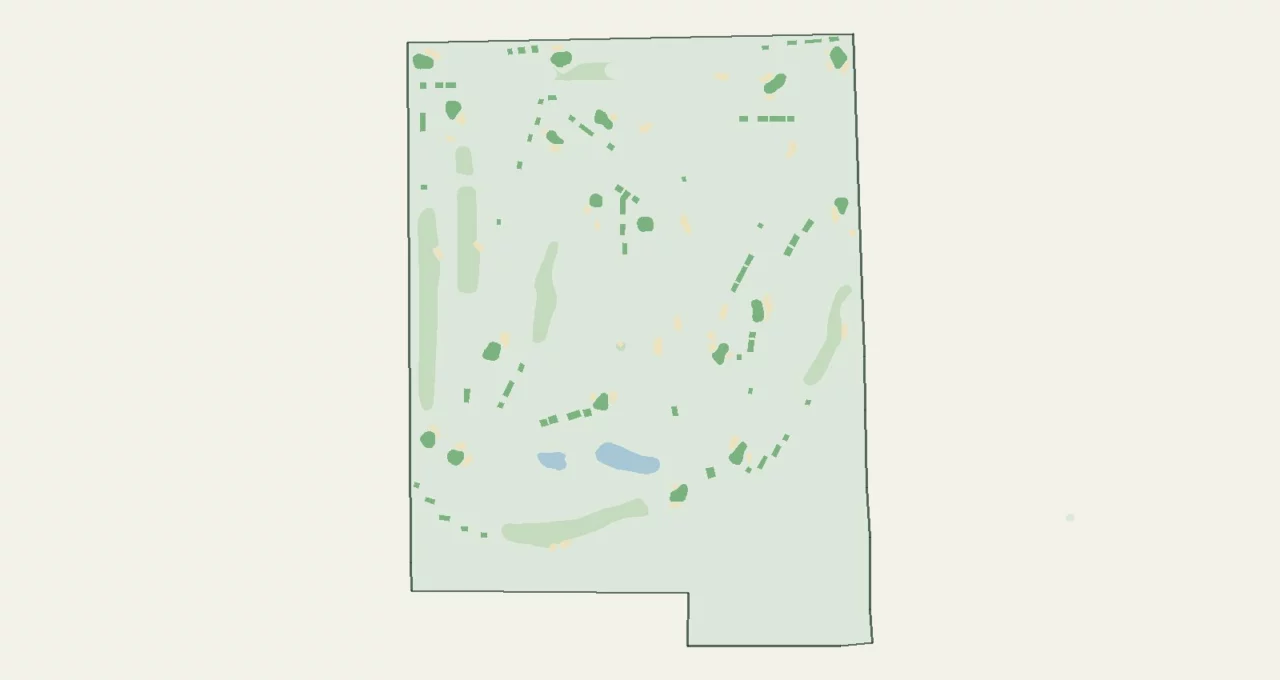
Layout of Plum Hollow Country Club from OpenStreetMap survey data (ODbL licence).
Plum Hollow Country Club
Holes
18
By
—
Length
—
Green fee
—
Best season
Roughly April to October
Plum Hollow sits in Southfield, on the northern edge of Detroit, and its place in the record books comes from June 1947, when it staged the PGA Championship over 6,922 yards to a par of 72. That was the match-play era of the championship, when a title took a week of thirty-six-hole matches rather than four rounds of stroke play.
The club belongs to the ring of Detroit courses built while the motor industry was making the city rich, a group that includes Oakland Hills a few minutes north.
What it asks of you
Nearly 6,900 yards was a long course in 1947, and the routing was drawn for a ball that flew a good deal less far than a modern one. What survives from that period is usually the shape of the holes rather than their difficulty: generous corridors, bunkering set at the distances of the day, and greens defended more by their surrounds than by contour.
On a course of this vintage the practical advice is the same everywhere. The trouble that mattered when the holes were drawn is now short of where a good player lands the ball, so the second shot decides the hole, and a green missed on the wrong side is the only real penalty on offer.
Check the current card with the club. The 1947 numbers are what the championship record preserves, not necessarily what the members play today.
What players say about it
This is a private club, and public material about it is limited. The points below summarise what recurs in championship records, guest accounts and specialist reviews. These are other people’s opinions, not ours: we have not played the course, and we name and quote no one.
What comes up in its favor
- The 1947 PGA is the club’s distinction, and it is a genuine one: a major championship, in the match-play era, on this ground.
- The course is described as a solid example of Detroit’s inter-war golf, of which a good deal has been lost.
- The club is considered welcoming to guests by the standards of the area’s private clubs.
- Conditioning is reported as good.
What comes up against
- Access is closed: private club, play by invitation.
- It stands in the shadow of Oakland Hills, a few minutes away, and comparisons are not kind.
- The design has not been the subject of a celebrated restoration, and architecture writers pass it by.
- Very little first-hand material exists, so this summary rests on a narrow base and should be read as such.
Getting there and when to go
The club is in Southfield, about twenty-five minutes north-west of downtown Detroit.
The season runs roughly from April to October. June and September give the best conditions. Play is by invitation of a member.
Green fees
Guest conditions are set by the club. See the club’s own site.
How this page was made
The factual frame comes from public sources: OpenStreetMap for the location, and championship records for the 1947 PGA Championship, including the par and yardage played that week. The club publishes little history, and we have not filled the gaps with guesses: what is missing here is missing because it is not public. The opinion section summarises public reviews and guest accounts read in September 2026; there are few, we say so rather than hide it, and we reproduce no quotations.
We have not played this course, and this page is no substitute for a round. The club has not paid for this page, has not seen it before publication and has no say over its content. If you know the course and something here is wrong or out of date, write to us and we will correct it.