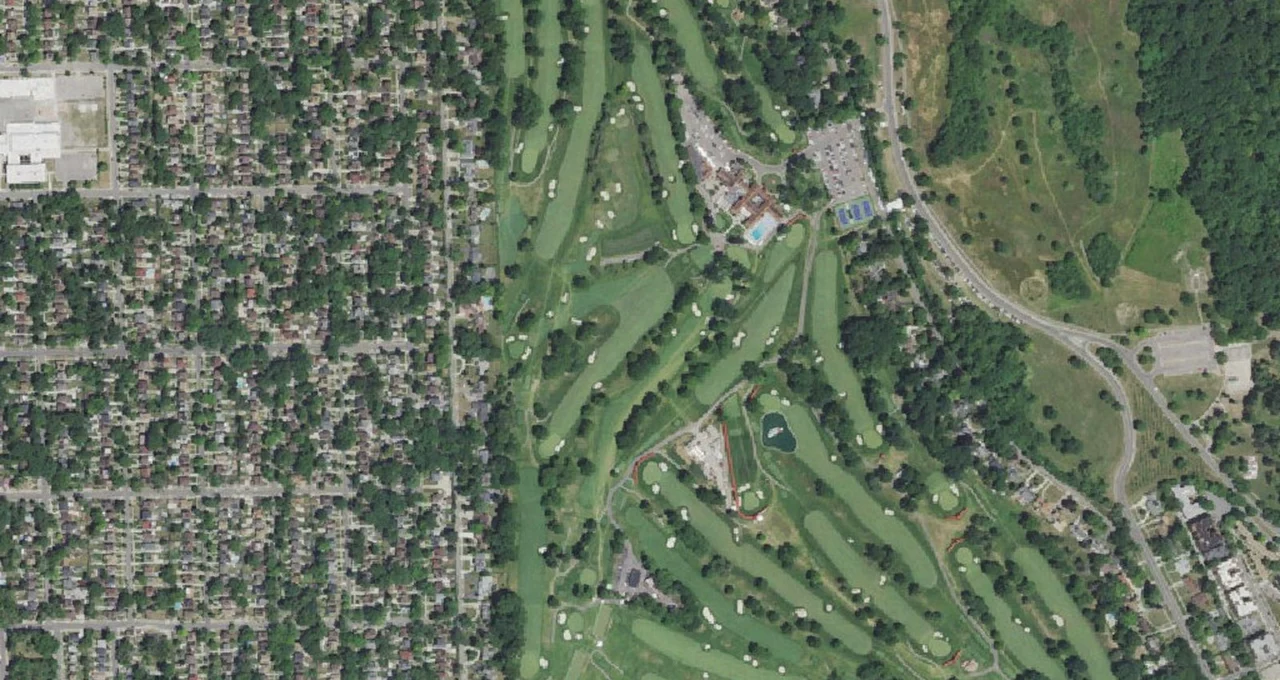
Detroit Golf Club from the air. Aerial imagery USGS, domaine public.
Detroit Golf Club
Holes
36 (North and South courses)
By
—
Length
—
Green fee
—
Best season
Roughly April to November
In 1916 a group of members who spent their winters in Pinehurst, North Carolina, commissioned Donald Ross, the professional there, to build thirty-six holes in Detroit. The work was completed in 1918, making this the first Ross-designed facility in Michigan. The club itself is older still, dating from 1899, and moved to its present ground beside Palmer Park for the Ross commission.
Since 2019 the North Course has staged the PGA Tour’s Rocket Classic, which brought a century-old private club back into public view for one week a year. The tournament routing borrows seventeen holes from the North and one from the South. A major restoration completed after the 2025 edition, led by Tyler Rae, took the tournament course to a par 70 for the first time and pushed the architecture back toward what Ross drew.
What it asks of you
Two Ross courses on flat ground inside a city, where the architecture has to do all the work. There are no elevation changes to create difficulty and no water to speak of, so the defenses are bunkering placed exactly at the landing zones, greens raised and crowned so that a ball missing the surface runs away from it, and a routing that changes direction constantly, so that no two consecutive holes play the same wind.
The North is the tournament course and the stronger of the two, running past 7,000 yards from the back tees as members play it. What tour players talk about is the greens: fast, tilted, and unforgiving of an approach that finishes on the wrong tier. What visiting amateurs talk about is the same thing, in less flattering terms. The South is shorter and more forgiving, and is where most guest rounds happen.
Tree cover was a defining feature for decades and has been thinned in the restoration work, restoring sightlines and the angles Ross intended. Players who knew the course before will find it a different, and by most accounts better, examination.
What players say about it
Access here is by membership or a member’s invitation, so public reviews are far fewer than for a resort course, and most of what exists comes from tournament coverage, architecture writing and the accounts of guests. The notes below summarize themes that recur across those public sources. They are other people’s opinions, not ours: we have not played the course, and we do not name or quote individual reviewers.
What comes up in its favor
- The greens are the most praised feature by a wide margin. Speed, contour and the way a crowned surface rejects an imprecise approach come up in nearly every account.
- The restoration work is well received. Recovering Ross angles and thinning trees is described as having returned strategy to holes that had become one-dimensional.
- The clubhouse and the sense of a club that has been in one place for a century draw consistent comment from guests.
- The routing on flat, constrained city ground is admired by people who write about architecture, precisely because the difficulty is designed rather than found.
What comes up against
- Access is the obvious one. This is an invitation-only equity club, and the majority of golfers who would like to see it will not get the chance.
- The South Course is regularly described as the lesser of the two, and guests who play only that one come away with a muted impression of the place.
- Some accounts find the North short by modern tournament standards, and note that the tour scores low there in calm conditions.
- The flat site is a genuine limitation for players who want elevation and views; the appeal here is architectural, not scenic.
Getting there and when to go
The club sits on Detroit’s north-western edge, beside Palmer Park and minutes from the Palmer Woods and Sherwood Forest neighborhoods, which is unusually close to a city center for a course of this age and size. Detroit Metropolitan airport is around forty minutes away.
The season runs from roughly April to November, and May through September is when the Ross greens and the bluegrass fairways are at their best. Guest play is arranged through a member; there is no public tee sheet.
Green fees
Guest conditions and rates are set by the club and are not published. See the club’s own site.
How this page was made
The factual frame comes from public sources: OpenStreetMap for the location, Wikipedia and published architecture coverage for the history, the design credits and the restoration, and the club’s own site for access and season. The opinion section summarizes public commentary and guest accounts read in September 2026; we report recurring themes rather than individual voices, and we do not reproduce or attribute quotes.
We have not played this course, and nothing here is a substitute for that. The club has not paid for this page, has not seen it before publication and has no say in what it says. If you know the course and something here is wrong or out of date, write to us and we will correct it.