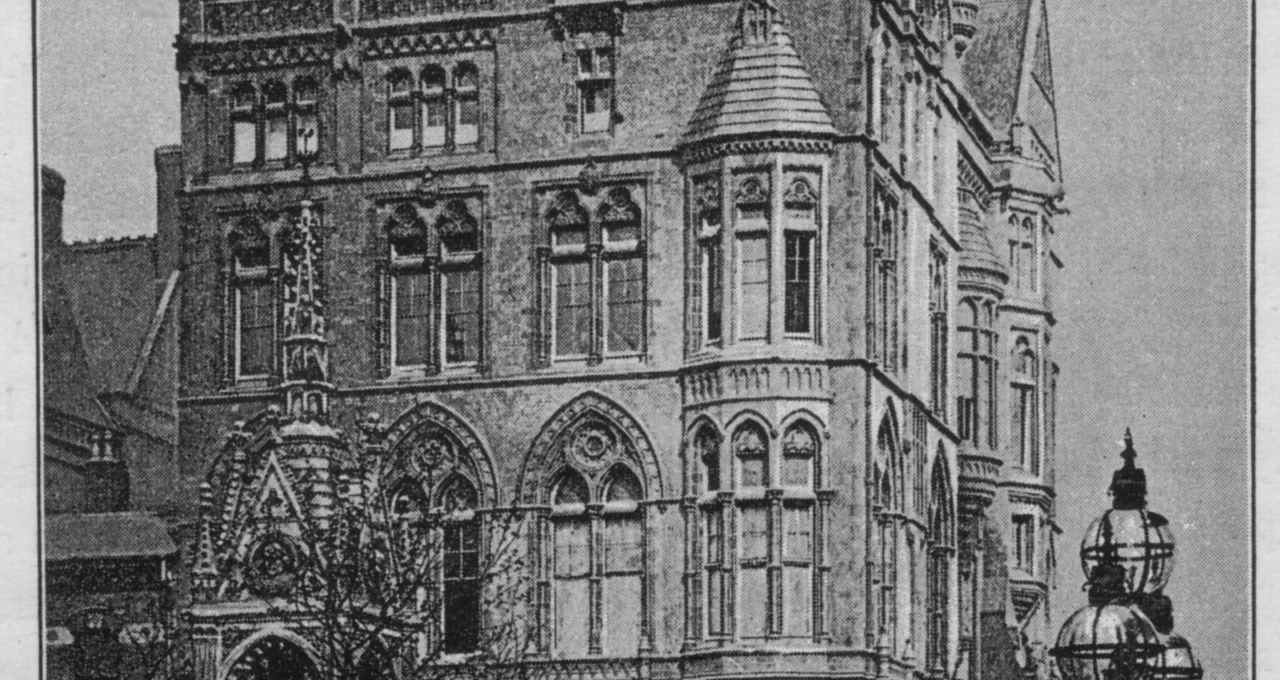
Birmingham Country Club — Photo Robert K. Dent. Original uploader was Oosoom at en.wikipedia / Wikimedia Commons, Public domain
The Country Club of Birmingham
Holes
36 (East and West courses)
By
—
Length
—
Green fee
—
Best season
All year
The Country Club of Birmingham was founded in 1898, moved to Lakeview in 1900 and again in 1926 to Shades Valley, in what is now Mountain Brook. Donald Ross carved two eighteen-hole courses out of 284 acres there. The club and its pool opened in 1926, the East Course followed in 1927 and the West in 1929.
What happened to the West afterward is the reason architecture enthusiasts come here. Robert Trent Jones rebuilt its greens in his own manner in 1959, raising them all in the style that defined his era. Pete Dye came in during the mid-1980s and dug back down to the original Ross green levels without restoring them, adding his own pot bunkering and mounding on top. The result is claimed as the only course in America carrying the fingerprints of all three architects, and you can read each layer on the ground.
What it asks of you
Alabama valley terrain at the southern end of the Appalachians, with real elevation change and mature hardwood. Bermuda turf, warm-season conditioning, and greens that run fast from spring through autumn.
The East is the more intact Ross course and predates the West by two years. Its green complexes are the flatter of the two, with subtler break, and five of them carry distinct multiple shelves that decide where an approach has to finish. It is the quieter examination and the one that rewards a second look.
The West is the tougher and the stranger. Trent Jones scalloped bunkering sits beside Dye pot bunkers and mounding on a Ross routing, and the effect is closer to a Dye course than to anything else: small undulating greens guarded by moguls, where a miss on the wrong side leaves very little. Playing both in one day is the most instructive thing you can do on this property.
What players say about it
Access is by membership or a member’s invitation, so the public record consists of guest accounts, architecture writing and rating panels rather than a volume of visitor reviews. The notes below summarize themes that recur across those public sources. They are other people’s opinions, not ours: we have not played either course, and we do not name or quote individual reviewers.
What comes up in its favor
- The greens are the most praised feature on both courses, described as quick and pure, and holding up in Alabama summer heat that would defeat many bent surfaces.
- The elevation change and the constant change of direction come up repeatedly as what makes the golf engaging rather than merely long.
- The layering of three major architects on the West is treated as a genuine attraction. Reviewers enjoy being able to see which hand did what.
- Conditioning is consistently described as firm and fast, which is the condition both courses were designed to be played in.
What comes up against
- Purists regret what was lost. Ross’s original green surfaces on the West are gone, and the successive reworkings are not restoration by any reading.
- The West punishes a miss on the wrong side severely, and players who prefer a course that gives back something after a mistake find it unforgiving.
- The East is regularly treated as the lesser of the two and gets less attention than its architecture deserves, which several accounts push back against.
- Access is the limit that applies to everything here: there is no visitor tee sheet, and the review record is correspondingly thin.
Getting there and when to go
Mountain Brook is fifteen minutes from downtown Birmingham and around twenty from Birmingham-Shuttlesworth airport, which makes this an easy stop on an Alabama trip that might otherwise be built around the Robert Trent Jones Trail.
The courses play all year. Spring and autumn are the best of it; midsummer in Alabama is hot and humid, and although the greens hold up, the walk does not get easier. Guest play is arranged through a member.
Green fees
Guest conditions and rates are set by the club and are not published. See the club’s own site.
How this page was made
The factual frame comes from public sources: OpenStreetMap for the location, Wikipedia and published architecture coverage for the history and the successive redesigns, and the club’s own site for access. The opinion section summarizes public commentary and guest accounts read in September 2026; we report recurring themes rather than individual voices, and we do not reproduce or attribute quotes.
We have not played these courses, and nothing here is a substitute for that. The club has not paid for this page, has not seen it before publication and has no say in what it says. If you know the courses and something here is wrong or out of date, write to us and we will correct it.