High-handicap irons in 2026: the forgiveness promised and what a swing robot measured
In a July 2026 robot test of four super game-improvement 7-irons, carry varied by barely five yards from one head to the next. What varied was how much distance each one lost on a bad strike: 12.2 yards for the best, 22.7 for the worst. That is the forgiveness high handicappers pay for, and it is not what the marketing leads with.
In brief
- The four sets: Callaway Quantum Max OS, Cobra King Max, Ping G740 (all 2026) and Cleveland Halo XL Full-Face (2024, still current), with 7-iron lofts of 28 to 29.5 degrees.
- In Golf Digest's July 2026 robot test, the Quantum Max OS lost 12.2 yards of carry from its best to its worst impact zone and the King Max 22.7; average carry differed by only 5.3 yards across the group.
- In October 2026 a U.S. retailer listed seven clubs from $999.00 (King Max) to $1,300.25 (G740), with the Halo XL Full-Face at $899.99 regular and from $699.99.
- Golfers praise easy launch and confidence at address; the recurring complaints are offset, bulk, little feedback on strike and shots that balloon for faster swings.
Every iron sold to high handicappers promises forgiveness: a bigger head, a lower center of gravity, a face that flexes more on a thin strike. In July 2026 a swing robot put four of this year’s super game-improvement 7-irons through the same impact pattern, and the gap between them was not where the marketing put it. Carry distance barely changed from one head to the next. What changed was how much each one gave back when the ball came off the toe or low on the face. This page sets out what four current high-handicap irons promise, what that robot test measured, what the sets cost in October 2026 and what golfers who play them say, for and against. It is a presentation of products and of public opinion, not a test: nobody at Panxis Golf hit any of these irons.
What “forgiveness” is supposed to mean
Forgiveness is not a single feature. It is a handful of design choices that all aim at the same golfer: someone who does not find the center of the face every time, whose misses are thin or toward the heel and toe, and whose swing speed with a 7-iron is moderate. The manufacturers use four levers, and every set on this page pulls all of them.
- A bigger head with weight at the edges. A longer blade, a thicker top line and mass pushed to the heel and toe raise what engineers call moment of inertia, the head’s resistance to twisting on an off-center hit. Less twisting means a miss toward the toe loses less speed and starts closer to the target.
- A low, deep center of gravity. A wide sole carries weight low and back, which gets the ball up even when the strike is low on the face. For a golfer who struggles to launch a 5-iron, this matters more than any distance claim.
- Offset. The face sits behind the hosel, which gives the hands a fraction more time to square it. Offset helps against a slice; it also makes the club look less like a classic iron at address, and some golfers never get used to it.
- A sole that forgives the ground. Wider soles with more bounce at the leading edge skid rather than dig on a heavy strike. A fat shot with a wide sole still loses distance, but less of it.
The trade-off is the same on every set: less feedback, less shaping of the ball and a bulkier look. For a 25 handicapper those are cheap trades. For a golfer heading toward single figures, they start to cost something.
What a robot measured in 2026
Golf Digest’s 2026 iron testing, run at Golf Laboratories and published in July, included a super game-improvement group of four 7-irons: the Callaway Quantum Max, the Callaway Quantum Max OS, the Cobra Baffler and the Cobra King Max. The robot swung at 82 mph, a moderate amateur 7-iron speed, with a premium tour ball, and struck six shots on each of six zones of the face: heel, center and toe in the middle of the face, and the same three low on the face. The full results are in Golf Digest’s analysis; three findings speak directly to the promise of forgiveness.
Distance was nearly identical. According to Golf Digest, the average carry of the four heads sat inside a band of 5.3 yards. Among the magazine’s standard game-improvement irons the spread was 17.2 yards. In other words, inside this category the distance claims mostly cancel out.
Mishits were where the heads parted. Golf Digest measured the drop in carry from each head’s best zone to its worst. The Quantum Max OS lost 12.2 yards, the smallest drop in the group. The King Max lost 22.7 yards, the largest. The other two sat between, at 15.7 yards for the Baffler and 17 for the Quantum Max. For a golfer whose iron shots often come off the bottom of the face, that difference shows up on the scorecard more than any headline carry number.
Dispersion was tight across the board. All four heads put their shots inside a smaller area than the magazine’s game-improvement average of 226.6 square feet. The Quantum Max OS produced 85.4 square feet, which Golf Digest says was the tightest of any iron it tested in 2026. The King Max produced the widest pattern of the four, 172.7 square feet, but with one of the narrowest side-to-side spreads in the whole test, about 7.25 yards. Its shots varied more in length than in direction.
Two limits are worth keeping in mind. A robot repeats the same swing, which no golfer does, and a test at 82 mph says less about a golfer swinging at 70. The Ping and the Cleveland on this page were not part of that group, so there is no comparable robot figure for them.
Callaway Quantum Max OS: the tightest pattern of the year
What Callaway published. The Quantum Max OS is the largest head in Callaway’s 2026 Quantum family, alongside the Quantum Max and the lighter Quantum Max Fast. Callaway builds it in two pieces with what it calls a 360-degree undercut cavity, a face shaped by its AI design process and a hollow space filled with urethane microspheres to damp vibration. The sole changes shape through the set. The published 7-iron loft is 29 degrees, with a lie of 62.25 degrees, a length of 37.25 inches and 4.8 millimeters of offset. A custom high-launch option adds two degrees to every loft. Stock shafts are the True Temper Elevate 85 in steel, or a Mitsubishi Vanquish or Project X Denali graphite.
The price in October 2026. A U.S. retailer listed the set at $157.14 per club in steel, which puts seven clubs at about $1,100. Graphite configurations ran up to $1,371.42 for seven.
Cobra King Max: weaker lofts, more offset
What Cobra published. The King Max went on pre-order on February 3, 2026 and reached stores three days later, replacing the DS-Adapt Max. Cobra pitches it at players who need maximum launch and fight a slice. It has a hollow body filled with foam, a face insert Cobra says flexes more, an 80-gram weight low in the sole and a rear medallion with a 3D-printed lattice section, which Cobra says saves enough weight to lower the center of gravity by about 2 millimeters. The lofts are about two degrees weaker than the standard King: 29.5 degrees for the 7-iron, 44.5 for the pitching wedge. Offset is 5.2 millimeters at the 7-iron and 7.6 at the 4-iron. Stock shafts are the KBS Tour Lite in steel and the KBS PGI in graphite.
The price in October 2026. The same retailer listed seven clubs (5-iron to gap wedge) at a regular price of $999.00 in steel, on sale from $979.99, and up to $1,141.68 in graphite.
Ping G740: the biggest G iron yet
What Ping published. Ping introduced the G740 in March 2026 and calls it its longest and most forgiving iron. The blade is longer than on the G440, the top line thicker and the sole wider, with what Ping calls a dual-camber shape. The face is heat-treated 17-4 stainless steel, thinner than before, and a three-zone badge in the cavity is meant to control how the face bends and to improve sound. The set has no 4-iron: it starts at the 5-iron and adds a utility wedge, a 50 and a 56, on the reasoning that a high handicapper is better served by a hybrid at the top of the bag. The 7-iron is 28 degrees, 37 inches long, with a 63-degree lie and 0.19 inches of offset. Ping offers a Power Spec 1.5 degrees stronger and a Retro Spec 2 degrees weaker at the 7-iron. Stock shafts are the AWT 3.0 in steel and the Alta CB Blue in graphite.
The price in October 2026. Ping sells by the club. The retailer listed the G740 at $185.75 per club in steel, $1,300.25 for seven. Graphite added to that. Among the four sets, it is the most expensive at seven clubs, and the cheapest if a golfer only needs five or six.
Cleveland Halo XL Full-Face: the iron that looks like a hybrid
What Cleveland published. The Halo XL Full-Face reached stores on January 19, 2024 and is still Cleveland’s high-launch iron in 2026. It is the furthest from a traditional iron on this page: a hollow, hybrid-shaped head with grooves that run all the way across the face, two white grooves at the bottom for alignment, and a variable-thickness face that Cleveland designed with an AI process. The sole changes through the set, with rails on the long irons, a V shape in the middle irons and a three-tier sole on the short irons. An 8-gram weight sits under the grip to counterbalance the club. Retailer spec tables give 29 degrees at the 7-iron and about 2 millimeters of offset. Stock shafts are the KBS Tour Lite in steel and the UST Helium Nanocore in graphite.
The price in October 2026. The retailer listed the set at a regular price of $899.99, with some configurations offered from $699.99. It is the least expensive set here, and the oldest design.
The four sets side by side
| Set | In stores | 7-iron loft | 7-iron offset | New, October 2026 |
|---|---|---|---|---|
| Callaway Quantum Max OS | Early 2026 | 29° | 4.8 mm | $157.14 a club in steel, about $1,100 for 7 |
| Cobra King Max | February 2026 | 29.5° | 5.2 mm | $999.00 for 7 in steel (sale from $979.99) |
| Ping G740 | March 2026 | 28° | 0.19 in (about 4.8 mm) | $185.75 a club in steel, $1,300.25 for 7 |
| Cleveland Halo XL Full-Face | January 2024 | 29° | about 2 mm | $899.99 regular, from $699.99 |
Set makeups differ and so do shafts. Compare the same clubs with the same kind of shaft before comparing prices.
What golfers are saying
Owner discussion of super game-improvement irons is thinner than for drivers or players’ irons. The buyers are often newer golfers or seniors who post less, and three of the four sets have been in stores for less than a year. What follows was read in published reviews, retailer customer reviews and the comments of Golf Digest’s Hot List player panel; the large forums returned little that was specific to these models. Nobody is quoted by name and nothing is counted.
What comes back in favor:
- Launch without effort. The praise that returns for all four is height: golfers who could not get a 5- or 6-iron airborne describe shots that finally stop on the green. It is most often said of the Halo XL Full-Face and the King Max, the two with the most help built in.
- The Callaway’s look grows on you, and its results hold up. Reviewers who first describe the Quantum Max OS as chunky end up recommending it to higher handicappers for its confidence at address and its consistency, which matches the robot’s narrow pattern.
- The Ping feels better than its size suggests. Reviewers describe a crisp, muted sound and a softer strike than they expected from such a large head.
What comes back against:
- Offset and bulk at address. The most common reservation about the King Max is the offset, which reviewers describe as the hardest thing to adjust to, and about the Halo the thick top line and hybrid profile. Golfers who come from a slimmer iron sometimes never settle.
- Little feedback on where the ball was struck. A wide sole and a big cavity soften bad strikes, and that is also the complaint: on the G740 in particular, reviewers say it can be hard to tell where the ball met the face.
- Too much height for faster swings. Players with more speed describe high, spinning shots that balloon in the wind, especially with the light stock graphite shafts. The Halo draws this criticism most.
- Gaps and finish. Weak lofts on the King Max and Ping’s choice to drop the long irons mean rethinking the top and bottom of the bag; the Halo’s chrome is described as marking easily.
Where American golfers find these irons
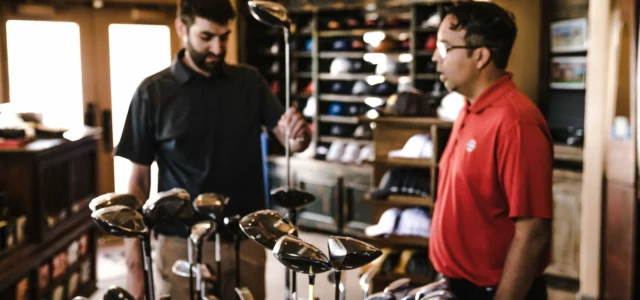
Big golf retail stores usually carry several of these sets and run hitting bays with launch monitors. Ask to hit the 7-iron and the 5-iron, not only the 7, and ask the fitter to show the carry difference between your best and your worst strikes. That number is the one the robot test points to.
Independent fitters and club builders can order any of the four with custom loft, lie and length. Ping and Callaway both offer weaker loft options for golfers who need height more than distance; ask about them before accepting the standard lofts.
The pro shop at your course may host manufacturer demo days in the spring, and some pros sell demo sets at a discount in the fall. Used-club specialists are worth a look for the Halo XL Full-Face, which has been on sale for almost three years; check the grooves, the shaft labels and the return policy.
Do you need a super game-improvement iron?
Three questions settle most cases. If your 5-iron and 6-iron rarely get airborne, if most of your misses are low on the face or fat, and if you would rather hit more greens than shape the ball, a set from this page will likely help. If your 7-iron already flies high and your misses are mostly direction rather than contact, a standard game-improvement set, or a fitting and a lie-angle check on your current irons, may serve you better.
Whatever you choose, watch the worst shots in a fitting session rather than the best one. The robot found almost no difference in how far these heads go when struck well. It found a large difference in how far they go when struck badly, which is what forgiveness was supposed to mean in the first place.
How this page was put together
This is a presentation of products and a reading of public opinion, not a test; nobody at Panxis Golf hit these irons. Specifications come from the manufacturers’ published material: Callaway’s Quantum Max OS spec table, Cobra’s King Max specifications as reproduced by an authorized retailer and its February 2026 launch as reported by GOLF.com, Ping’s G740 specification page, and Cleveland’s Halo XL Full-Face material as reported at launch by GOLF.com. The Halo’s 7-iron loft and offset come from retailer spec tables, not from a Cleveland sheet. The robot figures are Golf Digest’s, from its July 2026 analysis of super game-improvement irons; Panxis Golf did not reproduce them.
Prices were read on October 19, 2026, in U.S. dollars, at Carl’s Golfland, a U.S. retailer, because PGA TOUR Superstore’s pages could not be read. They are the “as low as” and regular prices shown on each product page and depend on set makeup and shaft. Prices change often.
What golfers say was read in reviews published by National Club Golfer, Plugged In Golf, Golf Monthly, GolfMagic and Golfalot, in the comments of Golf Digest’s Hot List player panel and in retailer customer reviews. Nobody is quoted by name, nothing is counted, and no impression is presented as a statistic. There is no commercial link here, no affiliate arrangement and no commission of any kind. If content on this site is ever paid for by a brand, it will carry an advertising label at the top of the page, before the first line.