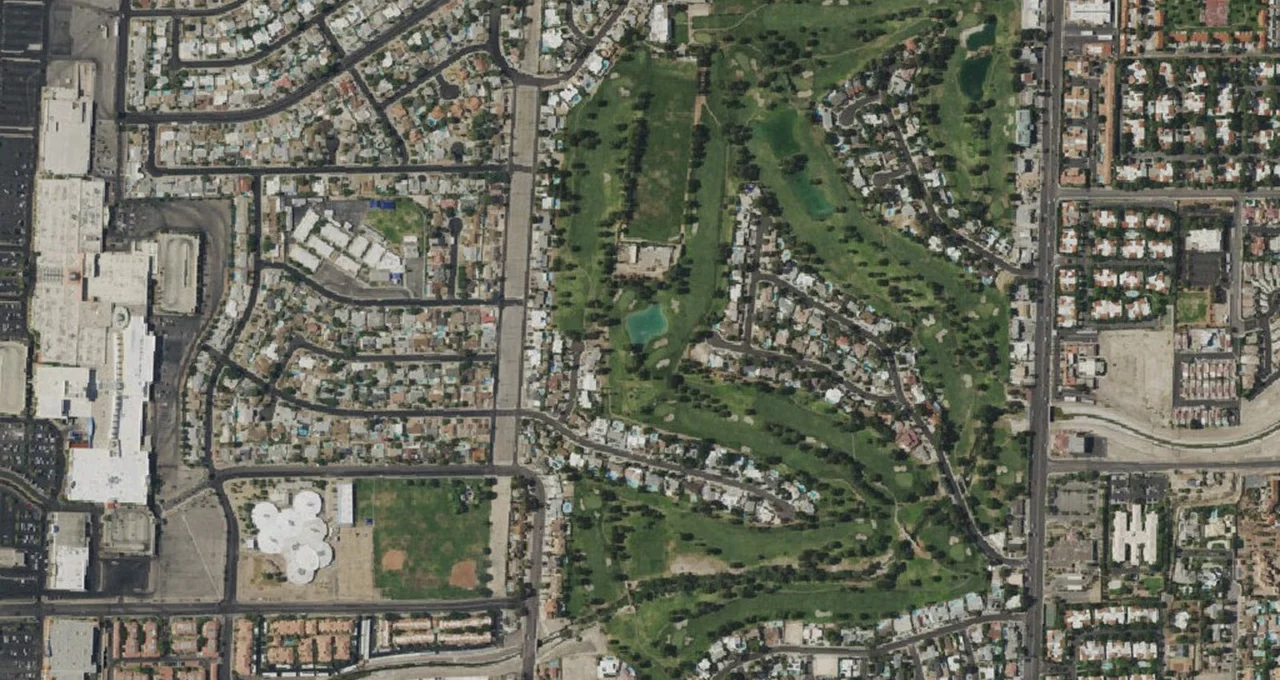
Las Vegas National Golf Club from the air. Aerial imagery USGS, domaine public.
Las Vegas National Golf Club
Holes
18
By
71 (36 out, 35 in) on the club's scorecard, the club's website, 18Birdies and Dutch Wikipedia
Length
6,614 yards from the Professional tees (rating 73.5, slope 138) on the club's scorecard printed in January 2024; Back 6,211 yards (71.6/133), Middle 5,703 (68.8/130), Forward 5,041 (70.2/119). 18Birdies gives a slope of 135 for the Back tees and 5,091 yards for the Forward tees; older sources give up to 6,815 yards
Green fee
—
Best season
Year-round; the club publishes rate seasons through summer 2027. Reviews mention fall overseeding with cart-path-only periods in October
Las Vegas National Golf Club is an 18-hole public course at 1911 East Desert Inn Road, in the Paradise Palms neighborhood east of the Las Vegas Strip, in the unincorporated part of Clark County that most addresses simply call Las Vegas. The club describes itself as a classic, traditional championship course less than ten minutes from the Strip, with thousands of trees, bunkered greens and a par of 71. Anyone can book a tee time, online or by phone, and the club publishes separate rate categories for Clark County residents and for visitors.
What sets it apart from most public courses in the valley is its age and its record. It opened in 1961, which makes it one of the oldest courses still in play in Las Vegas, and it has hosted the LPGA Championship, the PGA Tour’s Tournament of Champions, the Sahara Invitational and the Las Vegas Invitational. It is also where Tiger Woods played the first round of the event that became his first PGA Tour victory, in 1996. The fairways are lined with mature trees and with the mid-century houses of Paradise Palms, which gives the course a parkland feel that has little in common with the desert target golf of the newer courses on the edges of the valley.
Because several Las Vegas courses have closed in recent years to make way for housing, we checked that this one is still operating. It is. In November 2026 the club’s online booking system was offering tee times for later in the month, the club’s rate page lists seasons running through the summer of 2027, and golfers were posting rounds and reviews on the Hole19 and 18Birdies apps in October 2026. The recent closure in the news is Desert Pines Golf Club, a different course in east Las Vegas that shut in July 2026 for an affordable housing project. We found no current plan to redevelop Las Vegas National; the older questions about its future are described below.
From the Stardust to The National
The club’s own history, printed on its scorecard and on its website, is the most detailed account we found. According to it, the course was designed by Bert Stamps, opened for play in October 1961 as the Stardust Country Club and belonged to the Stardust Hotel and Casino. The scorecard calls the layout traditional in design and still a challenge for the best players. Several directories repeat the credit to Stamps and the 1961 date; one describes him as a former caddie and amateur golfer who became known for his designs. We found no record of a later redesign by another architect.
The names that followed track the ownership of the property. The club gives this sequence: the Del Webb Corporation took over in 1969 and renamed the course the Sahara-Nevada Country Club; American Golf Corporation bought it in 1982 and called it the Sahara Country Club; a partnership between American Golf and the Las Vegas Hilton renamed it the Las Vegas Hilton Country Club in 1994; and it became Las Vegas National Golf Club in 1998. In 2008, still according to the club, American Golf sold it to a partnership and its management went to Harrah’s Golf Management Group. The Dutch Wikipedia article on the course gives a slightly different version, in which American Golf and the Las Vegas Hilton renamed it the Las Vegas Hilton Country Club as early as 1982. We found no source naming the current owner or operator.
The club’s history also leans on its place in Las Vegas folklore. It says that members of the Rat Pack, Frank Sinatra, Dean Martin, Peter Lawford, Joey Bishop and Sammy Davis Jr., played there often in the 1960s and that locals still tell stories of late-night matches under the driving range lights. It also says that the house used in Martin Scorsese’s film Casino stands to the left of the first tee, between the 1st and 18th fairways.
A tournament course
The professional record is well documented, though not always in the same way. Wikipedia’s list of champions of the LPGA Championship, now the Women’s PGA Championship, gives the Stardust Country Club as the venue for six straight editions, from 1961 to 1966. Mickey Wright won in 1961 and 1963, Judy Kimball in 1962, Mary Mills in 1964, Sandra Haynie in 1965 and Gloria Ehret in 1966. The club’s history mentions Wright and Haynie among its LPGA winners.
The PGA Tour arrived in 1967. Wikipedia lists the Stardust Country Club as the venue of the Tournament of Champions in 1967, won by Frank Beard, and in 1968, won by Don January, before the event moved to La Costa in California. The club says the Sahara Invitational was played on the course from 1969 to 1976; Wikipedia’s article on that tournament gives Paradise Valley Country Club for 1970 and 1971 and the Sahara Nevada Country Club from 1972 to 1976, which covers the wins of Lanny Wadkins in 1972, Al Geiberger in 1974, Dave Hill in 1975 and George Archer in 1976. The club also lists Jack Nicklaus, Lee Trevino and Chi Chi Rodriguez among its winners; Nicklaus won the Sahara in 1969, Trevino in 1971 and Rodriguez in 1968, years for which the sources we read either name another course or give no venue at all.
After a long gap, the course joined the rotation of the Las Vegas Invitational, a five-round event played on several courses, from 1993 to 1996, according to the club. Davis Love III won in 1993 and Jim Furyk in 1995, two names the club cites. In 1996, Tiger Woods, in his first weeks as a professional, opened the tournament with a 70 at what was then the Las Vegas Hilton Country Club, one under par. The club’s scorecard notes that this was the highest score he posted all week; press accounts we read in search excerpts describe a 63 at TPC Summerlin and a 68 at the Desert Inn after it, and a playoff win over Love at the end. That was the course’s last year in the rotation.
The club also claims the course records. It says Arnold Palmer set a record of 63 during the 1967 Tournament of Champions, that Tom Kite lowered it to 62 in 1991 and that David Graham later tied it. We found no independent source for these scores and report them as the club’s claims. The club also hosts the Las Vegas Golf Hall of Fame, whose inductees, listed on its website, range from 1991 to 2008.
The card
The current scorecard, which the club publishes as a PDF and which carries a printer’s date of January 2024, has four sets of tees and a par of 71, 36 out and 35 in:
| Tees | Yards | Rating | Slope |
|---|---|---|---|
| Professional | 6,614 | 73.5 | 138 |
| Back | 6,211 | 71.6 | 133 |
| Middle | 5,703 | 68.8 | 130 |
| Forward | 5,041 | 70.2 | 119 |
The card does not say whether the Forward rating is for women, but at 70.2 for 5,041 yards it almost certainly is. The 18Birdies app gives the same Professional and Middle figures, a slope of 135 rather than 133 for the Back tees, and a Forward length of 5,091 yards, rated 70.2 and 119 for women and 68.1 and 117 for men. Older sources describe a longer course: the Dutch Wikipedia article gives 6,146 meters (about 6,720 yards) from the championship tees, rated 73.5 with a slope of 137, and an undated review on the Two Guys Who Golf site gives 6,815 yards from the tips and 6,418 from the middle tees. We follow the club’s current card.
The par of 71 is built from five par 3s, nine par 4s and four par 5s, which matches the club’s own description of five par 3s and four mid-length par 5s. The front nine opens with a 533-yard par 5 and plays to 3,444 yards from the Professional tees; it includes a second par 5, the 4th at 518 yards, and two par 3s, the 3rd at 198 and the 8th at 186. The back nine plays to 3,170 yards, with three par 3s (the 11th at 180, the 14th at 220 and the 16th at 210) and two long par 5s, the 15th at 543 and the 18th at 538. The par 4s range from the 336-yard 5th and the 324-yard 13th to the 437-yard 6th.
The men’s handicap index on the card puts the 6th first, the 12th (a 412-yard par 4) second and the 9th (a 421-yard par 4) third, with the 15th fourth. The easiest holes on the index are the 8th and the 11th, both par 3s. The women’s index also ranks the 6th first and moves the 15th to second.
What it asks of the golfer
At 6,614 yards from the back, Las Vegas National is not long by modern standards, and from the Back tees at 6,211 yards it looks gentle on paper. The ratings say otherwise: a slope of 138 from the Professional tees and of 130 even from the Middle tees put it among the harder public courses for a course of this length. The reasons are the ones the club itself gives, trees and bunkers, and the ones reviewers keep returning to.
The first is accuracy. The club says the course rewards accurate ball placement, and reviews describe tree-lined fairways, doglegs and approaches into greens framed by palms and guarded by bunkers. The 18Birdies community rates the course as hard, and a 2026 reviewer there calls the fairways narrow. Driving it long and crooked is not a strategy that works here; reviewers mention hidden hazards and doglegs that a first-time player does not see from the tee.
The second is water. The club says two lakes come into play on four holes; the older Two Guys review, which also counts creek crossings, says water affects ten holes. Its descriptions mention a creek running the length of the 4th, a tee shot over a creek on the 5th, water to the right on the 12th, 13th, 15th and 18th, and a creek to carry on the 16th. One Greenskeeper.org reviewer mentions streams on the 4th and 13th.
The third is the par 3s. Three of the five measure more than 195 yards from the Professional tees, and a Greenskeeper.org reviewer noted that all five play long from the tips. The 14th, at 220 yards, is described in the Two Guys review as long and tight, with bunkers short right and deep left; the 16th, at 210, plays over a creek to an elevated green.
The fourth is the rough and the greens. Several reviews describe thick rough, two or three inches deep near the fairways, in which balls settle down. The greens draw more varied comments than anything else on the course: some reviewers call them flat and fast, others slow after aeration, others hard to hold. The Two Guys review describes them as medium-sized, mildly undulating and medium-paced, with a share of poa annua in the mix. The 18Birdies community rates green speed as medium.
The climate matters too. Las Vegas summers are very hot, and the club divides its year into summer, fall and winter, and spring rate seasons. Reviews from October in several different years mention fresh overseeding, wet fairways and periods when carts were restricted to the paths.
One hole: the 6th
The 6th is the hole the club’s card treats as the hardest on the course, for men and for women. It is a par 4 of 437 yards from the Professional tees, 415 from the Back tees, 377 from the Middle and 366 from the Forward, the longest par 4 on the course from the back. The Two Guys review describes it as a long dogleg left with bunkers both in front of and behind the green.
That combination explains its ranking. A dogleg left on a tree-lined course asks for a tee shot that holds its line or turns slightly with the hole; a drive that runs through the corner or stays out to the right leaves a long approach. The second shot then has to carry the front bunkers without running into the ones behind the green. For most players, a long iron or hybrid into a guarded green is a reasonable definition of a bogey hole, and the card’s index invites them to accept that.
Two other holes are often singled out. The 12th, the second-hardest on the card at 412 yards, has water to the right off the tee and an uphill approach, according to the Two Guys review. And the same review calls the second shot on the 18th, a 538-yard par 5 with water right, trees left and a deep bunker in front of the green, the signature shot of the course.
What golfers say
Las Vegas National has a large body of public reviews: more than 50 on Greenskeeper.org, about 70 on Hole19 and several hundred ratings on 18Birdies, as well as reviews on GolfPass and Tripadvisor, both of which blocked our requests and which we read only in search excerpts. What follows sums up recurring themes; nobody is named and nothing is quoted.
On the plus side. History comes first. Reviewers enjoy the old-school Las Vegas atmosphere, the signs on the tees that recall the course’s tournaments and famous players, and a clubhouse bar full of memorabilia. The layout is often described as a real golf course rather than a resort showpiece, with mature trees, shade and a variety of hole lengths. The bunkers draw praise in several reviews for their sand and their condition. Pace of play is generally reported as good: the 18Birdies community rates it as fast, and several Greenskeeper.org reviewers report rounds between three and four hours. Staff, from check-in to the beverage carts, are described as friendly. The location, a short drive from the Strip, is the obvious practical advantage for visitors.
On the minus side. Conditions are the main complaint, and the greens above all. Over the years reviewers have reported dead spots, recent aeration, bumpy surfaces and unrepaired ball marks; Tripadvisor reviews from late 2025 and early 2026, read in search excerpts, describe greens with patches of bare dirt, and in September 2026 two 18Birdies reviewers complained about poor greens and hard bunkers. Several reviewers find the price high for the condition of the course. Other recurring criticisms are thick rough, worn tee boxes, muddy areas in winter, and coarse or thin sand in some bunkers in some seasons. Some reviews note that the surrounding neighborhood has declined, and one older review mentions litter and encampments along the creek channels.
The trend is unclear. A reviewer on 18Birdies wrote in October 2026 that conditions had improved over the past year, while others the month before described a decline. GolfPass’s aggregate scores, as they appear in search excerpts, are low for conditions and value and higher for layout and friendliness. In short, golfers who come for the history and an old-fashioned tree-lined layout tend to leave satisfied, and those who expect resort-standard greens are the ones most often disappointed.
How to play it
Las Vegas National is open to the public. Tee times are booked online through the club’s foreUP booking page, linked from its website, or by phone at (702) 889-1000. The club’s rate page distinguishes Clark County residents from non-resident resort guests, splits each season into morning, midday and late-afternoon time bands, and excludes blackout dates; the club also offers a Clark County player card. We do not publish prices: check the club’s rate page or the booking page for the current rate.
The TeeOff booking site says carts are included with tee times, and the club rents clubs; the club’s pages we read do not state whether walking is allowed, although one Greenskeeper.org reviewer reported walking a round in 2021. A collared shirt is required according to the TeeTimesUSA directory. The driving range is open from sunrise to sunset every day except Wednesday, when it closes at noon for maintenance, according to the club. Directories and reviews also mention a putting green and a chipping and bunker area. The club offers lessons, club fitting events, tournaments and outings, catering, and a bar and grill.
The practical advice from reviewers is consistent. Expect hot afternoons in summer and overseeding in early fall, when carts may be kept on the paths. Keep the ball in play rather than chasing distance, bring a club you trust for the long par 3s, and look at recent reviews or call the shop about green conditions before booking.
Getting there
The course is at 1911 East Desert Inn Road, Las Vegas, Nevada 89169, east of the Strip; a 2007 Las Vegas Sun article, read in a search excerpt, places it near the corner of Desert Inn Road and Eastern Avenue. Greenskeeper.org still lists the ZIP code 89109 and an older phone number; the club’s current address and number are the ones above. The club says it is less than ten minutes from the Strip.
The surrounding neighborhood, Paradise Palms, is known for its mid-century modern houses, many of which line the fairways. Its future has been a local subject before. In 2007 the Las Vegas Sun reported that the course was for sale and zoned for up to five single-family homes per acre, with no plans filed at the time. Around 2022, a KLAS television report on a residents’ gathering at the course quoted Clark County Commissioner Tick Segerblom as personally committed to keeping it open, at a time when several valley courses were closing in a drought. We found no later proposal to redevelop it.
How this page was made
This page is based on the club’s website (home page, history, course details, about us, rates, press and hall of fame pages, read on November 2, 2026) and its scorecard, published as two PDF files that we read as images, for the history, the card, the address and the policies; the club’s foreUP booking page, which on November 2, 2026 listed available tee times for November 10, 2026, to confirm that the course is operating; Wikidata (item Q15709483) and the Dutch Wikipedia article on the course for the names and older tee figures; Wikipedia’s articles on the Women’s PGA Championship, the Tournament of Champions, the Sahara Invitational and the Shriners Children’s Open for the tournament record; the reviews and course data on Greenskeeper.org, 18Birdies and Hole19, and an undated review on the Two Guys Who Golf site, for the hole descriptions and the opinion section; the TeeOff and TeeTimesUSA booking pages for carts and dress code; and the KLAS (8 News Now) report and news coverage of the Desert Pines closure for the context on redevelopment. The OpenStreetMap outline of the course gives the map position.
Several sources could not be read in full. GolfPass, Golf Digest, Tripadvisor, the Las Vegas Review-Journal and the USGA course rating database refused our requests, and the 2007 Las Vegas Sun article is behind a paywall, so we used search excerpts where we used them at all. Where sources disagree, we say so above: on the names and owners between 1982 and 1994, on the years the Sahara Invitational was played here (1969 to 1976 for the club, 1972 to 1976 for Wikipedia), on the slope of the Back tees and the length of the Forward tees, on older and longer yardages, on how many holes have water in play, and on the ZIP code. The course records are the club’s claims, and the Wikidata item gives neither an architect nor an opening date. We could not identify the current owner, the management company or the head professional. The opinion section summarizes public reviews over many years; we report recurring themes, not individual voices. Nobody from Panxis has played or visited this course, and this page is no substitute for a round.
Las Vegas National Golf Club has not paid for this page, has not seen it before publication and has no say over its content. This page contains no commercial link and earns us no commission. If you know the course and something here is wrong or out of date, write to us and we will correct it.
Other courses nearby
Closest to this one in our United States directory:
- Las Vegas Country Club — 1 mi
- Canyon Gate Country Club — 9 mi
- Kern River Golf Course — 215 mi
- Brookside Golf Club — 219 mi
The hole to know
A par 4 of 437 yards from the Professional tees, the number 1 handicap hole on the club's card for men and women alike: a long dogleg left that an older independent review describes with bunkers in front of and behind the green.