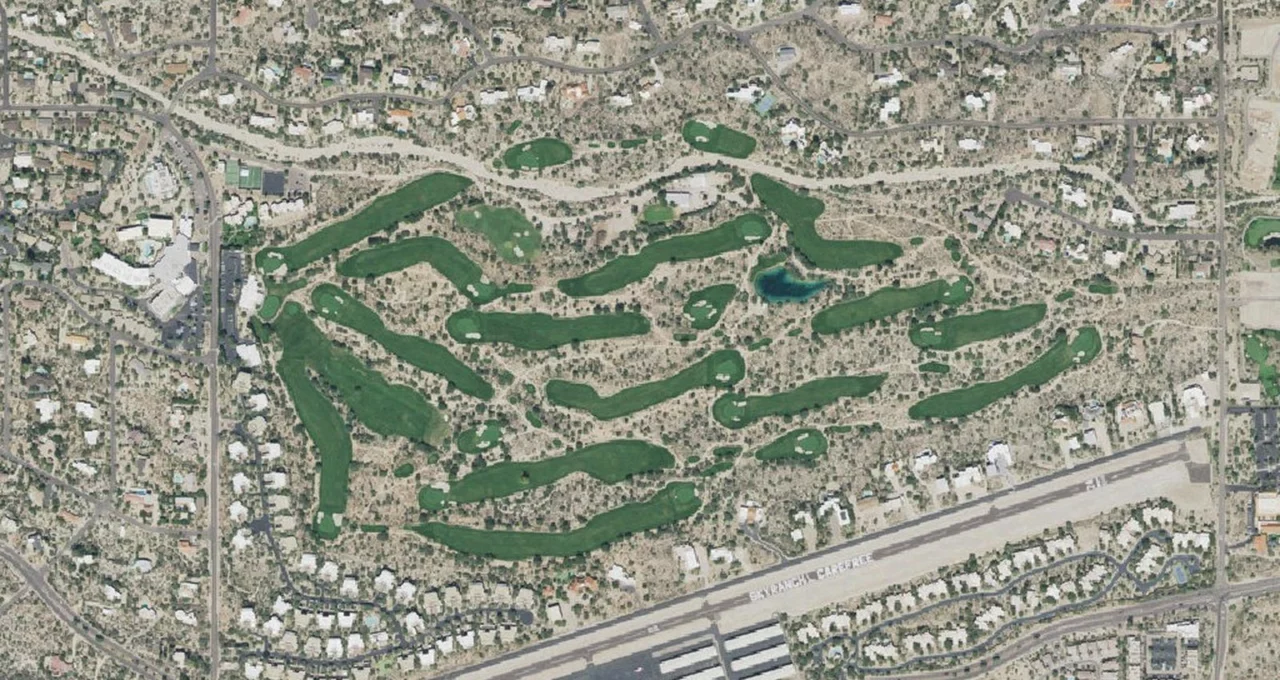
Desert Forest Golf Club from the air. Aerial imagery USGS, domaine public.
Desert Forest Golf Club
Holes
18
By
72
Length
7,203 yards from the Gold tees on the club's hole yardages (rating 75.5, slope 149 per Top100GolfCourses.com and Stymie; OpenGolfAPI gives 75.2/146); Wikipedia gives 7,201 yards and Stymie 7,182
Green fee
—
Best season
Year-round, according to the club; the course except the greens is overseeded with ryegrass from late September each year
Desert Forest Golf Club is a private, member-owned club in Carefree, Arizona, in the foothills north of Scottsdale, about 28 miles in a straight line from downtown Phoenix. The club gives its address as 37207 N. Mule Train Road, Carefree, AZ 85377. Its single 18-hole course was laid out by Robert “Red” Lawrence and opened in 1962, the date given by the club, Wikipedia and Wikidata. It is a par 72 that measures 7,203 yards from the Gold tees, the total of the hole yardages the club publishes on its course tour.
The course matters well beyond its size. Many writers, and the club itself, describe it as the first true desert course: a layout that used the Sonoran Desert as its hazard and its rough instead of covering it with grass and imported trees. Wikipedia writes that it was the first course in the western deserts to work the desert into the design rather than impose an eastern model on the landscape, citing Joan Fudala’s history of golf in Scottsdale. Lawrence earned the nickname “Desert Fox” from it. Sixty years later the course still has no out-of-bounds stakes, no water hazards and no fairway bunkers, according to the club, and it remains a fixture of national rankings. This page is a portrait built from public sources; because the club is private, most readers will only see it as a member’s guest.
A golf course at the heart of a new town
Carefree itself was a planned community. Wikipedia’s article on the town says it was conceived in the mid-1950s by two business partners, K.T. Palmer and Tom Darlington, with land sales starting in 1955 and homebuilding in 1958; the town was only incorporated in 1984. The club’s history page calls Darlington and Palmer “real estate visionaries” who founded Carefree “with Desert Forest Golf Course at its heart.” The site sits beneath Black Mountain, a local landmark that Wikipedia puts at 3,398 feet. Wikipedia gives the course an elevation of about 2,400 to 3,000 feet; Top100GolfCourses.com rounds it to about 2,500 feet. The altitude is part of the club’s appeal: a reviewer on that site notes that it keeps the course cooler than many Scottsdale layouts.
The architect was already near the end of a long career. According to the club’s biography and to Wikipedia, Robert Lawrence was born in White Plains, New York, in 1893, started as layout engineer at Westchester Country Club in Rye, New York, and worked as a design assistant to William S. Flynn at Merion from 1921 to 1932, which places him in the so-called Philadelphia School of golf architecture. Links Magazine and Top100GolfCourses.com add that he worked with Walter Travis on Westchester. He was a founding member of the American Society of Golf Course Architects and, according to the club, its first president. In May 1958, aged 65, he moved to Arizona, where he designed many courses. He died in Tucson in 1976 at 83 and was inducted into the Arizona Golf Hall of Fame in 2003.
The club keeps a course drawing dated October 1961 that shows the original bunkers, and its archive notes that Lawrence himself added a bunker on the 2nd hole in 1963. Wikipedia dates the design to 1961 and the club’s establishment to 1962. What all accounts stress is how little ground was moved. Wikipedia, drawing on Golf Arizona, writes that very little earth was shifted, which left narrow, rolling fairways that follow the natural terrain. Links Magazine goes further and says no bulldozers shaped the fairways: grass seed was laid directly on the desert floor. Top100GolfCourses.com adds two details from the construction story: Lawrence produced only one routing, and the shaper who did the work, Vernon Ward, died shortly after the course was finished. Wikipedia quotes the writer Scott Gummer in Links Magazine: beyond the boundary markers Lawrence staked, “nothing was to be touched,” and everything, from saguaro and ocotillo to the javelinas, coyotes and rattlesnakes, remains in play.
Rankings and championships
Desert Forest built its reputation through magazine lists. Wikipedia reports that Golf Digest has included it on its ranking of America’s 100 greatest courses for a total of 17 editions since the list began in 1969, and that Golf Magazine ranked it 35th on its 2009 list of the 50 greatest courses of the previous 50 years, the only Arizona course on that list. Wikipedia also says Golfweek has regularly ranked it among the 50 best modern courses in the United States, citing the magazine’s 2012 list. The club’s own course page, in a version archived in 2023, said it was ranked second in Golfweek’s list of Arizona’s best private courses. In his 2005 book “1001 Golf Holes You Must Play Before You Die,” Jeff Barr included the 7th, 13th and 16th holes. A Golf Digest course page exists, but it could not be opened when we prepared this page, so we have not used its current ranking.
The course has also hosted national amateur championships:
- 1990 U.S. Senior Amateur, played in October. Wikipedia’s list of champions records Jackie Cummings beating Bobby Clark 3 and 2 in the final, and its article on the club notes that Cummings, then 55, was at that point the youngest winner in the championship’s history.
- 2007 U.S. Women’s Mid-Amateur, from September 29 to October 4. AmateurGolf.com’s report gives the course as 6,208 yards and par 73 for the championship. Meghan Bolger of Haddonfield, New Jersey, won the final 1 up against Kerry Postillion, a Desert Forest member, after Postillion found a greenside bunker on the 18th.
- 2024 Pac-12 Men’s Golf Championship, April 26 to 28, hosted by Arizona State. The scores in Arizona State’s report imply a par of 71 for the event, one less than the card. The same report says the Sun Devils won the team title by 16 strokes, their first conference title since 2008, and that Stanford’s Karl Vilips took the individual title at 2 under par, one stroke ahead of Arizona State’s Ryggs Johnston.
The club’s course page lists other events held since 1962, among them the Arizona Open, the Arizona State Amateur, the Pacific Coast Amateur, the Goldwater Cup and the Trans-Mississippi Four-Ball. Arizona State’s 2023 announcement of the Pac-12 event also mentions that the 96th Arizona Amateur was played there in 2020.
The 2013 renovation
By the early 2010s the turf had declined. According to the club, it interviewed several architects known for restoration work in the autumn of 2012 and chose David Zinkand, a longtime member of the Coore and Crenshaw design team. The club dates the work to 2013 and summarizes the work as new tee boxes, better sightlines from the tees, greens brought up to modern standards and bunkering updated to tie in with the desert. Top100GolfCourses.com adds that bunkers were altered or moved, several holes were re-routed, every green complex was rebuilt, all the rough was regrassed and a new irrigation system installed, and that only 67 of the property’s 165 acres are turf, a figure Links Magazine also gives.
In a long 2018 interview on the GeekedOnGolf site, Zinkand explained the thinking. The aim was to raise the course rating to keep testing strong players while lowering the slope for higher handicappers. Tees were added, lengthened or moved, including a new forward set, the Copper tees. Greens on the 6th, 9th and 13th, altered in the 1970s, were rebuilt closer to their original grades, and the green speed target was set around 10.5 on the Stimpmeter for sustainability. Non-native trees and many mesquites were removed, native vegetation was restored, and some saguaros were salvaged and replanted. The club quotes a letter from Bill Coore to its board calling the result “an outstanding renovation project.”
What the course asks of you
The defining feature is what is missing. The club describes a course where, “much like the links courses in the United Kingdom, everything is in play,” with no out-of-bounds markers, no water hazards and no fairway bunkers. The desert itself is the rough: Top100GolfCourses.com lists saguaro, ocotillo, cactus and mesquite among the plants waiting off the fairway. Fairways are narrower than at many leading Arizona courses, often rippled and crowned, so a shot that lands slightly off line can run into the brush. Links Magazine offers a counterpoint: the fairways are wider than the encroaching desert makes them feel, and position off the tee matters more than width. Both nines open with doglegs that bend right, according to the same magazine.
The greens are bentgrass; tees, fairways, rough and green surrounds are hybrid Bermudagrass, and the club says the whole course except the greens is overseeded with ryegrass from late September each year. Top100GolfCourses.com describes greens that slope back to front with push-up contours, guarded by bunkers but open to both lofted and running approaches. Zinkand told GeekedOnGolf that slopes of five to six percent are common, which makes the transitions between hole locations abrupt.
The club’s course tour gives the following yardages, which correspond to the Gold tees:
- Front nine: 1st, par 4, 404 yards; 2nd, par 4, 456; 3rd, par 3, 171; 4th, par 4, 441; 5th, par 4, 464; 6th, par 4, 371; 7th, par 5, 551; 8th, par 3, 231; 9th, par 5, 533. Out: 3,622 yards, par 36.
- Back nine: 10th, par 4, 392; 11th, par 5, 594; 12th, par 3, 194; 13th, par 4, 466; 14th, par 4, 329; 15th, par 4, 435; 16th, par 5, 535; 17th, par 3, 169; 18th, par 4, 467. In: 3,581 yards, par 36.
Shorter sets bring the course within reach of most players. Stymie, a course database, lists ten tee combinations for men, from Gold at 7,182 yards (rating 75.5, slope 149) through Blue at 6,933 (74.5, 142), Black at 6,534 (72.2, 133) and Silver at 6,062 (70.4, 129) down to Copper at 4,765 (64.4, 116). For women it lists ratings from the Blue tees (6,816 yards, 79.2, 141) down to Copper (69.0, 123).
Several holes recur in published descriptions:
- The 3rd, a par 3 of 171 yards to a raised green, the second smallest on the course according to Top100GolfCourses.com, with bunkers all around. The Golfadelphia blog notes that it is exposed to the wind and hard to hold.
- The 7th, the hole most often cited as the signature: a par 5 of 551 yards that turns sharply right off a blind tee shot. A wash crosses the hole diagonally about 100 yards short of a green with a false front. A review published by ABC7 in San Francisco describes three landing areas separated by desert and the wash, with a bold drive into the middle fairway opening a chance to reach in two.
- The 8th, a downhill par 3 that Zinkand lengthened to 231 yards, toward a small, wide and shallow green with Black Mountain as a backdrop.
- The 11th, the longest hole at 594 yards, a three-shot par 5 bending left, where Lawrence covered a wash near the green with turf.
- The 14th, a par 4 of 329 yards rebuilt in 2013 with a new green as a drivable hole for long hitters, on a fairway that cants to one side.
- The 16th, a par 5 of 535 yards with a single tree in the fairway and a filled wash, a favorite of several reviewers.
- The 18th, a par 4 of 467 yards with a pinched fairway and fall-offs around the green, finishing in front of the clubhouse; Zinkand says he reworked it to be less forgiving for long hitters.
What golfers say
Because Desert Forest is private, public opinion comes mostly from guests and specialist writers. The material summarized here comes from the reviews posted on Top100GolfCourses.com, dated January 2019, September 2020 and June 2026; from the Golfadelphia blog review of May 2017, updated in 2019; from the 2018 GeekedOnGolf feature; from Links Magazine; and from the ABC7 review, dated 2010 in Wikipedia’s references. Reader reviews on Golf Digest and GolfPass could not be opened when we prepared this page, so we have not used them. These are other people’s opinions, not ours. Nobody from Panxis has played the course, and we name no reviewer.
What comes up in its favor
- The minimalist design: reviewers praise a course that sits on the natural ground instead of reshaping it, and the absence of out-of-bounds, forced water carries and fairway bunkers.
- Strategy: tee shots that require thought, a choice of approaches and greens that reward a player who stays below the hole.
- Walking: short distances from green to tee and gentle slopes make it, in several accounts, one of the most walkable courses in Arizona.
- The 7th, cited as outstanding in almost every review, and the drivable 14th.
- Conditioning after the 2013 renovation, described as excellent from tee to green in the 2026 review, and greens repeatedly called fast and true.
- The atmosphere: a small, old-fashioned clubhouse and an understated membership devoted to golf.
What comes up against
- Narrow, crowned fairways: missing them is costly, and a member of one reviewer’s group found the course “too narrow to play every day,” a view the reviewer rejected.
- Desert lies: the Golfadelphia reviewer warns that hardpan recoveries can damage clubs.
- Subtle, fast greens that the same blog calls the most vexing part of the course.
- Less spectacle than newer desert courses: a 2020 review argues that it has slipped in some desert rankings because rivals offer more dramatic terrain and views.
- A few holes judged ordinary, such as the 12th, or weaker than their neighbors, such as the 9th.
Getting there and playing
Desert Forest is a private club. Its membership page explains that, as at many member-owned clubs, membership begins with an invitation from a member; people without a connection can register their interest and are contacted when an opening arises. There is no public tee-time booking. Visitors play as a member’s guest, and the club publishes the customs it expects them to follow: no phone conversations on the course or in the clubhouse except in the locker rooms and the parking lot, devices only in silent mode, tucked-in collared shirts with sleeves for men, no denim of any color, hats worn bill forward, golf shoes without metal spikes, and a pace of play of 4 hours and 10 minutes for a foursome. The club says it is a non-tipping club, except for caddies.
Walking is part of the identity. The club describes the course as designed to be walked, offers electric walking carts and push carts, keeps a fleet of riding carts for the summer heat, and asks for caddies to be booked one week before the tee time. Its youth caddie program started in 2015, and the club says three of its caddies have received the Evans Scholarship. The ABC7 review notes that the cart paths are dirt. Practice facilities include a double-sided driving range, a chipping green, a putting green and a two-acre short-game area with two greens and four bunkers. The club describes the course as available year-round; summer heat in the Phoenix area is the main constraint.
The club sits on the north side of Carefree. Measured on the map, in a straight line, it lies about 28 miles north-northeast of downtown Phoenix and about 27 miles from Phoenix Sky Harbor International Airport; these are not road distances. The club does not publish green fees or membership dues, and we do not report any; the club’s website is the place to ask.
How we built this page
The factual frame comes from public sources: OpenStreetMap and Wikidata for the location and identifiers; the club’s website, desertforestgolfclub.com, for the address, the hole yardages, the turf, practice facilities, guest customs, membership process, caddie program, the architect’s biography and the 2012 choice of Zinkand; Wikipedia’s articles on the club, on Red Lawrence and on Carefree for the history, rankings and championships; Wikipedia and AmateurGolf.com for the 1990 and 2007 championships; Arizona State’s athletics website for the 2024 conference championship; Top100GolfCourses.com, Links Magazine, GeekedOnGolf, Golfadelphia and ABC7 for the course description and reviews; and Stymie and OpenGolfAPI for tee ratings. The club’s website blocks automated visitors, so some of its pages were read in the versions kept by the Internet Archive between 2023 and October 2026.
Where sources disagree, we say so. The length is 7,203 yards on the club’s hole-by-hole yardages and in OpenGolfAPI, but 7,201 in Wikipedia and 7,182 in Stymie. Ratings vary: OpenGolfAPI gives 75.2 and slope 146 without naming the tee, while Top100GolfCourses.com and Stymie give 75.5 and 149 for the Gold tees; the Black tees are listed at 6,522 yards by Top100GolfCourses.com and at 6,534 by Stymie and Golfadelphia. The par was 72 for the club, 73 for the women’s 2007 championship and 71 for the 2024 Pac-12 event. The club says there are no water hazards, while Top100GolfCourses.com mentions a small pond, out of play, by the 3rd, and Stymie lists water hazards and bentgrass fairways, which contradicts the club’s own description of Bermudagrass fairways. Top100GolfCourses.com says there are no forced carries; Golfadelphia describes carries over desert on the 2nd and 17th. The 10th is a dogleg left for Top100GolfCourses.com and a dogleg right for Golfadelphia. Top100GolfCourses.com says the course is overseeded only every four to five years, while the club says it overseeds every autumn. Wikipedia dates the founding of the architects’ society to 1946, the club to 1947. Some sources spell the architect of the renovation “Zinkland.”
Some details will age: the rankings, the tee ratings, which are revised periodically, the guest customs and the reviews read in October 2026. The opinion section reports recurring themes rather than individual voices. Nobody from Panxis has played or visited this course, and this page is no substitute for a round.
The club has not paid for this page, has not seen it before publication and has no say over its content. This page contains no commercial link and earns us no commission. If you know the club and something here is wrong or out of date, write to us and we will correct it. Wikipedia’s article on the club lists its championships, and the Top100GolfCourses.com profile describes every hole.
Other courses nearby
Closest to this one in our United States directory:
- Las Vegas Country Club — 244 mi
- Canyon Gate Country Club — 250 mi
- Fairbanks Ranch Country Club — 312 mi
- Brookside Golf Club — 360 mi
The hole to know
A par 5 of 551 yards that turns sharply right off a blind tee shot. A wash crosses the hole diagonally about 100 yards short of a green with a false front, according to Top100GolfCourses.com.