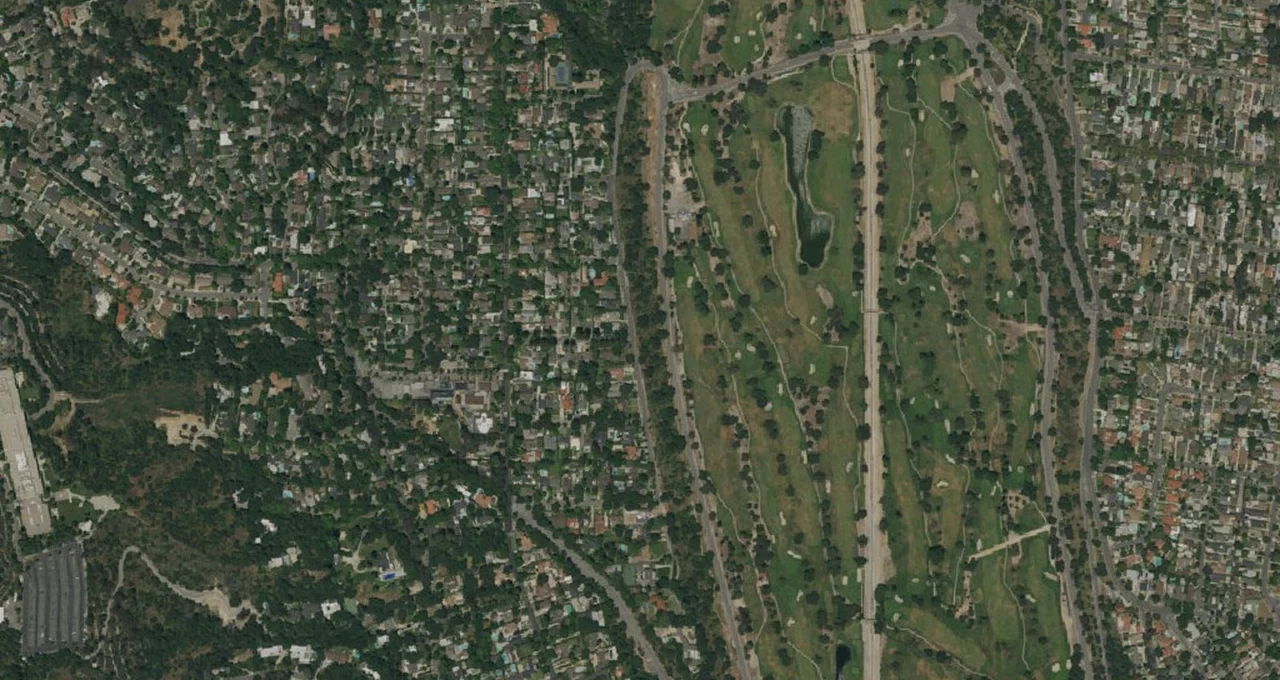
Brookside Golf Club from the air. Aerial imagery USGS, domaine public.
Brookside Golf Club
Holes
36 (two 18-hole courses: C.W. Koiner and E.O. Nay)
By
72 for the C.W. Koiner Course, 70 for the E.O. Nay Course
Length
Koiner: 7,104 yards from the Gold tees (rating 74.5, slope 133 for men); Nay: 6,025 yards from the Blue tees (69.1/121). Wikipedia gives 7,228 and 6,046 yards
Green fee
—
Best season
Year-round; open daily from dawn to dusk according to the club, with restrictions on some Rose Bowl event days
Brookside Golf Club is a public 36-hole golf complex in Pasadena, California, owned by the city and set in the Arroyo Seco, the broad dry wash on the city’s west side, right beside the Rose Bowl stadium. It has two separate 18-hole courses, and this page covers both: the C.W. Koiner Course, also called Course No. 1, a par 72 of 7,104 yards from the back tees, and the E.O. Nay Course, or Course No. 2, a par 70 of a little over 6,000 yards. Both were designed by William P. Bell, one of the most important architects of early Southern California golf. The club gives its address as 1133 Rosemont Avenue, Pasadena, CA 91103.
Golf began here in 1928. A 1938 trade article reports that construction started in the spring of that year and that the first eighteen holes opened for play on November 1, 1928. According to the Southern California Golf Association (SCGA), the Nay Course followed in two stages, with nine holes in 1932 and nine more in 1938. Brookside has since hosted a PGA Tour event, the 1968 Los Angeles Open, and a national amateur championship, the 1974 U.S. Amateur Public Links. Since July 2024 the complex has been managed for the city by Troon, with its subsidiary Indigo Sports running golf operations, maintenance, the shop and food service.
Two courses, one complex
The two courses share a clubhouse, a practice area and a booking system, but they are different propositions. The club itself sums up the difference on its frequently asked questions page: Koiner is the longer and more traditional of the two, while Nay is shorter and tighter but more forgiving, and suits a quicker or more casual round. Wikipedia’s article on the complex describes Koiner as relatively flat, with many bunkers, long rough and tricky greens, aimed at better players, and Nay as a course with smaller landing areas usually played by golfers of lesser ability. The SCGA describes Nay as popular with mid- and high-handicap golfers.
The Arroyo Seco, now a concrete-lined flood-control channel, runs between the two layouts, according to Wikipedia. Troon’s July 2024 announcement says both courses have Bermuda grass fairways and Poa annua greens, and that their holes are lined with eucalyptus, pine and oak. The San Gabriel Mountains rise just to the north, and the club leans on that view in its own description of the place.
The names honor two figures of Pasadena’s civic life between the wars. A list of winners of the Pasadena Noble Award, compiled by the Pasadena Public Library, records E. O. Nay in 1938 as chairman of the city’s Board of City Directors, and C. W. Koiner in 1945 as city manager. We found no source explaining when or why the courses were named after them, so this page goes no further.
Built in a riverbed
The most detailed early account we found is a February 1938 article in Golfdom, a trade magazine for golf course operators, written by D. Scott Chisholm and titled “Why Brookside Is Popular.” It describes a site that looked hopeless at the start. Like the Rose Bowl, the course was built in the Arroyo Seco, a riverbed filled with large boulders and small rocks when Bell took on the job, and more than 44,000 yards of topsoil had to be hauled in once the rocks were cleared. The writer credits the greens, molded from native sand and rich topsoil and drained underneath, with a remarkable record: according to the article, not one green had been out of commission since the course opened.
The same article gives a snapshot of Brookside in the late 1930s. The fairways were Bermuda grass and the greens a bent grass; the whole property, about 140 acres in the article’s count, was irrigated; and the rough was not grass at all but stones mixed with coarse gravel. At that date the article speaks of 27 holes, an 18-hole course plus a nine-hole course that “came later,” which fits the SCGA’s timeline for the Nay Course. The clubhouse was a rambling Spanish-style building paid for, the writer says, by a bequest from a Pasadena citizen who wanted to do something for golf in the city. The resident professional was Bill Hickey.
The link with the stadium was there from the start. Golfdom explains that the course could be played 364 days a year: on New Year’s Day the fairways became a parking lot for the Rose Bowl game, with upwards of 20,000 cars spread across them and the greens roped off, one man assigned to each green. The writer adds that a good 3-iron from the 17th tee would reach the west goalposts of the Bowl.
William P. Bell, born in Pennsylvania in 1886, moved to California in 1911 and worked as caddymaster and superintendent at the Pasadena Country Club before designing courses on his own from 1920, according to Wikipedia. He is credited with more than fifty courses, mostly in Southern California, including Bel-Air Country Club and the two municipal courses at Torrey Pines in San Diego, and he worked with George C. Thomas Jr. on Riviera. He died in Pasadena in 1953.
Tournaments at Brookside
Brookside’s tournament history starts almost at once. According to Wikipedia, the Pasadena Open was played at Brookside from 1929 to 1938, with winners including Craig Wood, Horton Smith, Tony Manero, Harry Cooper, Paul Runyan and Henry Picard; Wikipedia lists two editions in 1929 and none in 1936 and 1937.
The best-known event came in January 1968, when the Los Angeles Open, a PGA Tour stop that had been played at Rancho Park in Los Angeles since 1956, moved to Brookside for one year. Billy Casper won, with Arnold Palmer three strokes behind, according to Wikipedia and a golf history newsletter that went back through the period’s press coverage. That newsletter reports that Casper’s rounds were 70, 67, 68 and 69, for a total of 274, that a newly refurbished clubhouse was one of the main reasons for the move, and that the course had been remodeled by the architect Desmond Muirhead and measured more than 7,000 yards. It also reports that the clubhouse drew better reviews from the players than the course did, and the tournament went back to Rancho Park in 1969. We found the Muirhead remodel in that single source only.
In 1974 the Koiner Course hosted the U.S. Amateur Public Links Championship, the USGA’s national event for players from public courses. According to the USGA, the winner was Charles Barenaba, a 20-year-old college player from Hawaii, two strokes ahead of the runner-up; his brother Randy won the title the following year. The club also says Brookside hosted an LPGA event in 1971, and a California golf magazine mentions NCAA championships; we found no independent record of either to give details.
What the Koiner Course asks of the player
Koiner is the championship course, and its card shows why. From the Gold tees it measures 7,104 yards for a par of 72, with a course rating of 74.5 and a slope of 133 for men, according to the scorecard reproduced by a regional golf site and by a golf app. That is a demanding test for a public course. The other tees bring it down to 6,711 yards (rating 72.5, slope 129), 6,389 yards (71.0 and 126) and 6,000 yards (69.2 and 122). For women, par is 75, and the regional site gives a rating of 74.9 and a slope of 129 from the shortest tees.
The length is spread across the round rather than concentrated on a few holes. The front nine measures 3,595 yards from the Gold tees and the back nine 3,509, each a par 36. Several par 4s run well past 400 yards: the 3rd at 485, the 12th at 474, the 9th at 468, the 16th at 441 and the 13th at 424. There are three par 5s, the 2nd at 518 yards, the 6th at 528 and the 15th at 538, and four par 3s, the longest of which is the 4th at 202 yards. The shortest par 4s, the 10th at 316 yards and the 18th at 342, give some relief.
The two cards we consulted agree on par and yardage but not on the stroke index of every hole. One rates the 12th as the hardest hole and the 3rd as the second hardest; the other has them the other way round. Either way, those two long par 4s, both close to 475 yards from the back, are where most golfers will drop shots.
Reviewers who play from the white tees describe the course as tiring, with long par 4s and narrow, tree-lined fairways, and some advise moving up a set of tees to enjoy the round. The greens are the feature most often singled out: fast, true and, in several accounts, harder than they look, with difficult hole locations. The 1938 article’s emphasis on the greens suggests this has long been Brookside’s strong point.
What the Nay Course asks of the player
The Nay Course is a par 70 with two par 5s and four par 3s. The club gives its length as 6,025 yards, which matches the scorecard reproduced by the regional golf site: 6,025 yards from the Blue tees, with a rating of 69.1 and a slope of 121 for men, then 5,708 yards (67.5 and 117) and 5,326 yards (65.5 and 112). For women, the same site gives a par of 71, the 4th being a par 5 for them, and a rating of 70.9 with a slope of 124 from the shortest tees.
Its character comes from the front nine, which is all par 4s apart from one par 3: the 1st at 382 yards, the 2nd at 390, the 3rd at 405 and the 4th, the hardest hole on the card, at 433. The back nine is busier, with three short holes (the 10th, 12th and 15th, the last of them only about 128 yards), a long par 5 at the 11th of about 546 yards, a shorter par 5 at the 16th of 449 yards and a short par 4 at the 14th of under 275 yards. Each nine is a par 35.
For a high handicapper, Nay is the obvious first choice at Brookside, and the club says as much. The yardage is manageable, but the narrower landing areas reward a straight ball more than a long one. In the public reviews of Course No. 2, pace of play is usually described as quick, sometimes under three and a half hours, while opinions on conditions are much less kind than on Koiner (see below). One reviewer finds Nay more playable than its neighbor; others simply rate it below Koiner.
Life next to a stadium
No account of Brookside is complete without the Rose Bowl. Wikipedia reports that the courses serve as overflow parking for the stadium on the day of the Rose Bowl Game, for UCLA home football games since the university moved to the Rose Bowl in 1982, and for other major events. Its article says this has not damaged the quality of the courses but limits their availability on those days. Public reviews are less sanguine: several golfers describe dirt patches, roped-off tees and worn ground after concerts and other events, especially on the 1st hole of the Nay Course, and one describes a round disrupted by parking for the stadium’s flea market, with a hole temporarily shortened to a par 3.
The SCGA described the same tension in an article published in the late 2010s, quoting the head of the Rose Bowl Operating Company, the city-appointed body that oversees the stadium and the golf courses, on the need to balance the integrity of the courses against revenue-raising events. That article also notes a cut in the courses’ water allotment, a pressure familiar across Southern California.
The club’s frequently asked questions page does not list event closures. Before booking a round in the fall, check the UCLA home schedule and the stadium’s events calendar, as well as the club’s own booking calendar.
Practice, food and the rest
The club describes a 25-bay driving range equipped with Toptracer ball-tracking technology, two putting greens, a chipping area and a practice bunker. In 2023 the Rose Bowl Operating Company filed an environmental review, published in the state’s CEQA database, for a project to reorient and expand the driving range toward the north and to build a miniature golf course just west of it, on about 16 acres covering part of the existing range, the 10th hole of Koiner and the 6th and 7th holes of Nay. We found no source confirming when, or whether, each part of that project was completed.
The Brookside Restaurant serves breakfast and lunch daily, with a patio overlooking the course, according to the club’s FAQ; Troon’s 2024 announcement mentioned dinner as well, so check current hours. The club also runs the Tee Time Tavern, a bar with golf simulators, and rents out several banquet rooms. Rental clubs for men, women and left-handed golfers are available in the golf shop, which also offers club fitting by appointment. Lessons are given by PGA professionals and through First Tee, Greater Pasadena.
What golfers are saying
Brookside is heavily reviewed. In October 2026 a golf app showed an average of 4.1 out of 5 from 727 reviews for Koiner and 3.9 from 833 reviews for Nay, with course condition the lowest-scored item on both. Another app gave 3.9 for Koiner from 99 reviews. We also read the member reviews of a Southern California golf site, which are detailed and dated. The points below summarize what recurs across this material. They are other people’s opinions, not ours; nobody from Panxis has played the courses, and we name no one.
What comes up in its favor
- The greens are the most consistent source of praise on both courses: fast, smooth and true in most accounts.
- Koiner is respected as a long, serious test, with a layout reviewers call challenging and old-fashioned in the good sense.
- Staff get frequent compliments, from starters and marshals to the golf shop and the restaurant.
- The setting, under the San Gabriel Mountains and beside the Rose Bowl, is part of the appeal.
- Pace on Nay is often described as quick, and some Koiner rounds are reported at a reasonable four hours and change.
What comes up against
- Conditioning away from the greens is the main complaint: thin or patchy fairways, hard bunkers short of sand, worn tees. Recent reviews of Nay are the harshest.
- Many reviewers blame event parking and concert set-ups for the damage, and advise avoiding the days around big stadium events.
- Pace on Koiner can be slow, with some rounds over four and a half hours, particularly at weekends.
- Some golfers find the value poor once a cart is added, and one objected to a booking fee charged ahead of an aeration they were not told about.
- The practice range has drawn complaints about waits, limited space and missing targets, and one reviewer found it closed.
Who can play and how
Brookside is a public daily-fee facility. The club takes tee times online at any hour; it says tee times cannot be booked by phone, though you can call to ask about availability. The general public can book up to 14 days ahead, and holders of the club’s Arroyo Golf Card get a longer window. The club warns that weekends are very busy and suggests booking exactly seven days ahead. Cancellations must be made at least 24 hours in advance to avoid a no-show fee, and rain checks are prorated by holes played.
Singles and twosomes are paired into foursomes when it is busy, and groups larger than four cannot share one tee time. Carts are available on both courses, charged per rider, and the club notes that many golfers walk. The dress code is relaxed: collared shirts and golf trousers or shorts are encouraged on the course. Outside food and drink are not allowed, apart from water. Children under six are discouraged from going on the course, and juniors have their own rates, including access through the SCGA’s Youth on Course program on weekdays.
The course is open every day from dawn to dusk, according to the club, which makes it a year-round venue in Pasadena’s climate. The practice facility can close early on Monday mornings for maintenance.
Getting there
Brookside lies in the Arroyo Seco on the northwest side of Pasadena, reached by Rosemont Avenue and Rose Bowl Drive. In a straight line, the map point we use for the complex is about 0.7 miles from the center of the Rose Bowl, about 2.2 miles from Pasadena City Hall, about 9 miles from downtown Los Angeles, about 11 miles from Hollywood Burbank Airport and about 21 miles from Los Angeles International Airport. These are map distances, not driving distances, and traffic in the Los Angeles area can make them misleading.
On Rose Bowl event days, access roads and parking around the stadium are managed for the event, and the courses themselves may be in use as parking. Plan around the stadium calendar.
Green fees
Brookside publishes separate rates for each course, with weekday, Friday and weekend prices, twilight and later twilight rates, senior and junior rates, and cart fees per rider. Rates change without notice, so check them on the club’s booking page or on the pages for the Koiner Course and the Nay Course before you go.
How this page was made
The factual frame comes from public sources: OpenStreetMap and Wikidata for the location and identifiers; the club’s website, brooksidegc.com, for the address, the course lengths and pars, the architect, the practice facility, the booking rules, the opening hours and the services; Troon’s press release of July 17, 2024, for the management change and the turf and trees; Wikipedia’s articles on Brookside Golf Course, William P. Bell and the Pasadena Open for the layout, the stadium parking, the architect’s career and the early tournaments; the February 1938 issue of Golfdom for the construction and the early years; the SCGA for the opening dates of the Nay Course, the 1974 Public Links and the management context; the USGA for the 1974 champion; a golf history newsletter on Substack for the 1968 Los Angeles Open; the Pasadena Public Library for Koiner and Nay; the state CEQA database for the range project; Greenskeeper.org and the 18Birdies app for the scorecards; and golf apps and Greenskeeper.org member reviews for the opinions.
Where sources disagree, we say so. Wikipedia gives Koiner as 7,228 yards and Nay as 6,046 yards; the club gives 7,104 and 6,025, and we follow the club. The SCGA gives Nay as 6,022 yards and one app as 6,040, with slightly different lengths for four holes on the back nine; we follow the 6,025-yard card, which matches the club’s figure. Koiner’s rating and slope from the back tees are 74.5 and 133 on two cards; a booking platform shows 134 for the slope on one page and 73.6 and 128 on another, and we follow the cards. The two Koiner cards also differ on the stroke index of several holes. Wikipedia still names American Golf as the operator; the SCGA says American Golf held a lease for about thirty years, and the club and Troon say Indigo Sports, a Troon company, has managed the courses since 2024. The club calls Brookside the oldest golf course in Los Angeles County, but Annandale Golf Club, also in Pasadena, dates from 1906 in the records we found, so the claim cannot apply to golf courses in general; it may refer to public courses, but the club does not say so. The club’s own text speaks of a 95-year tradition, a figure that dates from a few years ago. Golfdom’s 1938 account of the greens as bent grass differs from the Poa annua greens described today, which reflects a change over time rather than an error. Wikidata’s coordinates differ slightly from OpenStreetMap’s; this page uses OpenStreetMap.
Some details will age: the management arrangement, the range and miniature golf project, the restaurant hours, the booking rules, the review counts and averages read in October 2026, and the rates, which we deliberately leave out. The opinion section reports recurring themes rather than individual voices, and we reproduce no quotations from reviewers. Nobody from Panxis has played or visited this course, and this page is no substitute for a round.
The club has not paid for this page, has not seen it before publication and has no say over its content. This page contains no commercial link and earns us no commission. If you know the courses and something here is wrong or out of date, write to us and we will correct it.
Other courses nearby
Closest to this one in our United States directory:
- Los Angeles Country Club — North Course — 16 mi
- Bel-Air Country Club — 17 mi
- Riviera Country Club — 21 mi
- El Caballero Country Club — 21 mi
The hole to know
On the C.W. Koiner Course, a par 4 of 485 yards from the Gold tees, the longest two-shot hole on the card and rated the hardest or second-hardest hole depending on the scorecard.