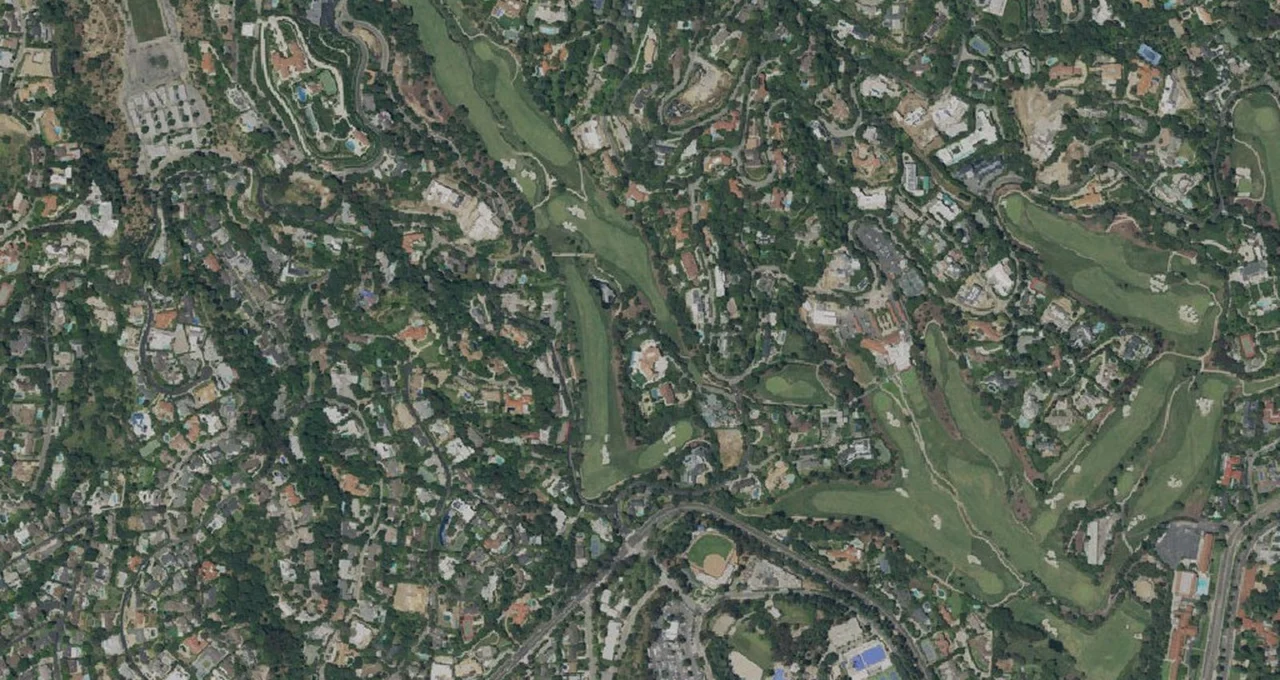
Bel-Air Country Club from the air. Aerial imagery USGS, domaine public.
Bel-Air Country Club
Holes
18
By
70
Length
6,782 yards from the Gold tees according to GolfPass (rating 74.3, slope 138); the hole-by-hole card adds up to 6,800. Set up at 6,187 yards for the 2023 U.S. Women's Amateur and about 6,284 for the 2026 Curtis Cup
Green fee
—
Best season
—
Bel-Air Country Club is a private club at 10768 Bellagio Road in Bel Air, on the West Side of Los Angeles, in the hills just north of Sunset Boulevard and the UCLA campus. Its 18-hole course was laid out in the mid-1920s by George C. Thomas Jr. with William P. “Billy” Bell, on land so broken up by canyons that golfers still move between some holes through tunnels, ride an elevator from the 9th green to the 10th tee, and cross a white suspension bridge, the Swinging Bridge, to reach the 10th green. Golf Digest calls the bridge the most famous in the city.
The course is a par 70, with a front nine of par 36 and a back nine of par 34. GolfPass lists its back Gold tees at 6,782 yards, with a course rating of 74.3 and a slope of 138; for national championships the USGA has set it up much shorter, at 6,187 yards for the 2023 U.S. Women’s Amateur and about 6,284 yards for the 2026 Curtis Cup. Between 2017 and 2018 the architect Tom Doak and his firm, Renaissance Golf Design, restored the course toward Thomas’s original design, and a new clubhouse opened in 2024 for the club’s centennial. The figures, the history and the points on which the sources disagree are set out below.
A canyon, a lost nine and a long par 3
The club was the idea of Alphonzo E. Bell Sr., an oil man who developed the Bel-Air residential tract in the 1920s. The UK Golf Guy review recounts that Bell made his fortune when he struck oil while drilling for water on his land; he then bought ground between Sunset Boulevard and the Santa Monica Mountains and sold it off in parcels. According to the University of Washington’s Pacific Coast Architecture Database, he founded the club to entertain the tract’s wealthy residents. Sources date the founding differently: the Top 100 Golf Courses website says the club was formed in 1924, another directory says 1925.
Bell hired George Thomas, the architect who also designed Riviera and the North Course of the Los Angeles Country Club. Thomas worked with Billy Bell, his construction and design collaborator (no relation to Alphonzo), and, according to Links Magazine, The Fried Egg and UCLA’s athletics website, with Jack Neville, the amateur golfer who had also designed Pebble Beach. The plan ran into trouble before construction began: in 1925, land intended for the course, flatter ground south of what is now Sunset Boulevard, went instead to the new UCLA campus. The Fried Egg writes that what remained, three steep canyons, could hold only about eleven holes.
The answer was the 10th hole. Thomas, who according to The Fried Egg had flown over the area in his seaplane, knew of a narrow valley to the west that could hold the back nine, if golfers could be taken across the ravine that separated it from the clubhouse. The famous version of the story, told by Links Magazine, is that Neville and Thomas tested the carry by putting a ball across the chasm; another account has each of the three men clearing it with a putter. The Fried Egg cautions that the story may not be entirely accurate. Whatever happened on that day, the result was a long par 3 played from one hill to a saddle on the other side, with the bridge for walking across, and a set of lighted concrete tunnels to get golfers out of the dead-end canyons. Golf Digest counts four places where players pass underground between parts of the course, including the tunnel to the clubhouse elevator.
Tom Doak, quoted by Links Magazine, called it possibly the most spectacular routing ever conceived, and added that if he had suggested such a plan to a client today, the client would think he was kidding.
The opening date also varies with the source. Wikipedia, Golf Digest and several directories give 1926; The Fried Egg and AmateurGolf.com give 1927. The original clubhouse, by the architect Carleton M. Winslow Sr. in the Spanish Colonial style, was built in 1926 and 1927 according to the Pacific Coast Architecture Database, and opened in 1926 according to Golf Digest.
Decades of changes, then a restoration
Like many courses of its era, Bel-Air was reworked repeatedly after the Second World War. The Fried Egg lists renovations by Dick Wilson in 1962 and Robert Trent Jones in 1974, and later work by Tom Fazio; other sources add George Fazio, and one names Robert Trent Jones Jr. rather than his father. Links Magazine writes that the course lost much of its character through changes that were fashionable at the time. Ponds were added, among them one in front of the 3rd green that Golf Digest dates to the 1980s, greens shrank, and, according to the UK Golf Guy review, the mounds on the “Mae West” green at the 12th were removed because they were thought unfair. In his Confidential Guide, Doak gave the course a 7 on his scale and named it among those he would most like to restore.
That chance came after a 2015 interview in which Doak discussed Bel-Air, which led the club’s green committee to invite him, according to The Fried Egg. Golf Course Architecture reported in October 2017 that work had begun on holes 11 to 16, with the aim of restoring all eighteen green complexes in time for grassing in early January 2018. The on-site team was Eric Iverson, Kye Goalby and Blake Conant, and the golf historian Tommy Naccarato did much of the research; historic aerial photographs guided the work. The Fried Egg adds that the crew found the original bunker outlines by digging down to old bunker sand, because mid-century crews had sometimes built over Thomas and Bell’s features rather than removing them.
According to Top 100 Golf Courses, the project cut the number of bunkers from 76 to 42, removed two ponds and changed half of the greens. Links Magazine adds that it restored the original green sizes and contours and the large Thomas and Bell bunkers, thinned trees and brought back short-grass surrounds. Golf Digest panelists, as quoted in its listing, wrote that the course now plays a few strokes easier because of the wider playing areas. The Fried Egg is more reserved: it finds the new bunkers too refined compared with the rugged originals, and considers the artificially powered brook running through holes 11 to 15 an eyesore.
The clubhouse followed. Golf Digest reports that the club demolished Winslow’s building in 2021 and replaced it with a larger one of about 64,000 square feet, designed by the firm MAI in the style and layout of the original, reusing stone from the old building and four fireplace hearths from the members’ card room. The USGA says it opened in September 2024.
What it asks of you
Bel-Air is not long by modern standards, and the reviewers agree that its difficulty lies elsewhere: in the slopes, the angles and the greens. The UK Golf Guy review describes generous width from the tee and rough that does not punish much, but sloping greens with large run-off areas that demand precise approaches and punish aggressive play toward the flag. A user of the Hole19 app warned in 2023 that the greens were running at 13 on the Stimpmeter.
Thomas opened each of his Los Angeles courses with a par 5 that good players can reach in two, Golf Digest notes, and Bel-Air’s first hole plays downhill toward Westwood and UCLA, with a view of downtown Los Angeles on clear days. UCLA’s website says Powell Library and Royce Hall can be seen from the first tee. The par 3s do much of the work of linking the canyons: the 3rd squeezes through a gap cut in a rocky hill, and the 5th and 16th climb to notches so that the tunnels to the next tees stay short, according to The Fried Egg. Because the western valley is cramped, Thomas staggered the landing areas of the 11th, 12th, 14th and 15th, and built the 12th green sideways into the canyon wall. Holes 9, 10 and 12 have no bunkers.
The figures below come from the only hole-by-hole card for the back tees that we found, a Gold tee card published by OpenGolfAPI, with the stroke index in brackets; the yardage of the 2023 U.S. Women’s Amateur setup, from the USGA fact sheet, follows. The Gold card adds up to 6,800 yards, while the same listing gives 6,782 yards in its header, and some of its holes may predate the restoration.
- 1st: par 5, 495 yards (5); 495 in 2023. Golf Digest gives 510 yards, with dry barrancas rebuilt in 2018 along the fairway.
- 2nd: par 4, 440 yards (1); 374 in 2023. The hardest hole on the card, described by the UK Golf Guy as a demanding uphill hole.
- 3rd: par 3, 175 yards (15); 155 in 2023. Golf Digest gives 160 yards. The pond added in the 1980s has given way to a large bunker in Thomas’s style, around an elevated green. Golf Digest reports that Richard Nixon, then a former vice president, made a hole-in-one here in 1961.
- 4th: par 4, 445 yards (7); 430 in 2023. Trees were removed on both sides of the fairway.
- 5th: par 3, 145 yards (17); 112 in 2023. A short par 3 with a steep back-to-front green.
- 6th: par 4, 380 yards (11); 378 in 2023.
- 7th: par 4, 415 yards (13); 348 in 2023.
- 8th: par 5, 515 yards (3); 495 in 2023.
- 9th: par 4, 410 yards (9); 318 in 2023. The Fried Egg’s favorite: a small barranca runs down the left and then crosses in front of a shallow, angled green, leaving a choice between attacking across it, laying up left or carrying a hill on the right.
- 10th: par 3, 205 yards (18); 205 in 2023. The canyon hole, described below.
- 11th: par 4, 395 yards (4); 385 in 2023. A dogleg left to a narrow green angled across the approach, with bunkers on both sides.
- 12th: par 4, 395 yards (6); 345 in 2023. The “Mae West” green, its mounds restored; no bunkers, and the angle of approach is everything, according to the UK Golf Guy.
- 13th: par 3, 240 yards (14); 172 in 2023. The gap between the two figures is the largest on the card.
- 14th: par 5, 585 yards (2); 547 in 2023. The longest hole.
- 15th: par 4, 465 yards (8); 426 in 2023.
- 16th: par 3, 200 yards (16); 150 in 2023. Downhill and well protected.
- 17th: par 4, 475 yards (12); 453 in 2023. From an elevated tee, the hole follows a ridge with a ravine on the inside of the dogleg; Golf Digest describes a canted fairway 50 yards wide and a narrow, sharply crowned green in front of the UCLA campus, where misses on either side are severe. Links Magazine writes that Bobby Jones and Ben Hogan are reported to have counted it among the best holes they played. The Fried Egg regrets that trees, probably planted to screen the houses below, now block the old shortcut along the ledge.
- 18th: par 4, 420 yards (10); 386 in 2023. The hole climbs about 70 feet, over a large center-line bunker, to a slender green near the Swinging Bridge, according to Links Magazine; the UK Golf Guy adds water down the right and trouble on the bank for a pull.
The 10th is the hole everyone remembers. After the 9th, golfers walk through a tunnel to an elevator that lifts them, by way of the clubhouse, to the high 10th tee. The tee shot crosses the ravine, with a carry of about 150 yards according to Links Magazine, to a green that Golf Digest compares to a catcher’s mitt, with moguls and ramps; short shots can roll some 20 yards back down the fairway. Players then cross the Swinging Bridge to reach the green. In 2015 the bridge was rededicated to Eddie Merrins, “the Little Pro,” the club’s head professional from 1962 to 2003.
Other tees on the GolfPass listing measure 6,523 yards from the Blue tees (72.6 and 135), 6,235 yards from the White tees (71.2 and 131), 5,812 yards from the Red tees (68.8 and 126) and 5,794 yards from the Green tees (68.6 and 126). The same listing gives women’s ratings of 73.0 and 142 from the White tees, at par 74, and 75.0 and 137 from the Red tees, at par 73; the women’s pars are not explained by any other source we read. For the 2023 U.S. Women’s Amateur, the USGA gave a rating of 76.7 and a slope of 142 for its 6,187-yard setup.
Championships
Bel-Air has hosted four USGA events, counting its share of a fifth. The 1976 U.S. Amateur was won there by Bill Sander, then 20, whom Sports Illustrated described as having eased to victory after a cautious final round; the Seattle Times later reported that he had arrived with flu symptoms. The 2004 U.S. Senior Amateur was won by Mark Bemowski. In 2017 the club shared the stroke-play qualifying of the U.S. Amateur with Riviera, where all the match play was held and Doc Redman won.
The U.S. Women’s Amateur came to Bel-Air from August 7 to 13, 2023, with a record 1,679 entries and a field of 156. Megan Schofill, then an Auburn graduate student, beat Latanna Stone of LSU 4 and 3 in the 36-hole final, according to Golf.com.
From June 12 to 14, 2026, the club hosted the 44th Curtis Cup, the match between the women amateurs of the United States and of Great Britain and Ireland. It was only the second Curtis Cup played in California, after San Francisco Golf Club in 1974. The United States, captained by Meghan Stasi, beat the defending side, captained by Catriona Matthew, by 13 points to 7; Kiara Romero secured the winning point, and Farah O’Keefe won all five of her matches, according to the Associated Press and AmateurGolf.com.
The course is also the home course of UCLA’s men’s and women’s golf teams, which, according to the university, have played there for more than 40 years; the club’s greenkeeping crew also maintains the tee and putting green of the team’s on-campus practice facility. Merrins coached the UCLA men from 1975 to 1989, a period that included the 1988 national title.
Hollywood stories
Bel-Air’s location has always drawn the film business. Golf Digest writes that its members have included actors, directors, musicians, athletes, professional golfers and U.S. presidents, and that the club’s motto for members is to leave your ego at the door. Merrins’s students, according to the Associated Press obituary published after his death in November 2023, included Bing Crosby, Ringo Starr, George C. Scott, Dean Martin, Celine Dion and Jack Nicholson.
The best-known story is that Howard Hughes landed a plane on one of the fairways, in pursuit of the actress Katharine Hepburn. It appears in many places but never with the same details: Top 100 Golf Courses puts the landing on the 14th fairway, the UK Golf Guy on the 8th, other accounts on the 7th or 9th, and one property listing dates it to 1936. We found no contemporary account to settle it, and treat it as club lore. The UK Golf Guy also relays that Johnny Weissmuller filmed Tarzan scenes in a hidden cave above the 4th hole, which we could not confirm elsewhere.
What golfers are saying
As a private club, Bel-Air has few public reviews, and most come from people who travel to play ranked courses. The main sources are nine reader reviews on Top 100 Golf Courses written between 2011 and 2026, with an overall rating of 4.5 out of 5; about twenty short ratings on the Hole19 app, averaging 4.8; and the detailed accounts of The Fried Egg and the UK Golf Guy. Golf Digest ranks the course 125th in the United States in its 2025 to 2026 list, which it says is its best placement in more than 30 years, and Top 100 Golf Courses ranks it 82nd in the country. What follows summarizes recurring themes, not individual voices.
What they like
The routing comes first, in almost every review: the way the holes fit into the canyons, the variety of shots and the sense of adventure created by the tunnels, the elevator and the bridge. Several reviewers describe the round as an experience as much as a game, and one called it the most fun he had had on a course in the western United States. The 10th, 17th and 9th are the holes named most often. Reviewers praise the green complexes and the restored bunkering, the condition of the course, and the welcoming atmosphere; the UK Golf Guy found it the most fun of Los Angeles’s three Thomas clubs, thanks to its members and staff. The history, from the bridge to the displays in the clubhouse, is part of the appeal.
What they like less
Criticism is mild but consistent on one point: the course is not as long or as hard as the other famous clubs nearby, and one reviewer wrote that it lives in the shadow of the North Course at the Los Angeles Country Club. A 2016 review, before the restoration, called it “Riviera-lite” for its similar opening holes and greens. The Fried Egg gives it one “egg” on its own scale, judging the restoration incomplete and the presentation “more Hollywood than Thomas,” while saying it has the potential to rise. App users mostly warn about the speed of the greens.
Nobody from Panxis has played the course. This section is a summary of what others have written, not our own judgment.
Who can play
Bel-Air is private. The club’s website states that guests must be accompanied by a member at all times; there are no public tee times, and no green fees are published. Guests check in at the security kiosk at the entrance, giving the name of the member they are meeting, and then use valet or self-parking.
The club publishes a dress code: for men, collared golf shirts tucked in, golf slacks or knickers, no shorts, jeans, tank tops or warm-up suits, and hats worn brim forward and removed in the Grill Room, Top of the Tee and Bel-Air Room; for women, shirts, skirts, culottes, tailored slacks or Bermuda shorts of a set minimum length. Only soft spikes are allowed. Mobile phone calls are banned on club premises outside the phone rooms on the clubhouse main floor, the locker rooms and members’ cars.
GolfNow lists carts for rent, walking permitted, a driving range and a putting green. The UK Golf Guy notes that outsiders sometimes play in charity events held at the club.
Getting there
The club’s address is 10768 Bellagio Road, Los Angeles, CA 90077, with a single main phone line on the club’s website, which also gives directions. Measured in a straight line from the middle of the course, the UCLA campus is less than a mile to the southeast, the San Diego Freeway (Interstate 405) a little over a mile to the west, the Los Angeles Country Club about two miles to the southeast and Riviera about three and a half miles to the southwest. Santa Monica Pier is about five and a half miles away, Los Angeles International Airport (LAX) and Hollywood Burbank Airport about ten miles each, and downtown Los Angeles about twelve miles to the east. These distances are measured on the map and not by road; on the West Side, traffic decides the travel time more than distance does.
Green fees
Bel-Air publishes no green fees, and none are given here. Golf is for members and the guests they accompany, and membership terms are not published. For anything else, start with the club’s website.
How this page was made
The factual frame comes from public sources: OpenStreetMap for the location; Wikidata (Q4881691) and Wikipedia for the entity record; the club’s website for the address, the guest, parking, dress and phone rules; the USGA’s 2023 U.S. Women’s Amateur fact sheet for the setup, hole-by-hole yardage and the list of earlier championships; AmateurGolf.com and the Associated Press for the 2026 Curtis Cup; Golf.com for the 2023 final; Sports Illustrated (1976) and the Seattle Times (1996) for Bill Sander; Clemson Athletics and AmateurGolf.com for the 2017 U.S. Amateur; Golf Course Architecture (October 2017) for the restoration; Links Magazine, The Fried Egg, Golf Digest (its April 2026 article by Derek Duncan, read in an authorized republication by Australian Golf Digest, and its course listing as quoted by search engines), Top 100 Golf Courses and the UK Golf Guy for the history, the holes and opinions; UCLA Athletics for the team’s home course; the Associated Press obituary of Eddie Merrins (November 2023); the Pacific Coast Architecture Database for the original clubhouse; and the GolfPass, GolfNow, OpenGolfAPI and Hole19 listings for tee data and ratings. Several pages refused our requests, including the USGA’s 2026 Curtis Cup and 2017 articles on the club, Golf Digest’s own pages, GolfPass, the Golf Club Atlas forum and a Geoff Shackelford preview behind a paywall; where we use them, it is only through what search engines quoted from them.
Where sources disagree, we say so. The club’s founding is 1924 for Top 100 Golf Courses and 1925 for another directory; the course opened in 1926 according to Wikipedia, Golf Digest and several directories, and in 1927 according to The Fried Egg and AmateurGolf.com. Jack Neville’s role is mentioned by some sources and not by others, and the putter story about the 10th is told in two versions and doubted by The Fried Egg. The later architects vary (Robert Trent Jones or his son; George Fazio named by some only), and the restoration is dated 2017 or 2018. Lengths differ: 6,782 yards for the Gold tees on GolfPass and in the OpenGolfAPI header, 6,800 on that card’s hole totals and “about 6,800” in Links Magazine; 6,505 yards on Wikipedia, 6,491 in the Pacific Coast Architecture Database and 6,482 on GolfNow, probably older tees; 6,187 for the 2023 championship and 6,284 for the 2026 Curtis Cup. Single holes differ too: the 1st is 495 or 510 yards, the 3rd 175 or 160. For the 5th, Links Magazine says the green was moved back to its 1926 location and the hole shortened by 30 yards, while the UK Golf Guy writes that the green was moved forward and rotated. The USGA fact sheet calls the 2023 event the club’s third USGA championship and dates its U.S. Amateur co-hosting to 2018; that championship was in fact played in 2017, as Clemson’s and other reports of the event confirm, and AmateurGolf.com counted the 2026 Curtis Cup as the fourth. The Howard Hughes landing is placed on four different fairways.
Some details will age: the rankings, the review counts and scores, the tee data, the dress code and the guest rules are those published up to October 2026, when we read them. Nobody from Panxis has played or visited this course, and this page is no substitute for a round. Public material on a private club is limited, and this page says less about the playing experience than it would for a public course.
The club has not paid for this page, has not seen it before publication and has no say over its content. This page contains no commercial link and earns us no commission. If you know the club and something here is wrong or out of date, write to us and we will correct it.
Other courses nearby
Closest to this one in our United States directory:
- Los Angeles Country Club — North Course — 2 mi
- Riviera Country Club — 4 mi
- El Caballero Country Club — 7 mi
- Brookside Golf Club — 17 mi
The hole to know
A par 3 of 205 yards across a ravine, with a carry of about 150 yards: golfers reach the tee by tunnel and elevator from the 9th green, and the green by the Swinging Bridge, the canyon crossing that made Thomas's back nine possible.