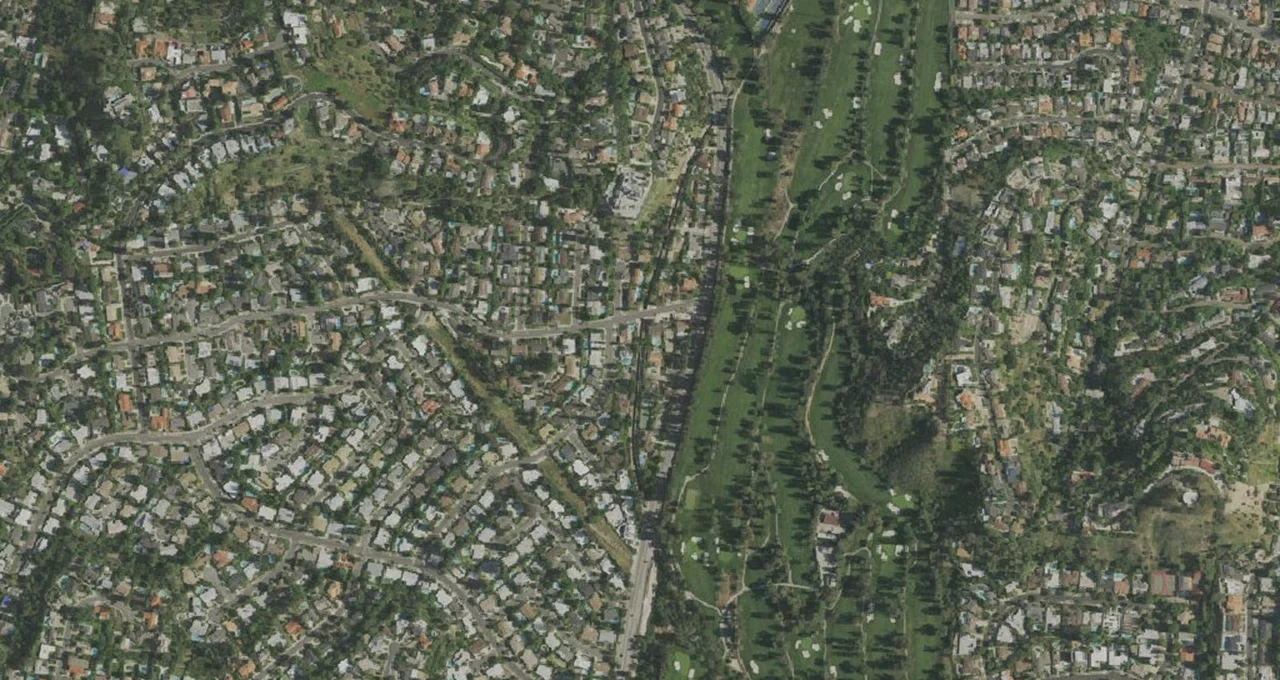
El Caballero Country Club from the air. Aerial imagery USGS, domaine public.
El Caballero Country Club
Holes
18
By
71 for men on the club's card (front 36, back 35); 72 for women from the same tees (GolfPass, Stymie); the LPGA winning scores of 2025 and 2026 imply a tournament par of 72
Length
7,019 yards from the Jones tees (rating 74.6, slope 137 for men, per GolfPass, OpenGolfAPI and Stymie); Black 6,726, El Cab 6,467, White 6,072, Gold 5,539, Knight 5,212, Family 3,243; older listings give 6,830 or 6,815 yards
Green fee
—
Best season
Year-round, according to GolfPass; OpenGolfAPI lists January to December
El Caballero Country Club is a private golf and country club in Tarzana, in the southwest of the San Fernando Valley in Los Angeles. The club gives its address as 18300 Tarzana Drive, Tarzana, CA 91356, on the wooded slopes that rise south of Ventura Boulevard toward the Santa Monica Mountains. Its 18-hole course is credited by the club and the USGA to Robert Trent Jones Sr. and dated to 1957, and it was reworked by his son Rees Jones in a renovation completed in 2021. On the current card it is a par 71 of 7,019 yards from the Jones tees, with a course rating of 74.6 and a slope of 137 for men, according to GolfPass, OpenGolfAPI and Stymie.
Two stories share the name. The first El Caballero was a 1920s club built on the ranch of Edgar Rice Burroughs, the author of the Tarzan novels, which gave Tarzana its name; that club staged the 1927 Los Angeles Open and then failed in the Depression. The second is the present club, founded in the 1950s by Bernie Shapiro as a club open to anyone regardless of religion, race or gender, at a time when many Los Angeles clubs were not. In recent years the course has returned to the national calendar: the USGA held the 2018 U.S. Women’s Amateur Four-Ball and the 2024 U.S. Girls’ Junior there, and the LPGA Tour played its JM Eagle LA Championship there in 2025 and 2026. This page is a portrait built from public sources. Because El Caballero is private, most readers will only see it as a member’s guest or as tournament spectators.
Burroughs, the 1927 Los Angeles Open and a failed first club
The club’s own history page explains the name: Spanish settlers called the creek that drains this part of the north slope of the Santa Monica Mountains “El Caballero,” the gentleman, and the course is still named after it. According to the same page, Harrison Grey Otis, the publisher of the Los Angeles Times, bought a 550-acre ranch here in 1911, and after his death in 1915 his estate sold it to Edgar Rice Burroughs, who called it Tarzana Ranch. The local history site Vintage Los Angeles dates Otis’s purchase to 1915 and Burroughs’s to February 1919, and the Homestead Museum, in a 2022 article on a press photo of the club, also gives 1919 for Burroughs.
Burroughs developed part of the ranch and, in the mid-1920s, built a golf course with home sites around it. The Homestead Museum writes that the club’s officers were named around March 1924, that Burroughs’s Mission Revival mansion became the clubhouse and opened over the Fourth of July weekend of 1924, and that the course, designed by William P. Bell with the help of his partner George C. Thomas Jr., opened on the weekend of September 5 and 6, 1925, with about 200 entrants in an inaugural invitational. It adds that the course was planned for 27 holes but built with 18. Vintage Los Angeles simply gives 1924 as the opening year and describes a course of 6,588 yards running through parts of two large canyons, with a tiny, bunker-ringed green at the 115-yard 17th.
The high point came quickly. The Los Angeles Open, the event that is today the PGA TOUR’s Genesis Invitational, was played at El Caballero in January 1927, its only visit, according to Wikipedia’s history of the tournament. The Homestead Museum gives the dates as January 7 to 9, 1927, and says Bobby Cruickshank won with a total of 282, with George Von Elm the leading amateur at 297. The club did not survive the years that followed. The Homestead Museum says it admitted the public in 1928 to stay afloat and was sold in 1930; the club’s history page says Burroughs lost the ranch to foreclosure by 1929. Burroughs himself stayed in Tarzana, where, according to Vintage Los Angeles, he kept an office on Ventura Boulevard until 1950, the year of his death.
Bernie Shapiro and the club that anyone could join
The present club starts with Bernie Shapiro, a businessman who, according to his 2005 obituary in the Jewish Journal, had built and sold a vending and nut-processing company called Royal Seal. The obituary says that after a round at Bel-Air Country Club in 1954 he wanted to join, but a friend told him he would not be welcome because he was Jewish, a story he told the Los Angeles Times in 1998. With a few friends, including the supermarket owner Eugene Gelson, he set out to build a member-owned club that anyone could join.
The club’s history page says the property had been held by a bank for several years when a neighbor, Norman Herman, began negotiations, and that in 1955 Shapiro met Herman’s widow, Sophia, who would not sell but agreed to a long-term lease. The founding rule, quoted by the club and in its 2021 announcement, reads: “No person shall be denied the privilege of the club, or employment by it, because of their race, color, creed, gender or religious belief.” According to the same announcement, members were judged on reputation, community service and philanthropy. The club, the Jewish Journal and Club + Resort Business all date the opening to 1957. Vintage Los Angeles writes that the new club was built on land adjacent to the old one and that Otis’s old ranch house was razed and replaced by a new clubhouse.
Who designed the present course is less settled than the club’s own pages suggest. The club, the USGA, FORE Magazine and Rees Jones’s firm credit Robert Trent Jones Sr., with the USGA dating his design to 1957. The Top 100 Golf Courses website calls the course a Jones remodel of an early 1960s design by William Johnson, and the JM Eagle LA Championship’s site says the original design is credited to William Johnson and that Jones redesigned it in 1963. The Dutch-language Wikipedia article, the only Wikipedia article on the club, names a third architect, Norman Macbeth, and a founding year of 1954. We found no primary document that settles the question.
Harbottle, Rees Jones and the 2021 relaunch
The course has been reworked twice in the last two decades. The USGA and FORE Magazine say the late John Harbottle renovated it in 2005, reworking the bunkers, the water features and a few greens. The larger project came later. Rees Jones’s firm and the club say the board began a comprehensive upgrade of the property in 2017, and the club officially relaunched the course on November 17, 2021, according to the announcement published by Rees Jones’s firm. That announcement and Club + Resort Business describe a three-year project; Golf Course Architecture and the Top 100 Golf Courses website describe a nine-month renovation of the course itself, which suggests the three years cover the whole program rather than the time the course was closed.
Rees Jones worked with his longtime associate Steve Weisser. Golf Course Architecture reports that every green was redesigned, bunkers were repositioned and made shallower and easier to walk into, fairways were regraded and trees were removed. Its captions describe some of the changes: a sixth green that receives shots more readily, a tenth hole where fill on the left now gives a bailout area short of the bunker, with an upsweep added at the back of the green, and a twelfth where trees near the cart path were removed and the green redesigned. Jones told the magazine that greens that ran at about 6 to 7 on the Stimpmeter in the 1960s would now run at about 9.5 to 12, and that the contours would be “probably more manageable” for members. The club’s course page adds smaller bunkers with new white sand, softened slopes and drought-tolerant plantings such as bougainvillea, with views opened toward native oak, olive and sycamore trees.
Water was the other driver. All of the turf was replaced with hybrid Bermuda grass, which the club says is more tolerant of drought, heat and disease. The club and Rees Jones’s firm say the course uses 30 percent less water and saves more than 35 million gallons a year; the JM Eagle LA Championship’s site gives a 33 percent reduction and says the work earned a Leadership in Conservation award from the Metropolitan Water District. Rees Jones’s firm lists the project as runner-up for America’s Best Renovation in Golf Digest’s 2023 awards. The practice facility was also rebuilt, with Toptracer and FlightScope systems, according to the club’s announcement.
Championships at El Caballero
Between the two Joneses, the course built a steady tournament record. The USGA and Wikipedia list El Caballero as the venue of the LPGA Tour’s Office Depot Championship from 2002 to 2004: Se Ri Pak won in 2002 and Annika Sorenstam in 2003 and 2004. The USGA also says the club has hosted many sectional qualifiers for the U.S. Open and the U.S. Amateur, most recently, at the time of its 2015 announcement, for the 2014 U.S. Senior Open.
The club’s first USGA championship was the 2018 U.S. Women’s Amateur Four-Ball, played from April 28 to May 2, 2018. FORE Magazine wrote at the time that none of the 25 USGA championships played in Southern California until then had come to the San Fernando Valley. In the final, Katrina Prendergast and Ellen Secor won 1 up against Lei Ye and Yachun Chang (spelled Yuchan Chang on Wikipedia), after winning three holes in a row from the 15th, according to the USGA. The second was the 75th U.S. Girls’ Junior, held from July 15 to 20, 2024; the USGA fact sheet listed the course at 6,347 yards and par 71 before the event, and Rianne Malixi of the Philippines beat Asterisk Talley 8 and 7, which the USGA called the largest margin in a final in the championship’s history.
The LPGA Tour came back while its usual Los Angeles venue, Wilshire Country Club, was being renovated. The JM Eagle LA Championship was played at El Caballero from April 14 to 20, 2025, and again in April 2026. Ingrid Lindblad of Sweden won the 2025 edition by one stroke at 21 under par, with a second-round 63, according to the AP and Wikipedia. In 2026, Hannah Green of Australia won a three-way playoff against Sei Young Kim and Jin Hee Im at 17 under, with a birdie on the 18th hole, according to the AP. The tournament’s site says the event returns to Wilshire in April 2027.
What the course asks of you
El Caballero is a parkland course on rolling ground cut by its creek, with tree-lined fairways. The club describes “tight fairways, gentle doglegs and greenside bunkers,” laid over modest hills and mature trees, and Rees Jones’s firm uses almost the same words. OpenGolfAPI counts 52 bunkers and eight water hazards.
The card published by GolfPass and Stymie has seven sets of tees: Jones at 7,019 yards, Black at 6,726, El Cab at 6,467, White at 6,072, Gold at 5,539, Knight at 5,212 and a short Family set at 3,243. For men they are rated from 74.6 and 137 (Jones) down to 58.1 and 95 (Family); for women the same tees play to a par of 72, with the Jones tees rated 80.4 and 146. The front nine is a par 36 and the back nine a par 35. OpenGolfAPI gives the hole-by-hole card from the Jones tees:
- Front nine: 1st, par 5, 522 yards; 2nd, par 4, 444; 3rd, par 4, 381; 4th, par 4, 409; 5th, par 4, 366; 6th, par 3, 217; 7th, par 5, 509; 8th, par 3, 226; 9th, par 4, 482. Out: 3,556 yards, par 36.
- Back nine: 10th, par 3, 181; 11th, par 4, 402; 12th, par 5, 541; 13th, par 4, 385; 14th, par 4, 449; 15th, par 4, 424; 16th, par 3, 169; 17th, par 4, 460; 18th, par 4, 452. In: 3,463 yards, par 35.
The course has three par 5s and four par 3s, and its strength is in the long par 4s: the 2nd (stroke index 1), the 9th, the 14th, the 17th (stroke index 2) and the 18th all measure more than 440 yards from the back. Two par 3s exceed 215 yards on the front nine. The greens are the feature everyone mentions. The club’s head professional at the time told FORE Magazine in 2018 that “it was the greens that made it tough” for the LPGA players, and that “it’s a course that brings out your weakness, whatever it is.”
A few holes come up in several accounts:
- The 1st, a par 5 of 522 yards from the Jones tees, which a 2012 reviewer on Greenskeeper.org found a demanding uphill start. Global Traveler, in an undated account of a round, notes out of bounds on the left and trees on the right.
- The 5th, a shortish par 4 of 366 yards with water front left, where FORE Magazine says long hitters can drive close to the green.
- The 7th, a par 5 of 509 yards that doglegs to the right; FORE Magazine says the green may be reachable in two.
- The 10th, a par 3 of 181 yards with a pond in front and to the right in Global Traveler’s description, where Rees Jones added a bailout area on the left.
- The 17th, described below.
The 17th shows how the same hole can change par. On the club’s card it is a par 4 of 460 yards and the second hardest hole by stroke index. FORE Magazine wrote that the USGA set it up as a par 5 of about 460 yards for the 2018 Four-Ball, with water on the left of a green that is not large, and the USGA’s account of the final mentions a birdie on “the par-5 17th.” Global Traveler also notes the pond in front of and to the left of that green.
The LPGA set the course up its own way, and the public record is confusing. Wikipedia lists the JM Eagle LA Championship at par 71 and 6,258 yards, but the winning totals it gives (267 at 21 under in 2025, 271 at 17 under in 2026) only add up on a par of 72. AP reports from both years mention a par-5 11th and 16th, a par-3 17th and a par-4 18th, which does not match the members’ card hole for hole. We could not find the tournament scorecard, so we cannot say how the holes were renumbered or which hole changed par.
What golfers say
El Caballero is private, so public reviews are few. The themes below come from what we could read in October 2026: four reviews on Greenskeeper.org, a Southern California golf community, dated 2012, 2017 (two) and May 2026; one review on the Top 100 Golf Courses website from March 2021, rated 3.5 out of 5; a short 2013 review on IllinoisGolf.com; and an undated first-person round in Global Traveler. The golf app 18Birdies showed an average of 5.0 out of 5 from 40 ratings, with the course rated very hard and its greens very fast, but no review text was visible. We also used published comments from the club’s staff, Rees Jones and the press. These are other people’s opinions, not ours. Nobody from Panxis has played the course, and we name no reviewer.
What comes up in its favor
- Conditioning: two of the four Greenskeeper.org reviews call the conditions immaculate, all three that give a score rate them highly, and the May 2026 review praises firm, smooth greens and tight fairways after the 2021 renovation.
- The greens: fast and very undulating, the feature reviewers and the club’s staff return to most often.
- The 2021 work: the 2026 reviewer singles out improved bunkers, sightlines and trees.
- Pace: two Greenskeeper.org reviewers finished in under four hours (one teed off at 7:10 a.m. and was done before 11), and 18Birdies rates the pace of play very fast.
- Service and setting: helpful staff and caddies, the renovated halfway house and the clubhouse interior are mentioned, and members are said to repair divots and ball marks.
- Variety: one reviewer found the holes varied and engaging, and the 2013 review calls it a “must play” if you get the chance.
What comes up against
- The rough: thick and grabby in three of the four Greenskeeper.org reviews, making recoveries around the greens hard.
- Difficult greens: the 2012 reviewer found them very fast and difficult, a strength for some players and a trial for others.
- The hills: the 2021 Top 100 reviewer found the course very hilly, which adds to the challenge.
- Bunkers: one 2017 reviewer felt the difficulty came from large bunkers rather than length, although the 2021 renovation made them smaller.
- Access: the obvious one. There is no way to play without a member.
Most of these reviews are few and some are old; only one was written after the 2021 renovation. They should be read as a sketch, not a verdict.
Getting there and playing
El Caballero is a private club. Its guest information page opens with “We are delighted to welcome guests of members,” OpenGolfAPI lists the course as private, and Stymie says tee times are arranged through a member. The club’s website has a member login and no public tee-time booking or published membership process. The club does not publish its rates, and we do not report any; the club website is the place to ask.
The guest rules are specific. All guests must use valet parking, and tipping is not allowed except for caddies. On the golf course, men wear collared shirts with sleeves, tucked in, with tailored trousers or golf shorts; T-shirts, cargo shorts and denim are not allowed; women’s tops need a collar or sleeves, and denim and tight workout bottoms are not allowed. Spikeless or flat rubber-soled shoes are required, and men remove hats indoors. Phones must be silent or on vibrate, with calls not allowed on holes 1, 9, 10 and 18, the driving range, the putting greens or the clubhouse patios.
On carts, the club’s pages say nothing. GolfPass lists carts, caddies and rental clubs as available, walking as allowed and metal spikes as not allowed; Stymie also says walking is permitted and carts are available, and 18Birdies lists motor carts and pull carts. GolfPass gives the season as year-round, and OpenGolfAPI lists January to December. The practice facilities include a driving range, a short-game area and a putting green, according to GolfPass, with the technology added in 2021.
For most people, the realistic way to see El Caballero is a tournament. The LPGA has announced its return to Wilshire Country Club in 2027, and we found no future USGA championship scheduled at El Caballero when we prepared this page.
The USGA describes Tarzana as less than 25 miles from Los Angeles, and FORE Magazine gives about 30 minutes to downtown and 15 minutes to Burbank by car. Measured on the map in a straight line, the course is about 18 miles from Los Angeles City Hall, about 16 miles from Los Angeles International Airport, about 10.5 miles from Hollywood Burbank Airport and about 4.5 miles from Van Nuys Airport. These are not road distances, and Valley traffic can stretch the drive considerably.
How we built this page
The factual frame comes from public sources: OpenStreetMap and Wikidata for the location and identifiers; the club’s website, elcaballerocc.com, for its history page, its course page and its guest information; the announcement of the 2021 relaunch published by Rees Jones’s firm and Club + Resort Business, and the firm’s project page; Golf Course Architecture for the renovation; the Homestead Museum and Vintage Los Angeles for the 1920s club; the Jewish Journal’s 2005 obituary of Bernie Shapiro; the USGA announcement of 2015, USGA championship reports and FORE Magazine for the 2018 and 2024 championships; Wikipedia for the Los Angeles Open, the Office Depot Championship, the U.S. Women’s Amateur Four-Ball, the U.S. Girls’ Junior and the JM Eagle LA Championship; AP reports for the 2025 and 2026 LPGA events and the tournament’s own site; the Dutch-language Wikipedia article; GolfPass, OpenGolfAPI, Stymie and 18Birdies for the card and ratings; and Greenskeeper.org, the Top 100 Golf Courses website, IllinoisGolf.com and Global Traveler for reviews. Several pages refused our requests, including the GolfPass review pages, Golf Digest, a USGA championship fact sheet and a golf architecture forum; we used only what we could read.
Where sources disagree, we say so. The current course is credited to Robert Trent Jones Sr. in 1957 by the club and the USGA, to Jones remodeling a William Johnson design by the Top 100 Golf Courses website and the JM Eagle site (which dates the redesign to 1963), and to Norman Macbeth in 1954 by the Dutch-language Wikipedia. The 1920s course opened in 1924 according to Vintage Los Angeles and on September 5 and 6, 1925, according to the Homestead Museum; Otis bought the ranch in 1911 according to the club and in 1915 according to Vintage Los Angeles; the first club was lost by 1929 according to the club and sold in 1930 according to the Homestead Museum. Vintage Los Angeles places the modern club on land adjacent to the old one, which the club’s history does not say. The 2021 work is a three-year project for the club’s announcement and a nine-month renovation for Golf Course Architecture and the Top 100 Golf Courses website; the water saving is 30 percent for the club and 33 percent for the JM Eagle site. Stymie lists bent grass greens, while the club says all turf was replaced with hybrid Bermuda and GolfPass lists Bermuda greens. The back-tee length is 7,019 yards on today’s card, against 6,830 yards in GolfPass’s summary and 6,815 yards on the older card that 18Birdies still shows, and the hole yardages in Global Traveler’s account (174 yards at the 6th, 141 at the 10th) match neither. Wikidata places the club in Encino, OpenStreetMap and the club in Tarzana. The LPGA par of 72 implied by the winning scores conflicts with the par 71 that Wikipedia lists for the event.
Some details will age: the reviews read in October 2026, the tee ratings, which are revised periodically, the guest rules, and the club’s tournament schedule after the LPGA’s return to Wilshire. The opinion section reports recurring themes rather than individual voices. Nobody from Panxis has played or visited this course, and this page is no substitute for a round.
The club has not paid for this page, has not seen it before publication and has no say over its content. This page contains no commercial link and earns us no commission. If you know the club and something here is wrong or out of date, write to us and we will correct it.
Other courses nearby
Closest to this one in our United States directory:
- Bel-Air Country Club — 7 mi
- Riviera Country Club — 8 mi
- Los Angeles Country Club — North Course — 9 mi
- Brookside Golf Club — 21 mi
The hole to know
A par 4 of 460 yards from the Jones tees and stroke index 2, with water on the left of a fairly small green. The USGA played it as a par 5 for the 2018 U.S. Women's Amateur Four-Ball (FORE Magazine).