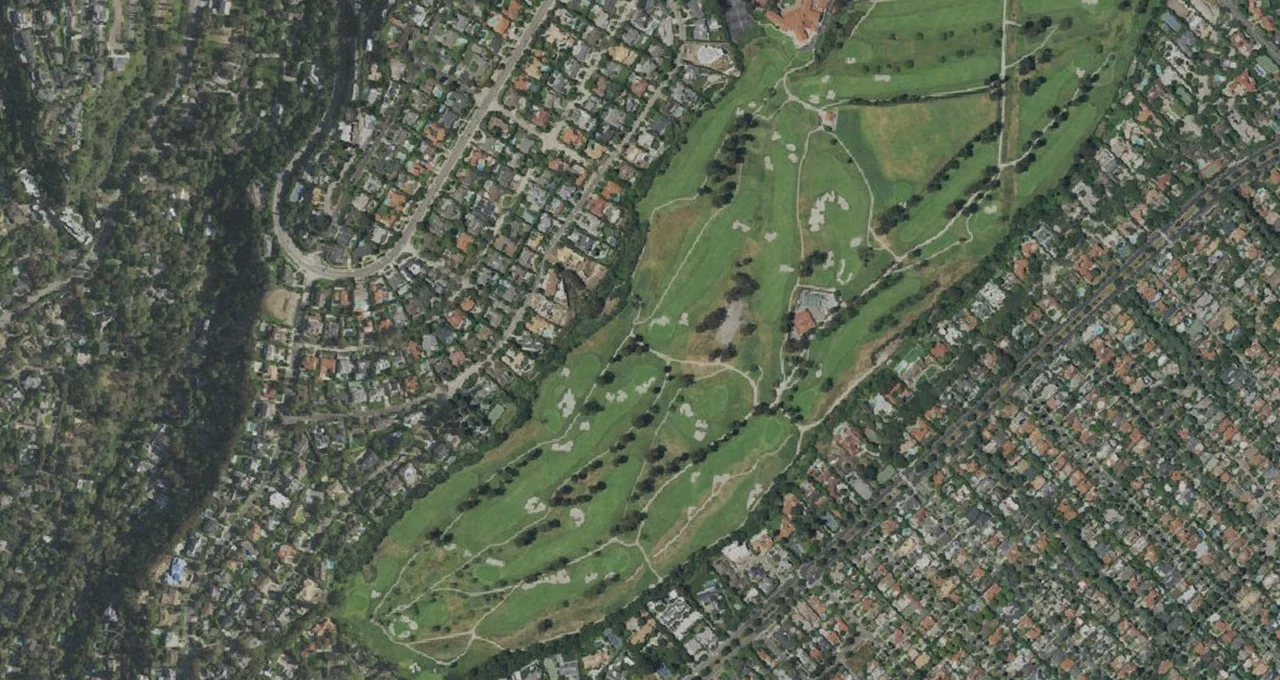
Riviera Country Club from the air. Aerial imagery USGS, domaine public.
Riviera Country Club
Holes
18
By
71
Length
7,384 yards (2026 Genesis Invitational setup)
Green fee
—
Best season
Year-round
The Riviera Country Club sits in Santa Monica Canyon, in the Pacific Palisades neighborhood on the Westside of Los Angeles. It was founded in 1926 by members of the Los Angeles Athletic Club, and George C. Thomas Jr. designed the course with William P. Bell, who helped lay it out and organize the crew that built it. According to the club, Thomas worked on the design for 18 months and through 15 versions, the course opened in 1927, and the Spanish revival clubhouse followed in 1928. Thomas, an amateur architect, gave his services without charge.
The course is a par 71: 35 out, 36 in, with four par 3s, three par 5s and eleven par 4s. For the 2026 Genesis Invitational it was set up at 7,384 yards, 63 yards longer than for the last PGA TOUR event played there, in 2024. The fairways and rough are kikuyu grass and the greens are Poa annua. Member tees are shorter, but the club’s website does not publish a scorecard, so the tournament figure is the only current one we can confirm.
Few courses carry this much championship history. Riviera hosted the 1948 U.S. Open, won by Ben Hogan with a total of 276 that set a new record for the championship, the PGA Championship in 1983 and 1995, the U.S. Senior Open in 1998, the U.S. Amateur in 2017 and, in June 2026, the U.S. Women’s Open, won by Nelly Korda at 8 under par. The USGA has chosen it for the 2031 U.S. Open, and the 2028 Olympic golf competitions will be played here, almost a century after the club hosted parts of the equestrian and modern pentathlon events of the 1932 Games.
The PGA TOUR event now called the Genesis Invitational, which began as the Los Angeles Open, has been played at Riviera almost every February since 1973. It went elsewhere in 2025: the Palisades Fire of January that year forced it south to Torrey Pines. The fire came within about a quarter mile of the 17th green, but the club itself was spared. The tournament returned in February 2026, and Jacob Bridgeman won it at 18 under par for his first PGA TOUR title. Hogan’s three wins at the club in 1947 and 1948, two Los Angeles Opens and the U.S. Open, earned it the nickname Hogan’s Alley, which it shares with Colonial in Fort Worth.
What it asks of you
Riviera does not overwhelm with length. It asks for control, and it asks for it from the very first shot. The 1st tee sits about 75 feet above the fairway, next to the clubhouse, and the hole is a short par 5 of 503 yards. The drop and the width invite a driver, but out of bounds on the left and a barranca crossing the fairway explain why most tour players take an iron. It is statistically the easiest hole on the course, and it hands over its birdies only to players who respect it.
Then the course turns serious. The 2nd is a long par 4 of 471 yards that plays uphill, often into the breeze off the Pacific, to a green the tournament guide describes as only 25 feet wide at its widest point. It is the number one handicap hole. The 4th, the par 3 Hogan called the best in America, is built on the Redan idea: a large bunker in front and a green that falls hard from right to left, so the good shot uses the slope rather than flying at the flag. It was stretched to 273 yards for the 2026 Genesis Invitational; members play it far shorter, but the principle does not change.
The 6th is the hole people know from photographs: a par 3 of 199 yards with a bunker in the middle of the green. Find the wrong side of it and you must choose between putting around the sand and chipping over it. The 7th and 8th test the tee shot, with bunkers and the barranca squeezing the 7th and a split fairway on the 8th, divided by a dry wash. The 9th, long and uphill, finishes the front nine on a green set on a shelf.
The 10th and the back nine
The 10th is the most discussed short par 4 in American golf: 315 yards, reachable from the tee for a strong player, with a narrow green angled from left to right and bunkers on three sides. A bunker across the left of the fairway shapes the layup. Going for the green and missing right usually leaves a pitch over sand onto a surface running away from you, which is why eagle and bogey are equally possible. There is no water on the hole; the whole danger lies in the angle.
The 11th is a par 5 of 583 yards and a birdie chance for anyone who finds the fairway, with eucalyptus and the barranca in play. The 12th is a long par 4 into a narrow green guarded by the barranca, bunkers and a tree on the left known as Bogey’s Tree, after Humphrey Bogart, a member. The 13th is driven down a corridor of eucalyptus with the barranca on the left. The 14th is a par 3 to Riviera’s largest green, wide but shallow, with two large bunkers in front.
The 15th is a long par 4 bending right, into the sea breeze and, late in the day, into the setting sun, onto a two-tier green. It was the hardest hole of the 2020 tournament. The 16th, the shortest par 3, is a small green ringed by deep bunkers. The 17th, the longest hole at 590 yards from the tournament tees, climbs toward the clubhouse, and the 18th finishes with a blind tee shot played from well below the fairway to a green in a natural amphitheater under the clubhouse terrace.
The grass
Kikuyu is the variable nobody escapes. The grass, from East Africa, was brought to Riviera for its polo field in the 1930s and planted on slopes against erosion, then spread until it took over the course. On the fairway it gives excellent lies, with the ball sitting up. In the rough it behaves very differently: the ball may perch on top, which produces flyers, or sink to the bottom, where the grass grabs the hosel and closes the clubface. Around the greens it makes delicate chips difficult, because club and ball tend to get tangled. For a visitor used to bentgrass or Bermuda, the practical rule is simple: from the rough, take the sure way back to the fairway.
What players say about it
Riviera is a private club, so most public accounts come from guests, architecture writers and tournament coverage. The points below summarize what recurs in public reviews, forums and articles. These are other people’s opinions, not ours: we have not played the course, and we name and quote no one.
What comes up in its favor
- The strategy is the main reason people love it: holes that offer a real choice from the tee, reward thought over power, and allow a recovery from trouble without drowning the round in penalties.
- The variety of the routing, which sends the front nine in many different directions and makes the wind change from hole to hole.
- The stretch from the 5th to the 8th and, above all, the 10th, often held up as the best short par 4 anywhere.
- The caddies, described by guests as well informed about the club’s history, about how the course has changed, and about how to play from kikuyu.
- The history: Hogan, the Los Angeles Open and the atmosphere of the 18th below the clubhouse.
- The course is said to be harder in person than it looks on television, with deeper bunkers and a more punishing rough than a broadcast suggests.
What comes up against
- Access: the course is private, and a round depends on an invitation.
- Architecture critics feel that successive renovations, especially the work of the early 2000s, have softened or reshaped the original bunkers and the barranca, and that the course has lost some of the rugged look of its early photographs.
- The eucalyptus trees are a recurring complaint, particularly on the 13th, which some writers see as out of character with the rest of the course.
- Kikuyu divides opinion: it removes the ground game around many greens and makes some short shots a lottery, which not everyone enjoys.
- Narrow mowing lines on some fairways are said to reduce the strategic options the design was built for.
- Some reviewers find the 18th more impressive as a setting than as a golf hole.
The facilities
Riviera is a golf and tennis club. The club describes its tennis side as one of the oldest and largest in the western United States, with 24 courts and a large teaching program. The clubhouse, completed in 1928 in the Spanish revival style, overlooks the 18th green; after the 2025 fire, the club opened rooms on its top floor to members displaced by the fire.
The club’s equestrian past survives mainly in its history: the 1932 Olympic events and the polo field that brought kikuyu to the property. Caddies are part of the guest experience in visitor accounts. Public descriptions of the dress code mention a collared shirt, slacks or tailored shorts, and no denim; your host is the best source for current rules.
Getting there and when to go
The club is at 1250 Capri Drive in Pacific Palisades; the course lies about a mile from the Pacific. It is about 15 miles west of downtown Los Angeles as the crow flies and about 9 miles north of LAX, but distances in Los Angeles are measured in traffic, and the drive can take far longer than the mileage suggests. Pacific Palisades is still rebuilding after the 2025 fire, and construction traffic is part of the neighborhood.
The course is played year-round. Southern California winters are mild, with most of the rain falling between November and March; early summer often brings a marine layer that keeps mornings gray and cool near the coast. The course is given over to the Genesis Invitational each February and to any championship it hosts, which will include the 2028 Olympics and the 2031 U.S. Open. Play is by invitation of a member.
Green fees
Riviera is a private club and publishes no green fee. Guest conditions are set by the club and depend on the invitation. Some visitor accounts describe other arrangements with prices attached; the club does not confirm them, so we do not repeat them. See the club’s own site.
How this page was made
The factual frame comes from public sources: OpenStreetMap for the location; the club’s website for its founding, architect, opening dates, clubhouse and tennis facilities; the PGA TOUR and published scorecards for the 2026 tournament par, length and hole yardages; the Genesis Invitational’s hole-by-hole guide for the character of each hole; the USGA and championship coverage for the U.S. Open, U.S. Women’s Open and 2031 selection; LA28 and the International Golf Federation for the Olympic events; and press coverage for the 2025 fire. The encyclopedia entry was used with caution, for the handicap order, the grass and the course’s general history. The opinion section summarizes public reviews, forums and architecture writing read in September 2026; we report recurring themes rather than individual voices, and we reproduce no quotations.
We have not played this course, and this page is no substitute for a round. The club has not paid for this page, has not seen it before publication and has no say over its content, and the page carries no commercial link and earns no commission. If a page on Panxis Golf is ever paid for by a brand, it will say so at the top, before the first line. If you know the course and something here is wrong or out of date, write to us and we will correct it.
Other courses nearby
Closest to this one in our United States directory:
- Bel-Air Country Club — 4 mi
- Los Angeles Country Club — North Course — 5 mi
- El Caballero Country Club — 8 mi
- Brookside Golf Club — 21 mi
The hole to know
A 315-yard par 4 that a strong player can drive, with a narrow green angled from left to right and bunkers on three sides. A bunker across the left of the fairway shapes the layup, and a miss to the right of the green leaves a pitch over sand onto a surface running away: eagle and bogey are equally possible.