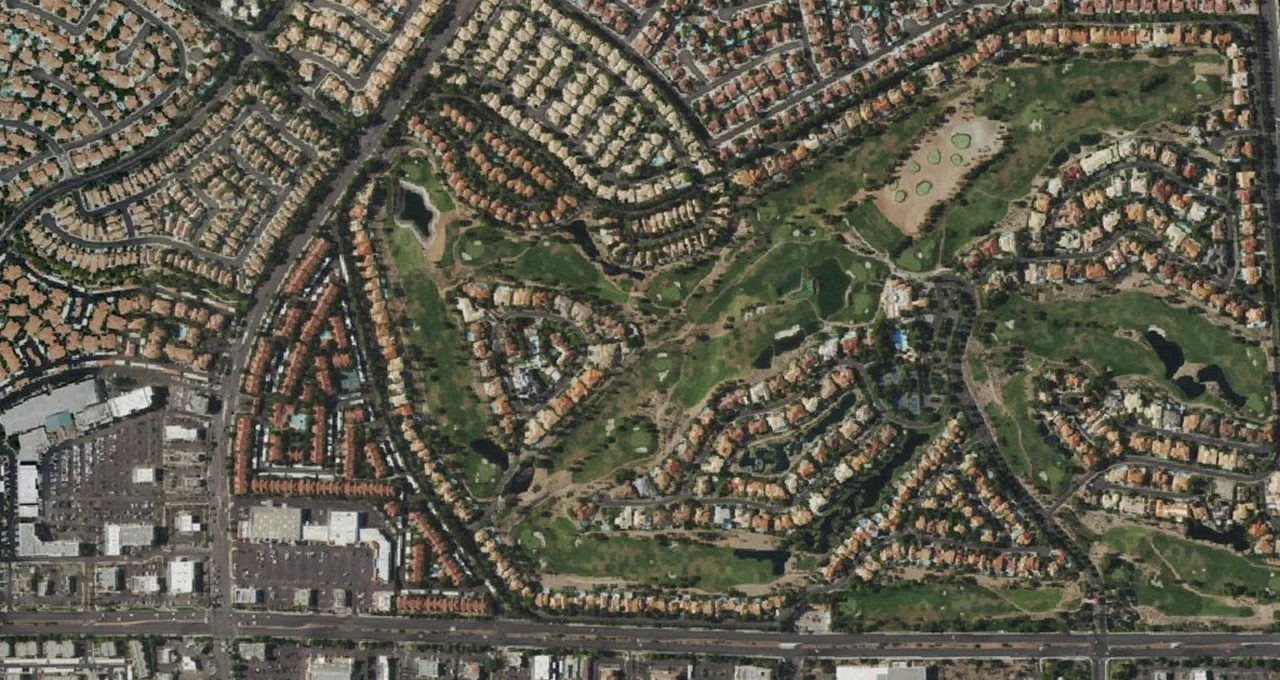
Canyon Gate Country Club from the air. Aerial imagery USGS, domaine public.
Canyon Gate Country Club
Holes
18
By
72
Length
6,769 yards from the longest tees on the club's scorecard (rating 72.6, slope 137); directories give 73.0/136 for the same tees, and Wikipedia 6,742 yards
Green fee
—
Best season
Year-round, according to a golf directory; summers are very hot and winters can be windy
Canyon Gate Country Club is a private golf and country club on the west side of Las Vegas, Nevada, inside a guard-gated residential community of the same name. The neighborhood lies off West Sahara Avenue, between South Durango Drive and South Fort Apache Road, with the club’s address at 2001 Canyon Gate Drive. Its 18-hole championship course was designed by Ted Robinson, the California architect who designed more than 160 courses, and the club gives 1989 as the year it was built. Canyon Gate belongs to Invited, the Dallas-area operator of private clubs formerly known as ClubCorp.
On the scorecard the club publishes, the course is a par 72 that measures 6,769 yards from the longest of its four sets of tees, with a course rating of 72.6 and a slope of 137. The club says the layout covers 160 acres. Its signature is water: lagoons and ponds come into play on many holes, an unusual sight in the Mojave Desert, and the course is framed by mature trees, palms and the walls of custom homes, with the red sandstone of Red Rock Canyon and the Spring Mountains on the western horizon. In 1993 it hosted a stop on the LPGA Tour.
A lake-filled course on the edge of the desert
Canyon Gate was among the early private golf communities on the west side of the valley. A 2015 feature in the Las Vegas Review-Journal described it as a neighborhood once on the far fringe of town that had become nearly central to the west side as the city grew around it, with Summerlin, Tivoli Village and Boca Park now close by. The same article quoted a couple who said they bought the second home sold in the development, in 1989, which fits the year the club gives for the course. We found no reliable primary source naming the original developer; one online club directory names one, but the same site gives founding dates that contradict every other source, so we leave it out.
The architect is better documented. Ted Robinson, born in Long Beach, California, in 1923 and died in Laguna Beach in 2008, built most of his work in the western United States, Hawaii and Asia. According to Wikipedia, his fondness for lakes, waterfalls and streams earned him the nickname “King of Waterscapes.” His best-known course, Sahalee Country Club near Seattle, hosted the 1998 PGA Championship; in the Palm Springs area he designed Desert Springs, among others, and in southern Nevada Rhodes Ranch and Tuscany. Canyon Gate fits the pattern: the Review-Journal quoted the club’s head professional in 2015 as saying that people who play the course “can’t believe how many holes you have to go over water.” Robinson’s son, Ted Robinson Jr., continues the family design firm. A private-club directory says he refined Canyon Gate in 2005; we found no other source that describes that work, so we cannot say what it involved.
The ownership is easier to follow. Canyon Gate has long been part of ClubCorp; the 2015 Review-Journal article already described it that way. ClubCorp was taken private by Apollo Global Management in 2017 and announced its new name, Invited, in 2022. In June 2026, according to the trade site TurfNet, KSL Capital Partners closed a deal to acquire Invited from Apollo. Membership in Canyon Gate can come with access to the wider Invited network of clubs, which the club sells as an add-on.
The 1993 LPGA event
For one year, Canyon Gate was a tour venue. The Las Vegas LPGA, which ran from 1990 to 1993, was played at the Desert Inn Country Club for its first three editions, then moved to Canyon Gate for the last one. According to Wikipedia’s record of the 1993 LPGA Tour, the event was decided over 54 holes and finished on April 4, 1993. England’s Trish Johnson won with a score of 209, seven under par, four shots ahead of Missie McGeorge. It was Johnson’s first LPGA Tour title, and she won again two weeks later in Atlanta. The tournament did not return after 1993.
Water, turf and the 2024 work
A green course in the desert raises an obvious question about water. The 2015 Review-Journal article said the course was fed by recycled water, with broad natural grass and some artificial turf in less visible spots. More recently, the club says it completed a phased, multimillion-dollar project in 2024, built around a new irrigation system, practice-area upgrades and what it calls strategic turf optimization. Pages on the club’s website say the work reduced turf by more than 20 acres to conserve water, while an older page still described the same project as underway. The same announcements list smaller items around the clubhouse: a music system at the golf staging area and range, resurfacing of a parking lot and a tennis court, and an enlarged ballroom.
The context matters in southern Nevada. A state law passed in 2021, AB 356, bars the use of Colorado River water to irrigate what it calls nonfunctional turf on many properties from January 1, 2027. The club presents its turf reduction as a conservation effort and does not say whether it was tied to that law or to any rebate program, and we found no water-agency record of the project. What can be said is that the course a visitor sees today should have less grass at the edges than older photos and reviews suggest.
What it asks of you
At 6,769 yards from the back tees, Canyon Gate is not long by modern championship standards, and the reviewers we read agree on that. What they stress instead is precision. Narrow fairways, water close to many greens and steeply contoured putting surfaces are the recurring themes. Several reviewers say accuracy from the tee matters more than distance, and one points out that the course plays tight between the homes that line most holes. Those homes also mean out-of-bounds on both sides of some holes, as the club’s notes on the 3rd confirm.
The club publishes four sets of tees, listed simply as Tee 1 to Tee 4 on its card. Adding up its hole-by-hole yardages gives 6,769 yards for Tee 1 (3,374 out, 3,395 in), 6,324 yards for Tee 2, 5,982 yards for Tee 3 and 5,111 yards for Tee 4. Each nine is a par 36, with two par 5s and two par 3s on each side. Golf directories give the tees colors (Gold, Blue, White and Red) and their own ratings, which we discuss in the method section below.
The course page carries a short pro’s tip for each hole. Drawing on it and on the scorecard, these are the holes that define a round:
- 1st, par 5, 545 yards from the back tees. An opener that allows a big drive, with water on the right to avoid.
- 3rd, par 4, 441 yards. The longest par 4 on the front nine, with out-of-bounds on both sides and a grass bunker on the right off the tee.
- 5th, par 4, 344 yards. A short par 4 on which the club’s advice is to leave the driver in the bag and set up the approach instead.
- 6th, par 3, 196 yards. Played over water; anything short finds the hazard.
- 7th, par 5, 526 yards. Straightaway, but a pond guards the green, so the lay-up distance matters.
- 9th, par 4, 399 yards. Water in play from the tee, and a fairway that feeds balls from left to right. Reviewers single out the 9th and the 10th as holes where the ball can roll into the water when the ground is firm in winter.
- 11th, par 4, 420 yards. Uphill, needing two long shots to reach a green ringed by bunkers.
- 12th, par 3, 243 yards on the card. The longest par 3 on the course.
- 14th, par 4, 297 yards. The shortest par 4, but the green sits above water in front, with bunkers behind it.
- 16th, par 5, 484 yards. The last par 5, with bunkers in the middle of the landing area that reward a carry.
- 17th, par 3, 223 yards. Bunkers front and back and a ridge that splits the green into tiers.
- 18th, par 4, 415 yards. A finishing hole whose green sits between water and bunkers, with another large ridge through the middle.
Two features run through those notes. The first is the length of the par 3s: from the back tees, three of the four are 196 yards or more, and the 12th and the 17th play well over 200. The second is the greens. Members who post on a regional review site describe them as fast and multi-tiered, with pin positions that can make a long putt very difficult, and they estimate their speed at about 9 to 10 on the Stimpmeter. The greens are bentgrass, according to a golf directory. For a high handicapper, the realistic plan drawn from these accounts is to play from a forward tee, take less than driver on the shorter par 4s, aim for the middle of the greens and accept that some of the long par 3s will be bogey holes.
One local professional, quoted in 2015, pointed to a gentler side of the course: unlike desert-target courses in the valley, where a missed shot ends up among rocks and cactus, Canyon Gate has grassy margins where a ball can usually be found. Water is the hazard here, not the desert.
Practice facilities include a driving range, a chipping area, a practice bunker and a large putting green, grouped together according to member reviews. The club offers lessons with PGA professionals, men’s and women’s clinics, an adult beginner program and club fitting on a Trackman launch monitor. Its junior program, which the club calls Crush It!, takes children aged 4 to 16 and includes camps and PGA Junior League teams.
What golfers are saying
As a private club, Canyon Gate draws far fewer public reviews than the resort and daily-fee courses of Las Vegas. In October 2026 a golf app showed an average of 4.6 out of 5 from 17 reviews, posted between 2016 and 2024. A regional review site carried seven detailed member reports written between 2019 and 2022, and a large golf travel site had a handful of reviews. The points below summarize what recurs. They are other people’s opinions, not ours; nobody from Panxis has played the course, and we name no one.
What comes up in its favor
- The greens are the most praised feature: smooth, fast, true and generally in good condition, with few ball marks.
- Reviewers find the layout varied and fun, with water on many holes and mature trees and palms that make it feel unlike a desert course.
- The views come up often: the mountains to the west and, from some spots, the Las Vegas Strip.
- Pace of play is good in several reports, with little waiting between shots.
- Staff and members are described as friendly, and event staff are praised for outings.
- The practice area, with everything in one place, gets positive mentions.
- One reviewer on a travel site called it good value for Las Vegas golf.
What comes up against
- Winter conditions draw the most complaints: thin fairways, dormant rough that does little to stop the ball, and firm ground that carries balls into the water.
- Some tee boxes are described as uneven, and some waste areas as overgrown, leaving little chance of a recovery shot.
- Wind can make the course hard work on a cold day.
- One member found some holes forgettable and felt several water hazards were more decorative than strategic.
- Access is the obvious drawback for visitors: there are no public tee times, and one reviewer warns that the course can be closed to outside play on several days a week because of member and club events.
- One review noted that the carts had no GPS.
Who can play
Canyon Gate is a private club. The course is open to members and their guests, and the club sells several kinds of membership: full golf memberships with access seven days a week, and more limited golf categories, including a weekday option, as well as tennis and pickleball, pool, fitness and social memberships. The 2015 Review-Journal article noted that membership is not reserved for people who live in the gated community. Members of other clubs in the Invited network may be able to play through the company’s reciprocal programs, which several reviewers mention; the conditions are set by the club and by Invited, so check with them before planning a round.
Walking is allowed, according to a golf directory, and the club has motor carts and pull carts. Metal spikes are not allowed, and the same directory lists a dress code that excludes denim, T-shirts, athletic shorts, sweatpants and similar clothing. The course is open year-round. Beyond golf, the club has tennis and pickleball courts, a fitness center, a pool, a restaurant and grill, and indoor and outdoor event spaces that are rented for weddings, corporate meetings and golf outings. The main club number is (702) 363-0303 and the golf shop’s is (702) 363-0442.
Getting there
The club is in the 89117 ZIP code on the west side of the Las Vegas Valley, reached from West Sahara Avenue. Entry to the community is through a guarded gate, so guests should expect to give their name or their host’s name on arrival. The area is suburban and car-dependent; driving or a ride-hailing service is the practical way to arrive.
In a straight line, the course is about 7 miles from the center of the Las Vegas Strip, around Flamingo Road, about 7.9 miles from the visitor center of Red Rock Canyon National Conservation Area, about 8.4 miles from Fremont Street downtown and about 8.7 miles from Harry Reid International Airport. These distances are measured on the map and not by road.
Summer in Las Vegas is very hot, and many golfers in the valley play early in the morning from June to September. Winter is mild but can be windy and cool, and member reviews suggest the course is at its firmest and thinnest then.
Green fees
As a private club, Canyon Gate does not publish public green fees, and guest fees and membership dues are set by the club. For membership categories and guest policies, contact the club through its own page on the Invited website or call the club directly.
How this page was made
The factual frame comes from public sources: OpenStreetMap for the location; the club’s pages on the Invited website for the scorecard, the hole-by-hole notes, the rating and slope, the 160 acres, the 1989 date, the 2024 renovation, the instruction and junior programs, the membership categories and the contact numbers; Wikipedia and Wikidata for the architect, the 6,742-yard figure, the 1993 tournament and the identifiers; Wikipedia’s articles on Ted Robinson, the Las Vegas LPGA and the 1993 LPGA Tour for the biography and the result; a July 2015 feature in the Las Vegas Review-Journal for the community, the recycled water and the club’s ties to ClubCorp; TurfNet and business press for the changes of ownership at Invited; the Nevada Legislature for AB 356; golf directories (GolfPass, Golf Digest, a private-club directory, Stymie) for tee ratings, policies and alternative figures; and Hole19, the regional site Greenskeeper.org and GolfPass for the reviews.
Where sources disagree, we say so. The year differs: the club, Wikipedia and Golf Digest give 1989, while GolfPass and another directory give 1985; an online club magazine that gives 1981 and 1984 was not used. The length differs too: the club’s card adds up to 6,769 yards, while Wikipedia, Golf Digest and one GolfPass summary give 6,742 yards, and a real estate blog gives about 7,150 yards, which matches no scorecard. The ratings vary from source to source. The club gives 72.6 and 137 for 6,769 yards; GolfPass gives 73.0 and 136 for the same Gold tees, with Blue at 6,301 yards (71.1 and 132), White at 5,968 yards (69.4 and 127) and Red at 5,111 yards (70.4 and 125 for women); Golf Digest gives a slope of 136; Stymie gives 72.9 and 137 for 6,691 yards; and one GolfPass summary gives 73.0 and 125. GolfPass’s Blue and White yardages differ slightly from the club’s Tee 2 and Tee 3 totals, which suggests the card has been revised; this page follows the club. The club’s own tip for the 12th calls it 245 yards from the gold tees, while its card shows 243. One directory credits the design to Ted Robinson Sr. and another to Ted Robinson Jr.; most sources say Ted Robinson, and the 2005 work by his son appears in one directory only. That same directory calls the club member-owned, which conflicts with its place in the Invited network. The coordinates given by Wikipedia, Wikidata and OpenStreetMap differ slightly; this page uses OpenStreetMap.
Some details will age: the review counts and averages read in October 2026, the membership categories, the programs and the ownership of Invited, which changed hands in 2026. Guest fees are deliberately left out. The opinion section reports recurring themes rather than individual voices. Nobody from Panxis has played or visited this course, and this page is no substitute for a round.
The club has not paid for this page, has not seen it before publication and has no say over its content. This page contains no commercial link and earns us no commission. If you know the course and something here is wrong or out of date, write to us and we will correct it.
Other courses nearby
Closest to this one in our United States directory:
- Las Vegas Country Club — 8 mi
- Bakersfield Country Club — 211 mi
- Brookside Golf Club — 213 mi
- Los Angeles Country Club — North Course — 228 mi
The hole to know
A par 3 of 223 yards from the back tees, with bunkers in front of and behind the green and a ridge that splits the putting surface into tiers, so the tee shot has to find the right level.