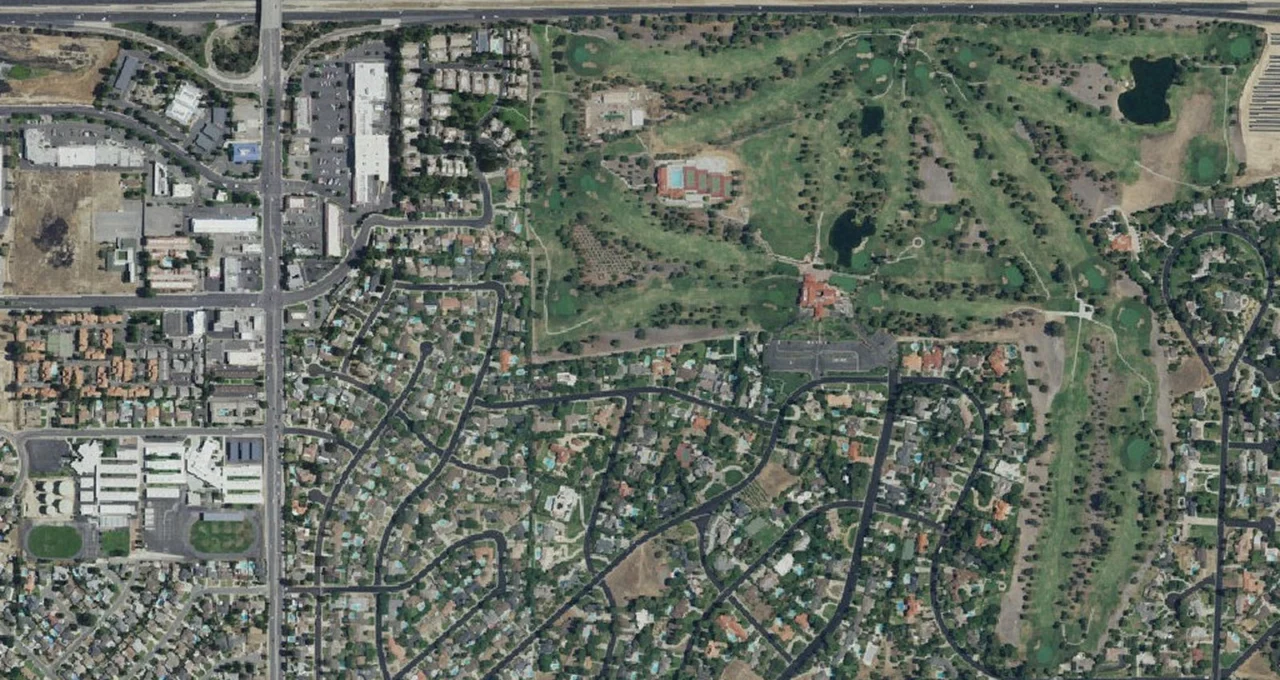
Bakersfield Country Club from the air. Aerial imagery USGS, domaine public.
Bakersfield Country Club
Holes
18
By
72
Length
6,822 yards from the Blue tees on the club's scorecard (rating 73.0, slope 132); Wikipedia, Foretee and a 2006 championship report give 6,819, PrivateIQ 6,935
Green fee
—
Best season
—
Bakersfield Country Club is a private golf club at 4200 Country Club Drive in Bakersfield, California, on the northeast side of the city, where the floor of the San Joaquin Valley gives way to foothills. Its 18-hole course, which the club credits to the architect William P. “Billy” Bell, is laid out over rolling ground that sets it apart from most courses in Kern County: Wikipedia calls it one of the few naturally hilly courses in the county, and the club describes its setting as “the sunwashed hills of northeast Bakersfield.”
On the scorecard the club publishes, the course is a par 72 that measures 6,822 yards from the Blue tees, with a course rating of 73.0 and a slope of 132, and 5,441 yards from the forward Silver tees. It was a PGA Tour venue in 1961 and 1962, a stop on what is now the Korn Ferry Tour in 1990 and 1991, and the host of the Southern California Golf Association’s amateur championship in 2006. It still holds a professional event, the Bakersfield Open, most winters. The figures, the history and the points where the sources disagree are set out below.
A club of oil and farm families
The club tells its own story in a few lines. Its history page says it was founded by families “with great pride and values born out of the farmlands and oil fields surrounding Bakersfield,” and that the same values and friendliness have carried into second and third generation memberships. A 2016 “Made in Kern County” feature by the Bakersfield television station KERO 23ABC places the founding in the 1940s and says the founders had families in mind when they began a golf tradition on the northeast side of town.
The exact year depends on the source. Wikipedia, the GolfPass directory and the GolfN directory give 1950 as the year the club was established or the course built. The Foretee directory says the course opened in 1949, and a review site lists the club as established in 1949. One membership directory, PrivateIQ, gives 1924, which matches neither the other sources nor the club’s own account of a postwar founding; we found nothing to support it. The club’s website gives no date at all.
The same 2016 feature reports that William Bell designed the original course and added nine more holes in the 1950s, which suggests the course did not open with all eighteen holes; we found no other source that describes the opening layout, and the club does not say. It also records that the club’s grand entrance was rebuilt in the 1990s and that the club had recently built a new facility with a large pool, a workout center, a day spa and tennis courts.
The club has given its name to its surroundings. The residential area around the course is a census-designated place called Bakersfield Country Club, first listed in the 2020 census with 1,715 residents on about three quarters of a square mile, according to Wikipedia. The Wikidata record for the club, Q4849291, carries that population figure, a sign that the club and the neighborhood are partly merged in that database.
Which Bell?
Two architects named William Bell worked in California in this period, a father and a son, and the sources split between them. William Park Bell, born in Pennsylvania in 1886 and known as Billy, was one of the leading course architects in Southern California from the 1920s until his death in 1953. His son, William Francis Bell, born in Pasadena in 1918, carried on the practice and is credited with more than 200 courses, among them the two courses at Torrey Pines, according to their Wikipedia biographies.
The club’s own history page names “William P. (Billy) Bell, famous for his strategic use of existing terrain,” and its scorecard simply prints “Course Architect William Bell.” Wikipedia and a 2016 golf travel blog also name William P. Bell. The GolfN directory credits William F. Bell alone; the Foretee and GolfPass directories list both men. Given that the course dates from around 1950, when the father was still active and the son was already working with him, a joint attribution is plausible, but none of the sources we read documents who did what. One directory, PrivateIQ, contradicts itself, naming both Bells in its listing and Bob Baldock in its description, with a later refinement by Robert Muir Graves in 1985; we could not confirm either name elsewhere.
What it asks of you
The defining feature of the course is the ground. In the 2016 KERO feature, the club manager at the time said the many rolling hills and few level lies are a big part of what makes the course special, and that Bell had been drawn to the site by that terrain. Reviewers say the same thing in their own words: elevation changes, mature trees and doglegs in the style of the era, and views of the nearby mountains. The club’s history page adds that the grill room looks out on the Tehachapi Mountains, to the southeast.
The greens draw the most comment. Several reviewers describe large greens that slope from back to front, which makes it important to stay below the hole. Opinions on their speed vary with the season and the year: a reviewer at a 2022 event found them fast and smooth and said they held approach shots, golf app users describe them as very fast, while the author of a 2016 blog review, playing in September, found them soft and receptive at medium speed but hard to read, with downhill putts that were difficult to stop. Wind is the other factor; one reviewer in 2026 found the course played long in the afternoon breeze.
The scorecard gives the following pars and Blue tee yardages, with the men’s stroke index in brackets. The front nine measures 3,448 yards and the back nine 3,374, both par 36.
- 1st: par 4, 372 yards (5).
- 2nd: par 5, 530 yards (15). A scoring chance: a leader in the 2006 Southern California Amateur made eagle here.
- 3rd: par 3, 177 yards (17).
- 4th: par 4, 456 yards (1). The hardest hole on the men’s card.
- 5th: par 4, 451 yards (3).
- 6th: par 5, 592 yards (9). The longest hole on the course.
- 7th: par 4, 343 yards (7).
- 8th: par 3, 180 yards (11).
- 9th: par 4, 347 yards (13).
- 10th: par 4, 393 yards (10).
- 11th: par 5, 515 yards (16). A power line crosses this hole; a ball that hits it must be replayed, under the local rules.
- 12th: par 4, 360 yards (8). A sharp dogleg right around a creek that feeds a lake beside the green, with palm trees and the clubhouse behind; the 2016 blog reviewer called it the signature hole.
- 13th: par 3, 227 yards (6). The longest par 3.
- 14th: par 4, 441 yards (2).
- 15th: par 5, 531 yards (14). A hole that swings both ways: the same 2006 leader made eagle here in the morning and a double bogey seven in the afternoon.
- 16th: par 4, 296 yards (18). The shortest par 4, and the easiest hole on the card; the power line rule also applies here.
- 17th: par 3, 192 yards (12).
- 18th: par 4, 419 yards (4). The finish below the clubhouse patio.
The card lists four sets of men’s tees. Besides the Blue tees, the White tees measure 6,484 yards (rating 71.3, slope 128), the Gold tees 6,194 yards (70.0 and 125) and the Silver tees 5,441 yards (66.4 and 115). For women, the card rates the Gold tees at 76.0 and 135, the Red tees, 5,968 yards, at 74.7 and 131, and the Silver tees at 71.9 and 125. The women’s par is 73 or 74, because the 14th is a par 5 for women and the 4th is a par 4 or 5 depending on the tee; women also have their own stroke index, which makes the 2nd the hardest hole.
Read as a whole, the card describes a strong par 72 rather than an extreme one. The 4th and 5th, two of the three par 4s over 440 yards, are rated the first and third hardest on the course, so a golfer can lose ground early. The back nine offers more chances, with the short 16th, a reachable par 5 at the 15th for long hitters and a mid-length dogleg at the 12th, but the 13th and 17th are long par 3s and the 14th and 18th are among the hardest holes. The scale of the greens and the slopes around them mean that the second shot and the first putt often matter more than the drive.
The local rules printed on the card say something about the setting too. The driving range is out of bounds, white posts and perimeter fences mark the boundary, wires and stakes supporting young trees give free relief, and flower beds are no-play zones from which a drop is mandatory. The club also has an 18-hole putting course built on a slope beside the clubhouse, which the 2016 blog reviewer found fun but difficult.
Water and a dry valley
Bakersfield sits at the dry southern end of the San Joaquin Valley, and water has shaped the course in recent years. In April 2015, when the governor of California ordered a 25 percent cut in urban water use, the club’s superintendent at the time told PGA.com that the club had already been reducing the area of play and replacing thirsty plants with drought tolerant ones, that about 10 acres had already been taken out, and that areas around holes 6, 7 and 8 were being converted. He described the club’s water use as already very lean. The director of golf said that if conditions worsened, the club could stop watering everything but the tees and greens.
The KERO feature the following year reported that many areas along the fairways had been converted to drought tolerant plants and shrubs over the previous three years, and that the club had planted citrus and other fruit trees, using some of the fruit in its kitchen. Reviewers since then mention fairways that look less green than the rest of the course but play firm, and a rough of mixed grasses. The GolfN and GolfPass directories list Bermuda grass on fairways and greens; the club does not publish its turf types.
Tournaments
The club’s first spell on the national stage came in the early 1960s. The Bakersfield Open, a PGA Tour event, was played there in October 1961 and won by Jack Fleck at 276, 12 under par, in a playoff with Bob Rosburg. The tournament returned in 1962 as the Bakersfield Open Invitational, and Billy Casper won it at 272, 16 under par, four strokes ahead of Tony Lema, according to Wikipedia. It was not held again.
A second professional event used the course three decades later. The Ben Hogan Bakersfield Open, on the tour then called the Ben Hogan Tour and now the Korn Ferry Tour, was played at the club in 1990, the year that tour began, and won by Mike Springer at 209, then in 1991, won by Olin Browne at 207. The event moved to Seven Oaks Country Club, elsewhere in Bakersfield, in 1992.
In amateur golf, the club hosted the 2004 SCGA Foursomes, won by Tim Hogarth and John Pate, according to AmateurGolf.com. It also hosted the 107th Southern California Amateur in July 2006, which the SCGA’s championship history lists as won by Scott McGihon. A report from that championship gave the course at 6,819 yards and noted that the course record of 63 belonged to Dave Barber, a former head professional at the club. In 2026 the club was listed as a local qualifying site for the U.S. Amateur, on June 8; no results were posted when we read the listing.
The current Bakersfield Open is a three-round event of the Golden State Tour, a California mini-tour for young professionals, played at the club in winter. According to The Bakersfield Californian, the local professional Manav Shah won the 2018 edition at 16 under par, two strokes ahead of Jake Sarnoff, tying the tournament’s lowest total, after birdies on the 15th, 16th and 17th. He won again in 2021 with a chip-in birdie on the 18th, according to the station KGET. A 2022 edition ran from February 23 to 25 with a field of about 100 to 120 players, according to the station KBAK. Shah, who went on to play the Korn Ferry Tour and the 2026 U.S. Open, has described the event as a point of community pride.
What golfers are saying
As a private club, Bakersfield Country Club has relatively few detailed public reviews. The material for this section is a 2016 round described on the Bogeys Across America blog, member and guest reviews on the Greenskeeper site (seven in total, two of them readable, from 2022 and 2026), ratings on the Hole19 app (4.7 out of 5 from 15 reviews) and the GolfN app (4.2 from three), and Google reviews of the club as a whole (4.6 out of 5 from 184), as reproduced by a travel site. Many of the Google reviews concern events and dining rather than golf. We report recurring themes and do not quote individuals.
What they like
- The terrain: elevation changes, rolling hills and mature trees, which reviewers find unusual for the Central Valley.
- The greens, described as fast and smooth by several reviewers, and as a real test because of their size and back-to-front slope.
- The 12th hole, with its creek, lake and palm trees, singled out as the most photogenic on the course.
- The clubhouse, the locker rooms and the views over the valley, and practice facilities that one app user calls superb.
- A friendly, unpretentious atmosphere and attentive staff; the 2016 blog author described a friendly, blue-collar feel.
- Pace of play: the blog reviewer’s group took about four hours in a shotgun start.
What they like less
- The routing, which one 2026 reviewer found confusing because of holes that cross each other.
- Fairways that look less polished than the greens, and a thick rough that is hard to play from, according to a 2022 reviewer; the 2016 blog author found the fairways soft and wet, with little roll.
- For the blog author, the course was good rather than outstanding, not on a level with Southern California’s best old private clubs.
- A few reviews call for updates to parts of the course and the pool.
Nobody from Panxis has played the course. This section summarizes what others have written; it is not our own judgment.
Who can play
Bakersfield Country Club is private. The club describes itself as a private family club for members and their guests, and its history page says it offers a limited number of full equity memberships along with non-equity tennis and social memberships. PrivateIQ describes membership as by invitation and member-owned. There are no public tee times; a visitor plays as a member’s guest or, occasionally, at an outside event such as a charity tournament or association outing. Wikipedia notes that members have reciprocal playing privileges at other private clubs in the Bakersfield area. The club’s membership packet is available on request from its website.
Directories list a driving range, a putting green, a short game area with a practice bunker, motorized carts and pull carts, and say walking is allowed; one adds caddie service, which we could not confirm. The club’s pro shop sells equipment and offers club repair and lessons. Away from the course, the club has four lighted tennis courts with a pro shop, a fitness center, locker rooms with card rooms and lounges, a grill room, a formal dining room overlooking the valley and banquet facilities for up to 250 people, according to its website.
The club does not publish a golf season. The GolfN and GolfPass directories describe the course as open all year, which fits Bakersfield’s mild winters, and the professional event is played in February.
Getting there
The club is at 4200 Country Club Drive, Bakersfield, CA 93306, on the northeast side of the city. The club’s directions from the Los Angeles area are to take Interstate 5 north to Highway 99, leave Highway 99 at Highway 178 East, which runs through downtown Bakersfield and becomes a freeway, exit at Oswell Street and turn right, then turn left on Country Club Drive after three traffic lights. The clubhouse and the golf shop have separate phone numbers listed on the club’s contact page.
Measured in a straight line from the middle of the course, downtown Bakersfield is about five miles to the west-southwest and Meadows Field Airport, the city’s airport, about seven miles to the northwest. Tehachapi is about 33 miles to the southeast. Downtown Los Angeles and Los Angeles International Airport are about 100 and 105 miles to the south-southeast, and Fresno about 104 miles to the northwest. These distances are measured on the map and not by road; the drive from Los Angeles, over the mountains on Interstate 5, is longer.
Green fees
Bakersfield Country Club publishes no green fees, and none are given here. Golf is for members and their guests; guest rounds are arranged through a member, and membership terms are available from the club. For anything else, start with the club’s own website.
How this page was made
The factual frame comes from public sources: OpenStreetMap for the location and identifiers; Wikidata for the entity record; the club’s website for the scorecard (a PDF card with tees, yardages, pars, ratings, stroke indexes, local rules and the names of the director of golf, architect and superintendent), the history, directions, hours and contact pages; Wikipedia for the club, the census-designated place, the two William Bells and the 1961, 1962, 1990 and 1991 professional events; KERO 23ABC for its 2016 feature and its report on the current Bakersfield Open; PGA.com for an April 2015 article on water restrictions; AmateurGolf.com for the 2004 Foursomes, the 2006 Southern California Amateur and the 2026 qualifier; the SCGA championship history, read through search results because its site refused our requests; The Bakersfield Californian for the 2018 Bakersfield Open, also read through search results because its site refused our requests; KGET and KBAK for the 2021 and 2022 editions; the Bogeys Across America blog for its 2016 round; and the GolfN, Foretee, GolfPass, PrivateIQ, Greenskeeper, Hole19 and Wanderlog listings for directory data and reviews. We could not open the GolfPass review pages or the Yelp listing.
Where sources disagree, we say so. The length from the back tees is 6,822 yards on the club’s current scorecard and in Wikipedia’s scorecard table, 6,819 yards in Wikipedia’s summary, Foretee and the 2006 championship report, and 6,935 yards on PrivateIQ. The rating and slope from those tees are 73.0 and 132 on the club’s card, 72.6 and 131 in Wikipedia’s table and on GolfN, and 72.5 and 127 on Foretee; we use the club’s card. Wikipedia rates the men’s Silver tees at 66.1 and 113, against 66.4 and 115 on the card. Foretee lists White tees of 6,458 yards and Red tees of 6,156 yards, against 6,484 and 5,968 on the card. The founding year is 1950 for Wikipedia, GolfPass and GolfN, 1949 for Foretee and a review site, the 1940s for KERO, and 1924 for PrivateIQ, which we consider unsupported. The architect is William P. Bell for the club and Wikipedia, William F. Bell for GolfN, both for Foretee and GolfPass, and Bob Baldock with Robert Muir Graves in part of the PrivateIQ listing, which we could not confirm. The statement that nine holes were added in the 1950s comes from a single source. The club manager’s surname is spelled two ways in the KERO feature.
Some details will age: the names of the staff, the dining and fitness hours, the membership categories, the review counts and scores, and the dates of the Bakersfield Open are those published up to 2026 and read in October 2026. The club’s website carries a 2016 copyright notice, and some of its pages may be older than they look. Nobody from Panxis has played or visited this course, and this page is no substitute for a round.
The club has not paid for this page, has not seen it before publication and has no say over its content. This page contains no commercial link and earns us no commission. If you know the club and something here is wrong or out of date, write to us and we will correct it.
Other courses nearby
Closest to this one in our United States directory:
- El Caballero Country Club — 89 mi
- Bel-Air Country Club — 95 mi
- Brookside Golf Club — 95 mi
- Los Angeles Country Club — North Course — 96 mi
The hole to know
A par 4 of 360 yards from the Blue tees that bends sharply right around a creek feeding a lake beside the green, with palm trees and the clubhouse behind it; a 2016 blog review called it the course's signature hole.