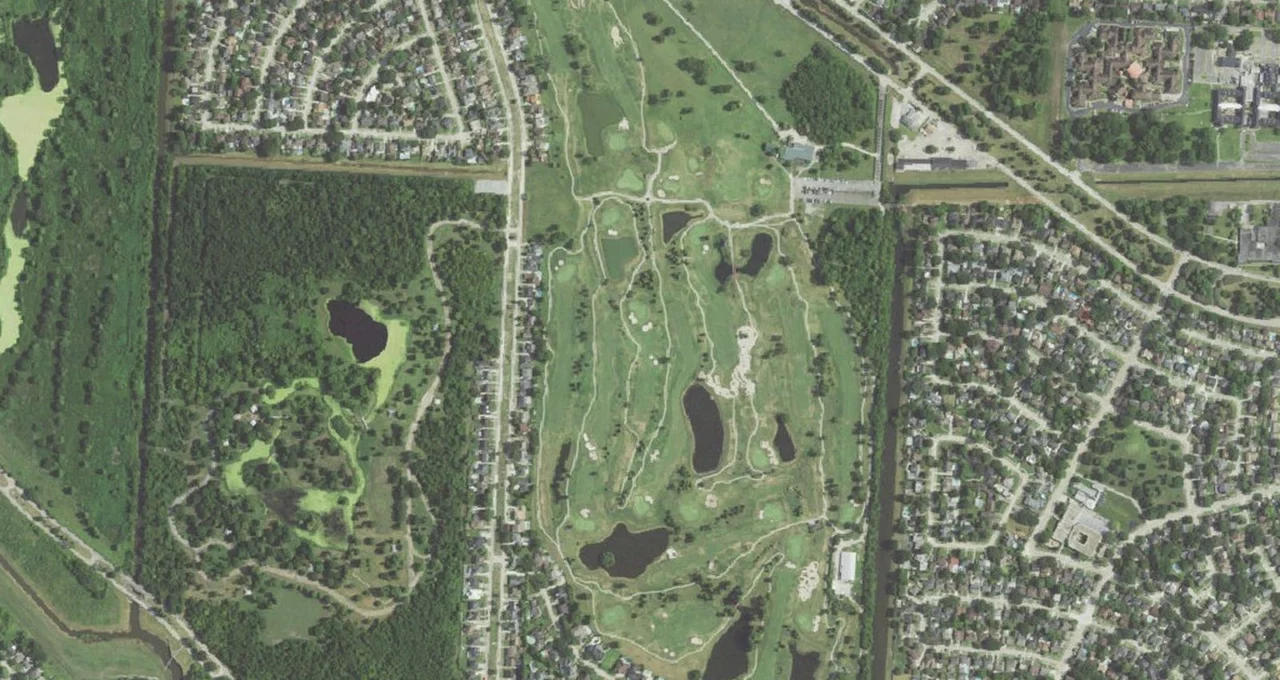
Lakewood Golf Club from the air. Aerial imagery USGS, domaine public.
Lakewood Golf Club
Holes
18
By
72 from every tee (club, GolfNow, GolfPass, 18Birdies)
Length
7,002 yards from the Gold tees (rating 74.1, slope 139, according to the club, GolfNow and GolfPass); 18Birdies gives 73.1 and 135, older sources 73.3 and 132; Blue 6,430, White 5,917, Red 5,432 yards
Green fee
—
Best season
Year-round (GolfN, GolfNow)
Lakewood Golf Club is an 18-hole, par 72 course in Algiers, the part of New Orleans that lies on the West Bank of the Mississippi River. It opened in 1961 as Lakewood Country Club, a private club, and for 26 years, from 1963 to 1988, it was the home of the city’s PGA Tour event, the New Orleans Open. Since 2003 it has belonged to the New Orleans Firefighters’ Pension and Relief Fund, which closed the private club, had the course redesigned by Ron Garl and reopened it to public play in 2009 under its current name. The club’s address is 4801 General De Gaulle Drive, New Orleans, LA 70131.
From the back tees the course measures 7,002 yards. It is a flat, parkland layout among oaks and cypress trees, with water in play on many holes and a set of bunkers that few courses would dare: several of them are cut in the shape of flames and filled with red sand, a tribute to the firefighters who own the place. The OpenStreetMap entry for the course still carries the old name, Lakewood Country Club; the club, the directories and Wikidata (item Q15755343) use Lakewood Golf Club.
Two Lakewoods, one name
The name is older than the course. According to Wikipedia’s article on the Lakewood neighborhood of New Orleans, Lakewood Country Club first operated on the East Bank, near Lakeview, on land that predated most of the houses around it and gave its name to the area. When the routes of Interstates 10 and 610 were fixed in the 1960s, much of that golf course was taken for the interchange, the club moved to Algiers, and the rest of the old course became the Lakewood North and Lakewood South subdivisions. The article gives no date for the move, and the dates it implies do not sit easily with a new course in Algiers that opened in 1961, so we report the move without trying to date it more precisely.
The Algiers course was designed by Robert Bruce Harris (1896 to 1976), a Chicago landscape architect turned golf course architect. The American Society of Golf Course Architects, which he helped found and presided over from 1947 to 1949, credits him with more than 150 courses designed or remodeled and lists Lakewood in New Orleans in his portfolio. A 2016 article by Steve Habel in Louisiana Golf associates him with the “garden school” of design. GolfN, ForeTee, GolfNow and Where2Golf all give 1961 as the year the course was built, and the club’s history page, read in a search excerpt, says Lakewood Country Club opened in 1961.
The tour years
Lakewood’s place in golf history comes from the New Orleans Open, the event now played as the Zurich Classic. Wikipedia’s list of venues puts it at City Park until 1962, then at Lakewood Country Club for every edition from 1963 to 1988, before it moved to English Turn in 1989. The club says that eight members of the World Golf Hall of Fame won there during that period.
The list of champions in Wikipedia bears that out. Bo Wininger won the first Lakewood edition in 1963. Gary Player won in 1972, Jack Nicklaus in a playoff in 1973, Lee Trevino by eight strokes in 1974 with a total of 267, Billy Casper in 1975, Hubert Green in 1979, Tom Watson in 1980 and 1981, Seve Ballesteros in 1985 in an event shortened by weather, and Ben Crenshaw in 1987. Chip Beck closed the Lakewood era in 1988 with 262, 26 under par, which Wikipedia gives as the tournament’s lowest winning score. Two sources we read name other winners at Lakewood, Arnold Palmer and Lanny Wadkins among them; neither appears in Wikipedia’s list for those years, so we leave them out.
ForeTee adds that the course has hosted two USGA championships and two Southern Golf Association championships, without naming them, and that the Tulane University men’s and women’s golf teams used Lakewood as their home course for many years. We could not confirm the championships independently.
Sale, storm and rebirth
By the early 2000s the private club was in financial trouble. ForeTee, Where2Golf and Louisiana Golf all report that the New Orleans Firemen’s Pension and Relief Fund bought the property in May 2003 for $6 million, when the club was close to bankruptcy. The fund’s plan was ambitious: the renovated course would be the first phase of a golf resort with villas, a hotel and condominiums on the land around it. Hurricane Katrina, in August 2005, changed the timetable. The club’s own history, as quoted by Texas Outside, says the storm destroyed more than 2,500 trees and did significant damage to the course.
The fund hired the architect Ron Garl to rebuild it. According to ForeTee, the renovation cost about $9 million and the course reopened for public play on February 28, 2009, as Lakewood Golf Club. Habel’s articles describe the work as a new set of holes that kept the character of the Harris layout while adding new bunkering, reshaped fairways and new tees and greens. Where2Golf dates Garl’s redesign to 2008, other directories to 2009; the work was presumably carried out in 2008 and the course opened in 2009.
The resort never followed. In 2014 the pension fund hired brokers to sell the course and its development land, according to a press release distributed by Business Wire. Later reporting in The Advocate, which we could read only in search excerpts, describes a loan on the course caught up in the collapse of First NBC Bank and operating losses for the fund. We found no recent report of a sale, and booking platforms list tee times at Lakewood through the fall of 2026, so as far as public sources show, the course is open and still in the fund’s hands.
The card
The current card has four sets of tees, all par 72. The figures shared by the club’s course page (read in a search excerpt), GolfNow and GolfPass are:
- Gold: 7,002 yards, rating 74.1, slope 139
- Blue: 6,430 yards, rating 71.1, slope 130
- White: 5,917 yards, rating 68.6, slope 124
- Red (women): 5,432 yards, rating 71.5, slope 127
Other sources disagree. The 18Birdies app lists five tees, Gold at 7,002 yards, Blue at 6,434, White at 5,937, Silver at 5,471 and Red at 5,386, with men’s ratings of 73.1 and a slope of 135 from the Gold tees. Habel’s earlier article and Where2Golf give a rating of 73.3 from the back, with a slope of 132 in Habel’s text. These are probably older or more recent ratings of slightly different tees, but none of these sources dates its card.
The hole-by-hole yardages from the Gold tees, as listed on the Open Golf API directory, which draws on OpenStreetMap, add up exactly to 7,002 yards, and their stroke index matches the one shown on GolfPass:
| Hole | 1 | 2 | 3 | 4 | 5 | 6 | 7 | 8 | 9 | Out |
|---|---|---|---|---|---|---|---|---|---|---|
| Par | 5 | 4 | 3 | 5 | 4 | 4 | 4 | 3 | 4 | 36 |
| Yards | 569 | 357 | 141 | 533 | 378 | 439 | 411 | 189 | 443 | 3,460 |
| Index | 5 | 13 | 15 | 11 | 9 | 1 | 7 | 17 | 3 | |
| Hole | 10 | 11 | 12 | 13 | 14 | 15 | 16 | 17 | 18 | In |
| Par | 5 | 3 | 4 | 5 | 4 | 4 | 4 | 3 | 4 | 36 |
| Yards | 541 | 169 | 398 | 519 | 385 | 459 | 467 | 160 | 444 | 3,542 |
| Index | 16 | 14 | 6 | 12 | 10 | 2 | 4 | 18 | 8 |
The structure is classic: four par 3s, four par 5s and ten par 4s, with two par 5s and two par 3s on each nine. The individual yardages agree with what the published descriptions say about specific holes: 569 yards for the 1st, 378 for the 5th, 411 for the 7th, 519 for the 13th, 385 for the 14th, 160 for the 17th and 444 for the 18th.
What it asks of the golfer
The card tells most of the story. Lakewood’s difficulty is concentrated in its long par 4s. The four hardest holes on the stroke index, the 6th (439 yards), the 15th (459), the 9th (443) and the 16th (467), are all two-shotters of more than 435 yards, a point Habel also makes. The 18th, at 444 yards, makes five such holes. For a player who does not carry the ball far, these play like short par 5s, and a round here is often decided by how many of them end in bogey or worse.
The par 3s are the opposite. None is longer than 189 yards from the back, and the shortest, the 3rd, is 141. They are protected by water and sand rather than by length, which suits players whose strength is a precise mid or short iron. The par 5s range from 519 to 569 yards; the 13th, the shortest of them, has a cross bunker about 50 yards short of the green, according to Habel, which a player going for the green in two has to clear or play around.
Water and sand are the main hazards. Texas Outside counts 38 bunkers and water on 14 holes, and describes several styles: deep pot bunkers, long waste bunkers and multi-fingered bunkers whose narrow fingers make a clean escape difficult. Its review describes the 7th, a 411-yard par 4, as a hole with a waste bunker on the right off the tee, a fairway that bends to the right and a green guarded by a fingered bunker and a lake on the left; the 12th as a hole that asks for an accurate drive to stay clear of a lake on the right, then an approach over a natural brush area and another lake about 100 yards short of the green; and the 14th as a 385-yard dogleg right where a bold drive over tall trees shortens the hole. Habel adds that the 14th green breaks hard from left to right.
The ground is flat, which Where2Golf notes makes the course easy to walk, and New Orleans wind takes the place of elevation as the factor that changes clubs from one day to the next. Texas Outside lists Bermuda grass greens. Thick rough is mentioned in reviews, and one reviewer who had good conditions described the greens as fast, at 10 to 11, true and receptive to hold a well-struck approach.
One hole: the 18th, “Fire in the Hole”
The closing hole is the one the club itself puts forward. The club’s course page, quoted in search excerpts, calls the 444-yard 18th “Fire in the Hole” and presents it as the clearest tribute to the firefighters who own the course: its bunkers are traced in the shape of flames and filled with red sand. Habel counts four of these “flaming” bunkers on the course, three of them on the 18th; Where2Golf places flame bunkers on the 1st and the 18th, and mentions another bunker shaped like a Maltese cross, the emblem of firefighters, while Habel describes one shaped like a fleur-de-lis on the 1st and one shaped like a fireman’s seal.
On the card the 18th is a par 4 of 444 yards from the Gold tees, with the 8th stroke index. Habel writes that it usually plays into the wind, which makes it longer than its number for most players. The red bunkers are there to catch the approach, and the long fingers of the flames are where reviewers say an escape becomes difficult. For a mid-handicapper, the sensible plan is a drive into the fairway, then an approach that favors the safe side of the green rather than the flag; a bogey here is no disgrace, and a big number in the flames is the real risk.
The hole also carries one of Lakewood’s oddest features. After Katrina, the Indiana woodcarver Dayle Lewis turned several of the storm-damaged trees on the course into sculptures, according to Habel; Where2Golf confirms that a woodcarver was commissioned to carve lifelike figures from some of the trunks. On the 18th, Habel describes a Lewis carving of an angel hovering over a firefighter who carries a baby. Just before it, the 17th, a 160-yard par 3 played over a pond to a green surrounded by water on three sides, gives a round its last chance to go wrong.
What golfers say
Lakewood has many public reviews, on GolfPass (the former Golf Advisor), the 18Birdies and Hole19 apps, GolfN, Golfshake and travel sites such as Texas Outside, spread over more than fifteen years. The ratings vary widely by platform: at the time of reading, 18Birdies showed an average of 4.4 out of 5 from more than 300 reviews, while GolfPass excerpts showed averages around 3 out of 5, with a high score for the layout and low scores for conditions and value. We read the GolfPass reviews only in search excerpts, because that site blocked our requests. What follows sums up recurring themes, without naming anyone.
On the plus side. The layout is the most consistent source of praise: reviewers call it fun, challenging and well designed, and GolfPass’s layout score is its best. The history counts for many visitors, who like playing a course where Nicklaus, Watson and Trevino won. The flame bunkers and the tree carvings are mentioned again and again as memorable features, and several reviewers describe the course as immaculate or in great shape on the day they played, with true, fast greens. The staff is praised as friendly and professional. The practice area is a strong point: the club calls it one of the best in the New Orleans area and the only short game practice facility around, and reviewers agree that the range and short game area are excellent, although one notes few targets beyond about 110 yards. Some local players call it the best course for the money in the area.
On the minus side. Conditions are the main complaint, and the most recent reviews are the most critical. Several reviews from 2025 on GolfPass and Hole19 describe poor greens with weeds, and rough fairways. Others, over the years, describe a course that looked shaggy on arrival or needed more care. Value divides opinion: some visitors from out of town find the course overpriced for what they get, and one reviewer of a multi-course trip called it the only course that did not meet expectations. Pace of play gets mixed reports, from good to very slow behind large groups. The clubhouse is described as modest; a listing mentions a temporary clubhouse, and one reviewer notes that it is not much to write home about.
In short, players who come for the layout, the history and the practice area tend to leave satisfied, and the disappointments are mostly about maintenance, which seems to vary a great deal from one season to the next.
How to play it
Lakewood is open to the public. The club describes itself as a daily fee facility with an optional membership; GolfN calls it semi-private. Tee times are taken through the club’s online booking, by phone and through GolfNow, which lists Lakewood tee times through the fall of 2026. The club gives its phone number as (504) 373-5926, as do GolfN and Where2Golf; ForeTee gives (504) 393-1010. We do not publish rates, which change with the day and season: check the club’s own page before booking.
According to GolfNow, carts are included with the green fee, rental clubs are available, metal spikes are not allowed and proper golf attire is required. Where2Golf says walking is permitted at certain times, so ask the pro shop before planning to walk. The course is listed as open all year. The club offers private and group lessons and playing lessons, and runs a year-round junior program with weekly clinics on weekend mornings open to members and the public. The practice facility includes a grass driving range, a putting green, a chipping area and a practice bunker.
Practical advice from the reviews is consistent. Check recent comments on conditions before a visit, especially in summer. Play early in the day in the hot months, expect wind on the closing holes, and keep the ball out of the bunkers, which are deeper and more intricate than their red color alone suggests.
Getting there
The course is in Algiers, on the West Bank, off General De Gaulle Drive, about six miles southeast of downtown New Orleans according to Where2Golf. From the French Quarter or the Central Business District, the usual route crosses the Mississippi on the Crescent City Connection bridge. Habel’s article places the course in Gretna, which is the neighboring city on the West Bank; the club, the directories and the postal address all put it in New Orleans, ZIP code 70131. Nearby courses include English Turn, which took over the tour event in 1989, and Timberlane Country Club, both a few miles away.
How this page was made
This page is based on Wikipedia’s articles on the Lakewood neighborhood of New Orleans and on the Zurich Classic of New Orleans, for the original club and the list of tour venues and winners; Wikidata (item Q15755343) for the identity and location; the American Society of Golf Course Architects’ page on Robert Bruce Harris; the club’s own pages on its history, course, contact details, instruction and junior golf, read only in search excerpts; ForeTee, GolfN, GolfNow, Where2Golf, the Open Golf API directory, 18Birdies, Hole19 and the Greater New Orleans Sports Foundation venue listing for the card, the ratings, the amenities and the history of the sale and renovation; Steve Habel’s articles in Louisiana Golf (2016) and on Cybergolf, and the Texas Outside review, for the description of the holes, the bunkers and the carvings; a 2014 Business Wire press release and excerpts of The Advocate for the fund’s finances; and the reviews on GolfPass, 18Birdies, Hole19, GolfN, Golfshake and Texas Outside for the opinion section. The OpenStreetMap outline of the course gives the map position. Pages were read on November 2, 2026.
The club’s website, lakewoodgolf.com, refused our automated requests, as did GolfPass, GolfLink and Golf Digest; we read them only through search excerpts, and The Advocate’s articles were not readable in full. Where sources disagree, we say so above: on the ratings and the number of tees, on the year of Garl’s redesign (2008 or 2009), on the club’s status (public daily fee with optional membership, or semi-private), on its phone number, on its city (New Orleans or Gretna) and on the shapes and positions of the themed bunkers. We could not date the move of the club from the East Bank, name the two USGA championships ForeTee mentions, or confirm a current owner other than the pension fund, and we have not filled those gaps. The opinion section summarizes public reviews over many years; we report recurring themes, not individual voices. Nobody from Panxis has played or visited this course, and this page is no substitute for a round.
Lakewood Golf Club and the New Orleans Firefighters’ Pension and Relief Fund have not paid for this page, have not seen it before publication and have no say over its content. This page contains no commercial link and earns us no commission. If you know the course and something here is wrong or out of date, write to us and we will correct it.
Other courses nearby
Closest to this one in our United States directory:
- Bayou Oaks at City Park — North Course — 9 mi
- City Park Golf Course (Baton Rouge) — 78 mi
- Highland Park Golf Course — 313 mi
- Hermann Park Golf Course — 323 mi
The hole to know
"Fire in the Hole", a par 4 of 444 yards from the Gold tees that usually plays into the wind, guarded by flame-shaped bunkers filled with red sand in tribute to the firefighters who own the course.