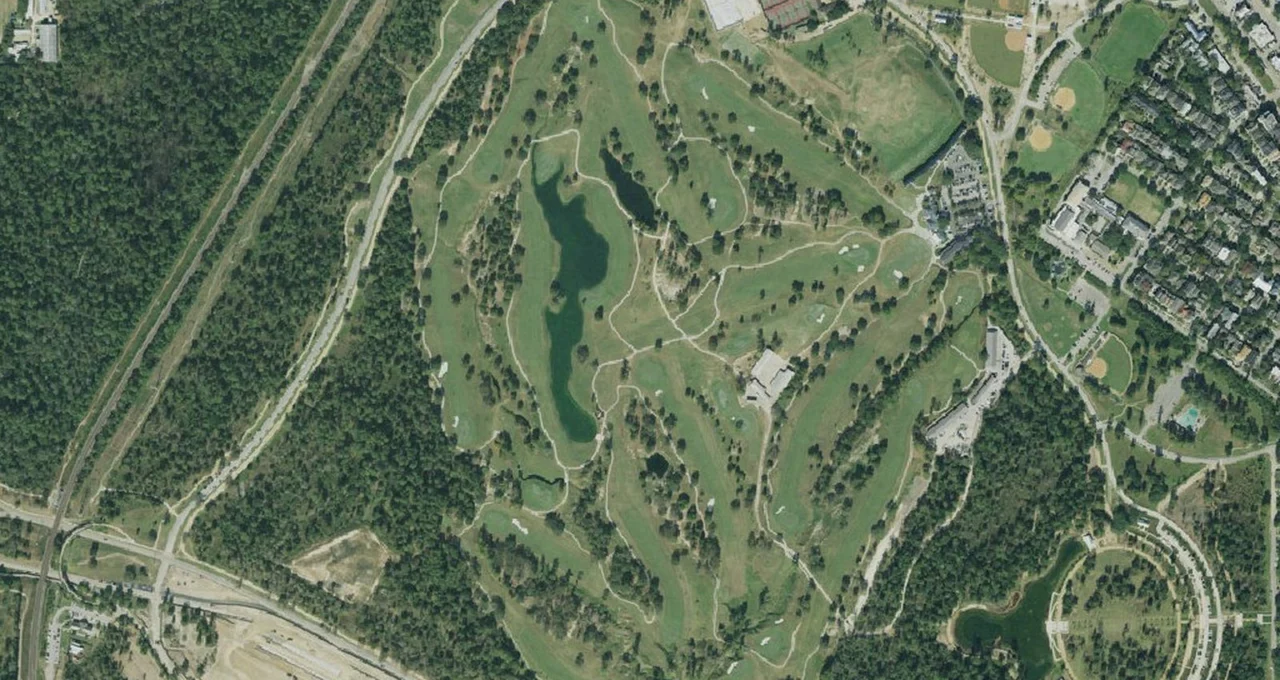
Memorial Park Golf Course from the air. Aerial imagery USGS, domaine public.
Memorial Park Golf Course
Holes
18
By
70 for the Houston Open (The Golf News Net, 2026 card); 72 for daily play, with the 1st and 14th as par 5s (18Birdies card). The 2026 Chevron Championship was played as a par 72
Length
7,475 yards on the 2026 tournament card (The Golf News Net); for daily play, Blue tees 7,464 yards (rating 74.2, slope 128), White 6,584, Gold 5,930, Green 5,595, Red 4,851 (18Birdies). Golf Course Gurus gives 7,432 from the Blue tees and GolfNow 7,292. The 2026 Chevron Championship: 6,811 yards
Green fee
—
Best season
Year-round (GolfNow, GOLF.com); closed Tuesdays for maintenance, and closed to the public around the professional events
Memorial Park Golf Course is an 18-hole municipal course owned by the City of Houston, inside Memorial Park, about five miles west of downtown. Its address is 1001 East Memorial Loop Drive. It is open to the public, the club counts more than 50,000 patrons a year, and it is the home of two professional events: the PGA Tour’s Texas Children’s Houston Open, played here again since 2020, and, since April 2026, the LPGA’s Chevron Championship, a major.
The layout goes back to John Bredemus, whose redesign of an earlier nine-hole course opened as 18 holes in July 1936. Tom Doak rebuilt it in 2019 with Brooks Koepka as player consultant. On the 2026 tournament card reported by The Golf News Net it is a par 70 of 7,475 yards. Public golfers play the same ground as a par 72: on the card carried by 18Birdies, the Blue tees measure 7,464 yards, with a rating of 74.2 and a slope of 128. GOLF Magazine ranked it 88th on its 2024-25 list of Top 100 Courses You Can Play.
From a soldiers’ nine to Bredemus
The club’s history page begins in 1912 with a nine-hole course with sand greens, built near the hospital at Camp Logan for convalescent soldiers. Wikipedia’s article on the park also gives 1912 for the nine holes. It adds that the City of Houston took ownership of the land in May 1924, as a memorial to soldiers who died in World War I, and that the original park plan came from Hare and Hare of Kansas City. The park today covers about 1,466 acres. Its operation passed in 2016 from the city’s parks department to the Memorial Park Conservancy, a private nonprofit, while the golf course’s own site still runs under the name Houston Municipal Golf Courses and links to the city’s parks department.
According to the club, Bredemus redesigned the course in 1935, after the hospital closed, and it opened in July 1936. Sources do not agree on the dates. GOLF Magazine lists 1935, Wikipedia and Golf Course Gurus 1936, and GolfNow gives 1912 as the year built. ForeTee has a different chronology altogether: a nine-hole course opened in 1923 and expanded to 18 holes by Bredemus in July 1924. We follow the club, whose account is the most detailed.
Wikipedia’s park article records that the winner of the 1965 PGA Championship learned the game on this course, and that the ashes of Dave Marr, who won that title, were spread over it.
The last big change before Doak came in the mid-1990s. The club says a renovated course reopened in 1995 with a lighted driving range, putting and chipping greens and a new clubhouse. Mike Bailey, writing in December 2019, dates that work to 1994 and credits the local architect Carlton Gipson; GOLF.com’s 2019 report refers to a 1996 renovation overseen by Baxter Spann’s firm. None of the sources reconciles these accounts.
Doak, Koepka and the 2019 rebuild
Jim Crane, the owner of the Houston Astros, took on the Houston Open through the team’s foundation. On January 9, 2019, according to GOLF.com, the Houston City Council approved a plan under which the Astros Golf Foundation would pay for a renovation and host the tournament through 2023. The course closed the same day, after the last group. ForeTee dates the closure to January 4. Local reaction was not unanimous: GOLF.com reported that Spann objected to the speed and secrecy of the process, and that some golfers feared losing access and the course’s identity. In April 2023, ABC13 reported that the agreement between the foundation, the city and the PGA Tour had been extended through 2028.
Tom Doak’s firm, Renaissance Golf Design, led the work. It was his first design to host a PGA Tour event. Before work began, he told The Fried Egg it was “still going to be a municipal course,” playing about 60,000 rounds a year outside tournament weeks. Koepka gave his input on site visits and by email, according to the PGA Tour, and he plays down his part: “I give Tom all the credit. He came up with 99.9 percent of them.” What he did push for was variety in the par 3s. In March 2026 he told reporters he had not wanted long-iron par 3s, and argued that the best in the world measure 150 to 160 yards or less.
The site is very flat, with a few natural ravines, and Doak told GOLF.com that drainage was the main problem. New drainage and irrigation went in, and storm water now goes to larger ponds, with the main pond tripled to about eight acres, according to The Golf News Net. Bailey reports that Doak kept the original routing while changing many holes, that an extra par 3 and an extra par 5 were added, and that one lake and two ponds were removed. The Golf News Net says every hole was changed in some way. The plan also included a practice facility, and when the course reopened it had a two-tier range with 42 bays on each level.
The ribbon was cut on November 4, 2019, and public play resumed on November 6. Most sources speak of about 10 months of work. The Fried Egg wrote of 18 months. One GolfPass article we saw in an excerpt speaks of a 2021 redesign, which fits no other source.
The most cited change is the bunkers. ForeTee says Doak cut them from 54 to 19. Others give different totals afterward: 19 in the PGA Tour’s 2021 preview and at Golf Course Gurus, 20 in the PGA Tour’s 2020 reports, 21 in search excerpts, and about 30 in Bailey’s December 2019 review. Two bunkers were added at the 17th in 2024, which may explain part of the spread, though no source says so. In place of sand, Doak used steep slopes of short grass around the greens.
The tournaments
The Houston Open was played at Memorial Park in 1947 and every year from 1951 to 1963, 14 editions in all. The club’s page mentions only the 1951 to 1963 run. Wikipedia’s list of winners includes Bobby Locke in 1947, Jack Burke Jr. in 1952 and 1959, Cary Middlecoff in 1953, Arnold Palmer in 1957 and Bob Charles in 1963. Bobby Nichols won in 1962 in a playoff over Jack Nicklaus and Dan Sikes.
The event came back after more than 50 years. Carlos Ortiz won in November 2020 at 13 under, two shots ahead of Dustin Johnson and Hideki Matsuyama. Jason Kokrak won in 2021 at 10 under and Tony Finau in 2022 at 16 under. No tournament was played in 2023, because the event moved from the fall to March. Stephan Jaeger won in 2024 at 12 under, Min Woo Lee in 2025 at 20 under, and Gary Woodland in March 2026 at 21 under with rounds of 64, 63, 65 and 67. Woodland won by five over Nicolai Højgaard. Scores have fallen since 2020, when the PGA Tour reported a first-round field average of more than two over par. The Golf News Net says the course is not especially difficult in March, when the turf is softer and overseeded.
The LPGA’s Chevron Championship moved here for 2026 from The Club at Carlton Woods. The event was played April 23 to 26 as a par 72 of 6,811 yards. Nelly Korda won at 18 under, five shots ahead of Patty Tavatanakit and Ruoning Yin. Search excerpts we read mention a temporary pool beside the 18th green for the winner’s traditional jump, and a man-made pond planned there for 2027.
The card
There are two cards, and the difference matters. The tournament card reported by The Golf News Net in March 2026 reads as follows, par 70: 1st, par 4, 522 yards; 2nd, par 3, 167; 3rd, par 5, 587; 4th, par 4, 490; 5th, par 4, 440; 6th, par 4, 443; 7th, par 3, 216; 8th, par 5, 625; 9th, par 3, 182. Out: par 35, 3,672 yards. 10th, par 4, 456; 11th, par 3, 237; 12th, par 4, 496; 13th, par 4, 406; 14th, par 4, 529; 15th, par 3, 155; 16th, par 5, 616; 17th, par 4, 405; 18th, par 4, 503. In: par 35, 3,803 yards. That makes five par 3s, ten par 4s and three par 5s, an unusual mix.
For daily play, the card on 18Birdies gives a par of 72, 36 on each nine, by counting the 1st and the 14th as par 5s. GOLF.com reported the same plan in 2019: a par 72 for everyday play and a lower par for the Open. This card also differs on a few lengths: the 9th is 202 yards, the 16th 576 and the 17th 414, for a total of 7,464. Its stroke index makes the 4th the hardest hole, followed by the 12th, the 8th and the 16th. The 14th, a brute for the pros at par 4, is the easiest hole on the index at par 5.
The tees on that card are Blue, 7,464 yards (rating 74.2, slope 128); White, 6,584 (71.1, 121; women 76.6, 127); Gold, 5,930 (68.0, 115; women 72.9, 120); Green, 5,595 (65.7, 102; women 70.6, 117); and Red, 4,851 (63.1, 98; women 67.3, 111). Golf Course Gurus gives the same men’s ratings on a slightly different set of lengths, from 7,432 yards on the Blue tees to 4,826 on the Red. Other figures circulate: GolfNow lists 7,164 yards with a rating of 73.0 and a slope of 122, plus 7,292 yards from the Blue tees; ForeTee also uses 7,292. Wikipedia’s park article gives 75.0 and 130 from the back tees, without a date. The club’s own pages publish no yardages or ratings, and we did not read the USGA database.
The tournament length has moved over time. The Golf News Net’s 2024 card totals 7,435 yards, the number GOLF Magazine still shows, with the 16th at 576. The 2026 card adds 40 yards, which matches the 16th at 616, and The Golf News Net says the length has not changed since 2025.
What it asks of the golfer
The everyday slope of 128 from the Blue tees is moderate for a course of that length, and it falls to 121 from the White tees and 115 from the Gold. The ground is flat. The Golf News Net says the putting surfaces are large and that there is fair room to miss off the tee. Golf Course Gurus describes widened fairways and calls it an easy walk. For a high handicapper, fewer bunkers should mean fewer lost strokes, and Bailey made that point after his round in 2019.
The difficulty is around the greens. They have more movement than before the rebuild, Bailey wrote, and two-putts cannot be taken for granted; missing on the right side can be better than facing a putt with several breaks. Slopes of short grass carry approach shots away from the hole. The PGA Tour notes that amateurs can putt from many of these spots, while pros must chip from tight lies. Tour players made the point in plainer terms: Kramer Hickok called it “a course of misses,” and Scottie Scheffler said it was “very, very difficult to get up and down” around the greens.
Published turf details come from two sources: the PGA Tour’s 2021 preview, which gives MiniVerde Bermuda greens averaging about 7,000 square feet, with 419 Bermuda around them, and Fairway Finder, which lists Tifway 419 on fairways and tees. The PGA Tour’s preview counts two water hazards, in play on four holes. In daily play, GOLF.com reported in 2024, the greens run about 10 to 10.5 on the Stimpmeter, against a target of 12 for tournament week, so a public golfer does not meet the greens the pros see.
The closing run is the part of the design most often described. The PGA Tour says Doak borrowed the idea of a demanding final three from Pete Dye, his former mentor. The 16th is a par 5 with water down the right and around the green, leaving, per Golf Course Gurus, only the back open; going for it in two is, in that reviewer’s words, very risky. The 17th is a short par 4 with a pond ahead of the green. It was rebuilt for 2024: the PGA Tour reports that the green, once about five yards from the water, now sits about 30 yards behind it with fairway between, and that two bunkers were added on the left. The back tee went from 382 to 405 yards, and a forward tee of 329 yards made it drivable on the final Sunday that year. The 18th is a par 4 of 503 yards, and one public reviewer warns of strong wind there.
Elsewhere, the 13th, a short par 4 of about 400 yards, has neither bunkers nor penalty areas, but the PGA Tour reports it played over par in the first round in 2020 because its small, raised green is surrounded by short grass. Golf Course Gurus calls the 4th, at 490 yards, the hole to fear: it looks like a dogleg left from the tee but turns back to the right, and greens in regulation are rare. The same reviewer calls Houston’s summer heat and humidity stifling and recommends a cart then.
One hole: the 15th
The 15th is the shortest hole on the course and the one that shows the 2019 thinking most clearly. The card gives 155 yards at par 3, and it can play far shorter: the PGA Tour measured 110 yards in the first round in 2020, and GOLF.com about 115 on the Sunday in 2021. Giles Kibbe, the president of the Astros Golf Foundation, told PaperCity in 2021 that it was “145 yards stretched out to the limits,” a figure that differs from every card we read.
Golf Course Gurus, which names it the signature hole, describes a domed green with severe slopes off every edge and a creek along the left and short sides. A Doak description we read only in an excerpt speaks of a pin cut into the narrow front tongue of the green, with run-offs in all directions, including down and left toward the creek. Koepka has said the hole was a subject of his conversations with Doak. For the Open, the hole is ringed by grandstands, including a double-decker section, in a setup PaperCity compares to the 16th at TPC Scottsdale. On public days, none of that is there, and the challenge is a short iron to a small target. A shot that comes up short or left may reach the creek.
What golfers say
Public scores vary with the platform. We saw 4.7 out of 5 from 96 reviews on Hole19, 4.5 from 623 on 18Birdies, and 4.5 from 1,270 on Fairway Finder. GolfPass, which we could read only in search excerpts, shows 3.9 from 34 reviews, and Yelp, also in an excerpt, 3.0 from 52. Golfshake’s 4.4 rests on five reviews from 2011 to 2018, mostly before the rebuild. Hole19 shows little written text, and GolfPass reviews we saw are undated in the excerpts, so some may predate the current course. We report recurring themes here, and we name no reviewer.
On the plus side. The most frequent praise is for conditions: Fairway Finder’s reviewers call them immaculate and say the greens roll well, and 18Birdies scores condition 4.3 out of 5, with one comment calling them pristine. Layout scores well too, at 4.3 in the GolfPass excerpt. Reviewers like the par 3s and the water on the 16th and 17th. Houston residents tend to speak of good value. Tour players in 2021 were, according to GOLF.com, pleasantly surprised by the conditioning, and Kokrak called the topography impressive for flat ground. Adam Scott called it “relentless” in 2020, saying it demands a lot of good hitting. Golf Course Gurus grades it B and places it 19th in Texas, and says it is among the best municipal courses in the country.
On the minus side. Access is the main complaint. Bailey wrote in 2019 that most times were gone by 6:01 a.m., and compared the scramble to the old days at Bethpage; reviews on Fairway Finder also describe tee times as hard to get. Non-residents find it expensive, and the online booking fee draws comments. Pace is disputed: excerpts mention a round of over five hours with a wait on every hole and another under four, while 18Birdies rates pace as fast. Conditions divide opinion in the excerpts too, with one reviewer saying the traffic is wearing the course down. Others object to the worn mats at the busy range, or to a staff they found less friendly than expected. On the design, Golf Course Gurus calls the land relatively uninspiring. The GOLF.com report of the 2021 event also noted bare runoff areas and mud on the ball after rain.
In short, reviewers credit the conditions and the value for city residents, and fault how hard it is to get on.
Who can play
Anyone can play: this is a public course, and the club publishes separate resident and non-resident fee tables, which we do not reproduce. Fairway Finder’s reviewers report that the resident rate requires a City of Houston address and an ID check. According to the club’s FAQ, standard tee times open three days ahead, online at 6 a.m. and by phone at 9 a.m., at 10-minute intervals. Reservations 4 to 14 days ahead are possible for an extra per-person fee and must be canceled by calling the pro shop four days before the tee time. Walk-up play is allowed only when a time is unbooked or a group does not show. Online booking runs through the TenFore system, and the club’s site links to an account registration page. Times can be booked by phone at (832) 968-7486; the pro shop, at (832) 395-7653, does not take bookings.
The course is closed on Tuesdays for maintenance, and otherwise plays all year, according to GolfNow and GOLF.com. It also closes around the professional events. In the 2023-24 cycle, GOLF.com reported, the course shut for three weeks in November to establish overseed, moved to one shotgun start a day from March 1, closed to the public on March 18, a week before the pros arrived, and reopened the Wednesday after the tournament. We did not find a published calendar for the coming season, so check the club’s site before planning a trip for March or April, when both events are played.
Golf carts are available, and the club’s site shows a “cart path only” banner, a status that its newsletter updates. The club’s fee list includes push carts and rental clubs. Walking is allowed according to GolfNow, which also lists caddies and bans metal spikes. At the range, the last balls are sold at 8 p.m. and it closes at 9 p.m. The club’s site also lists lessons and a junior camp. One reviewer says nine-hole rounds are not offered.
Getting there
The course is inside Memorial Park, at 1001 East Memorial Loop Drive, Houston, TX 77007, close to the center of the city and next to Buffalo Bayou. The club says parking is paid at the golf course lot, as at the fitness and tennis center lots, by meter or through the ParkHouston app; the Memorial Park Conservancy’s site has the map. Older directories list other phone numbers; use those from the club’s site, given above. The club warns that the course has no weather alert system.
How this page was made
This page draws on the club’s course page, tee-time page and FAQ, read on November 6, 2026, for the history, booking, hours, parking and phone numbers; The Golf News Net’s scorecards from March 2024 and March 2026 and its 2019 reopening report; the 18Birdies and Golf Course Gurus cards and comments; Wikipedia’s articles on Memorial Park, the Houston Open and the 2026 Chevron Championship; the GOLF.com reports of January 2019, November 2021, April 2024 and January 2026, and its Top 100 listing; PGA Tour articles of November 2020, November 2021 and March 2024; Mike Bailey’s December 2019 review, reprinted by Indiana Golf; The Fried Egg’s pieces of 2018 and 2020; PaperCity (2021); ABC13 (2023); Club and Resort Business (2019); Golf365 (2025); a March 2026 report in The Star on Koepka; GolfNow, ForeTee, Fairway Finder, Hole19 and Golfshake. OpenStreetMap (relation 13729803, whose name, address and website match the club) gives the map position, and Wikidata (Q15779239) the identification.
We could not read several useful pages. GolfPass refused our requests, including its scorecard, its reviews and its hole-by-hole guide; Golf Digest’s pages, Golf Club Atlas, the Houston Chronicle’s archive and the inkl copy of a Doak article refused too, and Golf Monthly and the Action Network came back empty. Their content appears here only where we saw it in search excerpts, and we say so. The city’s council documents on the tournament agreement were seen only in excerpt.
The sources disagree on several points, and we flag them above: the opening date, the 1990s renovation, the date of the 2019 closure and the length of the work, the number of bunkers, the yardage of the course and of the 15th, the ratings and slope, and the par. Published costs for the 2019 work also vary widely; we do not print them, nor any fee. The club speaks of more than 50,000 patrons a year, GOLF.com in 2024 of upward of 50,000 rounds and other sources of 60,000. The club also calls it a 600-acre course, a figure we could not confirm. The review section relies on platform summaries and short comments of uneven age. Nobody from Panxis has played or visited this course, and this page is no substitute for a round.
Memorial Park Golf Course has not paid for this page, has not seen it before publication and has no say over its content. This page contains no commercial link and earns us no commission. If you know the course and something here is wrong or out of date, write to us and we will correct it.
Other courses nearby
Closest to this one in our United States directory:
- River Oaks Country Club — 1 mi
- Hermann Park Golf Course — 5 mi
- BraeBurn Country Club — 8 mi
- Lions Municipal Golf Course — 145 mi
The hole to know
A par 3 of 155 yards on the card, the shortest on the course, often played shorter by the pros: a domed green with steep slopes off every edge and a creek along the left and short sides (Golf Course Gurus), ringed by grandstands during the Houston Open.