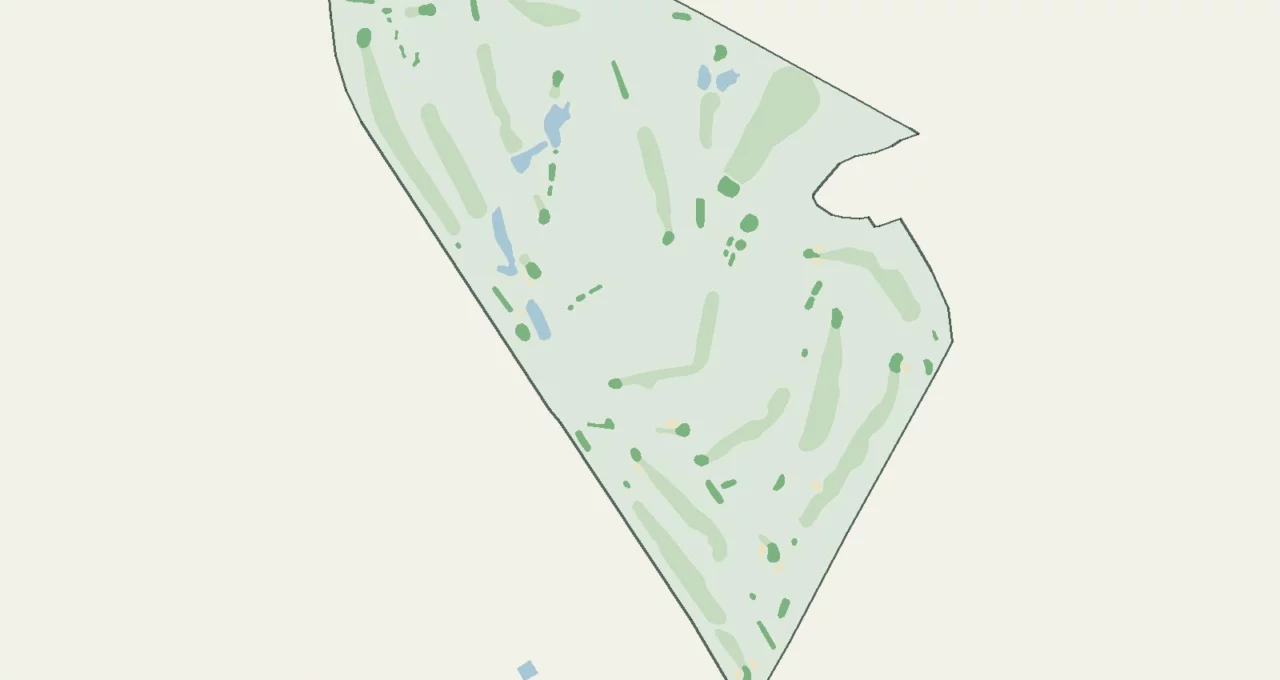
Layout of Lions Municipal Golf Course from OpenStreetMap survey data (ODbL licence).
Lions Municipal Golf Course
Holes
18
By
—
Length
About 5,750 yards
Green fee
—
Best season
Year-round
Members of the Austin Lions Club formed a municipal golf association in 1924, leased part of the Brackenridge Tract from the University of Texas and turned heavily wooded ground into a nine-hole course by the autumn of that year. A brick clubhouse and a second nine followed. Austin has called it Muny ever since.
Its place in the history of the game rests on 1950, when it was quietly desegregated. Historians recognise Lions Municipal as the first municipal course in the South to desegregate voluntarily, several years before federal public accommodation law and before access opened at other public courses. There is a historical marker on the property, and the course carries a National Trust listing as a threatened place: the land belongs to the university, the lease has been contested for years, and the course’s future is a live civic argument in Austin.
What it asks of you
Eighteen holes over about 141 acres, at roughly 5,750 yards. That is short by any modern measure, and it is the reason the course works as a city course: a round is quick, a beginner is not overwhelmed, and the land does not sprawl.
The trees do the defending. The tract was heavily wooded when the Lions Club took it on and the corridors are still tight in places, so the tee shot is about position rather than distance. On a course this short, the driver is rarely the right club, and the player who leaves it in the bag scores better.
The par threes average around 150 yards, which for a course of this length means they carry a disproportionate share of the difficulty. Muny is won and lost on iron play.
What players say about it
The points below summarise what recurs in public reviews on course sites and in local coverage, of which there is a great deal because of the land dispute. These are other people’s opinions, not ours: we have not played the course, and we name and quote no one.
What comes up in its favor
- The history is what visitors come for, and the 1950 desegregation is the reason the course has defenders far beyond Austin.
- The location, minutes from downtown on the Colorado River side of the city, makes it the most convenient round in Austin.
- It is affordable and genuinely public, which in a city with Austin’s costs is now unusual.
- The tree cover and the old routing give it a character that newer municipal courses do not have.
What comes up against
- Conditioning varies, and reviewers link it to the uncertainty over the lease: a course whose future is unsettled is a course nobody invests in.
- At 5,750 yards it offers a low handicap very little.
- Pace of play is slow at peak times, as at any popular city course.
- The dispute over the land is unresolved, and anyone planning a trip should check the course is still open.
Getting there and when to go
The course is on Enfield Road in west Austin, on the Brackenridge Tract, about ten minutes from downtown.
The season is year-round in central Texas. October to May is the comfortable window; July and August are punishing. Tee times are booked through the city.
Green fees
Rates and tee times are set by the city. See the city’s own page.
How this page was made
The factual frame comes from public sources: OpenStreetMap for the location, encyclopaedic entries, the historical marker record and preservation filings for the founding, the lease and the 1950 desegregation, and the city’s course page and public course records for the layout and the yardage. The opinion section summarises public reviews and local coverage read in September 2026; we report recurring themes rather than individual voices, and we reproduce no quotations.
We have not played this course, and this page is no substitute for a round. Nobody has paid for this page, and no one saw it before publication. If you know the course and something here is wrong or out of date, write to us and we will correct it.