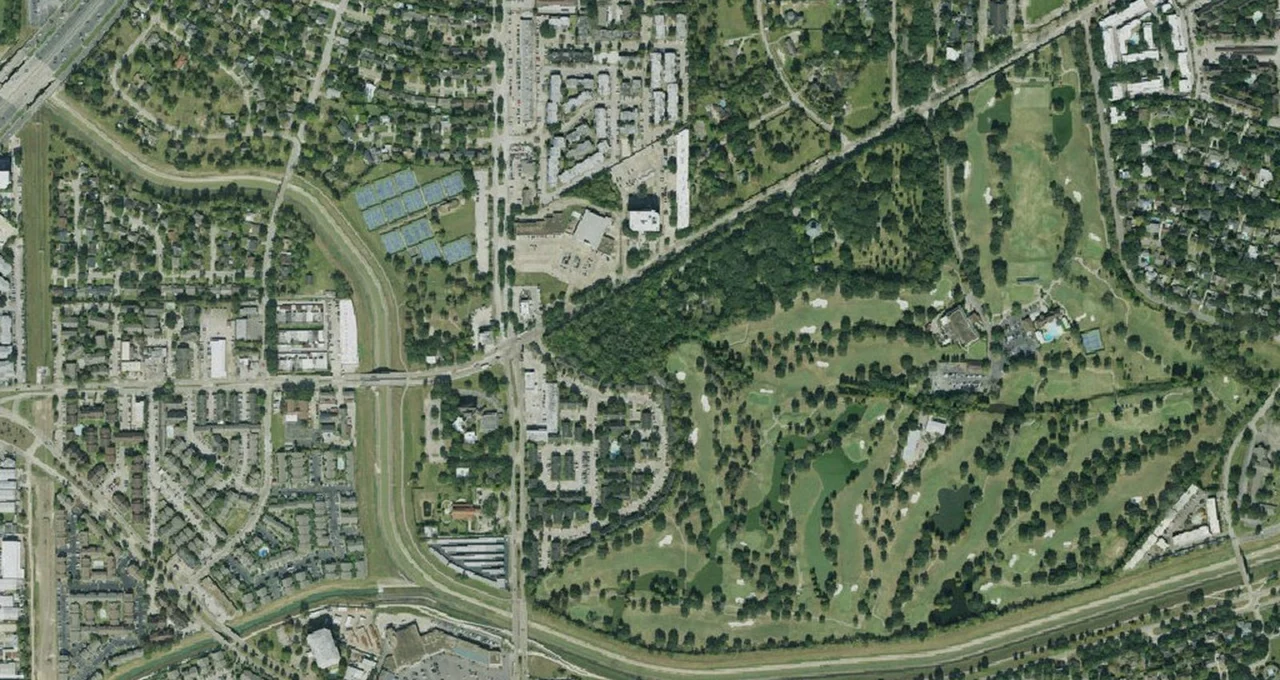
BraeBurn Country Club from the air. Aerial imagery USGS, domaine public.
BraeBurn Country Club
Holes
18
By
72 (36 out, 36 in)
Length
6,923 yards from the back tees on the post-renovation cards in course databases (rated 74.4/134 for men in one directory, 74.1/146 in another); older cards give 6,837 yards (72.9/130) or 6,808 yards (72.8/131)
Green fee
—
Best season
Year-round, according to Golfdom and a booking directory
BraeBurn Country Club is a private, member-owned golf club in southwest Houston, Texas, at 8101 Bissonnet Street, a few miles southwest of the city of Bellaire. Its 18-hole course was first laid out in 1926 by John Bredemus, the architect often called the father of Texas golf, under the name Colonial Country Club. The club took its present name in 1931, and it describes itself as the fourth-oldest club in Houston. Brays Bayou forms the southern edge of the property.
The course is a par 72 for 18 holes. The longest card circulating today, which matches the “just under 7,000 yards” announced by the Texas Golf Association, measures 6,923 yards from the back tees. The course was reshaped twice in the modern era: by Carlton Gipson in 1991, in a project tied to flood control that gave it slopes rarely seen in Houston, then by Tripp Davis between 2021 and 2022, when every green, tee and bunker was rebuilt. Jimmy Demaret, the first golfer to win the Masters three times, was its head professional from 1936 to 1941. This page is not about Brae Burn Country Club in West Newton, Massachusetts, a different club with a similar name.
From Colonial to BraeBurn
According to the club’s history page, the course was founded in 1926 as Colonial Country Club, on what was then suburban land off Bissonnet Road. John Bredemus designed it. Born in Flint, Michigan, in 1884, Bredemus was a track and field champion and a Princeton civil engineering graduate before he moved to Texas in 1919, according to Wikipedia; he went on to design Memorial Park Golf Course in Houston, and he was inducted into the Texas Golf Hall of Fame in 1981. The club credits him with a minimalist approach that moved very little earth, and it quotes Harvey Penick as saying that it takes the eyes of an artist to design a course but the skills of an engineer to build one, and that Bredemus was both.
Colonial did not last long under its original owners. The club says that in October 1929 a group led by Jack Burke Sr., Bredemus himself and Sid Van Ulm bought it from the original developer for $60,000. The Texas Golf Association gives the same three names and the same year. The club was then restructured, and BraeBurn Country Club was officially established on May 5, 1931, according to the club. A golf history blog tells a slightly different story: that the first developers lost the course to the bank that had financed them after the 1929 crash, and that Burke’s group bought it from the bank in the early 1930s. Burke Sr. was then the professional at River Oaks Country Club; his son, Jack Burke Jr., would later found Champions Golf Club in Houston with Jimmy Demaret.
The Demaret years
Demaret, born in Houston in 1910, is the name most closely tied to BraeBurn. The club says he first came to the property in 1926, as a teenager working for Bredemus during the construction of Colonial. He became head professional at BraeBurn in February 1936 and held the post until 1941. During that time, according to the club and the Texas Golf Association, he won nine PGA Tour events: the San Francisco National Match Play Open in 1938, where he beat Sam Snead 4 and 3 for his first tour win; the Los Angeles Open in 1939; six events in 1940, including the Western Open and his first Masters; and the Inverness Invitational Four-Ball in 1941, partnered with Ben Hogan. Wikipedia records that Demaret won the Masters again in 1947 and 1950, becoming the first three-time champion, and that he was inducted into the World Golf Hall of Fame in 1983, the year he died in Houston.
The club’s history also records that during the Second World War, the draft took members and staff away and squeezed the club’s income, and that five of the game’s best-known players took part in an exhibition on the first tee, which is today the 10th, to raise money for the war effort. The club’s page shows a war bond ticket and images of Bob Hope, but it does not name the five players, and we did not find another source that does.
Tournaments
BraeBurn’s list of events is long for a private club of its size. The club and the Texas Golf Association cite the 1950 Houston Open, which Wikipedia says Cary Middlecoff won at 11 under par, three strokes ahead of Pete Cooper; it was the only Houston Open played at BraeBurn, between stints at Pine Forest and Memorial Park. In 1952 the course hosted the LPGA’s Houston Weathervane, which the club says Betsy Rawls won by three strokes over Babe Zaharias. The NCAA men’s championship came in 1954. The club adds that the U.S. Ryder Cup team practiced there in 1967, and that Greg Norman brought his charity tournament, the Miracle Network Golf Tournament, to BraeBurn in 1988 with a field that included Fred Couples, Mark O’Meara, Jay Haas and Steve Elkington.
State amateur golf has come back since the renovation. The Texas Golf Association lists the 1995 Texas Amateur, won by Brad Elder, and the 2005 Texas Mid-Amateur Match Play among its past events at the club. In March 2024 it announced five more: the Texas Four-Ball in 2024, the Women’s Senior Stroke Play in 2025, the Texas Senior Amateur in 2026, the Texas Mid-Amateur in 2030 and the Texas Amateur in 2032. The 49th Texas Four-Ball was played there in August 2024 and decided in a playoff, with a winning total of 20 under par over three rounds of better-ball, and two aces made on the 14th in the final round. The 89th Texas Senior Amateur followed in September 2026; the association’s championship page credits Andy Hydorn of Houston with a one-stroke win after a closing 71.
A course reshaped for floodwater
Houston is flat, and Brays Bayou, which runs along the south side of the property, has a long history of flooding. The course as it plays today owes much of its shape to that problem. The club says Carlton Gipson, a Texas architect who worked mostly around Houston, redesigned the course in 1991 and gave prominence to elevation changes and rolling ground. Several trade publications describe the same work as a reshaping carried out to deal with flooding, which left the course with significant elevation change, unusual for the area.
The golf history blog mentioned above adds the details. According to it, the club reached an agreement with the Harris County Flood Control District that let it use almost $2.5 million in flood-control funds to rebuild the course as a runoff area for the bayou during heavy rain, and Gipson’s crews moved more than 300,000 cubic feet of earth to create the retention areas. We found no record from the district itself to confirm these figures, so they rest on that single account. We also found no report on how the course fared during Hurricane Harvey in 2017, when several other Houston courses were badly flooded.
The result is a course where water is part of the landscape. A course-ranking site that profiles BraeBurn says water comes into play on nearly every hole, while noting that none of the hazards are fed by the bayou itself. A reviewer on the same site, writing in 2025, describes an urban parkland layout that uses local streams and lakes in its routing.
The Tripp Davis renovation
Members approved a full renovation of the course in 2020, and the club hired Tripp Davis, an Oklahoma architect and member of the American Society of Golf Course Architects. Work began in February 2021, according to Golf Course Architecture magazine. The basic routing stayed the same, but the project rebuilt and reshaped every green, rebuilt and moved the tees, and rebuilt the bunkers in what the architect called a more classic style, placed to make better use of the slopes created in 1991. A new irrigation system went in, along with upgraded drainage meant to improve winter conditions. The practice range and short-game areas were redone as well. Davis said the aim was to give the course the feel of the early American “Golden Age” of architecture. The club adds that the plan also added yardage for longer hitters.
The front nine was due to reopen in December 2021, according to the architects’ society, and the full course reopened with a celebration on April 23 and 24, 2022, according to a golf travel writer. The club now says its fairways and tees are NorthBridge bermudagrass and its greens Mini-Verde, an ultradwarf bermudagrass. One trade report adds that the bunkers were reduced in size by about 20 percent and that some 90 acres were grassed, with a zoysia variety alongside the bermudagrass; the other reports mention only the bermudagrass. The club describes the course as covering 150 acres. Its general manager at the time spoke of the renovation as a way to mark the club’s 90th anniversary, and the Texas Golf Association says the work brought back design elements of Bredemus that had been lost or obscured over the years.
What it asks of the player
The Texas Golf Association describes BraeBurn as a parkland course known for its many trees, twisting fairways and well-guarded greens, a course that rewards shot-making. Its head professional told the association he considers it a tournament-style course. The club itself stresses that tees sit close to the previous greens, which makes it an easy course to walk.
The 6,923-yard card circulating in course databases is a par 36 on each nine, with ten par 4s, four par 3s and four par 5s. Hole by hole, it reads as follows, with the stroke index from one database in parentheses:
- 1st: par 4, 402 yards (3).
- 2nd: par 3, 178 yards (13). One course directory calls it the signature hole, without saying why.
- 3rd: par 4, 426 yards (7).
- 4th: par 5, 549 yards (9).
- 5th: par 4, 422 yards (1). The hardest hole on that card.
- 6th: par 4, 346 yards (5).
- 7th: par 3, 240 yards (11). The longest one-shotter on the course; its green was reshaped in the renovation.
- 8th: par 4, 360 yards (17).
- 9th: par 5, 509 yards (15).
- 10th: par 4, 408 yards (4). Once the first hole, according to the club.
- 11th: par 4, 386 yards (8).
- 12th: par 4, 375 yards (12).
- 13th: par 5, 508 yards (16).
- 14th: par 3, 152 yards (18). The shortest hole, and the one where two aces fell on the final day of the 2024 Texas Four-Ball.
- 15th: par 4, 451 yards (2).
- 16th: par 3, 208 yards (10).
- 17th: par 4, 466 yards (6). The longest par 4 on the card.
- 18th: par 5, 537 yards (14).
That gives an outward nine of 3,432 yards and an inward nine of 3,491. The par 3s cover a wide range, from 152 to 240 yards, which the Texas Golf Association singles out. Two of the four par 5s, the 9th and the 13th, are short enough at about 510 yards to be reached in two by a long hitter, and the stroke index ranks them among the easiest holes. The difficulty is concentrated in the long par 4s: the 5th, the 15th and the 17th, all over 420 yards.
The closing hole sums up the course. The course-ranking site describes the 18th as a par 5 with a lake guarding the right side of the fairway from the tee and a pond in front of the green, which forces a decision on the second shot: go for the green over the water, or lay up. Its description gives the hole as 540 yards and may predate the renovation, so the details of the hazards are worth checking on the ground.
For a club golfer, the main lessons from the published material are about precision more than length. Trees frame the holes, the fairways bend, and water is close on many of them. A 2025 reviewer found the greens relatively small even after they were enlarged in the renovation. The ratings published for the forward tees suggest a demanding course even from short distances, so choosing the right tee matters.
What golfers are saying
As a private club, BraeBurn draws few public reviews. In October 2026 one golf app showed an average of 4.8 out of 5 from 14 reviews, without displaying their text, and a course-ranking site showed two reviews, both at the top mark. A course-review site gives it a B grade and places it 29th in Texas. The points below summarize what recurs in the reviews we could read. They are other people’s opinions, not ours; nobody from Panxis has played the course, and we name no one.
What comes up in its favor
- Reviewers who saw the course after the renovation praise the layout and the conditioning; one places it among the best courses in Houston.
- The architecture gets credit: an urban parkland design that weaves streams and lakes into the routing, which one reviewer compares favorably with a smaller version of Memorial Park.
- The elevation changes, rare in Houston, the practice areas and the clubhouse are mentioned on a golf app’s summary.
- The club’s family atmosphere comes up as well.
What comes up against
- Access is the main drawback: the course is open only to members and their guests.
- The greens are relatively small, according to one reviewer, even after being enlarged.
- One reviewer, writing just after the reopening, noted that the new course was still young, a caveat that time has probably eased.
- The sample is very small, and none of the published reviews says much about pace of play or value.
Who can play
BraeBurn is a private, member-owned club. According to its membership page, membership is by invitation only: prospective members are introduced by a current member and are encouraged to visit as a guest first. The club offers stockholder, junior (under 35) and non-resident memberships, the last reserved for families whose home and business are at least two counties away from Harris County. Besides golf, the club has tennis and pickleball, a pool, a fitness center and dining.
Golfers who are not members can play only as guests of a member, under the club’s guest guidelines, which cover dress code, etiquette, pace of play and guest privileges and are published on the club’s guest information page. A booking directory adds that walking is allowed, metal spikes are not, and carts and rental clubs are available, along with a driving range, a short-game area, a putting green and a teaching professional. The course is played year-round, according to Golfdom and the same directory. One course directory lists BraeBurn as a public daily-fee course, which contradicts everything the club publishes; we have ignored it.
Getting there
The club sits at 8101 Bissonnet Street, Houston, TX 77074, in the southwest part of the city, between Bissonnet Street to the north and Brays Bayou to the south. Most visitors will arrive by car. The front desk can be reached at (713) 774-2586, the number published by the club.
In a straight line, the course is about 4 miles from the center of Bellaire, about 8 miles from Memorial Park Golf Course, about 11 miles from downtown Houston, about 15 miles from William P. Hobby Airport and about 24 miles from George Bush Intercontinental Airport. These distances are measured on the map, not by road.
Green fees
BraeBurn does not publish green fees, since the course is reserved for members and their guests. Guest conditions are set by the club: see the club’s guest information page or call the front desk.
How this page was made
The factual frame comes from public sources: OpenStreetMap and Wikidata for the location and identifiers; the club’s website, braeburncc.com, for its history, the course and renovation pages, the membership categories, the grasses, the acreage and the contact details; the Texas Golf Association for the 1929 purchase, the past and future championships, the 2024 Texas Four-Ball and the 2026 Texas Senior Amateur; Wikipedia for the biographies of John Bredemus and Jimmy Demaret and for the 1950 Houston Open; Golf Course Architecture, Golfdom, the American Society of Golf Course Architects, Golf Course Industry and a golf travel writer for the 2021 and 2022 renovation; a Houston golf history blog for the 1991 flood-control project; a course-ranking site for the water hazards and the 18th hole; course databases and booking directories (Open Golf API, GolfPass, GolfNow, Stymie, Golf Course Gurus, Wander) for scorecards, ratings and policies; and golf apps and review sites for the reviews.
Where sources disagree, we say so. Length and ratings differ widely. Older cards, still shown by several directories, give 6,837 yards from the Black tees with a rating of 72.9 and a slope of 130, or 6,808 yards with 72.8 and 131, the figure Golfdom also used in 2021; these appear to predate the renovation. Newer cards give 6,923 yards from the back tees, but rate them at 74.4 and 134 for men in one directory and 74.1 and 146 in another, and one database labels that set of tees Blue rather than Black. Another card on GolfPass adds up to 7,107 yards hole by hole while its own summary says 6,837. We follow the 6,923-yard card, which several sources share hole by hole and which fits the Texas Golf Association’s “just under 7,000 yards”, and we do not choose between the ratings; the stroke indexes come from a single database. The date of Bredemus’s design is 1926 for the club and the Texas Golf Association, 1931 for several trade publications, which use the year the club took its present name. The renovation was completed in 2021 according to the Texas Golf Association and in 2022 according to the club and the trade press. The history blog says a group led by Jimmy Demaret developed the original course, which is hard to square with the club’s account that Demaret was a teenage employee of Bredemus in 1926; we follow the club. A course-ranking site says the original layout lasted more than 60 years before Gipson’s work, while the club dates the course to 1926 and the redesign to 1991. The figures for the flood-control deal and the earth moved come from one source only, as does the zoysia mentioned in one trade report.
Some details will age: the scorecards and ratings, which change when a course is re-rated; the schedule of state championships; the review counts and averages read in October 2026; and the guest rules, which the club revises. Green fees are deliberately left out. The opinion section reports recurring themes rather than individual voices. Nobody from Panxis has played or visited this course, and this page is no substitute for a round.
The club has not paid for this page, has not seen it before publication and has no say over its content. This page contains no commercial link and earns us no commission. If you know the course and something here is wrong or out of date, write to us and we will correct it.
Other courses nearby
Closest to this one in our United States directory:
- River Oaks Country Club — 8 mi
- Hermann Park Golf Course — 9 mi
- Lions Municipal Golf Course — 142 mi
- Brookhaven Country Club — 239 mi
The hole to know
A par 5 of 537 yards on the 6,923-yard card. A course-ranking site describes a lake along the right side of the fairway from the tee and a pond in front of the green, which forces a choice on the second shot between carrying the water and laying up.