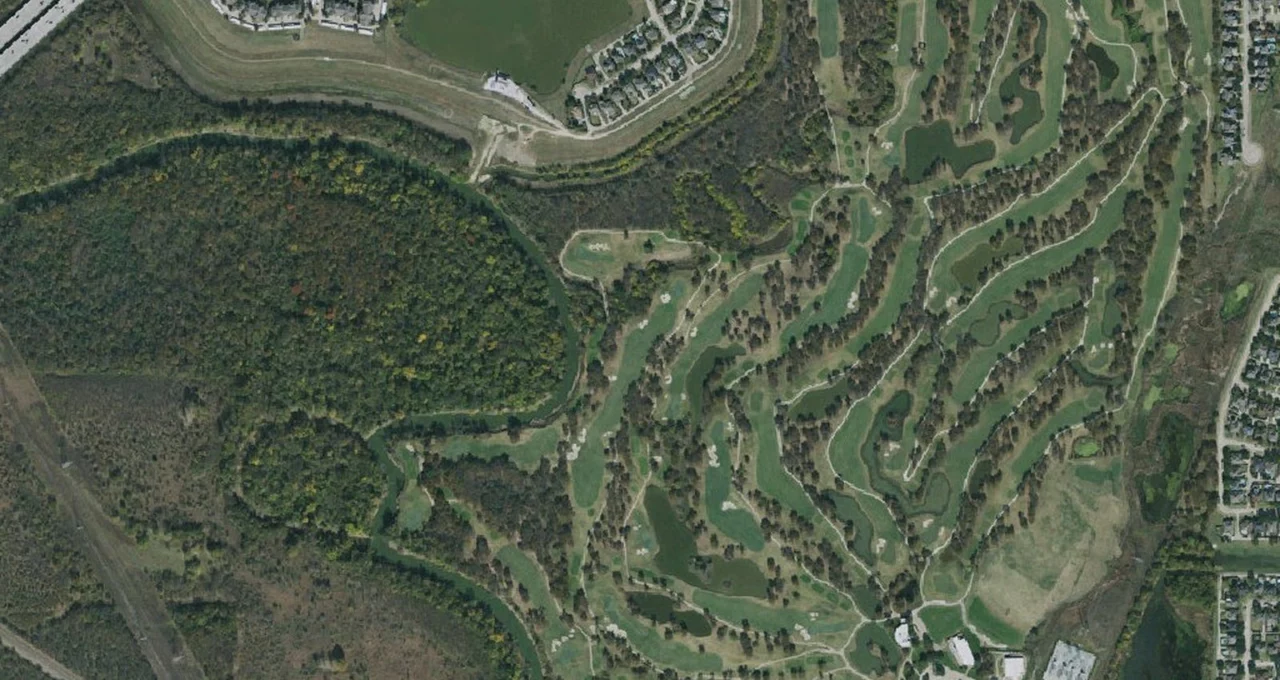
Indian Creek Golf Club from the air. Aerial imagery USGS, domaine public.
Indian Creek Golf Club
Holes
36
By
72
Length
Creek 7,235 yards and Lakes 7,000 yards from the back tees, on the club's course pages; yardages, ratings and slopes of the other tees are not published there
Green fee
—
Best season
—
Indian Creek Golf Club is a 36-hole public golf facility owned by the City of Carrollton, Texas, in the northern suburbs of Dallas. It gives its address as 1650 West Frankford Road, Carrollton, TX 75007. The two courses, the Creek and the Lakes, both play to a par of 72, and both sit in the floodplain where Indian Creek meets the Elm Fork of the Trinity River. The club’s website carries the City of Carrollton logo and says the facility is managed by Orion, a golf management company. Its golf shop can be reached at (972) 466-9850.
Two things define Indian Creek more than any single hole. The first is that it is a municipal complex with two full courses, which is uncommon even in a metropolitan area as golf-heavy as Dallas-Fort Worth. The second is the river. The land that gives the courses their trees, their creeks and their ponds is the same land that put both of them under water in 2015, and the story of the last decade at Indian Creek is largely the story of how the city brought them back.
Two courses in a floodplain
Directories that cover the club credit both original layouts to the architect Dick Phelps, hired by the city to fit 36 holes into the low ground along Indian Creek and the Elm Fork. The Creek Course came first: most sources date it to 1983. The opening year of the Lakes Course is less settled. Some directories give 1986, while a club profile published by the Texas Golf Association’s Lone Star Golf magazine dates it to 1987. We could not find a city document that settles the question, so we give both years.
The Creek Course was later reworked by the architect Jeff Brauer. The club’s own course page says it was redesigned by Brauer in 2004; one golf directory gives 2003 for the same work. The Lakes Course was rebuilt much more recently, in a project that closed it at the end of 2018 and that the club describes as a full renovation, completed in 2019, with new greens, fairways and cart paths. The club’s course page credits that redesign to Todd J. Clark, a member of the American Society of Golf Course Architects, and cites a cost of four million dollars.
The 2015 flood and the comeback
In the spring of 2015, heavy rain made Lake Lewisville overflow upstream, and from late May the water drained into the Trinity River floodplain where the courses lie. A CBS Texas report from November 2015 quoted Carrollton’s assistant city manager as saying the courses were under water until early August, and put the damage to the two courses at about one and a half million dollars. At the time, the city planned to repair the Lakes Course and was still studying whether to repair the Creek Course or put the land to another use.
The city chose to bring both back. A Dallas golf association’s blog, writing in March 2017 about an event held at Indian Creek, noted that the club had needed until the summer of 2016 to reopen after the floods forced a complete shutdown. A review posted on Greenskeeper.org in August 2016 described the Lakes Course as freshly reopened after about fourteen months of closure, and mentioned that the Creek Course was due to reopen at the same time.
The Lakes renovation that followed was the second phase of that recovery. In a post dated December 14, 2018, the club announced that the course was closed and that work had begun on a new cart path, a fully updated irrigation system, new green complexes built to USGA specifications, leveled fairways and tees, and new grass in areas still recovering from the flood. The post explained that the old greens had lost their identifiable gravel layer after more than thirty years, and that the new putting surfaces would be TifEagle Bermudagrass.
The Creek Course
The club calls the Creek its championship layout, “for those wanting a next level experience.” Its course page describes rolling terrain, generous fairways, large undulating greens and strategic bunkers, with native mesquite groves lining many of the fairways and the Elm Fork of the Trinity River running through the back nine. The club itself calls it the “grip it and rip it” side of the complex, noting that most of the hazards are lateral rather than forced carries.
On the club’s card the Creek measures 7,235 yards from the back, with 3,510 yards out and 3,725 yards in, and four sets of tees. The course page does not publish the yardages, ratings or slopes of the shorter tees, so we leave them out. The back nine is where the length is. It opens with a 430-yard par 4 and a 584-yard par 5, includes a par 3 of 260 yards at the 12th, and finishes with a run of three long holes: the 16th, a par 5 of 601 yards and the longest on the course, then par 4s of 470 and 461 yards. The shortest hole on the Creek is the 14th, a par 3 of 131 yards.
The front nine is more balanced, with par 4s between 376 and 444 yards, two par 5s of 554 and 514 yards, and two par 3s of 168 and 201 yards. For a golfer choosing between the two courses, the arithmetic is simple: from the back, the Creek is 235 yards longer than the Lakes, and nearly all of that difference is on its inward half.
The Lakes Course
The club presents the Lakes as the more accessible of the two: “accessible, affordable and fully renovated in 2019, this course is fun for all.” Its course page describes a tree-lined layout that is a habitat for birds, rewards the right club off the tee and the ability to shape shots, and is level and walkable, with short distances from each green to the next tee. The club notes that it is a favorite with golfers who like to walk.
From the back, the Lakes measures 7,000 yards on the club’s card, split almost evenly between 3,497 yards out and 3,503 yards in. Each nine has two par 5s and two par 3s. The par 5s run from 541 to 567 yards, the par 3s from 162 to 190 yards, and the longest par 4s, at the 9th and 16th, measure 439 and 441 yards. The renovated course is not short from the back, but its length is spread out, with no single hole that stands apart the way the Creek’s 12th and 16th do.
What it asks of you
On both courses the first question is water. The club does not publish a hole-by-hole account of where it comes into play, and public sources disagree. One golf directory describes the Creek as having water on all eighteen holes; a reviewer on Greenskeeper.org wrote that water features come into play on about fourteen holes of the Lakes. We cannot confirm either count, but the sources agree that ponds, creeks and the river are part of most holes at Indian Creek. A ball that finds the water is usually lost to the side rather than short of a green, which is consistent with the club’s description of mostly lateral hazards on the Creek.
The second question is the tee shot. On the Creek, the mesquite groves that line the fairways reward a straight drive more than a long one, even though the fairways are described as generous. On the Lakes, the trees and the club’s own emphasis on “proper club selection off the tee and shot shaping” suggest a course where the driver is not always the right choice, and at least one reviewer describes its fairways as narrow.
The third question is the greens. The club describes the Creek’s greens as large and undulating; the Lakes greens were rebuilt in TifEagle Bermudagrass in the 2018 and 2019 renovation. Several public reviews of both courses mention fast or slick greens. A player who comes from courses with slower surfaces will want to spend time on the practice green before the round.
Finally, there is the setting. Because the courses lie in a floodplain, drainage after heavy rain is a recurring theme in reviews, and the history of 2015 is a reminder that the river decides more than the calendar does. North Texas summers are hot, and the club’s own pace of play policy asks groups to complete eighteen holes in four hours and twenty minutes or less.
What golfers are saying
Public reviews of Indian Creek are spread across several golf apps and directories, many of them short, and some date from before the flood or before the Lakes renovation. We summarize what recurs and leave out what appears only once or is clearly out of date.
What golfers like. The Creek Course is the one most often recommended. Reviewers who have played both tend to describe it as the stronger and more interesting layout, and several describe it as being in very good shape from tee to green after its reopening. The cart GPS gets a positive mention; the club says every cart carries a Visage GPS system with Bluetooth speakers and USB ports. Friendly, helpful staff and a fair price for what the courses offer also come up in positive reviews.
What golfers criticize. The most persistent complaint, on both courses, is uneven ground: bumpy fairway areas and, in some reviews, tee boxes that are not level. Drainage after rain is the second recurring theme, unsurprising for courses built in a floodplain. Some reviewers mention weeds in the grass or work in progress, such as bunkers under construction, and feel the conditions did not match the price on the day they played. Reviews written before the 2019 renovation were often harsh on the Lakes Course; more recent ones describe it as better than they remembered, though still behind the Creek.
Because the Lakes was rebuilt in 2019 and both courses were restored after 2015, older reviews should be read with their date in mind.
Access and how to play it
Indian Creek is open to the public. Tee times can be booked on the club’s website or through its free app, seven days in advance, with online booking opening at midnight. The golf shop takes reservations by phone from 7 a.m. to 6 p.m. daily. On Saturdays and Sundays, tee times must be prepaid; on weekdays they can be booked online without prepayment. Cancellations more than 24 hours ahead can be refunded or turned into a rain check, while later cancellations receive a rain check only.
Walking is allowed, with walking rates reserved by calling the golf shop. Single players are paired and share carts. Ride-along and spectator carts are not available on weekends or holidays. The club also offers Finn Scooters, single-rider vehicles intended to speed up play. Children under six are not allowed on the course unless a non-playing adult supervises them at all times.
The club publishes rate categories for juniors aged 21 and under, seniors aged 60 and over and active military, as well as a discount for Carrollton residents who show a driver’s license with a city address. Rates change by season and time of day; we do not reproduce them here, and the club’s rates page is the place to check them.
The facilities
The club has a driving range with a seasonal grass tee, used when the weather allows. On the club’s rates page, the range opens 30 minutes after sunrise and closes 30 minutes before sunset, and it is closed for maintenance from Tuesday at 1 p.m. to Wednesday at 11 a.m. Directories also list a putting green and a short game area. The club offers lessons with its instructors and through the Angella Then Golf Academy, and it runs junior programs and adult scrambles through the year.
The clubhouse restaurant is the Arrowhead Grill, and the club offers beverage service on the course. Indian Creek also hosts golf events and rents space for private functions.
Getting there and when to go
The club sits on West Frankford Road in Carrollton, a suburb in the northern part of the Dallas-Fort Worth area, on the low ground along the Elm Fork of the Trinity River. Golf directories list the Creek Course as open year-round, which matches the climate of North Texas, where winter days are often mild enough to play.
The heat of July and August is the main constraint. An early tee time is the usual answer, and the club’s twilight rates, which it lists from March through October, offer another. Spring and autumn are the most comfortable seasons, but spring is also when heavy rain is most likely, and after a storm the low-lying holes can stay wet. Calling the golf shop before a round after heavy rain is a sensible precaution on courses with this history.
For a first visit, the choice of course depends on the player. A golfer who wants length, the river and the more varied layout will prefer the Creek. A golfer who wants a walkable, recently renovated course with short transitions between holes will be well served by the Lakes. A player with a whole day can play both.
How this page was made
This page was written from public sources consulted in October 2026: OpenStreetMap for the location, the address and the phone number; Wikidata for the identity of the club; the club’s website for the ownership logo, the management company, the two courses, their pars, card yardages and hole-by-hole lengths, the redesign credits for Jeff Brauer and Todd J. Clark, the cost of the Lakes renovation, the cart GPS, the scooters, the restaurant, the instruction, the booking, cancellation, cart, walking and pace of play policies, the rate categories, the resident discount and the range hours; the club’s blog for the December 2018 announcement of the Lakes renovation; a CBS Texas report from November 2015 for the flood; a 2017 post on the blog of a Dallas golf association for the reopening in 2016; and golf directories, including GolfN and Foretee, for the original designer and the opening years. Where sources disagree, as they do on the opening year of the Lakes Course and on the date of Jeff Brauer’s work on the Creek, we give both versions.
The opinion section summarizes public reviews read on Greenskeeper.org, Hole19 and in excerpts from other golf directories. GolfPass, Golf Digest and the Lone Star Golf magazine could not be read directly and were seen only through search engine excerpts; no key figure on this page rests on them alone. We report recurring themes rather than individual voices, we name no reviewer and we count nothing. We could not find the yardages, ratings and slopes of the shorter tees, a hole-by-hole account of where water comes into play, a dress code or general clubhouse hours, so they are absent. Nobody from Panxis has played or visited these courses, and this page is no substitute for a round.
The City of Carrollton and the club’s management have not paid for this page, have not seen it before publication and have no say over its content. This page contains no commercial link and earns us no commission. If you know the courses and something here is wrong or out of date, write to us and we will correct it.
Other courses nearby
Closest to this one in our United States directory:
- Brookhaven Country Club — 6 mi
- Lions Municipal Golf Course — 194 mi
- River Oaks Country Club — 241 mi
- BraeBurn Country Club — 245 mi
The hole to know
On the Creek Course, a par 3 of 260 yards from the back tee on the club's card, the longest one-shot hole of the complex, on a back nine where the Elm Fork of the Trinity River comes into the round.