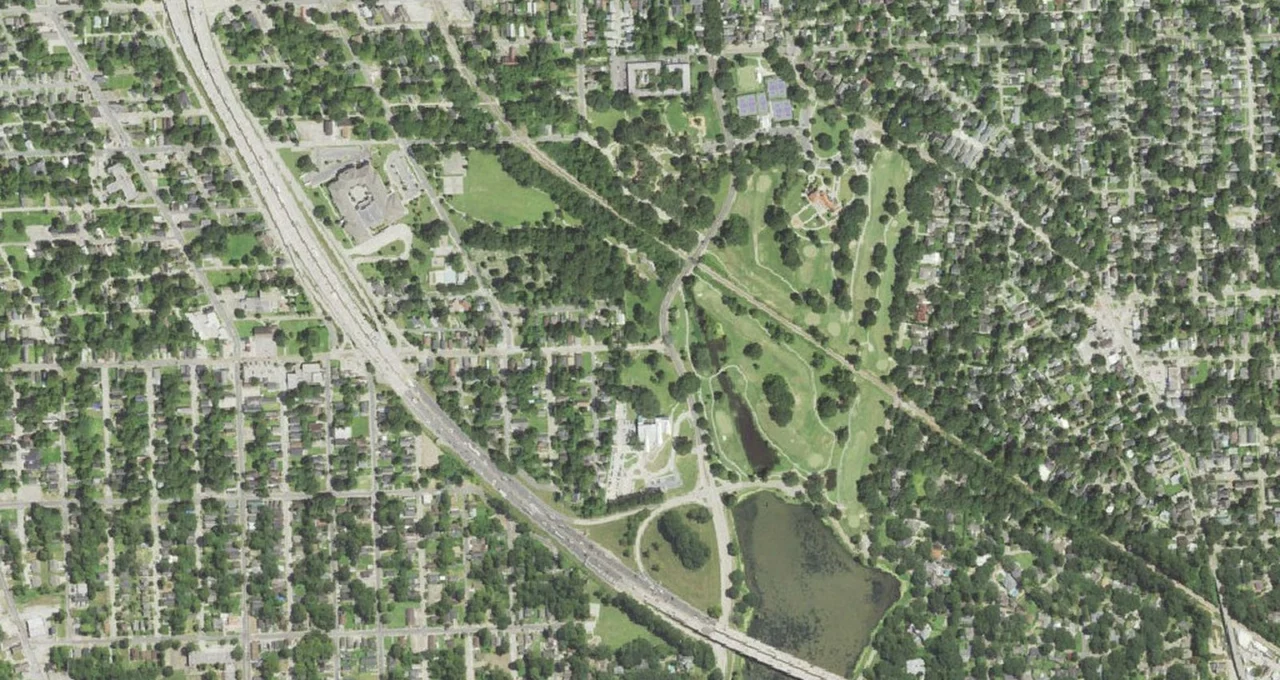
City Park Golf Course (Baton Rouge) from the air. Aerial imagery USGS, domaine public.
City Park Golf Course (Baton Rouge)
Holes
9
By
32 since the 2007 renovation (34 before it, according to the 2002 National Register nomination and Wikipedia)
Length
2,300 yards from the Purple tees (rating 31.2, slope 107 for men); 1,967 yards from the White tees and 1,876 from the Gold tees
Green fee
—
Best season
Year-round; open daily from 7 a.m. to sunset, according to BREC
City Park Golf Course is a public nine-hole golf course in Baton Rouge, Louisiana, owned and run by BREC, the Recreation and Park Commission for the Parish of East Baton Rouge, which markets it as Historic City Park Golf Course. It sits a little southeast of downtown, between Perkins Road, Dalrymple Drive, East Lakeshore Drive and City Park Lake, and it is not to be confused with the far larger City Park in New Orleans, which has golf courses of its own. The course gives its address as 1442 City Park Avenue, Baton Rouge, LA 70808.
Today’s layout has four par 3s and five par 4s for a par of 32. From the back (Purple) tees it measures 2,300 yards, with a course rating of 31.2 and a slope of 107 for men according to the tee table published on GolfNow; BREC’s own scorecard prints the same figures for two loops, 4,600 yards, par 64, rating 62.4 and slope 107. The course was designed by Tom Bendelow, the Scottish-born architect of the Chicago firm American Park Builders, and its clubhouse by the architect L. A. Grosz. According to its National Register of Historic Places nomination, it was completed in 1926 and officially opened in 1928. It was Baton Rouge’s first public golf course and, in the words of that nomination, its only public course until the mid-1950s. It was listed on the National Register on December 20, 2002.
A municipal course from golf’s golden age
The fullest account of the course’s origins is the nomination form prepared in 2002 by the staff of Louisiana’s Division of Historic Preservation, which places City Park in what golf historians call the Golden Age of Golf, the 1920s, when the number of courses in the United States multiplied and cities began building their own. Before City Park, the form says, Baton Rouge had two private courses, the Baton Rouge Country Club and the Westdale Club. In 1923 the city’s taxpayers approved a bond issue to acquire land for public parks, and on December 10, 1924, the City of Baton Rouge signed an agreement with Myron H. West, president of American Park Builders of Chicago, to design a community golf course. The designer on West’s staff was Bendelow.
Bendelow, born in Aberdeen in 1868 and dead in 1936, was one of the most prolific course designers of his era; Wikipedia credits him with roughly 600 courses and records his nicknames, “the Johnny Appleseed of American Golf” among them. His best-known work is Medinah Country Club near Chicago. The 2002 form notes that it is not known how much time he spent in Baton Rouge: designers of the period often spent a day or two on site staking out a layout and left the work to local crews. The landscaping, it says, was done by the local horticulturist Steele Burden, presumably to Bendelow’s instructions. American Heritage credits Burden with planting most of the live oaks that now line the fairways.
The land itself had a long history. The nomination places the course on part of the former Richland Plantation, outside the city limits of the time, with Perkins Road and Dalrymple Drive still country lanes when it opened. City Park Lake, which forms the southern edge of the course, was created at the same time as the course; University Lake, just to the south, followed in the 1930s. A rail line already crossed the property at an angle and still does. In the 1960s, Interstate 10 was built across City Park Lake, which the nomination says compromised the view of the lakes from the course.
The golf course was one part of a larger recreation complex. The nomination describes a large swimming pool behind the clubhouse, a zoo across Perkins Road and an amusement pavilion with a merry-go-round northwest of the clubhouse. None of these survive, but the outline of the pool was still visible in 2002, and the pool’s old pump house still stands in the rough to the right of the 9th hole. The form also states plainly that “anyone” who could play a public course in that era often meant white golfers only.
Segregation and 1964
City Park was segregated for its first decades. WBRZ reported in November 2025 that a plaque now hangs in the clubhouse honoring Marshall J. Honore, the first African American to play a round at the course, in 1964, after it was desegregated; he had died earlier that year at the age of 100. An article in The Advocate, of which we could read only an excerpt, dates the opening of City Park and Webb Park golf courses to Black golfers to May 27, 1964, one day after BREC received a federal court order to desegregate the park system, and says seven Black golfers played City Park that day. 225 Magazine notes that Black families were not allowed to swim in the City Park pool under Jim Crow; according to a history written by the late Lillie Petit Gallagher and published by the Friends of City Park, the pool, opened in 1928, closed in 1964.
The clubhouse and the National Register
The clubhouse, at the north end of the course facing Perkins Road, is a stucco building with a red tile roof in the Spanish Revival taste and a four-bay gallery with paired Colonial Revival columns, according to the nomination. Its main floor was a single large room for dining and social events, with a lounge, a kitchen and a ladies’ dressing room on either side; the basement, which opens at ground level at the back because the land falls away, held changing rooms, lockers, showers and ticket sales. By 2002 the main floor had for years housed a local art gallery, and BREC still lists an art gallery in the clubhouse alongside the pro shop. The columns had been replaced, the fireplace walled in and the ceiling lowered, but the form concluded that someone from the early days would recognize the building.
The National Register listing covers about 48 acres and three contributing resources: the course, the clubhouse and the pump house. Its period of significance runs from 1928 to 1952. According to a 2013 report in 225 Magazine, the listing followed a 2002 proposal to build a parish library on the course grounds, which supporters of the course answered by seeking historic status. Wikipedia’s article on Bendelow says City Park was the first golf course to be honored in this way by the National Park Service, and Gallagher’s history calls it Louisiana’s first golf course on the National Register; BREC’s own page says it is one of 20 courses in the country on the Register. We could not check these claims against a full list.
What the course asks of you
The defining feature of City Park, in a part of Louisiana known for flat ground, is its slope. The 2002 nomination explains that the course straddles the Baton Rouge Fault, and that Bendelow used the escarpment to build a hilly course on which ground levels vary by as much as 25 feet; BREC also gives elevation changes of up to 25 feet, while the Friends of City Park speak of 30. The other hazards are trees, mostly mature live oaks, which make the course tight; fairways set close together with little traditional rough, so that they sometimes run into one another; the rail line, which the form describes as level with the course in places, below it in others and on a high embankment elsewhere, and which creates out-of-bounds on several holes; and the remains of an old bayou in the southwest corner, which supply the water. About half the original sand traps survived in 2002.
The layout was changed in 2007. BREC says the renovation left the course with four par 3s and five par 4s; the 2002 nomination, written before it, describes a par-34 course with only two par 3s, and the yardages it gives are longer on almost every hole. The hole notes below combine BREC’s current descriptions and scorecard with the 2002 description where it helps. Yardages are from the Purple tees, with the White and Gold tees shorter.
- 1st, par 3, 149 yards. BREC calls it a simple opener with a large green and no bunkers, but tricky slopes on the green. In 2002 it was a 160-yard par 3.
- 2nd, par 4, 347 yards. A tight tee shot to a very small green, says BREC. The nomination described an oak-lined fairway with a small trap right of the green.
- 3rd, par 4, 370 yards. BREC calls this the tightest tee shot in Baton Rouge, with out-of-bounds and a bunker left on the approach. The hole runs alongside East Lakeshore Drive behind a line of trees, and the 2002 form described a complex, mounded green guarded by a trap and a grass bunker.
- 4th, par 4, 310 yards. Drivable for big hitters, according to BREC, with a large oak, a pond and a significant drop. It is the only hole the rail line actually crosses: the fairway goes down the escarpment about 150 yards from the tee, to a green on a high mound.
- 5th, par 3, 143 yards. Today a short hole over water. In 2002 it was a 410-yard dogleg par 4, which the nomination said golfers traditionally rated the hardest par 4 in Baton Rouge, with a carry over the bayou.
- 6th, par 4, 262 yards. A short par 4 with water right of the fairway and beyond the green, says BREC; the 2002 version was a 375-yard hole made blind by an oak about 100 yards out.
- 7th, par 4, 377 yards. The hardest hole on the card (stroke index 1) and, for BREC, the toughest on the course: a right-to-left dogleg to a small green guarded by sand and water. The 2002 form described a double tee, a blind crest about 100 yards out and a steep drop to a low green beside the railroad embankment.
- 8th, par 3, 205 yards. A long uphill par 3, nearly blind from the back tee, says BREC; the nomination describes a steep hill starting about 20 yards in front of the tee and rail-line rough all down the right.
- 9th, par 3, 137 yards. A short downhill hole to the most sloped green on the course. Before 2007 this was a hilly 320-yard dogleg par 4, with the old pump house in the right rough.
The numbers make clear that City Park is not a long course: no par 5s, three holes under 160 yards from the back and a total of 2,300 yards. What it asks for is control: a straight drive between oaks, judgment of distance up and down slopes, and a touch on small or steeply tilted greens. BREC presents it as well suited to quick rounds and league play, and the low course rating, 31.2 for nine holes from the back, puts it within reach of beginners. The White tees play 1,967 yards and the Gold tees 1,876 yards, with ratings of 30.1 and 29.9 for men.
A course under debate
The future of the course has been argued over for more than two decades, which matters to anyone planning to play it. In 2005, according to 225 Magazine, BREC commissioned two concepts for City Park, one with the course and one without; a survey at the time found 34 percent of respondents wanted to keep it and 30 percent to eliminate it. In 2013 a petition to turn the course into a central park was nearing 1,000 signatures, the same magazine reported, while rounds had fallen from 21,887 in 2009 to 16,335 in 2012.
Play has since grown sharply. WAFB reported in March 2026 that City Park recorded more than 28,000 rounds in 2025, up from fewer than 10,000 in 2018, according to BREC. The Friends of City Park, a group that campaigns to keep the course intact, gives 28,225 rounds for 2025 and 15,927 for 2014, and describes a level of more than 22,500 a year since 2019, which does not match WAFB’s figure for 2018. Supporters also point to First Tee junior programs and high school golf on the course.
In 2025 and 2026 BREC ran a master planning process for City-Brooks Community Park and the University Lakes with the design firm Sasaki. In July 2026, WAFB reported, two concepts called “The Big Loop” and “The Stitch” kept the course but reduced its footprint, and a state representative, Dixon McMakin, proposed a compromise that would leave it untouched. In August WAFB reported that the latest draft kept nine holes and a par of 32 but would change the layout and cut the length from about 2,300 to 2,080 yards. Sasaki presented the final plan to the BREC Commission on September 24, 2026; WBRZ reported that the vote that evening only accepted that the plan was complete, and did not approve or reject its implementation. As of October 2026 we found no report of a final decision. The holes described above could change in the coming years.
What golfers say
The public material on City Park is thinner than for a large course, and we report it as such. The main source is the 18Birdies app, which in October 2026 showed an average of 3.8 out of 5 from 217 reviews, with sub-scores of 4.2 for value and 3.2 for course condition; the most recent ratings we could see, from June to August 2026, ranged from two to five stars, without readable text. A course directory page from GolfPass (formerly Golf Advisor) gave an average of about 4.2, but we could not open the page and read only search excerpts of its reviews. We also read a 2026 discussion among local golfers on the TigerDroppings forum and the comments of golfers quoted in local television reports. These are other people’s opinions; we name no one and quote no reviewer.
What comes up in its favor
- The terrain: golfers repeatedly mention the hills and elevation changes, unusual in Baton Rouge, and one forum post calls it the only course in the area with real topography.
- The layout and the setting, with old oaks and views of the lakes; one reviewer calls it a gem.
- Speed and convenience: no par 5s, a short total length and a central location make for a fast, walkable round.
- Value is the highest sub-score on 18Birdies, and the course is described as friendly to beginners.
- Its history, which many golfers quoted in local reports see as a reason to keep it as it is.
What comes up against
- Condition is the weakest point: reviewers mention rough or poorly patched greens and tired tee boxes, and condition is the lowest sub-score on 18Birdies.
- Crowds: forum posters describe the course as packed, including midweek, with waits for carts at times.
- Experienced players may find it too short; one forum post suggests rebuilding the greens to make it more interesting for them.
- An older review site, golfreview.com, shows a low average of 2 out of 5, but from only five reviews, some of them many years old.
Getting there and playing
City Park is a public course open to anyone. BREC says it is open every day from 7 a.m. to sunset, and GolfNow lists it as open year-round, which suits the Baton Rouge climate; the course can close temporarily for frost or for the whole day in bad conditions, according to BREC’s rules. Tee times can be booked online or by phone through BREC. Under BREC’s golf rules, reservations open at noon 13 days in advance, groups must have two to four players (a fivesome only with the manager’s permission), singles cannot book and may be paired on the day, and at the nine-hole courses every fourth tee time is held for walk-on golfers.
Walking is allowed, according to GolfNow, and carts are available. BREC’s rules say cart drivers must be at least 18 with a valid driver’s license, carts carry no more than two riders and two bags, keep to the paths unless otherwise allowed, and private carts are not permitted; golfers with a qualifying disability can ask for a flagged cart. Rental clubs and a teaching professional are available, according to GolfNow, but there is no driving range; the clubhouse has a pro shop and a putting green. The dress code requires sleeved shirts for men and rules out swimwear, short shorts and tank tops, and only non-metal spikes are allowed. Golfers under 13 must play with an adult. No outside food or drink is allowed, except for documented medical needs.
The course lies about 2 miles in a straight line from the Louisiana State Capitol downtown, about 1.7 miles from Tiger Stadium on the LSU campus, about 7 miles from Baton Rouge Metropolitan Airport and about 62 miles from New Orleans’s international airport. These are map distances, not driving distances. The clubhouse faces Perkins Road at the north end of the course.
Rates vary by day and time, with twilight rates from 3 p.m. during daylight saving time and from 1 p.m. otherwise, and discounted prepaid play online, according to BREC. We do not reproduce them; check them on the course page on BREC Golf before you go.
How we built this page
The factual frame comes from public sources: OpenStreetMap and Wikidata for the location and identifiers; the National Register of Historic Places nomination of 2002, published by the National Park Service, for the history, the 2002 layout, the clubhouse and the listing; Wikipedia’s articles on City Park Golf Course and Tom Bendelow for the listing date and the architect’s career; American Heritage for Steele Burden’s oaks; BREC Golf’s course page, scorecard and golf rules for the current layout, ratings, hours, services and booking rules; GolfNow for the tee table, walking and rental clubs; WAFB, WBRZ and 225 Magazine for the rounds played, the debate over the course and the master plan; WBRZ and an excerpt of The Advocate for the 1964 desegregation; the Friends of City Park for Gallagher’s history and its own figures; and 18Birdies, GolfPass excerpts, golfreview.com and the TigerDroppings forum for the opinions.
Where sources disagree, we say so. Par is 32 on BREC’s current scorecard and in GolfNow, but 34 in the 2002 nomination and in Wikipedia, which reflect the course before the 2007 renovation turned the 5th and 9th holes into par 3s. The nomination says the course was completed in 1926 and officially opened in 1928, and BREC says it was built in 1926; the Friends of City Park give a contract in 1923, informal play from 1925 and an official opening on August 3, 1928, while the nomination dates the contract to December 10, 1924. The course covers about 45 acres in the nomination’s description, 40 according to BREC and the Friends, and the listed district about 48. The maximum elevation change is 25 feet for BREC and the nomination, 30 for the Friends. American Heritage gives the address as 1422 City Park Avenue; BREC and the nomination give 1442, which we follow. GolfNow’s women’s figure for the White tees, 1,937 yards, differs from the 1,967 on BREC’s card. WAFB’s figure of fewer than 10,000 rounds in 2018 conflicts with the Friends’ claim of more than 22,500 a year since 2019. Some directories name other designers; we follow the nomination.
Some details will age: the master plan and any change to the layout, the rounds played, the review averages read in October 2026, the hours and booking rules, and the rates, which we deliberately leave out. The opinion section reports recurring themes rather than individual voices. Nobody from Panxis has played or visited this course, and this page is no substitute for a round.
BREC has not paid for this page, has not seen it before publication and has no say over its content. This page contains no commercial link and earns us no commission. If you know the course and something here is wrong or out of date, write to us and we will correct it. The National Register nomination tells the course’s early history in more detail.
Other courses nearby
Closest to this one in our United States directory:
- Bayou Oaks at City Park — North Course — 70 mi
- Hermann Park Golf Course — 257 mi
- River Oaks Country Club — 259 mi
- BraeBurn Country Club — 266 mi
The hole to know
A par 4 of 377 yards from the Purple tees, stroke index 1 and the toughest hole according to BREC: a right-to-left dogleg over a blind crest to a small green guarded by sand and water, beside the railroad embankment.