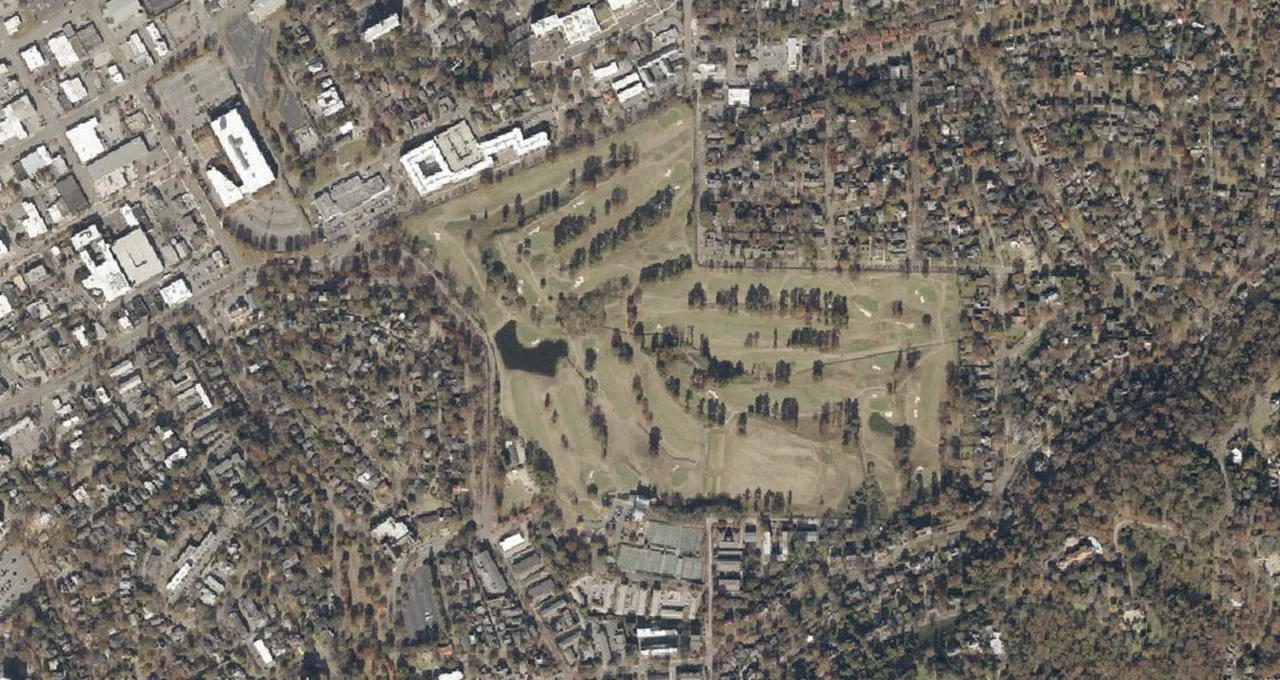
Highland Park Golf Course from the air. Aerial imagery USGS, domaine public.
Highland Park Golf Course
Holes
18
By
70
Length
5,801 yards from the I tees (rating 67.3, slope 123) on the club's ratings and GolfNow; the hole-by-hole card on GolfPass adds up to 5,818 yards
Green fee
—
Best season
All year (GolfNow)
Highland Park Golf Course is a public 18-hole course at 3300 Highland Avenue South in Birmingham, Alabama, a short drive from downtown. The club’s website calls it Alabama’s oldest golf course, and its history page dates it to 1903, when it was laid out for the Country Club of Birmingham. The land belongs to the City of Birmingham. According to Bham Now, a long-term lease is held by Highland Park Golf, LLC, whose managing partner is Bob Barrett, and the day-to-day operation is run by Honours Golf, a division of Troon. Wikidata describes it simply as a public golf course in Alabama and records a par of 70, the figure given by every source we consulted.
It is a short course by modern standards. The club gives “over 5,800 yards from back tees” and publishes ratings for four sets of tees, while GolfNow lists the matching yardages: the I tees at 5,801 yards (course rating 67.3, slope 123), the II tees at 5,368 yards (66.0 and 119), and the III tees at 4,793 yards, rated 64.1 and 114 for men and 70.0 and 113 for women. Those ratings are the ones on the club’s own page, and this page follows them. Other figures circulate. Wikipedia and an older GolfNow summary give a rating of 68.1 and a slope of 128 for 5,801 yards; a course directory lists the I tees at 5,590 yards with a 67.6 rating and a 124 slope; and the hole-by-hole card published by GolfPass adds up to 5,818 yards rather than 5,801. We could not reach the USGA course rating database to settle the question.
What the course lacks in length it makes up for in history. Bobby Jones won a tournament here as a teenager, a blind war veteran shot a round here that gave the course his name for decades, and in 1962 the city shut it, along with its other municipal courses, rather than open it to Black golfers. In 2025 Troon named it its Facility of the Year for the East.
From country club to city course
The early dates depend on the source. The club, Wikipedia and Bham Now give 1903 as the year the course was established as the Country Club of Birmingham. Bhamwiki, a local encyclopedia cited by Bham Now, tells it in more detail on its page about the Country Club of Birmingham: in 1900 the club moved to the site of the former Lakeview Park, at the end of the Lakeview streetcar line, where the club professional, Nick Thompson, laid out a nine-hole course on the hilly ground; a few years later he extended it to eighteen holes. Bham Now credits Thompson with designing the 18-hole course in 1903. We could not open Bhamwiki directly and rely on the excerpts shown by search engines.
The best-known episode of the country club years came in 1916. According to the club and Wikipedia, a 14-year-old Bobby Jones won the Birmingham Country Club Invitational on this ground, years before his major championship victories.
In the 1920s the Country Club of Birmingham built a new home with two courses in Shades Valley, in what is now Mountain Brook, and sold its old course to the city. Here again the year varies: Bhamwiki and a hickory golf website give 1926 for the sale, while Bham Now gives 1927 for both the move and the purchase. The club says the course opened to the public in 1927, and this page follows that date. Under the name Highland Park, it became a municipal course run by the city.
Closed rather than integrated
Like the rest of public life in Birmingham at the time, the city’s golf courses were segregated. In October 1961, according to the Tracing Center, a federal district court ruled that Birmingham’s segregated public recreation facilities were unconstitutional and ordered them integrated. Public Safety Commissioner Bull Connor responded by announcing that he would close dozens of parks, playgrounds, pools and the city’s four golf courses. In January 1962 the courses were shut, and police poured concrete into the holes so that no one could play. The golf blog Lying Four, which wrote about Highland Park in 2019, describes the same episode at this course.
The courses reopened as integrated facilities on June 29, 1963, after a change in the city’s form of government and the election of Albert Boutwell as mayor, according to the Tracing Center. In a 2013 NPR segment marking the fiftieth anniversary, Dr. Jesse Lewis, described as one of the first Black golfers to play Highland Park on the day it integrated, recalled the concrete in the holes. Lying Four notes that for roughly six decades after the course opened, Black golfers could not play it.
Charley Boswell’s course
For several decades the course carried the name of Charley Boswell, a Birmingham native. According to Wikipedia, Boswell was born in 1916, played football at the University of Alabama, earned a place with the Atlanta Crackers minor league baseball team in 1941 and was then drafted into the Army. Serving as a captain in the 84th Infantry Division in the Second World War, he was permanently blinded when a burning tank exploded as he tried to pull a wounded soldier from it. He took up golf during his rehabilitation and won the national blind golf championship in 1947, according to Wikipedia.
On October 5, 1956, Boswell shot 81 at Highland Park, which the club describes as a world record for a blind golfer at the time. The club’s history page says the course was named after him in 1955, yet also says it was renamed after that 1956 round; Wikipedia follows the second version. We cannot reconcile the two, so this page gives both. The club credits him with 17 national and 11 international blind golf championships, while Wikipedia counts 16 national and 11 international titles. According to the club, he also founded a celebrity golf tournament that raised money for the Eye Foundation Hospital in Birmingham, served as president of the United States Blind Golfers Association and was inducted into the Birmingham Golf Association Hall of Fame and the Alabama Sports Hall of Fame. A plaque in his honor stands on the first tee. According to Wikipedia, the name went back to Highland Park Golf Course after Honours Golf took over the operation.
Two renovations
By the late twentieth century the course was in poor shape: Lying Four cites a contemporary description of a course that had fallen into ruin. The club says a restoration led by Bob Barrett, a golf course developer and manager, together with the architect Bob Cupp, gave it a classic design with modern amenities. The club, Bham Now and Lying Four date that work to 1998; Bhamwiki, as shown by search engines, gives 1988. This page follows 1998. Lying Four calls it the course’s only major renovation and says the original playing corridors survived it largely intact. One course directory lists Cupp as the designer and 1998 as the opening year, which reflects the renovation rather than the origin of the course.
The second project focused on the putting surfaces and the bunkers. According to the club, it took seven months and was overseen by Landscapes Unlimited, in partnership with the City of Birmingham, its Parks and Recreation Department and Honours Golf. The greens were rebuilt with AU Victory bentgrass, a variety developed by the turfgrass team at Auburn University for heat and humidity, and the bunkers were rebuilt with new liners and sand using the Billy Bunker method. The club dates the work to 2019; a Troon press release, as indexed by search engines, says the course reopened on March 2, 2020, after work that began the previous August. Bham Now also mentions a new back tee on the par-4 15th, at the highest point of the property, with a view of the downtown skyline.
Recognition followed. The club says GOLF Magazine placed Highland Park on its 2021 list of the Top 100 Value Courses in the U.S. and on its list of the 30 best municipal courses in America, published the same year; Bham Now reported the municipal ranking in July 2021 without giving the exact position, and we did not find it elsewhere. In November 2025, at Troon’s Global Leadership Conference, the course received the Troon Golf Facility of the Year award for the East, according to Bham Now.
What it asks of you
The short card is deceptive. The club describes short, narrow, rolling fairways, elevation change on every hole, winding creeks, several lakes and heavily bunkered greens, with many uphill approach shots. Golf Digest, as shown by search engines, compares the layout to a New England style course with short, narrow holes that demand precision. The property is hemmed in by the city on all sides, and Lying Four notes that it has no room to grow. Expect to hit fewer drivers than usual and to think more about where the ball will finish on a slope.
The par of 70 is built unusually: the course card shared by GolfPass, Golf Record and Hole19 has five par 3s, ten par 4s and three par 5s, with an outward nine of par 36 and an inward nine of par 34. The greens are bentgrass, of the AU Victory variety developed for heat and humidity, and GolfNow lists Bermuda grass fairways. On the stroke index of that card, the 7th is the hardest hole, followed by the 11th, the 5th and the 10th; the 14th is ranked the easiest.
The front nine
The yardages below come from the I tees on the GolfPass card, with the II tees from the Golf Record card in brackets; the descriptions come from Lying Four and the course directories, and we name the source where it matters. The 1st is a par 4 of 307 yards (287) played from an elevated tee, short enough for long hitters to think about the green. The 2nd is a short par 5 of 465 yards (443), the easiest hole on the outward nine by stroke index, and the 3rd a par 3 of 136 yards (106). The 4th, a par 4 of 382 yards (363), has fairway bunkers on the right and a slope on the left that tends to nudge drives back toward the fairway, according to Lying Four.
The 5th, a par 3 of 196 yards (178) and third on the stroke index, is the hole GolfPass presents as the signature: a downhill tee shot over water. The 6th, a par 4 of 395 yards (366), runs downhill, with a bank on the left that can kick a miss back into play. The 7th, a par 4 of 423 yards (391), is the longest two-shotter on the card and ranked the hardest hole on the course. The 8th, a par 5 of 517 yards (498), has a green whose right side is accessible and whose left side is not, in Lying Four’s account. The 9th, a par 4 of 349 yards (338), brings the outward half to a close.
The back nine
The inward nine is shorter and, according to the stroke index, hardest near the start. The 10th, a par 4 of 382 yards (365), opens with a downhill tee shot to a wider fairway than the 1st and an approach over water that fronts the green. The 11th, a par 3 of 195 yards (179), is second on the stroke index. The 12th, a par 5 of 541 yards (485), is the longest hole on the course, with a narrow fairway; Lying Four suggests using a right-to-left slope on the right side. The 13th is a par 3 of only 113 yards (89).
The 14th, a par 4 of 273 yards (252), is the hole Lying Four singles out as the best on the course: it climbs uphill with a gentle bend from left to right, a large bunker is set into the last yards of the hill, and the approach is blind. The 15th, a par 4 of 326 yards (287), plays downhill and is listed by Lying Four as drivable; its new back tee, according to Bham Now, sits at the highest point of the property. The 16th is a par 4 of 350 yards (324), the 17th a par 3 of 117 yards (106). The 18th, a par 4 of 351 yards (311), starts with a dramatic downhill tee shot and ends with a climb back up toward the clubhouse.
A word on the cards. The yardages above sum to 5,818 yards on the GolfPass card and 5,368 yards on the Golf Record card, which matches the II tees. The Hole19 app shows a third card of 4,863 yards, close to but not identical with the 4,793-yard III tees. The club itself does not publish a hole-by-hole card online, so check the card at the first tee before relying on any single figure.
What golfers are saying
This section draws on user reviews on GolfPass, Tripadvisor, Hole19 and a business directory, as shown in search results or on the pages we could open, on the Golf Digest panel summary as indexed by search engines, and on the account published by Lying Four. These are other people’s opinions, not ours; nobody from Panxis has played the course, and we quote no one by name.
What comes up in its favor
- Conditioning, especially the greens, described as fast and true and in good shape; several reviewers link this to the 2019 and 2020 renovation.
- The setting: views of the downtown skyline, historic homes along the course and a city course that feels like a park.
- The character of the land, with constant elevation change and slopes that some reviewers say help slightly wayward shots back toward the fairway.
- Value for money and easy access to tee times, according to several reviewers.
- The history, from Bobby Jones to Charley Boswell, which visitors and golf writers mention as part of the appeal.
What comes up against
- Pace of play, the most frequent complaint, with reports of long rounds and backups on the first tee; one reviewer attributes it to carts being kept on the paths.
- A course that gets heavy play, with parts of the greens sometimes under repair and unrepaired marks blamed on other golfers.
- Tight fairways and a short total length that some players find confining, while others enjoy the precision it demands.
- A hilly walk, described by Lying Four as demanding.
How to play it
Highland Park is open to the public. Tee times are booked online through the club’s website, which links to Troon’s booking system, through GolfNow, or by phone at the golf shop; the club asks groups of five or more to call. The club offers rate categories for seniors aged 65 and over, juniors aged 17 and under, students with a valid ID, military and first responders, each with its own days and hours, and a twilight rate whose start time moves with daylight saving time. This page lists no green fee: current rates are on the club’s website.
GolfNow lists carts as included with green fees, and the club notes that junior rates do not include a cart. We found no published walking policy; given the hills and a reviewer’s mention of cart path rules, ask the golf shop before planning to walk. Metal spikes are not allowed and the dress code calls for appropriate golf attire, according to GolfNow. Rental sets of Callaway clubs are available for men and women, right- or left-handed, and clubs can be shipped to the course through Ship Sticks, according to the club.
The facilities
The club describes its driving range as state of the art, with a putting green, a short game area with a chipping green and a sand bunker, and areas for private instruction. According to the club, the range opens at 7 a.m. and stays open until dusk, except on Tuesdays, when it opens at 11 a.m. Demo days and club fitting events are held there. The Learning Center offers lessons and clinics, and the junior program includes Junior Golf, LPGA/USGA Girls Golf, PGA Junior League and the Troon Junior Club, among others, as well as the Get Golf Ready program for beginners.
The clubhouse houses the Highland Park Golf Shop and the Neighborhood Bar & Grille, and Hole19 describes an outdoor patio overlooking the course and the Birmingham skyline. The club hosts tournaments and outings, and its history page mentions a Tiger Woods Foundation junior clinic, which Bham Now dates to 2001, and the Birmingham Mayor’s Classic. Lying Four reported in 2019 that the course hosted the Southern Hickory Four Ball Championship, an event for golfers playing with antique clubs; we did not confirm whether it is still held there. According to Bham Now in 2021, the course recorded around 35,000 to 36,000 rounds of nine or eighteen holes in a typical year, plus about 20,000 visits to the range and learning center.
Getting there and when to go
The course is at 3300 Highland Avenue South, Birmingham, AL 35205, and the golf shop’s number is 205-322-1902. GolfNow lists the course as open year round, and it was offering tee times online for August 2026. Birmingham summers are hot and humid, which is exactly the condition the AU Victory bentgrass was chosen for; spring and fall are the most comfortable months for a hilly round. Contact details and tee times are on the club’s website.
How this page was made
The factual frame comes from public sources consulted in October 2026: OpenStreetMap and Wikidata for the location and the par; the club’s website for the address, phone number, par, tee ratings, history, Charley Boswell’s biography as the club tells it, the renovations, the awards, the practice facilities, rental clubs, rate categories and services; GolfNow for the tee yardages, grasses, season, carts and dress code; GolfPass, Golf Record and Hole19 for the hole-by-hole cards and stroke index; Wikipedia for the 1916 Bobby Jones victory, the renaming and Boswell’s life; Bham Now for the lease, the management, the 2021 ranking, the 2025 Troon award, the new tee on the 15th and the number of rounds; the Tracing Center and NPR for the 1962 closure and the 1963 reopening; Lying Four for the hole descriptions and the hickory championship. Where sources disagree, as they do on the founding year, the date of the sale to the city, the year the course was named for Boswell, his number of national titles, the date of the first renovation, the dates of the second, the ratings and the total yardage, we say so and name the source we follow.
Several sources could not be read directly: the USGA course rating database, Golf Digest, GolfPass, Bhamwiki, Tripadvisor and the Troon press release on the 2020 reopening, which blocked automated requests or had moved. For those, we relied on the excerpts shown by search engines and say so above. We could not find the exact position of the course in GOLF Magazine’s 2021 municipal ranking, a published walking policy or the name of the original architect beyond Nick Thompson. The opinion section summarizes public reviews; we report recurring themes rather than individual voices, and we reproduce no quotations. Nobody from Panxis has played or visited this course, and this page is no substitute for a round.
The club has not paid for this page, has not seen it before publication and has no say over its content. This page contains no commercial link and earns us no commission. If you know the course and something here is wrong or out of date, write to us and we will correct it.
Other courses nearby
Closest to this one in our United States directory:
- East Lake Golf Club — 143 mi
- Atlanta Athletic Club — 152 mi
- Forest Hills Golf Club — 272 mi
- Augusta Municipal Golf Course — The Patch — 273 mi
The hole to know
A par 4 of 273 yards from the I tees on the GolfPass card, last on the stroke index: it climbs uphill with a gentle bend to the right, a large bunker set into the top of the hill and a blind approach, according to Lying Four.