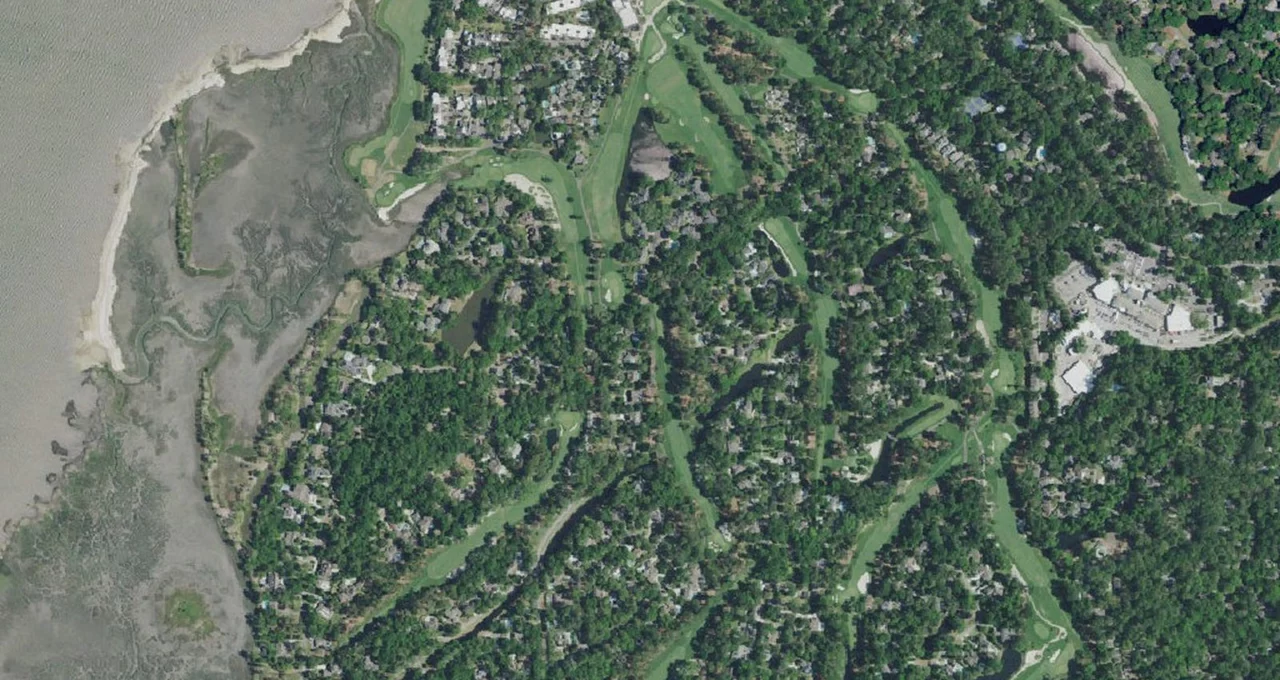
Harbour Town Golf Links from the air. Aerial imagery USGS, domaine public.
Harbour Town Golf Links
Holes
18
By
71
Length
7,131 yards from the Heritage tees on the resort's card (rating 75.5, slope 146); Wikipedia and a course directory give 7,099 yards (75.6 and 148)
Green fee
—
Best season
—
Harbour Town Golf Links is an 18-hole, par 71 public course in Sea Pines on Hilton Head Island, South Carolina, at the southern tip of the island where the last holes run out along Calibogue Sound. It is one of three courses at The Sea Pines Resort, alongside Heron Point and Atlantic Dunes. The resort’s website credits the design to Pete Dye with Jack Nicklaus as design consultant, and the course has hosted the PGA Tour event now called the RBC Heritage every year since it opened in 1969. The red-and-white striped lighthouse behind the 18th green is the image most golfers know it by, and it is the reason this page leads with a warning: the picture postcard finish is only one hole out of eighteen, and the other seventeen are a tight, low-lying test of position that has little to do with the open sea.
The course reopened in November 2025 after a six-month restoration led by Love Golf Design, with Davis Love III, a five-time winner of the tournament at Harbour Town, as player consultant. Everything on this page reflects the course as it stands after that work, as far as the published sources allow.
The length depends on the source. The resort’s own course page, with a hole-by-hole table, lists five sets of tees and gives the back tees, called Heritage, 7,131 yards with a course rating of 75.5 and a slope of 146. Summing the resort’s figures for the other tees gives Blue at 6,642 yards, White at 6,103, Gold at 5,478 and Green at 4,760; the resort publishes no rating for those. Wikipedia, and the tee table of a golf review and booking site as shown in search results, give the back tees 7,099 yards with a rating of 75.6 and a slope of 148, and that site lists older totals for the forward tees (Blue 6,681, White 6,253, Green 5,084). Wikidata records the par of 71 and a slope of 146, in line with the resort. This page follows the resort’s current card, which is also the only one that adds up hole by hole to the total it announces.
A small course on flat, wet ground
Sea Pines was the project of Charles E. Fraser, who developed the plantation on the southern end of the island. According to a PGA Tour feature on the course’s design history, Fraser, who did not play golf, wanted a championship course and turned to Jack Nicklaus, then in his playing prime, who recommended Pete Dye. The same article says it was Dye’s first commission outside the Midwest and Nicklaus’s first paid design work; the scorecard named Dye as architect and Nicklaus as design consultant. GOLF.com adds that Alice Dye spent considerable time on site with the two men, and The Fried Egg credits her directly with the 13th green and its bunker walled with railroad ties.
How much of the course belongs to Nicklaus is a long-running question, and the sources do not settle it. The PGA Tour article reports that Nicklaus recalled making 21 trips to the site, while a Golf Digest summary, as shown in search results, speaks of more than 100 inspection trips; The Fried Egg judges his influence on the design to have been limited. This page does not take a side and credits the course, as the resort does, to Dye with Nicklaus as consultant.
The land itself shaped the result. The Fried Egg describes a flat, soggy site beside the sound with barely five feet of elevation change across the property, so the greens had to be built up from the ground. Dye answered with a design that ran against the American fashion of the time for big, long courses: small greens, small tees, fairways that curve between live oaks and pines rather than turning at a sharp dogleg, and a premium on where the ball finishes rather than how far it goes. GOLF.com says a trip to Scotland, and Prestwick in particular, inspired the railroad ties that became a Dye signature. The PGA Tour article adds that the 18th fairway was built on fill from the harbor and that the sandy area on the 16th is reputed to be the first use of the term waste bunker in American design.
The course was barely finished in time. It opened during Thanksgiving week of 1969 for the first Heritage Golf Classic, and Arnold Palmer, then 40, won it with a total of 283, one under par, according to Wikipedia; the PGA Tour article notes that the victory ended a winless run of more than a year for him. The lighthouse came afterwards: Wikipedia’s article on the Harbour Town Light and other local histories say Fraser had it built between 1969 and 1970, and early skeptics nicknamed it Fraser’s Folly.
The tournament
The event has carried several names over the years, among them the Heritage Golf Classic, the Sea Pines Heritage, the MCI Heritage, the WorldCom Classic and the Verizon Heritage, according to Wikipedia; Royal Bank of Canada has been the title sponsor since 2012. It was first played in late November, moved to March and then, from 1983, to mid-April, the week after the Masters. In 2020 it was postponed to June because of the COVID-19 pandemic, and Webb Simpson set the tournament record that year with 262, 22 under par. The defending champion opens the week with a ceremonial tee shot into Calibogue Sound, accompanied by a cannon shot, and the winner receives a tartan jacket, according to Wikipedia.
Davis Love III holds the record with five wins (1987, 1991, 1992, 1998 and 2003); Hale Irwin and Stewart Cink have three each, and Nicklaus himself won in 1975. The recent winners, as listed by Wikipedia and confirmed for 2026 by the PGA Tour leaderboard, are Scottie Scheffler in 2024, Justin Thomas in a playoff over Andrew Novak in 2025, and Matt Fitzpatrick, who won his second title in a playoff over Scheffler in April 2026 at 18 under par. That 2026 edition was the first tournament on the restored course.
Course rankings tell a similar story of steady regard. Wikipedia reports that a Golf Digest survey of tour players once placed Harbour Town second among the courses they play, behind Augusta National. In Golf Digest’s 2025-26 ranking of the best courses in South Carolina, as reported by the state tourism office, Harbour Town is sixth, the same position as in the previous edition, and one of only two public-access courses in the state’s top ten.
The 2025 restoration
The work began in May 2025, after that year’s tournament, as an infrastructure project to support year-round championship conditions. According to Golf Course Architecture and GOLF.com, it grew into a restoration of features from the original design that had faded over the decades: greens had shrunk and lost hole locations, and greenside bunkers had drifted away from the putting surfaces. Love Golf Design, with Scot Sherman and the builder MacCurrach Golf Construction, rebuilt every green, every bunker and every bulkhead. The routing, the wetlands, the water hazards and the lighthouse did not change. The course reopened to the public in mid-November 2025, as reported by Golf Course Architecture, GOLF.com and the Savannah television station WTOC.
Golf Course Architecture lists the changes hole by hole. Several greens were expanded, including the 2nd, 5th, 6th, 7th, 10th, 11th and 12th, and the 15th green was reshaped to offer more hole locations. On the 2nd, a bunker was added behind the green and a fairway bunker pushed into the line of play. On the 4th, the bridge over the lagoon short of the green was removed. The 5th green was lowered by 16 inches, and a live oak was replanted 18 feet closer to the fairway, its canopy covering the right third of the green complex. The 14th gained a second pot bunker beside the existing one, and a bunker on the 16th was extended into the fairway. About a dozen bunkers received stacked-sod faces, a look that a Golf Digest column, as shown in search results, describes as a new aesthetic for the course. Coverage of the 2026 tournament singled out the 7th, 13th and 14th as the holes with the most visible changes.
This was not the first recent project. Golf Course Architecture reports that Scot Sherman, then lead architect at Love Golf Design, made a round of changes in 2020, shifting some fairway lines and widening a few areas, and that in 2015 the fairways were regrassed with Celebration bermudagrass while the greens were resprigged with TifEagle.
The grasses are one more point where sources differ. Wikipedia describes 419 bermudagrass fairways and rough, TifEagle greens overseeded with Poa trivialis in October, and seven grass types in all. Golf Course Architecture, writing after the 2025 restoration, gives TifEagle on the greens and Celebration bermudagrass on the fairways, tees and rough. This page follows Golf Course Architecture, which is more recent. Wikipedia also gives the average green at about 3,700 square feet, against a tour average of 6,600; the restoration has since enlarged several greens, and we found no updated average.
What it asks of you
Harbour Town is not long by modern tour standards, and that is the point of it. The difficulty lies in angles, in trees that hang over the line of play and in very small targets. Wikipedia lists ten holes where overhanging branches can block a shot (the 1st, 2nd, 8th, 9th, 10th, 11th, 12th, 13th, 15th and 16th) and five where there is very little margin between green and water (the 4th, 8th, 14th, 17th and 18th). The Fried Egg notes that the holes bend roughly as often to the left as to the right, so neither shot shape is favored, and that much of the strategy turns on a single contour or a single well-placed bunker, which photographs rarely show.
The card has four par 3s, eleven par 4s and three par 5s: 36 on the front nine and 35 on the back. The yardages below come from the resort’s Heritage tees, with the Blue tees in brackets, and the descriptions draw on the resort’s notes, Golf Course Architecture, the PGA Tour article and The Fried Egg. We found no published stroke index from the resort, so this page does not rank the holes by difficulty.
The front nine
The 1st, a par 4 of 414 yards (400), sets the tone: the resort says the drive must go straight through a chute about 30 yards wide. The 2nd, a par 5 of 544 yards (497), now has a bunker behind its enlarged green and a fairway bunker with a steeper sod face pushed into the line of play. The 3rd, a par 4 of 465 yards (412), has a smaller left greenside bunker and a larger right one set closer to the putting surface. The 4th is a par 3 of 194 yards (182) over water, which the resort calls a classic Dye risk-and-reward hole, with a bunker hidden behind the green.
The 5th is a par 5 of 561 yards (535) whose sharply raised green, in The Fried Egg’s reading, discourages any attempt to reach it in two; since the restoration, the green sits 16 inches lower and the replanted live oak overhangs its right side. The 6th, a par 4 of 419 yards (402), has an enlarged green. The 7th, a par 3 of 216 yards (189), has a larger green with less sand around it. The 8th, a par 4 of 467 yards (425), is in the resort’s words one of the toughest holes on the course, with water close to the green. The 9th is a short par 4 of 326 yards (313), with the clubhouse beyond the green; The Fried Egg describes a boomerang-shaped green behind a broad front bunker with three pot bunkers at the back, and a fairway only about 25 yards wide where tour players often lay up with an iron.
The back nine
The 10th, a par 4 of 435 yards (405), and the 11th, a par 4 of 432 yards (411), both have greens enlarged in 2025. The 12th, a par 4 of 426 yards (398), has an L-shaped green wrapped around a bunker at the front left, which has been restored to its original size. The 13th, a par 4 of 372 yards (350), is Alice Dye’s hole: a green perched inside a horseshoe-shaped bunker walled with boards. The 14th is a par 3 of 188 yards (162) with water on the right and pot bunkers left and long, now two of them, waiting for anyone who steers too far from the water.
The 15th, a par 5 of 584 yards (567), is the longest hole on the card; the resort calls it a thinking challenge, and the PGA Tour article describes a green tucked out of sight that keeps it a three-shot hole for most players. The 16th, a par 4 of 420 yards (383), bends left around the waste bunker that has now been pushed further into the fairway. The 17th, a par 3 of 198 yards (180), is played over a lagoon, with head winds and crosswinds the resort describes as frequent. The 18th, a par 4 of 470 yards (431), turns north along Calibogue Sound: the drive goes to a wide landing area jutting toward the sound, and the approach is played at the lighthouse, with mounds on the right that the resort says have cost many players their par.
What golfers are saying
The material behind this section is the user reviews on golf review and booking sites as shown in search results and on the pages we could read, discussion on a golf forum, The Fried Egg’s critical review and the press coverage of the restoration. The points below are other people’s opinions, not ours; nobody from Panxis has played the course, and we quote no one by name. Many of the reviews we could see predate the 2025 restoration.
What comes up in its favor
- The design itself: reviewers and critics describe eighteen distinct holes that reward thought and accuracy over power, with real variety around the greens.
- The finish along Calibogue Sound and the lighthouse, which many golfers describe as the memorable part of the round.
- Conditioning, often called excellent, with firm and quick greens; some reviewers link the good turf to the cart path rule.
- The forecaddies, praised for advice on lines, yardages and putts, and for helping the pace of play.
- The chance to play, without a membership, a course seen every year on the PGA Tour; reviewers often call it a bucket-list round.
- Early comment on the restoration, from tour players during the 2026 tournament, that the course still feels like the same course.
What comes up against
- The price, by far the most frequent complaint, with some reviewers judging the round worth it only once.
- The mandatory forecaddie, which some players would rather do without and which adds a gratuity on top of the round.
- Narrow, tree-lined corridors that some higher handicappers find punishing; The Fried Egg also argues that some holes would benefit from wider fairways and tree work.
- A sense, voiced by some reviewers and by The Fried Egg, that the course is overrated or presented too much like a manicured tour venue.
- Pace of play, judged fine by some and rushed or slow by others, and fairways judged only fair in some older reviews.
How to play it
Harbour Town is open to the public, and a stay at the resort is not required to book a tee time, according to a golf booking site and a third-party guide. Tee times are booked through the resort’s golf booking pages or the golf shop. The third-party guide says that resort guests can book further ahead than other players; we could not confirm the booking windows with the resort, so this page does not give them. Package bookings carry blackout dates during the RBC Heritage, and the course is given over to the tournament in April.
The resort requires one forecaddie per tee time for guest rounds at Harbour Town, and caddie requests are made when booking; walking caddies and forecaddies have been offered at the resort’s three courses since 2007, according to the resort. The course is cart path only for most of the year, the resort says, so many guests end up walking alongside their caddie. Golfers aged 17 and under receive a reduced rate. This page lists no green fee; rates are on the resort’s website.
The facilities
The Harbour Town Clubhouse, beyond the 9th green, has a pro shop, restaurants, locker rooms and elevated views over the course, according to the resort. It also holds the Pete Dye Room, a museum-style exhibit on the architect’s life and work. The resort’s Golf Learning Center offers individual lessons, golf schools, daily clinics, clinics for women and summer camps for juniors, and the resort lists club fitting among its services.
Getting there and when to go
The course address is 11 Lighthouse Lane, Hilton Head Island, SC 29928, inside Sea Pines, and the golf shop’s phone number is (843) 842-1904, according to the resort’s website. The resort does not publish a season, and we found no closing dates outside the tournament week; Wikipedia and The Fried Egg both describe overseeding from October, which keeps the course green through the winter. Contact details and tee times are on the resort’s website.
How this page was made
The factual frame comes from public sources consulted in October 2026: OpenStreetMap for the location; the resort’s website for the address, the par, the hole-by-hole card, the Heritage rating and slope, the hole notes, the caddie and cart policies and the facilities; Wikipedia and Wikidata for the opening, the grasses, the hazards, the tournament history and records; a PGA Tour feature on the design history; GOLF.com, Golf Course Architecture and WTOC for the 2025 restoration and the earlier projects; the PGA Tour leaderboard for the 2026 result; The Fried Egg for the site, the strategy and a critical view; the South Carolina tourism office for the 2025-26 Golf Digest state ranking. Where sources disagree, as they do on the length and rating, the forward tee totals, the grasses and Nicklaus’s role, we say so and name the source we follow.
Several sources could not be read directly: Golf Digest, the golf review and booking site that carries the scorecard and most of the user reviews, the resort’s page on the restoration and a press article on player reactions in 2026, all of which blocked automated requests. For those, we relied on the excerpts shown by search engines and say so above. We found no published stroke index, no booking window from the resort and no current national ranking we could confirm, and this page leaves them out. The opinion section summarizes public reviews; we report recurring themes rather than individual voices, and we reproduce no quotations. Nobody from Panxis has played or visited this course, and this page is no substitute for a round.
The resort has not paid for this page, has not seen it before publication and has no say over its content. This page contains no commercial link and earns us no commission. If you know the course and something here is wrong or out of date, write to us and we will correct it.
Other courses nearby
Closest to this one in our United States directory:
- Congaree Golf Club — 34 mi
- Kiawah Island Club, River Course — 53 mi
- Augusta Municipal Golf Course — The Patch — 117 mi
- Forest Hills Golf Club — 118 mi
The hole to know
A par 4 of 470 yards from the Heritage tees along Calibogue Sound: a drive to a wide landing area, then an approach at the striped lighthouse, with mounds on the right that the resort says have cost many players their par.