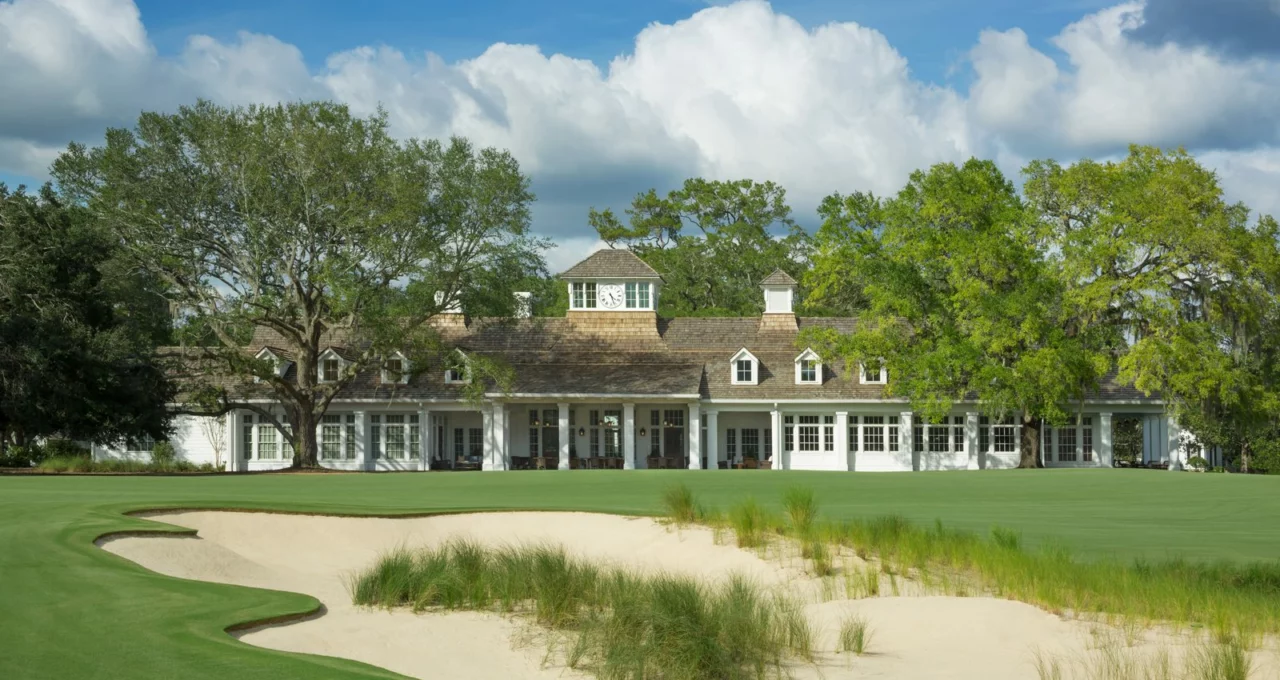
Congaree Golf Club — Photo Jay fraser4 / Wikimedia Commons, CC BY-SA 4.0
Congaree Golf Club
Holes
18
By
71
Length
—
Green fee
—
Best season
All year
Congaree opened in 2017 outside Ridgeland in Jasper County, on a historic eighteenth-century estate surrounded by more than two thousand acres of lakes and longleaf pine in the South Carolina Lowcountry, around thirty miles from Hilton Head. Tom Fazio designed the course.
What makes it unusual is not the architecture but the ownership. It is operated by the Congaree Foundation, whose stated purpose is to use the club to fund and run a programme bringing underserved young people into golf, education and mentoring. There are no members in the ordinary sense. There are Ambassadors, admitted by referral, who pay no initiation fee and instead make a contribution to the foundation. Golf Digest named it the best new private course of 2018 and then the best course built in the decade to 2019, and the PGA Tour arrived with the 2021 Palmetto Championship and the 2022 CJ Cup.
What it asks of you
A par 71 that stretches past 7,600 yards from the championship tees, which is long, but length is not really the point of the place. Fazio routed the course to sit inside the existing pine forest rather than clear it: wide corridors between mature longleaf, sandy soil that plays firm, and greens with more movement than his reputation would lead you to expect.
The presentation is closer to the Melbourne sandbelt than to the American parkland Fazio is usually associated with. Firm and fast fairways, minimal rough, bunkering that is the main defense, and very little water or forced carry. The difficulty lives in the angles and in the wind that comes off the coastal plain, which changes which side of a fairway is the right one from morning to afternoon.
It is a walking course with caddies, and that is not a stylistic flourish. The routing and the width only make sense at walking pace, when you can see where the next shot needs to come from.
What players say about it
There is no visitor tee sheet, so the public record consists of guest accounts, tournament coverage and rating panels rather than a volume of reviews. The notes below summarize themes that recur across those public sources. They are other people’s opinions, not ours: we have not played the course, and we do not name or quote individual reviewers.
What comes up in its favor
- The bunkering draws the strongest praise, described repeatedly as the best work on the property and the element that gives the course its character.
- The natural setting and the decision to build inside the longleaf forest rather than through it come up in nearly every account.
- The firm and fast sandbelt presentation is admired by players who prefer a ground game, and is unusual enough in the American southeast to be remarked on every time.
- The foundation model is treated as a genuine distinction rather than as marketing, and guests write about the young people working and playing on the property as part of the experience.
What comes up against
- Access is the whole difficulty. Ambassadorship is by referral only, and there is no route in for a golfer without a connection.
- The tour scored heavily here in its two visits, and some accounts conclude that the width which makes the course enjoyable also makes it soft as a championship test.
- The location is remote. Ridgeland is not near much, and a visit means building a trip around Hilton Head or Savannah.
- The review record is thin, and almost all of it comes from people who were invited, which is worth keeping in mind when reading any of it, including this summary.
Getting there and when to go
Ridgeland sits between Savannah and Hilton Head, around forty-five minutes from Savannah airport and thirty from Hilton Head. The course plays all year, with the Lowcountry winter mild and the summer hot and humid; spring and late autumn give the firmest conditions and the most comfortable walking.
Play is by invitation through the Congaree Foundation. There is no other route on.
Green fees
There is no published rate and no visitor tee sheet. See the club’s own site.
How this page was made
The factual frame comes from public sources: OpenStreetMap for the location, Wikipedia and published architecture and tournament coverage for the history, the design and the foundation model, and the club’s own site for access. The opinion section summarizes public commentary and guest accounts read in September 2026; we report recurring themes rather than individual voices, and we do not reproduce or attribute quotes.
We have not played this course, and nothing here is a substitute for that. The club has not paid for this page, has not seen it before publication and has no say in what it says. If you know the course and something here is wrong or out of date, write to us and we will correct it.