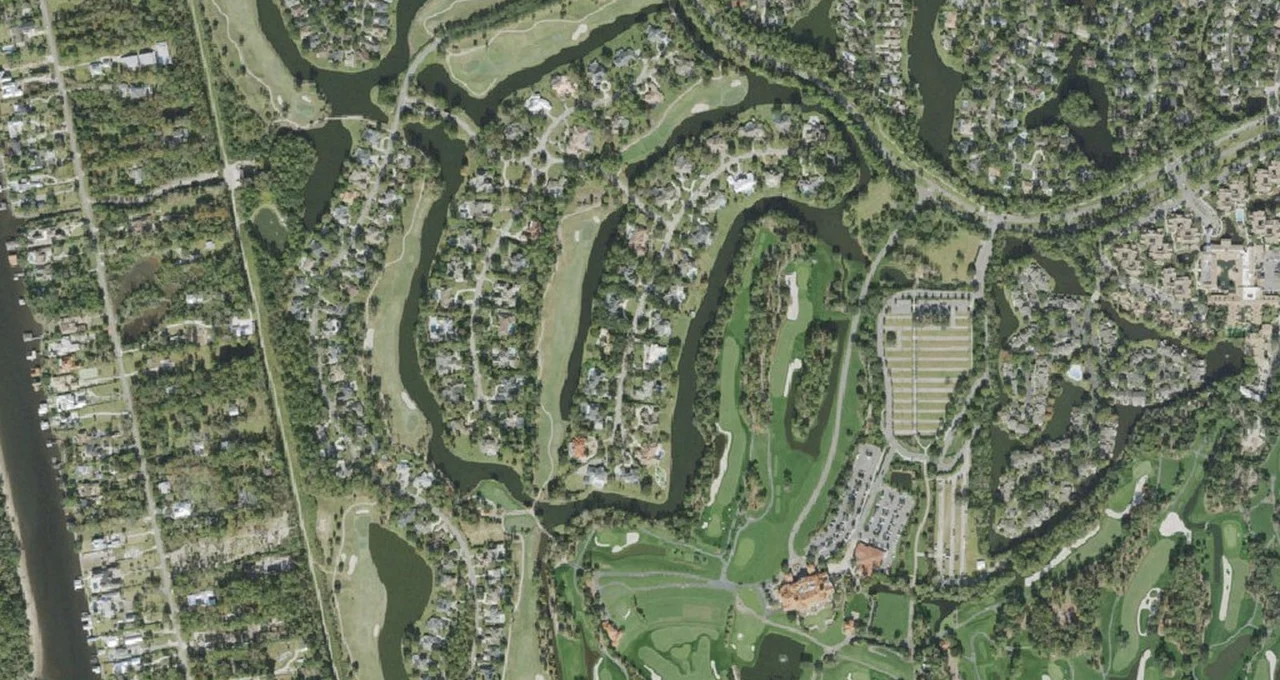
TPC Sawgrass from the air. Aerial imagery USGS, domaine public.
TPC Sawgrass
Holes
36 (THE PLAYERS Stadium Course and Dye's Valley Course)
By
72 (Stadium Course)
Length
7,275 yards in tournament setup (rating 76.4, slope 155 from 7,245 yards)
Green fee
—
Best season
Year-round, with published maintenance closures
TPC Sawgrass is in Ponte Vedra Beach, Florida, southeast of Jacksonville, and it is the home of THE PLAYERS Championship and of the PGA TOUR’s headquarters. The club has two courses, both by Pete Dye: THE PLAYERS Stadium Course, which opened in 1980 and has hosted the tournament since 1982, and Dye’s Valley Course, which opened in 1987. Unlike most courses that host a big tour event, both are open to the public. This page is mainly about the Stadium Course.
The club was the idea of Deane Beman, then commissioner of the PGA TOUR, who wanted a permanent home for the tour’s own championship, owned by the players. According to the club’s history, the owners of the neighboring Sawgrass Country Club, where the tournament was played from 1977 to 1981, refused to sell, and Beman found support instead from two local landowners, Jerome and Paul Fletcher, who sold the tour 415 acres of wooded wetland and swamp for one dollar. Pete Dye designed the course with his wife, Alice Dye, who is credited with the idea of the island green at the 17th.
The site was flat: the club says that Dye found no more than 18 inches of elevation above the waterline anywhere on the property. The lakes on the course were dug both for strategy and for fill, to build the contours of play and the first stadium mounding. Around the 1st and 10th tees and the 9th, 16th, 17th and 18th greens, Dye built gently sloping spectator mounds up to 30 feet high, so that thousands of fans could see the play. That idea gave the course its name, and it has been copied at tour venues ever since.
The Stadium Course is a par 72 of 7,275 yards in its tournament configuration, according to the tournament’s official site. Encyclopedic entries list it at 7,245 yards from the back tees, with a course rating of 76.4 and a slope of 155, and give TifEagle Bermuda greens and Celebration Bermuda fairways. Dye’s Valley Course, designed by Pete Dye with Bobby Weed and player consultant Jerry Pate, is also a par 72, listed at 6,847 yards with a rating of 74.0 and a slope of 134.
What it asks of you
Beman asked Dye for a course that favored no particular player or style of play, and the club’s description of the result is specific. There are short, medium and long holes among the par 3s, par 4s and par 5s; doglegs to the right and to the left; and a routing in which no two consecutive holes play in the same direction, so that the wind affects the field in a balanced way. For a visitor, that means no single strength carries the round. A long hitter who cannot shape the ball, or a precise player who cannot hit a long iron, will find holes that expose the weakness.
The first edition in 1982 was not a success with the players. The original design drew mixed and often very critical reactions, several of the leading players missed the cut, including Jack Nicklaus and Arnold Palmer, and Dye spent the following year softening the greens and replacing several bunkers. The first champion, Jerry Pate, celebrated by pushing Dye and Beman into the lake beside the 18th green and jumping in after them. The course has changed regularly since; the most recent large set of changes, in 2017 according to the tournament, included a rebuilt 12th, new tees and larger spectator areas.
A slope of 155 is at the top of the scale, and the course carries it for good reason: water is in play on many holes, the greens are firm and heavily contoured, and the margins around them are small. The practical lesson for a guest is to choose tees honestly, keep the ball in play, and accept that some holes are meant to be played for a bogey.
The front nine
The tournament card opens with a par 4 of 423 yards, a dogleg right with a fairway bunker and water on the right, followed by the 2nd, a short par 5 of 532 yards with water on the right and deep bunkers framing the green. The 3rd, a par 3 of 177 yards with a two-tiered green, is described by the tournament as a hole where more birdies are scored. The 4th, a short par 4 of 384 yards, has what the tournament calls one of the toughest greens on the course.
The 5th, at 471 yards, is the longest par 4 of the front nine, a dogleg right to a narrow, rolling green. The 6th, a par 4 of 393 yards, is described as the most beautiful hole on the course and asks for precise positioning. The 7th is a long dogleg right of 451 yards with water on the left. The 8th is the longest par 3 at 237 yards, to a deep and narrow green that often needs a long iron or a fairway wood, and the 9th, a par 5 of 602 yards, is the longest hole on the course.
The back nine
The 10th is a par 4 of 424 yards, a dogleg left to a green that falls away from the player. The 11th, a par 5 of 558 yards, has water splitting the fairway and several ways to play it. The 12th, rebuilt in 2017, is now a drivable par 4 of 369 yards with water on the left, a risk-and-reward hole in the middle of the back nine. The 13th is a par 3 of 181 yards with water on the left and a three-tiered green.
The 14th, a par 4 of 481 yards, is described by the tournament as one of the toughest holes to play, with a narrow driving area and a vast bunker. The 15th, a par 4 of 470 yards, was extended by 20 yards with a new tee in 2017. The 16th is a short par 5 of 523 yards, reachable in two by the professionals, with water on the right. Then comes the 17th, a par 3 of 137 yards to a green 78 feet long, surrounded by water except for a narrow path, with a small bunker at the front. The 18th, a par 4 of 462 yards with water all along the left, is one of the best-known finishing holes in golf.
The 17th
The island green was an accident of construction. The club’s history says a small pond was planned near the green; the area kept being dug for the sand found there, until the green was nearly surrounded by water, and Alice Dye suggested finishing the job. It is now perhaps the most famous par 3 in the world. The length changes every day during the tournament: in 2026, the PGA TOUR measured it at 143, 146, 126 and 134 yards over the four rounds. That week, 31 balls went into the water, and no one made a hole-in-one. Cameron Young won the 2026 edition at 13 under par, helped by a birdie at the 17th on the final day.
For an amateur, the 17th is less about length than about nerve: a wedge or a short iron to a target with no margin for a miss, often in the wind, with the knowledge that the ball will not come back. The Stadium Course also sells the experience around it: the clubhouse and the 17th can be visited on free guided tours, run every hour by the club’s storytellers, without playing golf.
What golfers say
The course is widely reviewed, on travel sites, golf booking platforms and in specialist guides. The points below summarize what recurs. These are other people’s opinions, not ours: nobody from Panxis has played the course, and we name and quote no one.
What comes up in its favor
- Playing the 17th and 18th, holes known from television, is described as a bucket-list experience that lives up to expectations.
- The back nine and the par 3s are singled out as the strongest part of the course.
- Forecaddies and caddies are widely praised for their help with reading greens, finding balls and giving yardages.
- Service and the sense of being treated like a tour player come up often, along with the clubhouse.
- The range of tees is said to make the course enjoyable for players of very different levels.
What comes up against
- The price comes up again and again: reviewers say that the cost, with caddie tips on top, should guarantee near-perfect conditions, which they do not always find.
- Carts are restricted to the paths on the Stadium Course all year, and rounds with a cart are described as slow, with a lot of walking back and forth between cart and ball.
- The course is described as very difficult for average players, with a lot of water, and the 14th in particular as a source of big numbers and three-putts.
- Some reviewers find the par 5s awkward, with uncomfortable third shots.
How to play it
TPC Sawgrass is a resort-style public facility, and both courses can be booked by anyone. The club offers two ways. The first is to book up to 14 days in advance, without lodging, by contacting TPC Sawgrass directly. The second is to book up to 12 months in advance through TPC Vacations as a stay-and-play guest at the nearby Sawgrass Marriott Golf Resort and Spa. Guests who have booked a room at that hotel by another route can reserve a tee time through the resort’s golf shop.
A credit card is needed to hold a tee time, and the club applies a cancellation policy that is stricter for the Stadium Course than for Dye’s Valley. Single players are accepted and groups of fewer than four may be paired. Standard rounds on the Stadium Course include a forecaddie for the group; players who want to walk must take a caddie, reserved at least 48 hours in advance. Rental clubs are available, and a non-playing guest can follow the round. On Dye’s Valley, carts may sometimes be allowed on the fairways, depending on the season and the weather.
The club also sells a TOUR Player Experience, with a professional caddie and access to the players’ locker room, and packages built around the PGA TOUR Performance Center, its instruction facility. Dye’s Valley is also a tournament course: the club says it hosts the PGA TOUR’s Q-School presented by Korn Ferry, and it has hosted Korn Ferry Tour events.
The club publishes closure dates well ahead. In 2026, the Stadium Course is closed from June 1 to 28, from August 10 to 14 and from October 19 to November 8; in 2027, from February 15 to March 16 and from May 31 to June 28, around THE PLAYERS, scheduled for March 2027. The clubhouse closes to visitors during tournament week.
Getting there and when to go
Ponte Vedra Beach is on the Atlantic coast, southeast of Jacksonville, the nearest large city. The golf season is year-round in North Florida. Spring and fall are the most comfortable months; summer is hot and humid, and the maintenance closures fall partly in early summer and in the fall, so it is worth checking the calendar before planning a trip. THE PLAYERS is played in March.
Green fees
Rates, caddie fees and stay-and-play packages are set by the club and change with the season. See the club’s booking page.
How this page was made
The factual frame comes from public sources: OpenStreetMap for the location; the club’s website for the history, the design brief, the stadium mounding, the origin of the island green, Dye’s Valley, the booking rules, the caddie and cart policies, the tours and the closure dates; THE PLAYERS Championship’s official site for the tournament yardage and the hole-by-hole descriptions; encyclopedic entries for the ratings, slopes, grasses, the size of the 17th green and the 1982 changes; and the PGA TOUR for the 2026 statistics at the 17th and the winner. We give the tournament yardage and the encyclopedic back-tee figures separately because they differ.
The opinion section summarizes travel reviews, golf booking platforms and specialist course guides read in September 2026. We report recurring themes rather than individual voices, and we reproduce no quotations. Nobody from Panxis has played or visited this course, and this page is no substitute for a round.
The club has not paid for this page, has not seen it before publication and has no say over its content. This page contains no commercial link and earns us no commission. If you know the course and something here is wrong or out of date, write to us and we will correct it.
Other courses nearby
Closest to this one in our United States directory:
- LPGA International — 72 mi
- Daytona Beach Golf Club — 74 mi
- Disney’s Palm Golf Course — 125 mi
- Congaree Golf Club — 167 mi
The hole to know
The island green: a par 3 of 137 yards to a green 78 feet long, surrounded by water except for a narrow path, with a small bunker at the front. In the 2026 PLAYERS, its length varied from 126 to 146 yards over the four rounds.