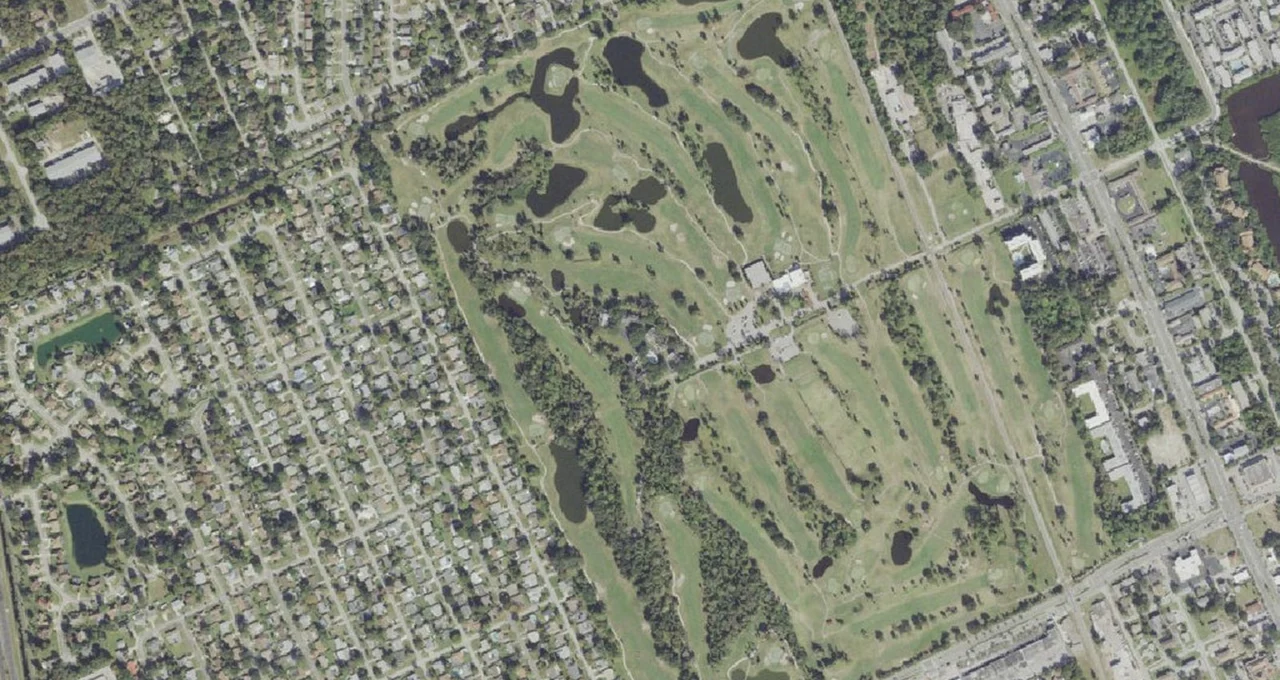
Daytona Beach Golf Course from the air. Aerial imagery USGS, domaine public.
Daytona Beach Golf Club
Holes
36 (South and North courses)
By
—
Length
—
Green fee
—
Best season
All year
The South Course at Daytona Beach was designed by Donald Ross and built from 1921. The first nine holes opened formally that year and the completed eighteen in January 1923. Ross returned in 1944 to redesign several holes and greens. The course is on Florida’s Historic Golf Trail, and it is one of the increasingly small number of Ross municipal courses still owned by the city they were built for.
A second eighteen, the North, was added later. The South is the Ross course, remains close to his original routing, and is the reason to come.
What it asks of you
Flat Florida ground with sandy soil, mature live oaks, tall pines and Bermuda turf. This is Ross working without elevation, which meant everything had to be done with bunkering and green contour, and the turtleback greens he is known for are the whole examination here.
The fairways are generous and there is very little water in play, which makes the South the easier of the two courses off the tee and the harder of the two around the greens. It is short by modern measure, running to a little over 6,300 yards from the back tees, and the yardage is not the point. Getting an approach to hold a crowned surface, and knowing where to leave it when you cannot, is what the course keeps asking.
The Atlantic is two miles east, which matters on a windy day more than the flat ground suggests.
What players say about it
This is a municipal course with a substantial review record. The notes below summarize recurring themes across specialist golf sites, traveler review pages and player discussion threads. They are other people’s opinions, not ours: we have not played the course. We report what comes back repeatedly rather than isolated remarks, and we do not name or quote individual reviewers.
What comes up in its favor
- Value is the most consistent point of praise. Reviewers repeatedly describe the price as remarkable for a genuine Ross course.
- The architecture draws the attention of anybody who cares about it, and the turtleback greens are treated as a lesson worth paying municipal rates to see.
- The course is described as playable and forgiving off the tee, which suits a visitor who wants a real course without a punishing afternoon.
- The history matters to people. Ross municipal courses still owned by their city are getting rarer, and reviewers say so.
What comes up against
- Conditioning is the clear dividing line. Reports range from good to poor, and greens are the most frequent complaint, including accounts of surfaces left heavy with sand after top dressing.
- Tee boxes and fairways draw criticism in the less favorable reviews, which is the familiar municipal problem of volume against budget.
- Better players find it too easy off the tee, and some conclude the course is more interesting historically than competitively.
- Summer here is hot, humid and prone to afternoon storms, and reviewers who came in July say so plainly.
Getting there and when to go
The course is in the middle of Daytona Beach, minutes from Daytona Beach International and about an hour from Orlando. LPGA International is ten minutes away, which makes a two-course weekend easy and gives an unusually wide range of price and style inside one small city.
Daytona plays all year, with January to April the busiest and best months. Book through the course.
Green fees
Rates and tee times are handled by the course and vary by season and time of day. See the course’s own site.
How this page was made
The factual frame comes from public sources: OpenStreetMap for the location, Wikipedia and published architecture coverage for the history and the design, and the course’s own site for access and booking. The opinion section summarizes public reviews and player discussions read in September 2026; we report recurring themes rather than individual voices, and we do not reproduce or attribute quotes.
We have not played this course, and nothing here is a substitute for that. The course has not paid for this page, has not seen it before publication and has no say in what it says. If you know the course and something here is wrong or out of date, write to us and we will correct it.