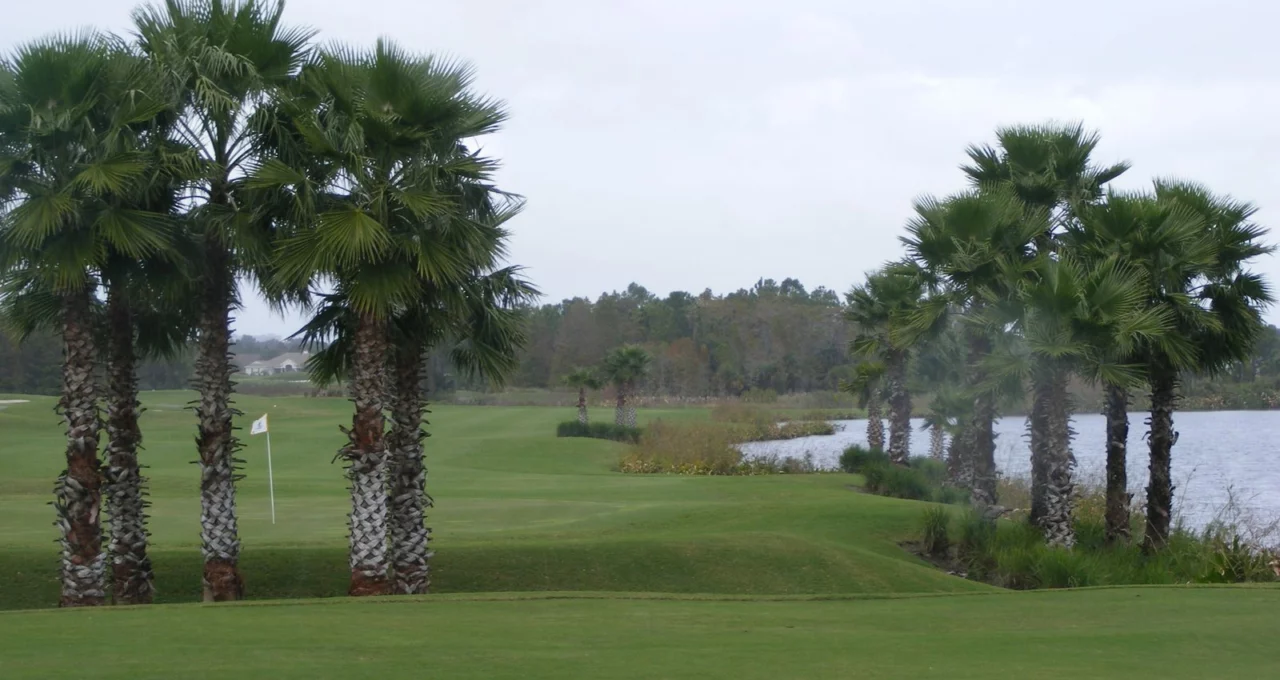
LPGA International — Photo Gamweb / Wikimedia Commons, CC BY-SA 3.0
LPGA International
Holes
36 (Jones and Hills courses)
By
—
Length
—
Green fee
—
Best season
All year
LPGA International was built as the golf home of the Ladies Professional Golf Association after the association moved its headquarters to Daytona Beach. Rees Jones designed the first course, which opened in 1994; Arthur Hills designed the second, which opened in 1998. The property has staged LPGA Tour events, the tour’s season-ending championship in an earlier era, Symetra Tour stops and college national championships, and it is still used for the tour’s qualifying school.
Thirty-six holes on one flat Florida property could easily have produced two versions of the same course. It did not, and that is the reason to come here rather than to any of the several resort courses within a short drive.
What it asks of you
The Jones course is the longer and more conventionally championship of the two: a links-influenced routing with broad fairways, large bunkers, water in play on many holes and a set of tees that runs from resort length to tour length. It is generous off the tee by design, and the scoring happens on the greens and around them rather than in the driving.
The Hills course is the tighter and, for many visitors, the more interesting one. Arthur Hills routed it through wetland, magnolia and native pine with no parallel fairways and almost no housing in view, and the effect that reviewers reach for most often is Pinehurst rather than Florida. It asks more questions off the tee and gives back less when you answer them badly.
Both play firm through the dry winter months and soft after summer storms, which changes the character of each course more than the yardage does. Wind off the coast is a factor on the Jones course in particular, where the exposure is greater.
What players say about it
The notes below summarize recurring themes in public reviews of the facility, read across specialist golf sites, traveler review pages and player discussion threads. They are other people’s opinions, not ours: we have not played these courses. We report what comes back repeatedly rather than isolated remarks, and we do not name or quote individual reviewers.
What comes up in its favor
- Conditioning is the most consistent point of praise: tees, fairways, bunkers and greens are all described as well kept, which is not a given at a high-volume public facility.
- Value is the second. Reviewers who booked online outside peak hours repeatedly describe the Jones course as a bargain for the quality on offer.
- The Hills course draws the stronger architectural reviews. The absence of parallel fairways and of surrounding houses comes up again and again as what sets it apart.
- Having two genuinely different courses on one site is treated as the property’s real asset, especially by visitors playing thirty-six holes in a day.
What comes up against
- Pace of play is uneven. Some accounts report rounds close to five hours on busy days, while others playing the Hills at quiet times finished in around three.
- Green speed disappoints a minority of players. The Jones greens in particular are described as slow, and the Hills greens as quicker but still short of fast.
- The Jones course is called too easy to score on by better players who found the fairways wide and the trouble avoidable.
- Summer here is what summer in central Florida is: heat, humidity and afternoon storms, and reviewers who came in July say so plainly.
Getting there and when to go
The facility sits on the western edge of Daytona Beach, minutes from Daytona Beach International and about an hour from Orlando, which is how most visitors arrive. The season peaks between January and April, when the courses are firm, the wind is honest and the tee sheet is full; book ahead for those months.
One local detail worth knowing: the Donald Ross municipal course in town is ten minutes from the gate, which makes an unusually varied golfing weekend possible inside one small city, at two very different price levels.
Green fees
Rates, packages and tee times are handled by the facility, and online booking outside peak hours is where most of the reported savings come from. See the facility’s own site.
How this page was made
The factual frame comes from public sources: OpenStreetMap for the location, Wikipedia and published architecture coverage for the history and the design credits, and the facility’s own site for access, season and booking. The opinion section summarizes public reviews and player discussions read in September 2026; we report recurring themes rather than individual voices, and we do not reproduce or attribute quotes.
We have not played these courses, and nothing here is a substitute for that. The facility has not paid for this page, has not seen it before publication and has no say in what it says. If you know the courses and something here is wrong or out of date, write to us and we will correct it.