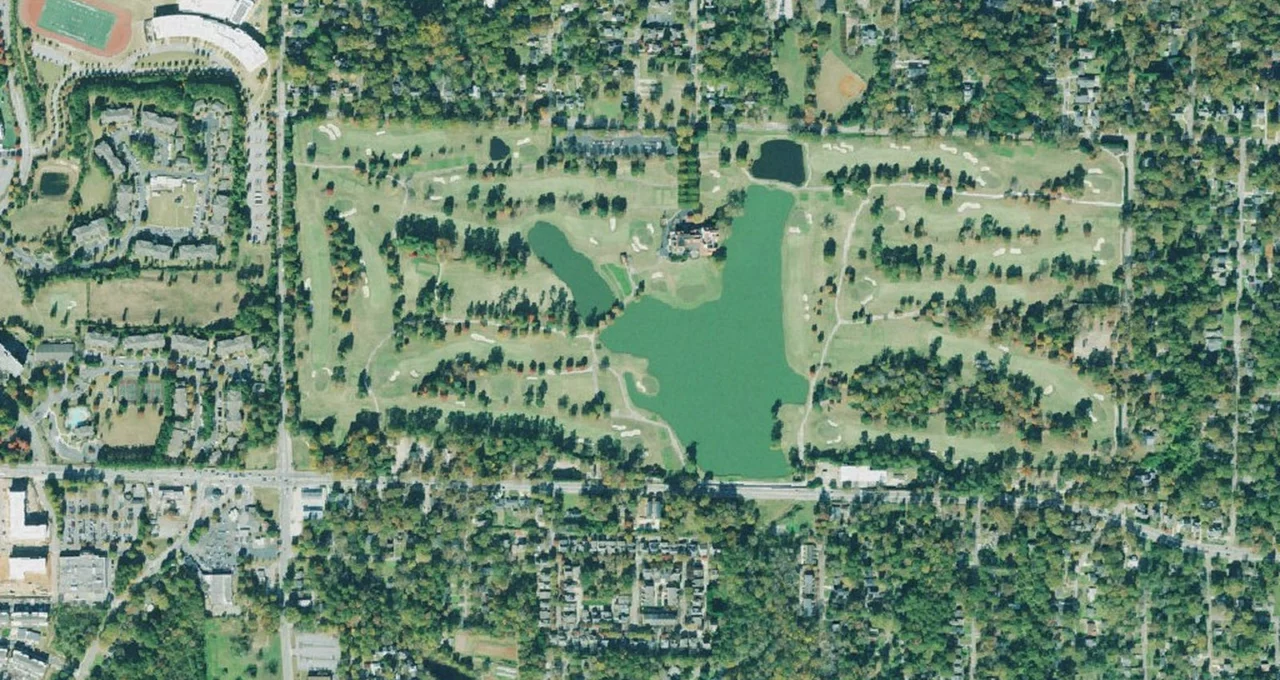
East Lake Golf Club from the air. Aerial imagery USGS, domaine public.
East Lake Golf Club
Holes
18
By
72 on the club's card; 71 for the 2024 TOUR Championship, 70 for the 2025 and 2026 editions
Length
7,515 yards from the Championship tees on the club's card (Medal 6,950, Jones 6,500, Member 6,100, Forward 4,800); 7,440 yards for the 2026 TOUR Championship (PGA TOUR)
Green fee
—
Best season
—
East Lake Golf Club is a private club in the East Lake neighborhood of Atlanta, Georgia, about five miles east of downtown. The club and OpenStreetMap give its address as 2575 Alston Drive SE, Atlanta, GA 30317. Its 18-hole course was first laid out by Tom Bendelow, reworked by Donald Ross in 1913, restored by Rees Jones in the 1990s and rebuilt by Andrew Green for the 2024 TOUR Championship. The club calls it Atlanta’s oldest golf course. On the scorecard it publishes today, it is a par 72 of 7,515 yards from the Championship tees; for the PGA TOUR it plays shorter and to a lower par, a point explained below.
Three stories meet here. East Lake is the home course of Bobby Jones, the amateur who won the Grand Slam in 1930. It has been the home of the TOUR Championship, the season finale of the PGA TOUR, for more than two decades. And since the 1990s it has been run as the engine of a neighborhood revival: according to Wikipedia and the Top 100 Golf Courses website, the club’s operating profits go to the East Lake Foundation, which works in the surrounding community. This page is a portrait built from public sources; because East Lake is private, most readers will only see it on television or as a member’s guest.
From the Atlanta Athletic Club to Bobby Jones’s home course
The club’s history page tells the founding story. The Atlanta Athletic Club, formed in 1898 by a group of 65 men led by Burton Smith, had no golf course at first. In 1904 it added golf by establishing East Lake Country Club on a 178-acre tract in DeKalb County, the site of a former amusement park. Tom Bendelow designed the first course, which broke ground in 1904, and the 18-hole course and its clubhouse held their grand opening on July 4, 1908. The club writes that the young Bobby Jones and his father attended. Wikipedia dates the first holes to 1906 and the full 18 to 1907, so the “1904” often quoted, including by the PGA TOUR, is the year the project started rather than the year golf was first played on a finished course.
In 1913 the club hired Donald Ross to rework Bendelow’s layout. The club says Bendelow’s routing did not bring the nines back to the clubhouse; Ross’s did, with two loops of nine, and the club states that his routing still exists. Ross also designed a second course, the No. 2, which the club says opened on May 31, 1930, the final day of Jones’s British Amateur match that year.
Jones grew up with the course. Atlanta News First, in an August 2026 piece on his legacy, writes that his family rented a summer home near the course, which then sat at the end of the trolley line, that he won a six-hole tournament there at the age of six, and that at 14 he won four tournaments in 1916, including the East Lake Invitation. His teacher was the club professional Stewart Maiden. Wikipedia adds that his father, Robert P. Jones, was president of the club from 1937 to 1942 and that Bobby Jones held the same office in 1946 and 1947. Another East Lake amateur, Charlie Yates, won the British Amateur at Royal Troon in 1938, according to Wikipedia.
The clubhouse has its own history. The Atlanta Athletic Club’s records list a fire that destroyed the first clubhouse in 1914 and a second fire in 1925 that took many trophies and artifacts with it. Wikipedia credits the Atlanta architect Philip Shutze with the two-story Tudor-style clubhouse that replaced it, and says the building was expanded by about 20,000 square feet in 2008.
Championships, decline and revival
East Lake’s championship record started early. The club lists the Southern Amateur, the Southern Open and the Georgia State Amateur among the events it has hosted. In 1950 Beverly Hanson won the U.S. Women’s Amateur there, which the club describes as the first USGA national championship played in the South. Before the 1963 Ryder Cup, George Cobb made changes to the course in 1959. That Ryder Cup was played from October 11 to 13, 1963, according to Wikipedia, and the United States, led by Arnold Palmer as playing captain, beat Great Britain 23 to 9. The club notes that it was the last time the United States had a playing captain.
The decline came quickly afterward. The club’s history says that as the neighborhood deteriorated in the late 1960s, the Atlanta Athletic Club sold the No. 2 course and moved north to what is now Johns Creek. Members bought the original course and clubhouse to keep East Lake going. Wikipedia dates that purchase to 1968 and says a group of 25 members led by Paul Grigsby formed East Lake Country Club; the Top 100 Golf Courses website places the same rescue in the early 1970s. The No. 2 course became the East Lake Meadows public housing project, and by the mid-1980s, in the club’s own words, the community was “a center for poverty, drugs and violence.”
The turnaround is tied to Tom Cousins, an Atlanta real estate developer and the original owner of the Atlanta Hawks, who died on July 29, 2025, at the age of 93, according to Golfweek. The date he took over is reported differently. Wikipedia says a charitable foundation headed by Cousins bought East Lake in 1993; Golfweek’s obituary says he founded the East Lake Foundation and bought the club in 1995; the club’s own mission page dates the foundation to 1995. The Top 100 Golf Courses website, citing George Peper’s book on PGA TOUR courses, says Cousins replaced the housing project with about 500 mixed-income apartments and townhouses and sold corporate memberships to fund the club, using golf “as a tool to revitalize the surrounding area.” The club’s mission page lists the partners of what it calls “Golf with a Purpose”: the East Lake Foundation, the residents of the Villages of East Lake, the Charles R. Drew Charter School, which opened in 2000 as Atlanta’s first public charter school and now serves more than 1,800 students from pre-K to grade 12, and First Tee of Metro Atlanta. Purpose Built Communities, founded in 2009 to reproduce the East Lake model, works in other cities.
Part of the old No. 2 course is golf again. The club says it was converted in 1998 into the Charlie Yates Golf Course, a nine-hole course designed by Rees Jones and named after the 1938 British Amateur champion. Its own website lists an address at 10 Lakeside Village Dr SE and offers online tee times; Wikipedia describes it as an executive course used for golf education for Atlanta children.
The TOUR Championship years
The professional era began in 1998, when Hal Sutton won the first TOUR Championship at East Lake, according to the club. Wikipedia’s history of the event shows East Lake alternating with Champions Golf Club in Houston from 1997 to 2003, with Atlanta hosting in 1998, 2000 and 2002, and becoming the permanent home from 2004. The club itself says permanent home “since 2005,” and Golfweek gives 2004, so the start date of the permanent arrangement differs by a year depending on the source. East Lake also hosted the 2001 U.S. Amateur, won by Bubba Dickerson, and the club lists the 1997 Western Junior. Since 2015 it has staged the East Lake Cup, a college match-play event, according to Wikipedia.
The FedEx Cup playoffs arrived in 2007, and the club notes that Tiger Woods was the first FedEx Cup champion that year. In the same event Zach Johnson shot 60, which Wikipedia and the PGA TOUR list as the course record. Woods returned in 2018 to win the TOUR Championship for his 80th PGA TOUR victory. The format changed twice in recent years: from 2019 to 2024 players started with strokes based on their FedEx Cup rank, and from 2025 everyone started at even par. Under that format Tommy Fleetwood won in 2025 at 18 under, and Scottie Scheffler won the 2026 edition at 16 under, three strokes ahead of Viktor Hovland, according to Wikipedia and the PGA TOUR leaderboard.
In 2016 the PGA TOUR and Rees Jones reversed the nines so that the tournament would finish on a par 5 rather than a par 3. The East Lake Foundation wrote at the time that the old closing par 3 had produced no eagles since 1998, and Rees Jones’s firm says the 18th fairway was regraded to give players a chance to reach the green in two. The present 15th, with its peninsula green, was the sixth hole before that switch.
That era is ending in its current form. In June 2026 the PGA TOUR announced a new competition structure from 2028 in which the TOUR Championship will rotate among courses. The Atlanta Journal-Constitution reported that East Lake has a contract to host the event through 2027, and Front Office Sports quoted the TOUR’s chief executive saying East Lake is “very much in the consideration set” for future editions. Which courses will host from 2028 had not been announced when we prepared this page.
The Andrew Green restoration
The most recent change is also the largest since the 1990s. Golf Course Architecture reports that Andrew Green was appointed in January 2022 to prepare a master plan. Global Golf Post writes that work began right after the 2023 TOUR Championship and took about a year, and Golfdom reports a grand reopening in July 2024, shortly before the course hosted the 2024 TOUR Championship at the end of August. The club’s home page dates the completed restoration to 2024; Wikipedia lists Green’s renovation under 2023, the year the work started.
The PGA TOUR’s page on the project says every tee, green, fairway and bunker was rebuilt. Green’s main reference was a 1949 aerial photograph, taken before later changes to Ross’s design, which the PGA TOUR says he found by searching government databases and which he described as “almost high-definition quality, incredibly sharp.” Golf Course Architecture adds that the routing is unchanged. The grasses changed as well: according to the PGA TOUR and Golfdom, the fairways went from Meyer to Zorro zoysia, which plays firmer and lets the ball roll further, and the greens went from MiniVerde to TifEagle Bermuda; Global Golf Post says the green surrounds and runoffs are Prizm zoysia. A stream between the 6th and 7th holes was restored with native plants, and the ponds and the lake were stabilized.
Several holes changed character. Global Golf Post and the PGA TOUR describe a two-level green at the 1st, a deep, diamond-shaped green split by a ridge at the 2nd, a restored dogleg left at the 5th, a 6th moved about 50 yards to the right to make a boomerang-shaped uphill par 5, and an 8th whose green was moved closer to the tee to create a potentially drivable par 4. At the 16th, Green used a description by O.B. Keeler, Jones’s biographer, of a shot Jones played from a “chasm” to the right of the green, and built a steep drop-off there. At the 17th, a long, narrow trench bunker was restored; the PGA TOUR describes it as a remnant of Civil War encampments. At the 18th the lake was reshaped so that it comes into play on lay-up shots.
Sources disagree on the trees. Global Golf Post writes that Green removed hundreds of trees and opened views from one end of the property to the other, while Golfdom says existing tree canopies were protected. Both can be partly true, but we could not find a figure from the club.
What the course asks of you
East Lake is a parkland course on rolling ground around a lake. The club’s card lists five sets of tees: Championship at 7,515 yards, Medal at 6,950, Jones at 6,500, Member at 6,100 and Forward at 4,800, all to a par of 72, with each nine a par 36. The card has four par 3s (the 2nd, 9th, 11th and 15th), four par 5s (the 1st, 6th, 14th and 18th) and ten par 4s. The par 3s are long from the back: 200, 270, 225 and 215 yards from the Championship tees.
The professionals play a different par. For the 2024 TOUR Championship the course played as a par 71, with the 1st as a par 4 of 510 yards; AP results and Golf News Net give 7,490 yards, while Golf Course Architecture and Golfdom give 7,455. In 2025 the 14th went back to a long par 4, which the PGA TOUR said lowered par to 70, and the TOUR lists 7,440 yards and par 70 for 2026. So the same course can be quoted as par 72, 71 or 70 depending on whether you read the members’ card or a tournament setup.
The demands are consistent across the sources. Green’s greens are the centerpiece: the PGA TOUR wrote in 2025 that slopes and swales divide them into small sections, and that players can putt, chip or pitch from closely mown zoysia around them rather than from Bermuda rough. Green said of the project that “we really wanted to try to get the player to feel like they’re playing more over the natural ground,” as quoted by Global Golf Post and Golfdom. Before the renovation, reviewers on the Top 100 Golf Courses website already described the greens as firm and very fast, and the rough as thick Bermuda grass that makes spin hard to control. Water is in play on several holes around the lake, and the fairway bunkers were rebuilt at varying distances from the tees, according to Golfdom.
A few holes come up in almost every account:
- The 1st, a par 5 of 535 yards on the club’s card that the TOUR plays as a par 4, with a new two-level green that recalls the two greens the hole once had.
- The 9th, a par 3 of 270 yards from the Championship tees, which the PGA TOUR notes was about 230 yards in Jones’s time, played at an angle over the water to a shallow target.
- The 14th, a par 5 of 585 yards for members and a hole whose par has changed for the tour: a long par 4 for years, a par 5 in 2024, and a par 4 of about 530 yards again from 2025.
- The 15th, the peninsula par 3, described below.
- The 16th, a par 4 of 460 yards with the deep, narrow green and the drop-off to the right inspired by Jones’s recovery.
- The 18th, a par 5 of 580 yards on the club’s card (585 for the TOUR), with the reshaped lake to deal with on the second or third shot.
The 15th is the hole with the deepest roots. Rees Jones’s firm writes that its peninsula green complex dates back to Bendelow’s course, where it served the par-5 16th, and calls it one of the first island greens in America. The club’s card gives it 215 yards from the Championship tees and 100 from the Forward tees. Green removed its bunker and, according to the PGA TOUR, shaped the green like a mitten with a roll-off at the back left. Harris English made a hole-in-one there in the first round of 2021, the most recent ace in the event according to the PGA TOUR.
What golfers say
East Lake is private, so public reviews are few. The themes below come from the reviews posted on the Top 100 Golf Courses website when we read them in October 2026, dated from 2016 to August 2026, most of them written before the 2024 restoration. We have also used published comments from critics and professionals in the golf press. These are other people’s opinions, not ours. Nobody from Panxis has played the course, and we name no reviewer.
What comes up in its favor
- History: reviewers describe a strong sense of the past on arrival, with the Jones memorabilia and the clubhouse displays often mentioned.
- Service and facilities: valet parking, day lockers, caddies and the restaurant and patio come up repeatedly.
- Conditioning: the course is regularly described as in excellent shape, with firm, fast greens.
- The use of the lake and the quality of the par 3s and par 5s, especially on the back nine.
- Playability: one reviewer found it fair and open enough for higher handicaps; the most recent, from August 2026, calls it a pure, classic design and a strong test.
- After the restoration, a tour player who is also an East Lake member, quoted by the PGA TOUR in 2025, spoke of more variety and complexity than on the previous version.
What comes up against
- The opening holes: several reviewers found the first four or five holes ordinary compared with the rest of the course., although most of those reviews predate the 2024 restoration.
- Before the restoration, one reviewer writing after a 2021 visit felt that much of Ross’s work had been lost, with flat greens and fairway bunkers offering little strategy.
- Narrow landing areas and hard recoveries after a miss, according to the August 2026 review.
- A city-course feeling, with a perimeter fence around the property, and few holes that one reviewer found truly memorable.
- When the nines were reversed in 2016, the course critic Geoff Shackelford doubted that the layout could produce the drama of other finales; the 2024 work changed the course considerably since then.
Getting there and playing
East Lake is a private club. Wikipedia and Wikidata describe it as such, the Top 100 Golf Courses website calls it “private and very exclusive,” and the club’s website has a member login and a guest information page written for “guests of Members.” There is no public tee-time booking on the club’s site and no published membership process. The club does not publish its rates, and we do not report any; the club’s website is the place to ask.
The guest rules are specific. The club states: “East Lake is a walking only golf club and caddies are required.” Golf carts “are available only to those players who have a State Issued Handicap Certificate,” and wet conditions may limit cart use. The pace of play is set at 4 hours and 20 minutes. Mobile devices must be on silent or vibrate, voice calls are limited to designated areas, and “no video or audio recording is permitted at the Club.” On dress, caps come off indoors and face forward outside, soft-spike golf shoes are expected, shorts must reach mid-thigh, men’s shirts must be tucked in, and “outerwear that is considered more streetwear than golf wear is not allowed.”
For most people, the realistic way to see East Lake is the TOUR Championship, played there in late summer; the 2026 edition ran from August 27 to 30, and the club’s home page lists a sales contact for the event. The club does not publish a playing season or a winter closure.
The club sits east of downtown Atlanta. Measured on the map in a straight line, it lies about 5 miles from downtown Atlanta and about 10 miles from Hartsfield-Jackson Atlanta International Airport; those are not road distances. The Atlanta Athletic Club, the founding club that left East Lake for Johns Creek in the late 1960s, is about 19 miles to the north. Golfers who want to play in the neighborhood without an invitation can look at the Charlie Yates Golf Course nearby, which takes tee times online.
How we built this page
The factual frame comes from public sources: OpenStreetMap and Wikidata for the location, the address and the identifiers; the club’s website, eastlakegolfclub.com, for its history page, the scorecard on its course page, the guest information, the TOUR Championship page, the mission page and the page on Tom Cousins; Wikipedia’s article on the club and its articles on the 1963 Ryder Cup and the TOUR Championship; the PGA TOUR’s pages on the restoration, the 2025 setup and the 2026 event; Golf Course Architecture, Global Golf Post and Golfdom for the 2024 restoration; Rees Jones’s firm and the East Lake Foundation for the 1990s work and the 2016 reversal of the nines; Golfweek for Tom Cousins; Atlanta News First, the Atlanta Journal-Constitution and Front Office Sports for Jones’s youth and the 2028 rotation; Golf News Net and AP results for the 2024 card; and the Top 100 Golf Courses website and OpenGolfAPI for reviews and directory data.
Where sources disagree, we say so. The founding year is 1904 for the club and the PGA TOUR, but the course opened in full on July 4, 1908, according to the club, and in 1907 according to Wikipedia. Rees Jones’s restoration is dated 1993 by the club, 1994 by his own firm, Wikipedia and the Top 100 Golf Courses website, and 1995 by Golf Course Architecture. The members’ purchase is dated 1968 by Wikipedia and the early 1970s by the Top 100 Golf Courses website. The Cousins takeover is 1993 in Wikipedia and 1995 in Golfweek and on the club’s mission page. The permanent TOUR Championship era starts in 2004 for Golfweek and Wikipedia and in 2005 for the club. Green’s renovation is listed as 2023 in Wikipedia and 2024 by the club. The 2024 tournament length is 7,490 yards in AP results and 7,455 yards in Golf Course Architecture and Golfdom. Directory ratings are inconsistent and out of date: OpenGolfAPI gives a rating of 74 and a slope of 137 without naming a tee, on a card of about 6,900 yards that does not match the club’s current one, and Wikidata gives a slope of 142 with no tee or source; we have used neither in the fact box. Some older descriptions, including Rees Jones’s and part of the Top 100 page, use the hole numbers from before the 2016 reversal, which is why the peninsula par 3 appears there as the 6th.
Some details will age: the reviews, most written before the restoration; the tournament setup, which the TOUR changes from year to year; the guest rules; and above all the TOUR Championship’s future at East Lake after 2027. The opinion section reports recurring themes rather than individual voices. Nobody from Panxis has played or visited this course, and this page is no substitute for a round.
The club has not paid for this page, has not seen it before publication and has no say over its content. This page contains no commercial link and earns us no commission. If you know the club and something here is wrong or out of date, write to us and we will correct it. The club’s course page carries its current scorecard, and Wikipedia’s history of the TOUR Championship lists every winner since 1987.
Other courses nearby
Closest to this one in our United States directory:
- Atlanta Athletic Club — 19 mi
- Forest Hills Golf Club — 131 mi
- Augusta Municipal Golf Course — The Patch — 131 mi
- Augusta National Golf Club — 132 mi
The hole to know
A par 3 of 215 yards from the Championship tees to a peninsula green that Rees Jones's firm traces back to Tom Bendelow's original course. Andrew Green removed its bunker in 2024; it was the 6th hole before the nines were reversed in 2016.