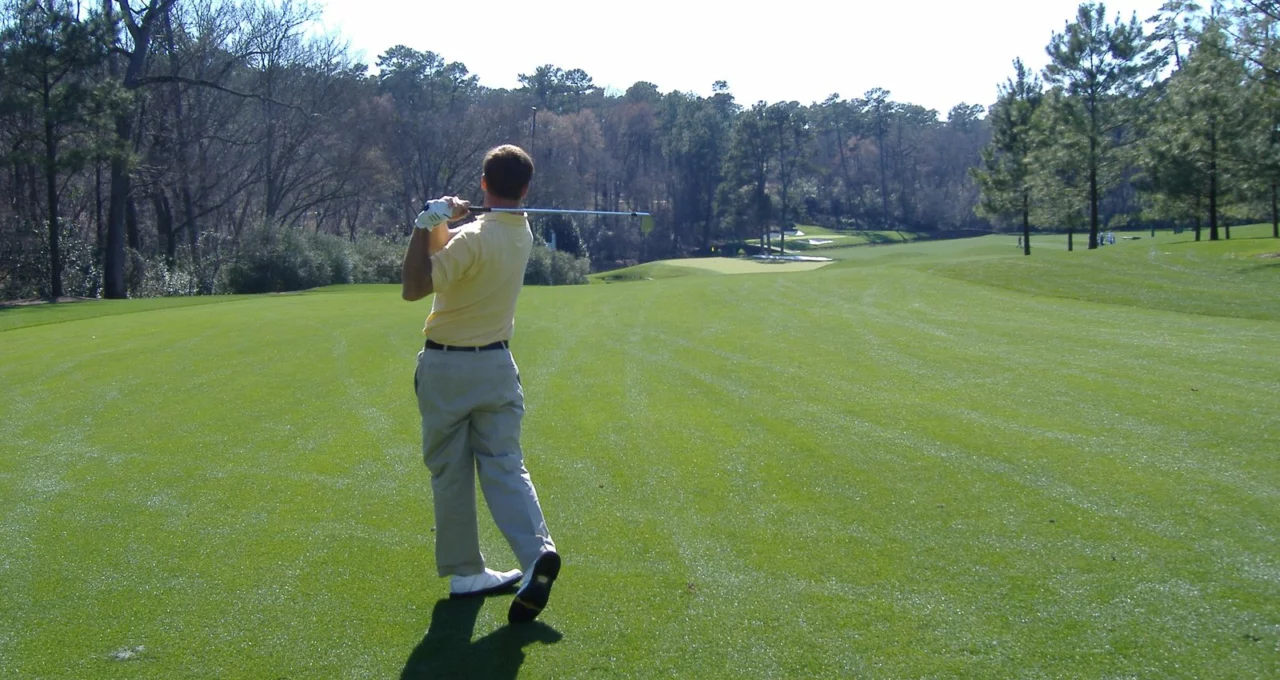
Augusta National Golf Club — Photo Florian Fritsch, assisted by Mark Anderson / Wikimedia Commons, CC BY-SA 3.0
Augusta National Golf Club
Holes
18
By
72
Length
7,510 yards
Green fee
—
Best season
Closed through the Georgia summer; open roughly October to May
Fresh from the Grand Slam of 1930, Bobby Jones wanted a winter club in his home state of Georgia and hired Alister MacKenzie to build it on a former plant nursery outside Augusta. The course opened for play in 1932 and the club formally in January 1933. MacKenzie died the following year, weeks before the first Masters, and never saw the tournament his course was built for.
What the two men set out to make was not a brute. They wanted width, angles and options, and a course a good amateur could enjoy while a great player still had to think his way around it. Very little rough, no forced carries to speak of, and greens that would decide everything. The first two of those three intentions have been eroded over ninety years. The third has not.
What it asks of you
A par 72 now measuring some 7,510 yards, a figure that has climbed steadily and would be unrecognizable to MacKenzie. The original design has been altered continuously: trees planted, holes lengthened, greens rebuilt, a second cut introduced. What survives is the ground itself, which falls far more sharply than television conveys, and the putting surfaces.
The greens run around thirteen or fourteen on the stimpmeter during the tournament, which is quick but no longer exceptional on tour. What makes them what they are is the combination: speed on top of severe contour, on top of firmness, on top of elevation change, with hole locations chosen so that a shot finishing on the wrong side of a ridge leaves a putt that cannot realistically be holed. The margin between a good approach and a scrambling bogey is measured in a few feet.
Amen Corner, the eleventh, twelfth and thirteenth, decides the tournament most years, and the twelfth in particular does it with wind that swirls in the corner of the property and cannot be read from the tee.
What players say about it
Nobody plays this course as a visitor, so there is no body of public player reviews of the kind that exists for a resort course. What there is instead is decades of comment from the professionals who play it once a year, from course-rating panelists, and from architecture writers. The notes below summarize themes that recur across those public sources. They are other people’s opinions, not ours.
What comes up in its favor
- The routing and the use of the land are close to universally admired, and the fall of the ground is the first thing anybody who visits mentions.
- Conditioning is treated as a category of its own. The presentation of the course during tournament week sets the standard the rest of the sport is measured against.
- The width off the tee and the absence of thick rough are praised by players who prefer a course that asks for thought rather than for accuracy alone.
- The greens, whatever else is said about them, are widely considered the most interesting set of putting surfaces in championship golf.
What comes up against
- Fairness is the recurring professional complaint. Tyrrell Hatton has argued publicly that a good shot can finish short-sided in a bunker because of the slopes, and that a player can go from no mistakes to struggling for par.
- Phil Mickelson has said the greens are among the softest surfaces played on tour for much of the last decade, and that they are the course’s only real defense, which is a criticism of the setup rather than a compliment.
- The lengthening and the tree planting over the decades are regularly described as a move away from what MacKenzie and Jones intended, trading width and options for a narrower and more conventional test.
- Access is the objection that sits underneath all the others. This is an invitation-only club with no visitor play of any kind, and the vast majority of people who care about the course will only ever see it on television.
Getting there and when to go
The property is on Washington Road in Augusta, fifteen minutes from Augusta Regional airport and a little over two hours from Atlanta. It is closed through the Georgia summer and open roughly from October to May.
For anyone without a member’s invitation, the only access is a Masters badge, allocated by a long-standing lottery that opens the year before. Practice-round tickets are drawn separately and are the more realistic entry. If you are in Augusta for the tournament and want to hit a ball yourself, the municipal course a few miles away is open to everybody.
Green fees
The club publishes nothing. The tournament site is the only official source. See the tournament’s own site.
How this page was made
The factual frame comes from public sources: OpenStreetMap for the location, Wikipedia and published architecture coverage for the history and the design, and the tournament’s own site for access. The opinion section summarizes public commentary from professionals, rating panelists and architecture writers, read in September 2026; we report recurring themes rather than individual voices, and we quote only remarks that were themselves made publicly and on the record.
We have not played this course, and nothing here is a substitute for that. The club has not paid for this page, has not seen it before publication and has no say in what it says. If something here is wrong or out of date, write to us and we will correct it.