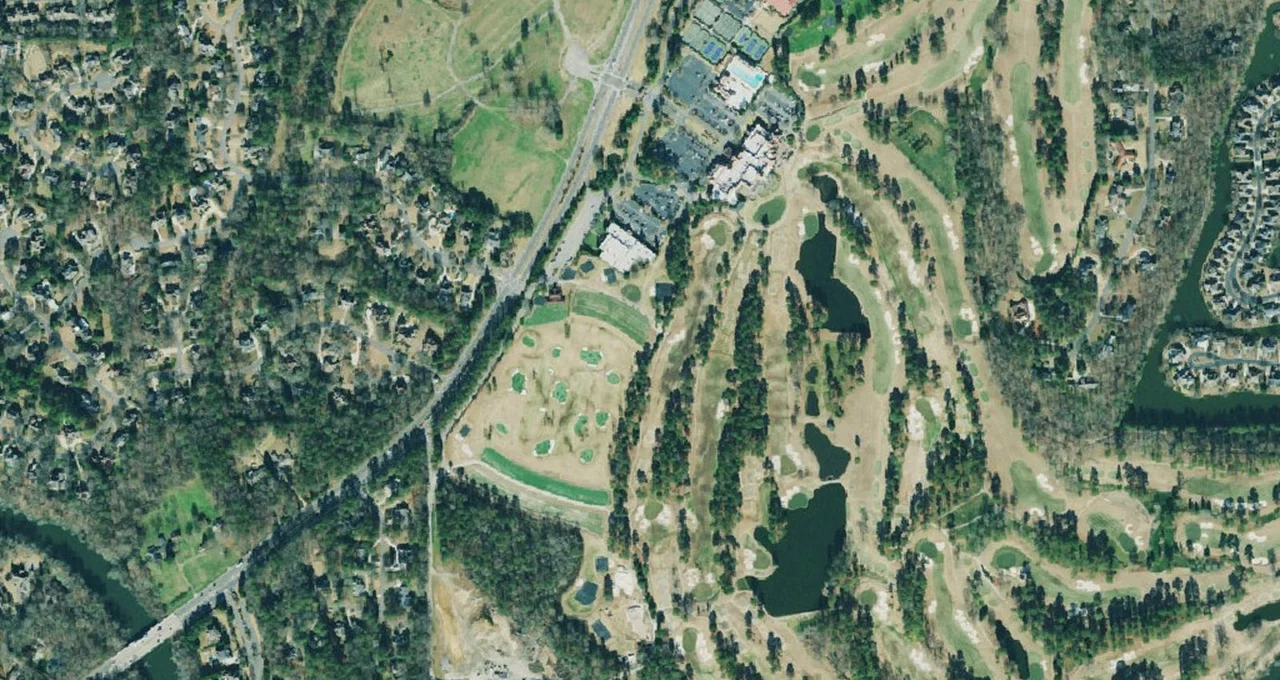
Atlanta Athletic Club from the air. Aerial imagery USGS, domaine public.
Atlanta Athletic Club
Holes
36
By
72 (Highlands); 71 (Riverside)
Length
Highlands: 7,613 yards from the Championship tees (rating 77.4, slope 152); Riverside: 7,152 yards from the Gold tees (74.9, 141), on the club's scorecards; Wikipedia gives 77.0 for the Highlands
Green fee
—
Best season
—
The Atlanta Athletic Club is a private club at 1930 Bobby Jones Drive in Johns Creek, Georgia, a city in north Fulton County that sits along the Chattahoochee River, a little over 20 miles north of downtown Atlanta. It has two 18-hole courses, the Highlands and the Riverside, plus a nine-hole par-3 course and a 20-acre practice ground. The club itself is older than almost any golf course in the South: it was chartered in 1898 as a downtown athletic club, opened its first course at East Lake in 1908, and is best known as the home club of Bobby Jones, the amateur who won the Grand Slam in 1930.
On the scorecard the club publishes, the Highlands is a par 72 of 7,613 yards from the Championship tees, with a rating of 77.4 and a slope of 152. The Riverside is a par 71 of 7,152 yards from its Gold tees, rated 74.9 with a slope of 141. The Highlands has hosted the 1976 U.S. Open and three PGA Championships, the Riverside the 1990 U.S. Women’s Open, and the club is due to host the U.S. Amateur in 2030 and the U.S. Women’s Amateur in 2035. Both courses are for members and their guests only.
From a downtown gym to East Lake
According to the club’s history page, the charter was signed on September 5, 1898, with Burton Smith as first president, and it stated that the club’s purpose was “preparing and maintaining a gymnasium and enjoying physical exercise.” The first rooms were on Edgewood Avenue in downtown Atlanta, then on Auburn Avenue; the club calls these premises the Town Club. Gymnastics, swimming and track came first, and the basketball team was coached from 1909 by John Heisman, the Georgia Tech football coach whose name is now on college football’s best-known trophy. Wikipedia dates his hiring as athletic director to 1908.
Golf arrived with the East Lake property. The club says it bought the land in 1904 from one of its members, Henry Atkinson, and opened its first course and clubhouse there in 1908 under the name East Lake Country Club. The real estate developer George W. Adair, whom the club calls the “Father of Atlanta Golf,” was behind the project, and his son Perry became one of the club’s early champions. Wikipedia gives 1904 as the year the course was built; the club gives 1908 for the opening, and the Top 100 Golf Courses website names Tom Bendelow as the designer of that first course.
East Lake is where the club’s golf identity was formed. Bobby Jones learned the game there under the club professional Stewart Maiden, who also taught Alexa Stirling, a three-time U.S. Women’s Amateur champion. The club’s golf legacies also include Charlie Yates, Dot Kirby, Martha Kirouac and Tommy Barnes, and Wikipedia adds Watts Gunn among its golfing members. George Sargent, winner of the 1909 U.S. Open and later president of the PGA of America, became head professional in 1932, and his son Harold succeeded him in 1947.
The East Lake years were not smooth. The club’s history records a fire that destroyed the first clubhouse in 1914, a new clubhouse in 1915, and a second fire in 1925 that took many artifacts with it, including the original Havemeyer Trophy that Jones had won at the U.S. Amateur; a replica is displayed in today’s clubhouse. A third clubhouse was finished in August 1926, and a second course was added in 1930. East Lake then hosted two national events under the club’s name: the 1950 U.S. Women’s Amateur, won by Beverly Hanson, and the 1963 Ryder Cup, which the United States won under its playing captain, Arnold Palmer. The club notes that it was the first Ryder Cup with fourball matches and the first scheduled over three days.
The move north to the river
By the late 1950s, much of the membership lived in the northern suburbs, and the club followed them. Its history page says it bought 614 acres of cotton and corn fields in north Fulton County in 1963, a property then called River Bend Country Club after the bend of the Chattahoochee beside it. In 1966 it commissioned Robert Trent Jones, no relation to Bobby, to design 27 holes, and the course opened on May 17, 1967. Members voted on names for the three nines: Big Bend, Waterloo and Long View. To finance the move, the club sold East Lake’s second course in 1965, and in 1968 the members voted to sell the East Lake property itself; the club says it stayed there until 1969. That property is today East Lake Golf Club, home of the PGA Tour’s season finale. The new site took the name Atlanta Athletic Club in 1969, and the downtown club building was sold in 1971.
The address was long given as Duluth, the nearest town with a post office, and the 2001 PGA Championship is still listed under Duluth in some records. The area was then unincorporated Fulton County; it became part of the new city of Johns Creek in 2006, according to Wikipedia.
The 27 holes became 36 in 1971, when a fourth nine was added and the club arranged the four loops into two 18-hole courses, the Highlands and the Riverside. Most sources, including the Top 100 Golf Courses website and the Breaking Eighty blog, credit that fourth nine to Joe Finger and say it forms today’s front nine of the Highlands, with Robert Trent Jones’s holes making up the back nine. Wikipedia names Joe Lee instead as the architect of the Highlands front nine. We found no primary source that settles it, and we note the point in the method section below.
Bobby Jones and the 1976 U.S. Open
Jones died in December 1971, and his last wish for the club is part of its story. According to the club, he wrote to the USGA in 1971 that he “would be most happy if my old club should become host for my favorite golf tournament.” The USGA awarded the 1976 U.S. Open to the club in 1972, and the letter is kept in the club’s Jones Museum, which the club says holds the largest collection of Bobby Jones memorabilia anywhere and opens to the public by appointment only. A statue of Jones stands at the club’s entrance, and the road it sits on carries his name.
That 1976 Open was won by Jerry Pate, a 22-year-old tour rookie, with a total of 277, three under par, two strokes ahead of Al Geiberger and Tom Weiskopf. The course then played as a par 70 of 7,015 yards, according to Wikipedia. Two shots from that week are still part of the club’s lore. The club’s own hole guide recalls a 2-iron that Pate hit down the water line on the 15th in the final round, to about eight feet, for a birdie two. And on the 18th, then a par 4, Pate hit a 5-iron from 191 yards out of the rough, over the water, to about three feet, and made birdie to win. The 18th is now a par 5.
A host of majors
The club lists the following championships on its own courses, and it says it is the first club to have hosted the U.S. Junior Amateur, the U.S. Girls’ Junior, the U.S. Amateur, the U.S. Women’s Amateur, the U.S. Open and the U.S. Women’s Open.
- 1976 U.S. Open, Highlands: Jerry Pate.
- 1981 PGA Championship, Highlands: Larry Nelson, by four strokes, his first major title.
- 1982 Junior World Cup: the club lists Nacho Gervas and José María Olazábal as the winners.
- 1984 U.S. Mid-Amateur: Michael Podolak.
- 1990 U.S. Women’s Open, Riverside, July 12 to 15: Betsy King.
- 2001 PGA Championship, Highlands, August 16 to 19: David Toms, one stroke ahead of Phil Mickelson. Toms made a hole-in-one on the 15th in the third round.
- 2002 U.S. Junior Amateur, Highlands: Charlie Beljan, on the 20th hole of the final.
- 2011 PGA Championship, Highlands, August 11 to 14: Keegan Bradley, in a three-hole playoff against Jason Dufner.
- 2014 U.S. Amateur, both courses: Gunn Yang beat Corey Conners 2 and 1 in the 36-hole final.
- 2021 KPMG Women’s PGA Championship, Highlands, June 24 to 27: Nelly Korda, at 19 under par, three strokes ahead of Lizette Salas.
- 2025 U.S. Girls’ Junior, Riverside: Aphrodite Deng, 15, beat Xingtong Chen 2 and 1 in the final and became the first Canadian to win the title, according to NBC Sports and ESPN.
Still to come: the U.S. Amateur in 2030, the centenary of Jones’s Grand Slam year, and the U.S. Women’s Amateur in 2035, which press reports place on the Highlands. Away from golf, the club also hosted ATP tennis, the AT&T Challenge, from 1993 to 2000, and built a stadium for it that it turned into a pickleball complex in 2024.
Two courses, several architects
Neither course is the one Robert Trent Jones left. Rees Jones, his son, has worked on both courses since 1994, according to his firm, including work before the 2001 and 2011 PGA Championships and a renovation of the Highlands in 2016 that added forward tees, regrassed fairways and greens, reworked the bunkers and rebuilt the 14th green. Wikipedia credits Rees Jones with work on the Riverside in 2003.
The Riverside changed more recently and more deeply. Tripp Davis, an Oklahoma architect, rebuilt it in a renovation the club calls multi-million-dollar, completed in November 2022, according to the trade site First Call. Tees, greens and bunkers were rebuilt and moved, new irrigation and drainage went in, trees were removed to open views, fairways were sand-capped and replanted in Zorro zoysia, with Tiftuf Bermuda in the rough and a fescue blend further out. Holes 3, 4, 5 and 12, 13, 14 were rerouted: the old par 5 at the 3rd became a short par 3, the 14th became a short par 4 along the river, and the lakes near the 14th and 18th greens were removed. First Call quotes the aim of giving Riverside the feel of a 1920s course that has not been touched.
The Highlands is next. In March 2025 the members approved a master plan that includes a renovation of the course by Andrew Green, whose recent work includes Inverness, Oak Hill’s East Course, Congressional’s Blue and East Lake. Golf Course Architecture reports that Green plans to rework the greens and the par 3s, introduce some “half-par” holes, shorten the walks between greens and tees and add shot options, with a new par 3 on land now used by the 11th. The work is meant to be finished in time for the 2030 U.S. Amateur; the start date differs between sources, as noted below. In other words, the Highlands described on this page is the one you would find in 2026, and it will change.
What it asks of you
The Highlands
The Highlands is a championship course and plays like one. From the back it is 7,613 yards (3,775 out, 3,838 in), and its rating of 77.4 puts it more than five strokes above par for a scratch player. The club’s hole guide, written for tournament play, returns to the same advice again and again: drive between bunkers set in the landing zones, around 270 to 350 yards from the back tees, and stay below the hole on greens that run fast from back to front. The 6th has the narrowest fairway on the course, 22 yards wide, according to the guide. Water is the other constant. Every par 3 plays over or alongside water, as one golf writer puts it, and lakes also guard the 8th, the 12th and the 18th.
- 3rd: par 4, 478 yards, the hardest hole for men on the card, usually into the wind, with a big set of bunkers on the right.
- 4th: par 3, 219 yards, to a long, narrow green with a lake in front, to the left and behind.
- 5th: par 5, 567 yards uphill, with cross bunkers about 100 yards short of a small, mostly blind green.
- 11th: par 4, 457 yards, a sharp dogleg left; the guide puts the carry over the last bunker at 290 yards and warns against trying it.
- 12th: par 5, 555 yards, reachable after a good drive, with water to the right of the green from 100 yards out.
- 13th: par 4, 391 yards, the shortest and tightest par 4, a dogleg right through tall pines.
- 14th: par 4, 468 yards, to what the guide calls the most severe green on the course.
- 15th: par 3, 260 yards from the Championship tees on the card, with a pond along the whole right side of the green.
- 16th: par 4, 485 yards, long, narrow and uphill.
- 17th: par 3, 210 yards, which the club calls its signature hole: tees stepped down a slope to a green almost surrounded by a lake.
- 18th: par 5, 576 yards, with a lake in front of a green that slopes hard from back to front.
The card offers seven sets of tees. For men, the Gold tees (7,304 yards) are rated 76.1 with a slope of 149, the Blue (6,860) 74.1 and 142, the White (6,284) 71.5 and 135, the Green (5,715) 69.0 and 128 and the Silver (4,838) 70.1 and 129. For women, the Green tees are rated 74.7 with a slope of 143. A seventh set, Black, totals 2,544 yards with no par shown; the club does not say what it is for. If you are a mid-handicapper playing as a guest, the White or Green tees are the realistic choice: from the back, the long par 3s over water and the long par 4s leave little room.
The Riverside
The Riverside starts on high ground and, after the first two holes, drops into the flat land along the Chattahoochee, as one reviewer describes it. Since 2022 it is a par 71 of 7,152 yards from the Gold tees, 3,577 out and 3,574 in, with five par 3s. Its hole guide is written by Tripp Davis himself, in the first person, and it is candid about his intentions: he describes “sucker pins” and landing areas designed to bait aggressive players. The greens are the theme, with subtle slopes and many distinct hole locations, so distance control matters more than power. Some notes from the guide:
- 1st: par 5, 602 yards, the longest hole, with a choice to lay up at 125 or 100 yards depending on the pin.
- 3rd: par 3, 168 yards, a new short hole that replaced the old par 5; long left is “a no-no,” the guide says.
- 7th: par 4, 481 yards, the hardest hole for men on the card, where the aggressive line down the left opens the green.
- 12th: par 5, 554 yards, with a creek on the right and a choice of lay-up areas.
- 14th: par 4, 311 yards, drivable for the brave, with the river along the whole right side.
- 17th: par 3, 243 yards, the longest and probably hardest par 3, with slopes that feed long shots from the right toward the left side of the green.
- 18th: par 5, 567 yards, without the lake that once guarded the green.
The card rates the Gold tees 74.9 with a slope of 141, the Blue (6,752 yards) 73.2 and 137, the White (6,222) 70.6 and 133, the Green (5,496) 67.5 and 125 and the Black (4,857) 64.9 and 122 for men. For women, the Gold tees are rated 76.9 with a slope of 141; the slopes given for the women’s Blue and White tees are 132 and 125.
Practice
The practice ground covers 20 acres, according to the club, with 62 hitting stations, two putting greens, four pitching and chipping greens, two practice bunkers and a fairway bunker. The nine-hole par-3 course has holes of 75 to 125 yards and is used for short-game work and junior instruction.
What golfers are saying
As a private club, the Atlanta Athletic Club has few public reviews compared with a daily-fee course. The material comes mostly from golf bloggers, ranking sites and their contributors, and a few short user reviews on course directories. In October 2026, the Top 100 Golf Courses website showed an average of 4.5 out of 5 for the Highlands and 4 out of 5 for the Riverside, and ranked them 5th and 15th in Georgia. The points below summarize what recurs. They are other people’s opinions, not ours; nobody from Panxis has played the course, and we name no one.
What comes up in its favor
- The championship history is the first thing reviewers mention, from Pate’s 5-iron to Toms’s ace on the 15th, along with the Bobby Jones collection.
- The Highlands is described as a true test, with large, firm, undulating Bermuda greens and a strong closing stretch from the 15th to the 18th.
- The 17th of the Highlands is often called the most beautiful hole on the property, and the 11th and 12th are singled out as the best par 4 and par 5.
- The renovated Riverside wins praise for its natural-looking bunkers, wider fairways, more room to miss and its river views; one blogger calls its back nine possibly his favorite nine at the club, and another found it as enjoyable as its more famous sister.
- Reviewers note the zoysia around the Riverside greens and bunkers and the overall conditioning.
- Elevation changes and the parkland setting of a 36-hole property along the river come up as a strength.
What comes up against
- Water is the main criticism of the Highlands: one ranking-site reviewer calls its use overkill, and notes that every par 3 relies on it.
- The same reviewer finds the front nine less inventive than the back, and the fairway bunkers repetitive in the driving zones.
- The Highlands bunker style is described as dated, a 1990s look, with tight run-off areas.
- Several reviews say the Highlands is punishing for mid- and high-handicap players, who need to choose their tees carefully.
- The Riverside, while friendlier, can still be hard for good players when the course is set up firm.
Who can play
The Atlanta Athletic Club is private. Its guest information page says members may invite and accompany guests for golf, dining and other amenities, and that all guests must check in with security at the gate. There are no public tee times and no published way for a visitor to book a round. The club has its own membership categories, described on its membership page. The R.T. Jones, Jr. Golf Instruction Center provides coaching, and the club runs a junior golf program, but the public material we found does not say whether its instruction is open to non-members. The club publishes a guest golfers’ guide and a dress code for guests; read them before a visit if a member invites you.
Getting there
The club is at 1930 Bobby Jones Drive in Johns Creek, Georgia 30097, and the main phone number is (770) 448-2166. Guests enter by the security gate. In a straight line, the club is about 2.5 miles from downtown Duluth, about 8 miles from downtown Alpharetta, about 19 miles from East Lake Golf Club, about 21 miles from downtown Atlanta and about 29 miles from Hartsfield-Jackson Atlanta International Airport. These distances are measured on the map and not by road; Wikipedia gives 23 miles from Atlanta, a figure closer to the drive.
Green fees
The club publishes no green fees, and none are given here. Golf is for members and the guests they accompany, under the club’s own guest rules; for anything else, contact the club through its website.
How this page was made
The factual frame comes from public sources: OpenStreetMap for the location and the address; the club’s website, atlantaathleticclub.org, for the two scorecards, ratings and slopes, the hole-by-hole guides, the practice facilities, the guest policy, the history of the club, the list of championships and their winners; Wikipedia for the 1976 U.S. Open, the club’s general history and the incorporation of Johns Creek; Wikidata for the identifiers; Rees Jones Inc. for his work on the courses; the trade site First Call for the Riverside renovation and the 2025 master plan; Golf Course Architecture for Andrew Green’s plans; NBC Sports and ESPN for the 2025 U.S. Girls’ Junior; the Top 100 Golf Courses website, the Breaking Eighty and Tiger Golf Traveler blogs and Golf Course Gurus for the architects of the 1971 nine and for the reviews. We could not consult the USGA’s course rating database, Golf Digest or GolfPass, which refused our requests.
Where sources disagree, we say so. The date of the move north varies: the club says the 27 holes opened on May 17, 1967; Top 100 Golf Courses and Breaking Eighty give 1964, one blog 1966. Wikipedia says the East Lake course was built in 1904; the club says it bought the land in 1904 and opened the course in 1908. The architect of the Highlands front nine is Joe Finger in most sources and Joe Lee on Wikipedia. Wikipedia dates the Rees Jones work on the Highlands to 2006 and 2016, while his firm says he has worked on both courses since 1994. Wikipedia gives a rating of 77.0 for the Highlands; the club’s current card gives 77.4. On the club’s Highlands guide, the 15th is described as a 227-yard hole, the card’s Gold figure, while the card gives 260 yards from the Championship tees, and the 5th is described as 565 yards against 567 on the card; this page follows the card. The women’s ratings for the Riverside Blue and White tees are not legible on the club’s card, which repeats the slope figures in the rating line, so we give only the slopes. The Top 100 Golf Courses page for the Riverside still gives 7,428 yards and four par 3s, figures that predate the 2022 renovation. One release from the club’s master plan places the 1990 U.S. Women’s Open on the Highlands; the club’s championship page and Wikipedia place it on the Riverside, which we follow. The start of the Highlands renovation is given as early 2028 in the March 2025 release and as July 2027 in Golf Course Architecture’s later report; both aim for completion before the 2030 U.S. Amateur. Wikipedia’s figure of 23 miles to Atlanta is not a straight-line distance.
Several things on this page will age: the Highlands renovation, which will change its holes, yardages and ratings; the future championships; the rankings and review averages, read in October 2026; and the scorecards, which follow the club’s website as published in October 2026. The opinion section summarizes reviews by golf blogs, ranking sites and directory users, read in October 2026. We report recurring themes rather than individual voices. Nobody from Panxis has played or visited this course, and this page is no substitute for a round. The public material is thinner than for a public course, and this page is shorter on player opinions as a result.
The club has not paid for this page, has not seen it before publication and has no say over its content. This page contains no commercial link and earns us no commission. If you know the club and something here is wrong or out of date, write to us and we will correct it.
Other courses nearby
Closest to this one in our United States directory:
- East Lake Golf Club — 19 mi
- Forest Hills Golf Club — 128 mi
- Augusta Municipal Golf Course — The Patch — 129 mi
- Augusta National Golf Club — 129 mi
The hole to know
The signature hole of the Highlands, according to the club: a par 3 of 210 yards from the Championship tees, played downhill from tees stepped down a slope to a green almost surrounded by a lake, with bunkers behind it.