Golf umbrellas in the wind: what a double canopy, 68 inches and fiberglass ribs really change
Titleist Tour Double Canopy, Callaway Tour Authentic and GustBuster Pro Series 62: U.S. prices in November 2026, the frame details that decide whether a golf umbrella survives the wind, and where it breaks.
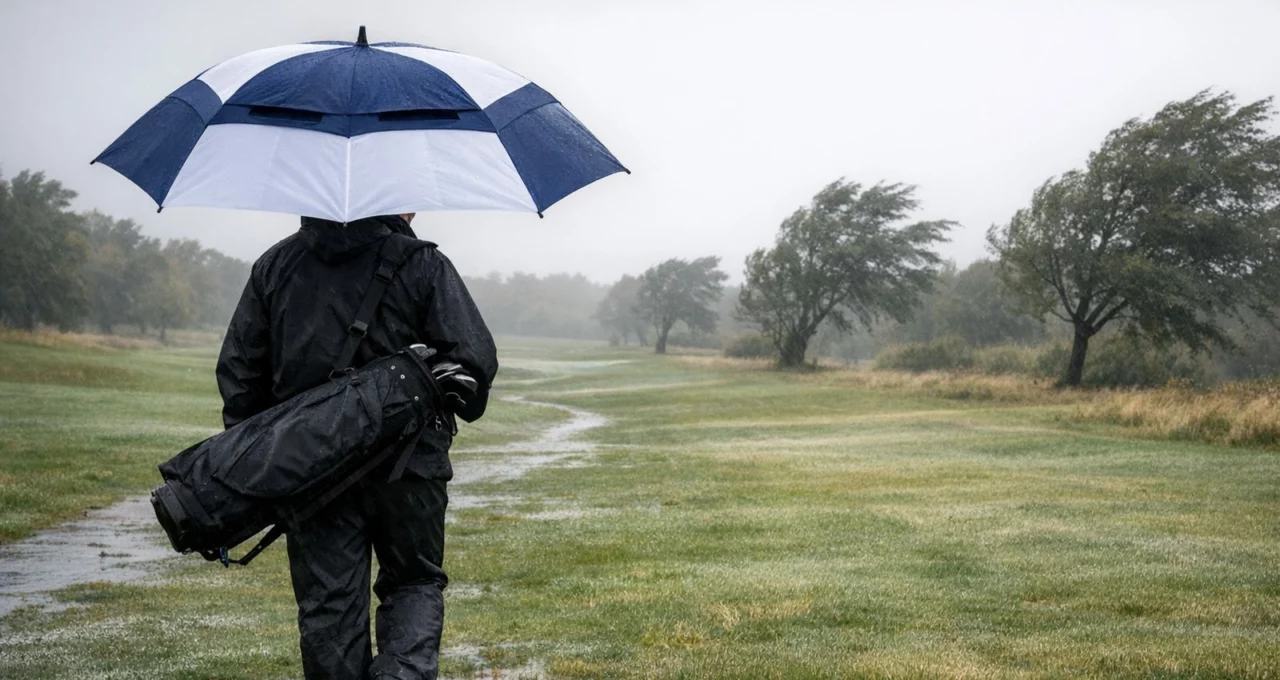
A golf umbrella spends most of its life folded in the side pocket of a bag, and is judged in about four seconds: the moment a gust catches it on an open tee and either slips through the canopy or turns the whole thing inside out. When it holds, nobody thinks about it again. When it breaks, it usually breaks in the same places, a rib that snaps at the joint, a canopy that tears at the tip, a runner that no longer locks. Golf umbrellas are sold on their size and the logo printed on the panels. What decides whether one survives a windy fall season is the frame, the canopy design and a few details the label mentions in passing.
This page presents three golf umbrellas Americans buy, from $49.99 to $89.99 where a U.S. golf retailer listed a price, with what their makers publish and what golfers say about umbrellas of this kind in public. It is a presentation of products and a reading of public opinion, not a test. Nobody at Panxis Golf opened, carried or measured any of these umbrellas for this page, and no wind figure on this page was measured by us.
What a golf umbrella has to do
A city umbrella covers one person on a sidewalk for a few minutes. A golf umbrella covers a player, often a bag and sometimes a playing partner, for four hours on ground with nothing to break the wind. That is why golf umbrellas are big: the common sizes are sold as 60, 62, 64 and 68 inches, and the figure is the arc of the canopy measured over the top, not the width of the shadow it casts on the ground. A 68-inch umbrella is the size most tour-branded models use, and it is large enough to keep rain off a stand bag hung from your shoulder.
Size works against you in the wind. A bigger canopy catches more air, puts more load on every rib and is harder to hold steady with one hand while the other pulls a club from the bag. Every golf umbrella is a compromise between the area it keeps dry and the force it has to resist. The frame and the canopy design decide where that compromise lands.
There is also the sun. On a summer afternoon in the South or the desert Southwest, an umbrella is shade between shots as much as rain cover, and several makers now sell a UV coating on the inside of the canopy as part of the pitch.
Five things that decide whether it survives the wind
- Single or double canopy. A double, or vented, canopy has a second layer of fabric over a ring of open slits near the top. A gust that would otherwise push the canopy inside out escapes through the vents. It does not make an umbrella unbreakable, but it is the single feature most golfers point to when an umbrella survives a windy day.
- What the ribs are made of. Steel ribs are cheap and strong but bend for good once they are pushed too far. Fiberglass ribs flex under load and spring back, which is why most golf umbrellas use them. Some premium models use carbon fiber for the ribs to save weight. Look for the words “fiberglass frame” or “fiberglass ribs,” and be wary of a listing that says only “wind resistant.”
- The joints and runner. Ribs rarely snap in the middle. They break at the small metal or plastic joints where the stretcher meets the rib, or at the runner, the sliding collar on the shaft. Reinforced joints are mentioned on some listings and ignored on others.
- Manual or automatic opening. An automatic umbrella opens at the press of a button, which is quick in a sudden shower. It also adds a spring and a catch that can fail. Most golf umbrellas sold by club brands open by hand.
- Weight and handle. A 68-inch umbrella with a fiberglass shaft and frame is noticeably heavier than a 60-inch one. A foam or rubber handle that stays grippy when wet matters more than it sounds, because you will often hold it in a wet glove.
One claim deserves care: the wind rating. Some brands publish a figure, such as “wind tested to 55 mph,” and name the lab that ran the test. That is more information than most listings give, and it is still a maker’s claim, measured in a steady airflow, not in the gusts that swirl around a clubhouse or a line of trees. A wind figure is useful to compare two umbrellas. It is not a promise that yours will hold on your course.
Titleist Tour Double Canopy Umbrella (2026)
Titleist has sold a tour-style double canopy umbrella for years and refreshes it with each new range. The 2026 version keeps the 68-inch size and the eight-panel canopy and changes the handle.
- What the maker lists, as reproduced by a U.S. dealer: 68 inches of coverage; 43 inches long; a double canopy design that lets air pass through; reinforced struts and ribs; a UV protective coating; a soft foam handle debossed with the Titleist script; eight panels; a tour-inspired bag to store it. The dealer page read for this article did not list the weight, the rib material or the opening system, and did not publish any wind figure.
- Who it suits: a golfer who walks or rides with a full-size bag and wants the largest coverage, with a vented canopy, from a club brand.
Price read in November 2026 at a U.S. golf retailer: $89.99, marked down from a listed $100.00.
Callaway Tour Authentic 68″ Umbrella
The Tour Authentic is Callaway’s tour-style umbrella, sold in the brand’s staff colors. Its listing is one of the few that names a material for the ribs.
- What the maker lists, as reproduced by a U.S. dealer: a 68-inch double canopy “for maximum protection and wind pass through”; carbon fiber ribs; a fiberglass shaft; a UV 50+ protective coating; an ergonomic non-slip handle; manual operation; a sleeve included. No weight and no wind figure were listed on the page read for this article.
- Who it suits: a golfer who wants the full 68-inch size with a frame described as carbon and fiberglass, and who is happy to open it by hand.
Price read in November 2026 at a U.S. golf retailer: $49.99, marked down from a listed $79.99. The umbrella was shown out of stock on that date, so this price may not return in the same form.
GustBuster Pro Series 62
GustBuster is a specialist umbrella maker whose whole pitch is wind. The Pro Series 62 is its golf model, slightly smaller than the tour-style umbrellas above, and the one most often cited by golfers who want a figure rather than a promise.
- What the maker publishes, as reproduced by dealers: a 62-inch double canopy with vents in the lower canopy; a nylon canopy; a wind tunnel test to 55 mph, which listings attribute to the College of Aeronautics in New York (one listing names Vaughn College, the school’s current name); a limited lifetime warranty. As with any maker’s wind figure, this was measured by a lab chosen by the brand, not by an independent reviewer.
- Who it suits: a golfer who plays on exposed, windy courses and would rather give up six inches of canopy for a frame sold specifically on its wind resistance.
No price is given here. The umbrella was not listed by the U.S. golf retailer whose prices are used on this page, and the figures seen on general marketplaces vary too much from one seller to the next to be quoted as a reference.
Side by side
| Umbrella | Size | Canopy | Frame, as published | Opening | Price read, Nov. 2026 |
|---|---|---|---|---|---|
| Titleist Tour Double Canopy (2026) | 68 in., 43 in. long | Double, eight panels, UV coating | Reinforced struts and ribs, material not listed | Not listed | $89.99 |
| Callaway Tour Authentic 68″ | 68 in. | Double, UV 50+ coating | Carbon fiber ribs, fiberglass shaft | Manual | $49.99 (out of stock) |
| GustBuster Pro Series 62 | 62 in. | Double, vented lower canopy | Wind tested to 55 mph by a lab named by the brand | Manual | No reference price |
What golfers are saying
Golfers rarely write long reviews of umbrellas, and almost never of one model in particular. What follows comes from owner reviews on retailer pages, buyer’s guides published by golf media and forum threads, and it describes what recurs about golf umbrellas of this kind, double canopy, 60 to 68 inches, rather than a verdict on any one of the three above.
What comes back in their favor:
- The vented canopy works. Owners of double canopy umbrellas often say theirs has never turned inside out on a windy day, and several say it is the reason they would never go back to a single canopy.
- The 68-inch size covers the bag. Golfers who carry a stand bag value an umbrella large enough to keep the grips dry along with the player, which a 60-inch umbrella struggles to do.
- Fiberglass flexes instead of breaking. Players describe watching the canopy bend hard in a gust and pop back into shape, which steel frames do not do.
What comes back against them:
- Ribs break at the joints. The most common complaint is a rib or stretcher snapping at the small joint near the runner, often after a season of use, and the umbrella is then hard to repair.
- The fabric tears at the tip. Several buyers report the canopy fraying or tearing where it is stitched to the top of the frame after long use.
- Big means heavy and awkward. A 68-inch umbrella is tiring to hold in a crosswind for four hours, and some golfers say it does not fit the umbrella holder on their push cart or in a riding cart.
- Wind claims meet real gusts. Golfers who bought an umbrella on a published wind rating sometimes report it inverting in a sudden gust anyway, a reminder that a lab figure is not a guarantee.
For independent comparisons of several golf umbrellas, golf media such as MyGolfSpy and National Club Golfer have published buyer’s guides over the years. They are worth reading for their own observations, which are theirs and not ours.
Where Americans play in the rain and the sun, and what each asks of an umbrella
The United States has no single umbrella climate, and the right umbrella depends on where your home course is.
- The Pacific Northwest. Golf in Seattle and Portland goes on through months of drizzle from fall to spring. Rain there is usually steady rather than violent, so coverage counts more than wind resistance: a 68-inch double canopy that keeps the bag dry earns its weight.
- Florida and the Gulf Coast. Summer brings sun all morning and thunderstorms many afternoons. The umbrella is shade before it is rain cover, which is where a UV coating matters. And when thunder is heard, no umbrella is protection: the National Weather Service’s guidance is that there is no safe place outdoors in a thunderstorm, and golf courses sound a horn for a reason.
- The desert Southwest. In Arizona and Nevada, an umbrella is almost only a sunshade, opened between shots on the tee and the green. A lighter 60 or 62-inch model is easier to keep open all day, and a white or silver canopy reflects more heat than a dark one.
- The Plains and the coasts. Courses on open prairie or on the ocean see wind that is the real enemy of any umbrella. Here a vented canopy and a fiberglass frame are worth more than a few extra inches of coverage, and a smaller umbrella that you can hold low is often better than a big one that pulls your arm.
- The Northeast and Midwest in fall. Cold rain and leaves on the ground make for long, wet rounds. An umbrella that fits the holder on your push cart frees both hands, and that matters more as the days get shorter.
One rule applies everywhere: under Rule 10.2b(5) of the Rules of Golf, you may hold your own umbrella over your head as you prepare to play, but you must not make a stroke while your caddie, a playing partner or an object deliberately placed protects you from rain, sun or wind. A partner holding the umbrella over you as you putt costs you the general penalty, two strokes in stroke play. Close it, or hold it yourself, before you swing.
As for where to buy, golf umbrellas are sold in the pro shop of most courses, often with the club’s own logo, in golf specialty stores and online. The pro shop is the place to see the size and the weight in hand. A specialty store lets you open several models side by side and compare the handle and the joints. Online, check whether the maker publishes the rib material and a wind figure, and read the warranty terms, because a lifetime warranty is only as good as the process for using it. A used umbrella is a reasonable buy if it opens and locks smoothly and the canopy is not frayed at the tip.
How to choose before you buy
- Pick the size for your bag and your wind. 68 inches if you carry and want the bag dry, 60 to 62 inches if you play in wind or want something lighter.
- Insist on a double canopy. It is the one feature golfers credit most often for surviving a gust.
- Ask what the ribs are made of. Fiberglass or carbon fiber flexes and returns. If the listing does not say, ask.
- Open and close it in the shop. Check that the runner slides and locks cleanly, that the joints look solid and that the handle fits your hand in a glove.
- Check it fits your cart. If you use a push cart or ride, make sure the shaft fits the umbrella holder before you leave the store.
- Look after it. Let it dry open, not folded in the bag, and close it before a gust does it for you. Most broken ribs come from being caught half open in the wind.
A good golf umbrella is one you stop noticing: it keeps the grips dry, survives the gust on the fourteenth tee and goes back in the bag. Spend on the frame and the canopy design, choose the size for where you play, and walk the few hundred yards from the last green to the parking lot with it closed if the wind has picked up.
How this page was put together
This is a presentation of products and a reading of public opinion, not a test. Nobody at Panxis Golf opened, carried or measured any of these umbrellas for this page. Features come from the makers’ published descriptions as reproduced on dealer product pages: Titleist for the Tour Double Canopy Umbrella (2026), Callaway for the Tour Authentic 68″ Umbrella, and GustBuster for the Pro Series 62, whose wind test figure and warranty are the maker’s own claims as reproduced by several dealers. Where a figure was not published on the pages read, such as weight for all three umbrellas, it is left out rather than estimated.
Prices were read on November 1, 2026, in U.S. dollars, at Carl’s Golfland, a U.S. golf retailer, for the Titleist and Callaway umbrellas. The PGA TOUR Superstore product pages could not be read on that date, and the GustBuster Pro Series 62 was not listed at Carl’s Golfland, so no price is given for it. Prices change with promotions, colors and stock, so the figure at checkout is the one that counts.
What golfers say was read in public owner reviews on retailer pages, in buyer’s guides published by golf media and in golf forum discussions, some only through search excerpts. Nobody is quoted by name, nothing is counted, and no impression is presented as a statistic. The rule cited is Rule 10.2b(5) of the Rules of Golf as published by the USGA. There is no commercial link on this page, no affiliate arrangement and no commission of any kind. If content on this site is ever paid for by a brand, it will carry an advertising label at the top of the page.