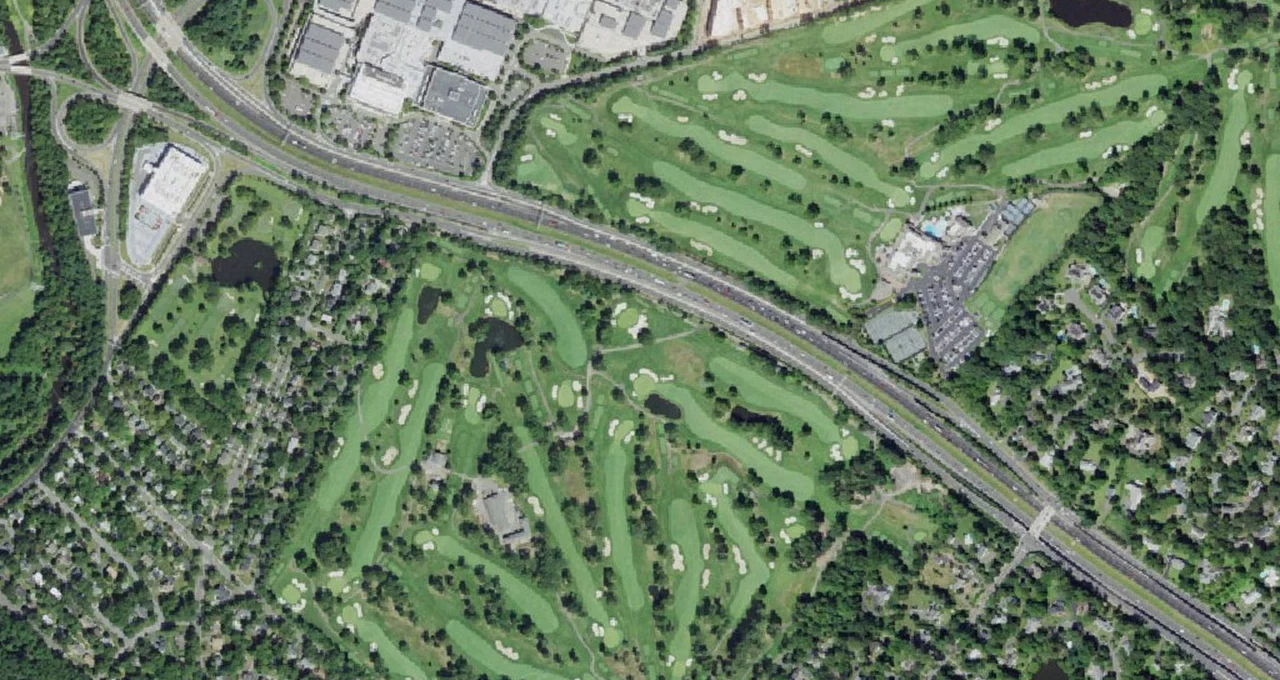
Canoe Brook Country Club from the air. Aerial imagery USGS, domaine public.
Canoe Brook Country Club
Holes
36 (two 18-hole courses, North and South)
By
72 on each course (the South plays 37 out, 35 back)
Length
North: 7,115 yards from the Blue tees (rating 74.3, slope 134); South: 6,753 yards (72.8, slope 131), per course databases. Wikipedia gives 7,163 and 6,707 yards
Green fee
—
Best season
The club says it is open eleven months a year; course databases give a golf season of March to November
Canoe Brook Country Club is a private, member-owned club in Summit, New Jersey, with 36 holes of golf on two 18-hole courses, the North and the South. This page covers the club and both of its courses. The property straddles the line between Summit, in Union County, and Short Hills, in Essex County, and the club gives its address as 1108 Morris Turnpike, Summit. The two courses lie on either side of New Jersey Route 24, a few hundred yards from The Mall at Short Hills, about 20 miles west of Midtown Manhattan.
The club was incorporated on December 12, 1901, according to the New Jersey State Golf Association, which calls it one of the state’s most distinguished clubs. Both courses are par 72. Course databases give the North 7,115 yards from the Blue tees, with a course rating of 74.3 and a slope of 134, and the South 6,753 yards from its Blue tees, rated 72.8 with a slope of 131. Other sources give other figures, as explained below. Canoe Brook has hosted the U.S. Women’s Amateur three times, in 1936, 1983 and 1990, and is now one of the regular sites of the final stage of qualifying for the U.S. Open. The club credits Rees Jones as the designer of both courses in their present form, but each sits on a long layering of earlier work.
A club that keeps rebuilding its courses
The founders were a group of businessmen from Summit. According to a course directory whose history of each course matches the outline given by Wikipedia, they chose Jack Vickery and his assistant, Alex Smith, in January 1902 to lay out an 18-hole course of about 5,754 yards. The front nine opened in the fall of 1902 and the back nine in 1905. The club’s clubhouse grew around an older building: a 2015 trade-magazine profile names it as the Wallace Farmhouse, from the middle of the nineteenth century, and says the grounds had been a summer resort before golf arrived and had housed American troops during the Revolutionary War. We found no other source for that last point.
In January 1916 the club hired Isaac Mackie as head professional, replacing Louis Tellier, according to a New York Times notice cited by Wikipedia. The same year Walter Travis, the Australian-born amateur champion turned architect, rebuilt all 18 holes under Mackie’s supervision. Wikipedia says the Travis design stretched what became the North Course to 6,611 yards from the championship tees, a long course for its day, and the directory credits this rebuilding with making it a championship course.
A second course followed in the 1920s, south of Morris Turnpike. Its origins are the least settled part of the club’s history. Wikipedia says the club hired the British firm of Harry Colt, Charles Hugh Alison and Alister MacKenzie in 1920. The Top 100 Golf Courses website credits Alison alone and dates the South Course to 1924. The course directory says it opened in 1927 and credits “Captain Allison” of the Colt firm. A contributor to an online golf-architecture forum, citing a 1925 article in Golf Illustrated, argues instead that the club chose plans drawn by its professional, Isaac Mackie, that clearing began in 1922 and that the course opened in 1924, and says he has seen no solid evidence of Alison’s involvement. We cannot settle the question and simply report the competing accounts.
The North Course was then reshaped twice by development around it. Part of its land became The Mall at Short Hills. Wikipedia says the Prudential Insurance Company approached the club in the early 1950s about a land swap to make room for the shopping center, and that Robert Trent Jones redesigned the North Course as a result. The course directory dates the change to 1945, says seven holes were lost and replaced by holes on land received in the exchange, and credits the new holes to A. H. Tull. Top 100 Golf Courses lists Travis, Tull and Robert Trent Jones as architects of the North. Then came the highway. Wikipedia places the construction and widening of Route 24 in the 1960s; the directory speaks of the 1970s and of a link between Interstates 78 and 287. Either way, holes next to the road on both courses had to be redesigned, and the club turned to Rees Jones, the son of Robert Trent Jones, whose firm the directory describes as the club’s resident architect ever since.
Jones has kept working at Canoe Brook for half a century. According to the directory, he partially renovated the South in 1974 and completely renovated it in 1993 and 1994, lengthening it by about 300 yards from the Blue and White tees, adding Gold tees for senior members, rebunkering most fairways and greens, rebuilding every tee and replacing five greens. The North was fully restored and partly redesigned under his direction from 1991. A 2015 trade profile adds that he re-routed the club’s 36 holes in the 1990s. The New Jersey State Golf Association, in a timeline of the state’s golf, counts six designers in the lineage of the two courses.
Championships
Canoe Brook’s record as a host is long. The U.S. Women’s Amateur came first in 1936, when Pam Barton of England beat Maureen Orcutt 4 and 3 in the final; USGA records place that championship on the South Course. It returned in 1983, when Joanne Pacillo beat Sally Quinlan 2 and 1, and in 1990, when Pat Hurst beat Stephanie Davis on the 37th hole of the final. The state association, in a preview of a later event, says the North Course was the venue for the 1983 and 1990 championships.
The New Jersey State Golf Association lists the state championships it has held at the club: the State Amateur in 1921, 1933, 1938, 1945, 1989, 2001 and 2013; the State Open in 1947, 1953, 1962 and 1978; and the State Women’s Amateur in 1982. Wikipedia adds the Metropolitan Golf Association’s Ike Championship in 2015. The club has also hosted the New Jersey Women’s Open on its North Course, according to the state association.
U.S. Open qualifying has made the club’s name better known outside the region. On June 5, 2006, Canoe Brook held a 36-hole sectional qualifier in which 153 players competed for 18 places, and Michelle Wie, then 16, became the first woman to reach that stage of U.S. Open qualifying. The Metropolitan Golf Association reported more than 4,000 spectators and 250 members of the media. Wie finished five strokes out of a playoff for the last place. Brett Quigley led the qualifiers at 131 after a second-round 63, seven under par, which the association said broke the South Course record by a stroke. Wikipedia lists the club as a sectional site again from 2016 to 2018, and the Metropolitan Golf Association has run the final stage of qualifying there more recently, in 2024 and 2025, with each player going round both courses in a single day. In 2025, the medalist at Canoe Brook finished seven under par for the 36 holes.
Ranking lists have been warmer in the past than they are now. Golf Digest’s page on the North Course says it was ranked among America’s 100 Greatest Courses from 1967 to 1970 and among New Jersey’s top ten from 1987 to 1993 and from 2001 to 2003. In October 2026, Top 100 Golf Courses placed the North 46th and the South 64th in New Jersey, a state crowded with famous private courses, Baltusrol among them, about three miles away.
What it asks of the player
The two courses do not play alike, and the club uses the difference: at U.S. Open qualifying, the Metropolitan Golf Association describes the North as typically the higher-scoring of the two. The state association calls the North a classic test that rewards precision, strategy and disciplined shot-making, with tree-lined fairways, demanding approach shots and subtly contoured greens. Both courses are long from the back tees, and the slopes published in course databases, from the high 120s to the high 130s depending on the tee and the source, put both well above the standard difficulty of 113 for an average golfer.
The North Course
The hole-by-hole card below, from the Blue tees, is the one published by two course databases that agree with each other. It adds up to 7,115 yards and a par of 72, 3,534 yards out and 3,581 back. The stroke index of each hole is in parentheses.
- Front nine: 1st, par 4, 445 yards (5); 2nd, par 5, 560 yards (1); 3rd, par 4, 376 yards (11); 4th, par 4, 350 yards (13); 5th, par 3, 170 yards (17); 6th, par 4, 442 yards (3); 7th, par 3, 203 yards (15); 8th, par 5, 558 yards (9); 9th, par 4, 430 yards (7).
- Back nine: 10th, par 4, 380 yards (16); 11th, par 3, 180 yards (18); 12th, par 5, 560 yards (8); 13th, par 4, 386 yards (10); 14th, par 3, 220 yards (14); 15th, par 4, 375 yards (12); 16th, par 4, 431 yards (2); 17th, par 4, 448 yards (4); 18th, par 5, 601 yards (6).
The course opens hard: a par 4 of 445 yards, then a par 5 of 560 yards rated the most difficult hole on the card, which one reviewer on a course-ranking site describes as a true three-shot hole for all but the longest hitters. The same reviewer finds the rest of the front nine adequate rather than exciting and the inward half more consistent. The finish is where the North earns its reputation. The 16th, a par 4 of 431 yards rated the second hardest hole, depends on placing the tee shot; the 17th is longer still at 448 yards; and the 18th, a par 5 of 601 yards, the longest hole on the property, is hard to birdie unless the first two shots are well placed. The databases list 72 bunkers and five water hazards on the North. For a high handicapper, the forward tees matter: the same databases give intermediate sets from 6,901 yards down to 6,134 yards, and a Red set of 5,684 yards.
The South Course
The South is shorter but no pushover, and it is laid out differently, with a par of 37 out and 35 back. Its card from the Blue tees, again as published by course databases, adds up to 6,753 yards.
- Front nine: 1st, par 5, 511 yards (7); 2nd, par 4, 394 yards (1); 3rd, par 4, 363 yards (9); 4th, par 3, 156 yards (15); 5th, par 4, 411 yards (3); 6th, par 5, 498 yards (13); 7th, par 3, 212 yards (17); 8th, par 5, 573 yards (5); 9th, par 4, 372 yards (11).
- Back nine: 10th, par 3, 181 yards (14); 11th, par 5, 546 yards (10); 12th, par 4, 391 yards (2); 13th, par 4, 418 yards (6); 14th, par 3, 198 yards (18); 15th, par 5, 489 yards (12); 16th, par 4, 428 yards (8); 17th, par 3, 195 yards (16); 18th, par 4, 417 yards (4).
The round begins with a par 5 that one golf blogger, as summarized by a ranking site, describes as steeply downhill to a shallow green guarded by a large pond. Reviewers single out the par 4s: the 2nd and the 5th on the way out, the 5th described as exacting, and the 12th and the 18th on the way in. The same reviewer finds the par 3s and par 5s rudimentary. Tom Doak, in his Confidential Guide to Golf Courses, called the South a good Alison design while noting the changes forced by the widening of Route 24. Course databases count 72 bunkers and six water hazards on the South, and give it White tees of 6,282 yards, Gold tees of 5,915 yards and Red tees of 5,599 yards.
What players say
As a private club, Canoe Brook draws few public reviews. We read the short reviews on a course-ranking site, the summary of a golf blogger’s round, the reviewer comments shown on Golf Digest’s course page and Tom Doak’s published assessment of the South. That is a thin base, and the points below should be read with that in mind. They are other people’s opinions, not ours; nobody from Panxis has played either course, and we name no reviewer other than a published author.
What comes up in its favor
- The North is described as a serious, demanding test, with strong opening and closing stretches and well-placed demands on both the tee shot and the approach.
- The 16th and 17th on the North, and the 2nd, 5th, 12th and 18th on the South, are the holes reviewers single out.
- The South’s land and routing are praised for making good use of a tight, sloping site, and one blogger enjoyed it more than the North.
- Conditioning draws praise on Golf Digest’s page, and a recent short review on a ranking site gave full marks for facilities.
- The club’s championship record and its two contrasting courses within one property are mentioned as strengths.
What comes up against
- Architecture is the main criticism. Reviewers find the North demanding but not distinctive by New Jersey standards, and one questions its place among the state’s best.
- One reviewer on Golf Digest’s page calls the North repetitive, with holes of similar length, bunkering that lacks character, and a course that would benefit from a restoration.
- The middle holes of the North are described as unremarkable.
- The South is called enjoyable but hardly memorable, with weak par 3s and par 5s, and its opening hole drew a negative verdict from one blogger.
- Several observers note how much both courses have been changed by the mall, the highway and repeated renovations, which leaves little of any single architect’s original work.
Who can play
Canoe Brook is a private club: the courses are for members and their guests, and there are no public tee times. Wikipedia describes it as member-owned. A 2015 trade profile counted 546 full members and about 1,200 across all categories, while a recent recruiting page from the club describes a family membership of more than 3,000 men, women and children. The same page says the club is open eleven months a year; course databases give a golf season of March to November. Beyond golf, the club offers tennis, paddle tennis, a pool complex and a fitness center.
The club has a strong caddie tradition. In September 2025 the state’s caddie scholarship foundation named Canoe Brook its Club of the Year, reporting that the membership had given more than $1 million since 1997 and that 86 of the club’s caddies had received scholarships. The state association has also held caddie training camps at the club since 2016, at the members’ request. We found no published policy on carts or walking.
The clubhouse was rebuilt and enlarged in three phases from 2013 to 2016. According to the 2015 profile, the work added the 1901 Tavern, a ballroom named for the founder Carroll Bassett, guest rooms, a relocated golf shop and a new pool house with a fitness center; in 2022 a club-industry magazine ranked it ninth among private clubhouses in the United States.
Getting there
The club is on Morris Turnpike at the edge of Summit, next to The Mall at Short Hills and close to the interchange of Route 24 and the John F. Kennedy Parkway. Interstates 78 and 287 are both within a short drive. In a straight line, the club is about 1.3 miles from Summit station and about 1.9 miles from Short Hills station, both on New Jersey Transit’s Morris and Essex Lines to New York; about 3 miles from Baltusrol Golf Club in Springfield; about 10 miles from Newark Liberty International Airport; and about 20 miles from Times Square. These distances are measured on the map, not by road.
Green fees
Canoe Brook does not sell rounds to the public, and we publish no fees. For membership, guest play or events, contact the club through its own website or by phone at (908) 277-0100.
How this page was made
The factual frame comes from public sources: OpenStreetMap for the location; Wikipedia and Wikidata for the founding, the architectural history, the land swap, the highway, the identifiers and the address; the New Jersey State Golf Association for the incorporation date, the state championships, the women’s amateur venues and the caddie program; USGA records and Wikipedia for the U.S. Women’s Amateur results; the Metropolitan Golf Association for the 2006 qualifier and the 2024 and 2025 final qualifying; a course directory used by private clubs for the early dates, Tull’s holes and the Rees Jones renovations; Top 100 Golf Courses and Golf Digest for rankings and reviews; course databases for the scorecards and ratings; and Club and Resort Business for the clubhouse and membership. The club’s own website could not be read when we prepared this page.
Where sources disagree, we say so. Lengths and ratings differ for both courses. For the North, course databases give 7,115 yards and 74.3/134 from the Blue tees, Wikipedia 7,163 yards and 74.3/136, and the club directory 7,066 yards and 74.8/138; the Metropolitan Golf Association set it up at about 7,150 yards for qualifying. For the South, the databases give 6,753 yards and 72.8/131, Wikipedia 6,707 yards and 72.7/131, and the directory 6,691 yards and 73.2/133. This page follows the database cards, which add up hole by hole. The South’s architect and opening date are disputed, as described above, and so are the date of the land exchange (1945 or the early 1950s), its architect (Tull or Robert Trent Jones) and the period of the highway work (1960s or 1970s). The course used for the 1983 Women’s Amateur is given as the North by the state association, while Tom Doak recalls the South set up for it with some North holes. A 2015 profile gives the property as 133 acres, which other accounts attach to the original 1901 site and which seems small for 36 holes; we leave it aside. Membership numbers and the cost of the clubhouse project also differ between sources.
Some details will age: ratings and tee yardages change after renovations and re-rating, rankings move each year, and qualifying sites rotate. Reviews were read in October 2026. Nobody from Panxis has played or visited this course, and this page is no substitute for a round.
The club has not paid for this page, has not seen it before publication and has no say over its content. This page contains no commercial link and earns us no commission. If you know the club and something here is wrong or out of date, write to us and we will correct it.
Other courses nearby
Closest to this one in our United States directory:
- Dyker Beach Golf Course — 20 mi
- Fiddler’s Elbow Country Club — 21 mi
- Douglaston Golf Course — 33 mi
- Village Club of Sands Point — 36 mi
The hole to know
On the North Course, a par 5 of 601 yards from the Blue tees, the longest hole on the property, which closes a demanding finish after the 431-yard 16th and the 448-yard 17th; reviewers say a birdie is hard unless the first two shots are well placed.