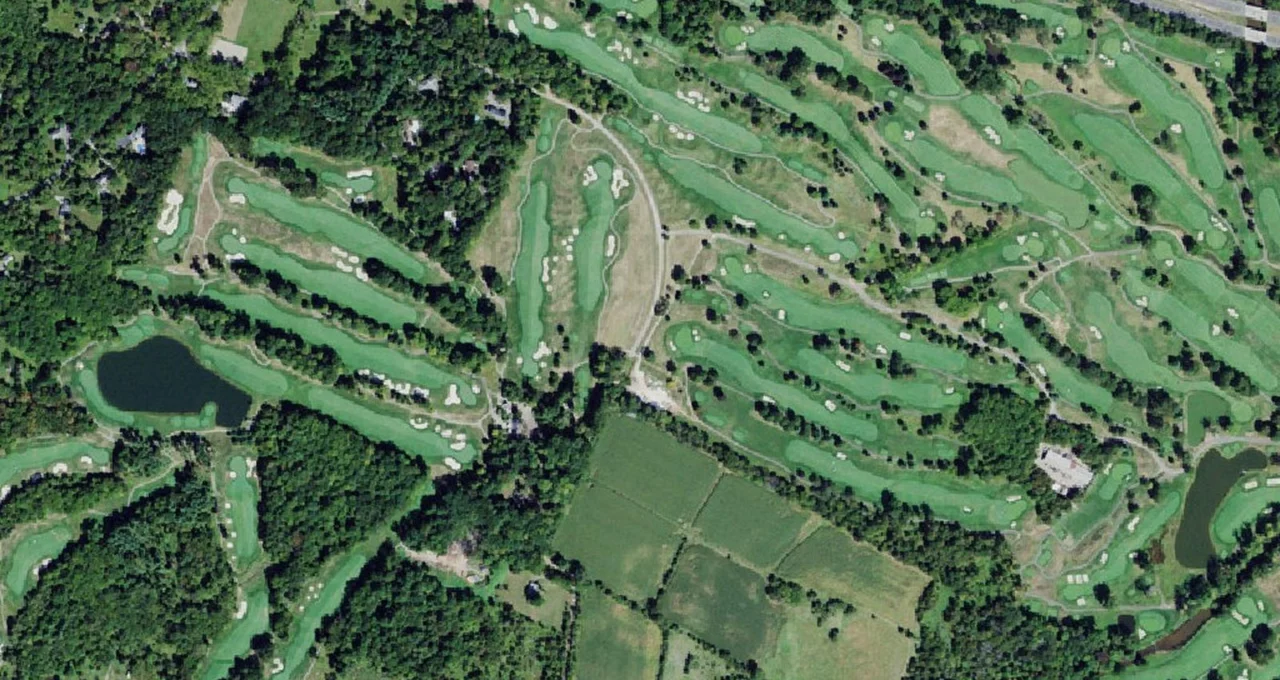
Fiddler's Elbow Country Club from the air. Aerial imagery USGS, domaine public.
Fiddler’s Elbow Country Club
Holes
54: three 18-hole courses (River, Meadow, Forest)
By
River 72, Meadow 71, Forest 72 (GolfPass cards)
Length
River 7,055 yards, Meadow 6,463 yards, Forest 7,128 yards from the Black tees (GolfPass and GolfNow); shortest sets 5,271, 5,214 and 5,154 yards
Green fee
—
Best season
Not published by the club; March 1 to December 31 according to GolfPass and GolfNow, March to November according to OpenGolfAPI
Fiddler’s Elbow Country Club is a private club in Bedminster Township, in the Somerset Hills of north central New Jersey. The club and OpenStreetMap give its address as 811 Rattlesnake Bridge Road, Bedminster, NJ 07921. What sets it apart is size: three 18-hole courses, the River, the Meadow and the Forest, for 54 holes in all. The club calls itself New Jersey’s largest golf facility and its only club with three championship courses, and the New Jersey State Golf Association (NJSGA) and Wikipedia say the same. Hal Purdy laid out the first 27 holes in 1965, Brian Silva added holes in the late 1980s, and Rees Jones designed the Forest Course, which the club dates to 1995.
On the cards published by GolfPass and GolfNow, the River Course is a par 72 of 7,055 yards from the Black tees, the Forest Course a par 72 of 7,128 yards and the Meadow Course a par 71 of 6,463 yards. Wikipedia puts the whole property at more than 1,200 acres along the Lamington River, astride Somerset and Hunterdon counties, with the main entrance next to Interstate 78. The club began as a corporate club for entertaining clients; since 2009 it has also taken families and individuals as members.
OpenStreetMap draws Fiddler’s Elbow as a single area covering the whole club, and a note on that map entry says the holes themselves have not been mapped yet. This page therefore covers the club and its three courses together. It is a portrait built from public sources; nobody from Panxis has played the courses, and because the club is private, most readers will only see them as a member’s guest or at an outing.
From peach orchards to a corporate club
The club’s history page and the NJSGA tell the story of the land in the same terms. In the late 19th century and into the early 1920s it grew peaches for James Nelson Pidcock, a former New Jersey congressman. By the 1920s it was part of a 20,000-acre estate belonging to the investment banker Clarence Dillon and his wife, Anne. In 1935 the Dillons sold 530 acres along the Black River to another investment banker, Frederick Strong Moseley Jr., and his wife, Jane Hamilton Brady. The name came from a nearby hamlet at a bend in the river shaped, in the club’s words, like a fiddler’s arm.
The Moseleys ran the estate as a sporting property. The club and Wikipedia describe fox hunts with bassets, foxhounds and horses, and the NJSGA adds that Frederick Moseley was a Bronze Star recipient in the Second World War. Their manor house, built of Pennsylvania fieldstone in the 1930s in the English manor style according to Wikipedia, is today’s clubhouse; the NJSGA mentions a two-story addition in 1968. After about 25 years, Jane Moseley died of injuries from a fire, and the property was sold and became a dairy farm.
In 1964 Raymond J. Donovan and Ronald A. Schiavone bought the land. Wikipedia’s article on Donovan says he joined the Schiavone Construction Company in 1959, later owned half of it, and co-founded and part-owned the club. The club’s history says it opened in 1965 with 27 holes, the Red, Blue and Green nines, designed by Hal Purdy, and that membership was corporate only, which made it the largest corporate-membership golf club in the country. An NJSGA announcement from 2021 compresses this into “27 holes of golf in 1964,” so the opening year depends on whether you count the purchase or the first round.
The club’s link to national politics came through Donovan. According to the club, Ronald Reagan debated Senator Eugene McCarthy there in 1977 and came back in 1979 for a fundraising dinner featuring Frank Sinatra; a room on the clubhouse’s second floor is still called the Reagan Room. In 1981 Donovan took leave to serve as Reagan’s Secretary of Labor until 1985. He resigned in March 1985 after a Bronx grand jury indicted him for larceny and fraud in connection with a New York City subway extension, and he was acquitted in 1987, according to Wikipedia. He died on June 2, 2021, at the age of 90. His three children, Kenneth, Mary Ellen and Keith, were all named as trustees of the club by Golfdom in 2016.
From 27 holes to 54
The growth came in two steps. First, a new nine. The club says it was added in 1987 and paired with the Red nine to form the Silver Course, while the Blue and Green nines became the Gold Course. Wikipedia dates the new nine to 1986 and the NJSGA to 1990, and both add that the Green Course was renamed the Gold in honor of the architect Brian Silva. GolfPass credits Silva and Geoffrey Cornish with work on both older courses in 1989, and the club itself dates Silva’s new holes to 1989.
Second, a whole new course. Rees Jones began work on a third 18 in 1992, according to Wikipedia and the NJSGA, and the club says it reached 54 holes on July 1, 1994. The club’s course page and GolfPass give 1995 as the year the Forest Course opened and GolfPass also credits Keith Evans as co-designer. Club and Resort Business, writing in 2011 when the general manager David McGhee retired after 30 years, credited his tenure with the expansion from 27 to 54 holes. The old color names gave way to today’s: the Blue-Red became the River Course, laid out around the Lamington; the Gold-Silver became the Meadow Course, on former pasture; and the newest became the Forest Course, set among white pines, beeches, oaks and other hardwoods.
The courses kept changing after that. The club says the River Course was renovated in 2008, and that Stephen Kay began carrying out the final master plan for the Meadow Course in 2013. Wikipedia’s article mentions Kay’s redesign of several Meadow holes without a date, and the club’s history places it in a multi-phase plan that also brought a practice facility, a new golf shop and cart barn, larger locker rooms and an aquatics center. Wikipedia dates the Sports and Leisure Center, with a pool, five Har-Tru tennis courts and a fitness center, to 2014 and 2015.
The membership model changed too. Club and Resort Business reported in 2011 that the club had opened to families and individuals in 2009; Golfdom, reporting the New Jersey PGA’s Club of the Year award in October 2016, dated the shift to a hybrid family and corporate club to 2010. Golfdom also noted that the club houses the executive offices of the New Jersey PGA and of its charity, the New Jersey Golf Foundation. In 2011 Club and Resort Business described Fiddler’s Elbow as the first New Jersey club certified as a sanctuary by the Audubon Society of New York State, for its birdhouses and buffer zones along the waterways.
Championships, outings and a film set
Fiddler’s Elbow is better known for corporate outings, charity days and member events than for championships. The NJSGA has used it for qualifying: in June 2019 the River Course, set at par 72 and 6,738 yards, hosted a qualifying round for the 118th NJSGA Amateur, where the medalist shot 3 under par 69. In October 2021 it staged the NJSGA’s 9th Women’s Four-Ball Championship, which the association described as the first NJSGA women’s championship held at the club. The American Junior Golf Association lists the club as a qualifying site for the K.J. Choi Foundation Junior Championship, and Drive, Chip and Putt has used it for sub-regional qualifying.
Its widest audience came from a comedy. GOLF.com reported on September 6, 2024, that a memo from the club’s trustees named Fiddler’s Elbow as the site where Netflix would film “most of the scenes” of a new movie, which GOLF.com identified as the sequel to Happy Gilmore. According to that memo, all three courses would appear on screen, the front nine of the Meadow Course would see the most changes, with holes rerouted and three of them closed for the rest of the season, and the Forest Course’s season would be extended for members. Wikipedia says filming in New Jersey ran from September 9 to December 10, 2024, and Happy Gilmore 2 was released on Netflix on July 25, 2025. New Jersey Monthly published a Netflix set photograph of Adam Sandler and the director at the club. GOLF.com also reported that the club planned a premiere screening as part of its 60th anniversary year, 2025.
What the course asks of you
All three courses are parkland layouts on rolling ground, with water from the Lamington River, its tributaries, ponds and wetlands in play on many holes. The club publishes a hole-by-hole description of each course with four sets of yardages, but it does not name the tees or give ratings, and its page contains some evident labeling errors, described in the last section. For tee names, ratings and slopes we have used the cards on GolfPass and GolfNow; GolfPass refused our requests in October 2026, so we read its cards in archived copies.
The River Course
The club describes the River as fairly forgiving off the tee, with the real test in the approach shots and contoured greens on which you want to stay below the hole. GolfPass lists six sets of tees, from the Black at 7,055 yards (rating 74.1, slope 131) through the Blue at 6,703 yards, the Member at 6,378 and the White at 6,230, to the Green at 5,271 yards. The card is a par 72 with five par 3s, five par 5s and eight par 4s, and its number one stroke index is the 2nd, a 434-yard par 4 that, the club says, climbs all the way to a narrow green sloping hard from back to front. The finish is the hole the club singles out: the 18th, a par 5 of 522 yards from the back that is reachable in two, with the Lamington running along the left and crossing the fairway about 20 yards short of a sharply sloped green. The 14th, a 185-yard par 3, has a pond across the whole front of the green.
The Meadow Course
The Meadow is the shortest of the three and, on paper, the most varied: the club speaks of moderate to significant elevation changes, tee shots that call for a range of clubs, and greens that “demand deft speed control.” GolfPass gives a par of 71 and lists the Black tees at 6,463 yards (rating 73.0, slope 136), the Blue at 6,136, the White at 5,884 and the Green at 5,214. The card has five par 3s and four par 5s. Two holes near the turn define it, according to the club: the 8th, a sharply doglegged par 5 of 468 yards with water and trees on the right that tempts long hitters to cut the corner, and the 9th, a 203-yard par 3 to a multi-tiered green. The 15th, at 463 yards uphill into the prevailing wind, is described by the club as the longest par 4 at Fiddler’s Elbow. The 17th is a downhill par 3 with a pond in front and the river behind, and the 18th a short par 4 of 351 yards with two forced carries over water, the last one over the Lamington to a small green.
The Forest Course
The Forest is the longest, and the one Rees Jones built from scratch. The club describes panoramic views, deep fairway bunkers to avoid off the tee and generous greens guarded by more deep bunkering. GolfPass lists the Black tees at 7,128 yards (rating 74.6, slope 137), the Blue at 6,716, the Member at 6,483 and the White at 6,262, all at par 72. The club calls the 5th, a 451-yard par 4 usually played into a headwind, the hardest hole by stroke index. The back nine has two par 5s that frame it, the 11th, a short par 5 of 506 yards with an uphill second, and the 18th, a 602-yarder with a lake along the right of the fairway and a multi-tiered green. A travel writer for Global Traveler, writing in November 2012, found it narrow and tree-lined, with many bunkers, and singled out the 5th and the 18th as the toughest holes.
The hole the club calls its signature is the Forest’s 17th, a par 3 of 194 yards from the back tees and 125 from the forward set. There is some room to the left, the club writes, but to hit the green “your tee shot has to take on the full length of the water.”
What golfers say
Because the club is private, there are few public reviews, and most are short. What follows summarizes recurring themes from the sources we could read in October 2026: the club-wide page on the 18Birdies app, which showed an average of 4.8 out of 5 from 275 ratings (value 4.4, course condition 4.6, difficulty rated “hard,” green speed and pace of play rated “fast”) with three written reviews from October 2025, July 2026 and September 2026; the GolfPass pages for the three courses, which show the same two reviews from 2017 on each course page (one at 4 out of 5, one at 1 out of 5); Hole19, which gives the River Course 4.8 from six ratings with almost no text; the Global Traveler account of a round on the Forest, published in November 2012; and the comment of a qualifier quoted by the NJSGA in 2019. These are other people’s opinions, not ours, and we name no reviewer. Nobody from Panxis has played the courses.
What comes up in its favor
- Condition: the most frequent praise. The 2025 and 2026 reviews on 18Birdies speak of a well-kept course and beautiful fairways, and the 2019 NJSGA medalist said the course “is always in good condition and it always plays fair.”
- The Forest Course: the favorable GolfPass review, from 2017, calls it the most interesting of the three, with superb holes for most of the round, the whole back nine and three strong closing holes, and moderate elevation changes with “no houses anywhere to be seen.”
- Variety across three courses: the same reviewer rated the Meadow and the River “pretty good also” and thought the Meadow’s back nine, except the 18th, as good as the Forest.
- Service and amenities: the 2012 Global Traveler account praised the service from the golf shop to the snack bar, and both GolfPass reviews rate the amenities good to excellent.
- A real test: a July 2026 review calls the layout “incredible” and finds the challenge worth it, and 18Birdies users rate the difficulty as hard.
What comes up against
- Design: the unfavorable GolfPass review, from 2017, called the course it covered (it names Hal Purdy, so one of the two older courses) narrow, uninteresting and without a single memorable hole. Other readers on GolfPass marked that review as unhelpful.
- The rough: the July 2026 review on 18Birdies found it penalizing enough to cost balls and sometimes to punish good shots.
- The greens: an October 2025 review calls them tough, and the 2017 reviewer of the Forest found them average to above average, “rarely” great.
- Information on the course: the 2012 writer regretted the lack of hole details on the scorecard and at the tees, such as the distance to the corner of a dogleg.
- Pace: rated “poor” in one of the two 2017 GolfPass reviews, although 18Birdies users rate the pace as fast.
Getting there and playing
Fiddler’s Elbow is a private club. The NJSGA, GolfPass and Wikipedia all list it as private, and the club’s membership page invites prospective members to contact its membership director rather than publishing categories or rates. The club does not publish its fees and we do not report any; the club’s website is the place to ask. The domain listed by OpenStreetMap and Wikidata, fiddlerselbowcc.com, now redirects to fiddlerselbow.com.
There are three ways onto the courses. Members play, of course. Guests can play with a member or, under the club’s guest policy, unaccompanied if a member books the tee time and names the member who will sign for the day’s charges; the member remains responsible for the guest, and on Saturdays and Sundays a guest’s tee time “must be after 11:30am.” The third is an outing: the club’s golf page invites corporations, government agencies and nonprofits to organize single or multi-course events through its outings manager.
The club’s dress code is detailed. On the course, only spikeless shoes are allowed, men’s shirts must have sleeves and collars and be tucked in, cargo shorts, t-shirts, tank tops and high-top sneakers are banned, caps must be worn bill forward, and golfers may not change shoes in the parking lot; day lockers are available. Phones must be on vibrate anywhere on the grounds. GolfPass and GolfNow list carts, pull carts and rental clubs, say walking is allowed and confirm that metal spikes are not. The practice facilities include a driving range, a chipping area and a putting green, and the club’s Golf Academy offers indoor and outdoor instruction year-round.
The club does not publish a playing season. GolfPass and GolfNow give March 1 to December 31; OpenGolfAPI lists March to November. In 2024 GOLF.com reported that the Forest Course’s season was extended during filming, which suggests the closing date can vary.
The entrance is on Rattlesnake Bridge Road, next to Interstate 78, according to Wikipedia. Measured on the map from the coordinates in OpenStreetMap, the club lies about 30 miles west of Newark Liberty International Airport and about 40 miles west of Times Square in Manhattan, in a straight line; those are not road distances. Other private clubs nearby include Trump National Golf Club Bedminster and the two courses at Hamilton Farm in Gladstone, and the semi-private Fox Hollow Golf Club in Branchburg is listed by GolfPass among its neighbors.
How we built this page
The factual frame comes from public sources: OpenStreetMap and Wikidata for the location, address and identifiers; the club’s website, fiddlerselbow.com, for its history page, its course page with hole descriptions and yardages, its golf, membership and awards pages and its guest information document; Wikipedia’s article on the club and its articles on Raymond J. Donovan and Happy Gilmore 2; the NJSGA’s club listing and its 2019 and 2021 news releases; Club and Resort Business (2011) and Golfdom (2016); the Boston Globe for Donovan’s obituary; GOLF.com (September 2024), Jersey Digs (November 2024) and New Jersey Monthly (July 2025) for the filming; Global Traveler (November 2012); and GolfPass, GolfNow, OpenGolfAPI, 18Birdies and Hole19 for cards, ratings, policies and reviews. The GolfPass pages refused our requests; we read their card and review sections in copies held by the Internet Archive.
Where sources disagree, we say so. The new nine is dated 1986 by Wikipedia, 1987 by the club and 1990 by the NJSGA; GolfPass credits Silva and Cornish with 1989. The club opened in 1965 according to the club and Wikipedia, while a 2021 NJSGA release says 1964. The shift to family membership is 2009 in Club and Resort Business and 2010 in Golfdom. Lengths and ratings differ between and within directories: for the River, GolfPass and GolfNow give the Black tees 7,055 yards, 74.1 and 131 in their tee table, but the hole-by-hole card on the same GolfPass page adds up to 7,044 yards and shows 74.4 and 133, the figures Golfify also gives, and the club’s own back-tee yardages add up to 7,003; the NJSGA set the course at 6,738 yards for its 2019 qualifier. For the Meadow, the tee table says 6,463 yards and 73.0, the card 6,491 yards and 71.6, OpenGolfAPI’s card 6,525, and the club’s yardages 6,445. For the Forest, the tee table and the club’s yardages both give 7,128, while the GolfPass card adds up to 7,085 and shows 74.0 and 139 instead of 74.6 and 137; the gap comes from the 14th, 466 yards on the club’s page and 423 on the card. The club’s course page also mislabels several holes: on the Meadow, the 11th is labeled a par 5 though it measures 213 yards and is described as a par 3; on the River, the 12th is labeled a par 4 but described as a par 3, and the 11th, 544 yards from the back, is labeled a par 4 where the GolfPass card has a par 5; two Forest holes are numbered “#1.” The pars we give follow the GolfPass cards, which match the hole descriptions. Wikidata places the club about 0.9 mile east of the OpenStreetMap point.
Some details will age: the reviews read in October 2026, the tee ratings, which are revised periodically, the season, the guest policy and the tees and routing of the Meadow’s front nine after the 2024 filming. The opinion section reports recurring themes rather than individual voices. Nobody from Panxis has played or visited this course, and this page is no substitute for a round.
The club has not paid for this page, has not seen it before publication and has no say over its content. This page contains no commercial link and earns us no commission. If you know the club and something here is wrong or out of date, write to us and we will correct it. The club’s course page carries its hole-by-hole descriptions, and its history page tells the story of the land.
Other courses nearby
Closest to this one in our United States directory:
- Canoe Brook Country Club — 21 mi
- Dyker Beach Golf Course — 37 mi
- Douglaston Golf Course — 53 mi
- North Hempstead Country Club — 57 mi
The hole to know
The signature hole, on the Forest Course: a par 3 of 194 yards from the back tees where, in the club's words, the tee shot "has to take on the full length of the water," with only a little room to the left.