Golf umbrellas for Prairie gusts and West Coast drizzle: vents, fibreglass ribs and the right arc
Sun Mountain Manual 68-inch, TaylorMade Tour Double Canopy 68" and ShedRain Windjammer 62": Canadian prices in November 2026 from C$34.99 to C$129.99, and which umbrella suits Prairie wind, coastal rain or Ontario heat.
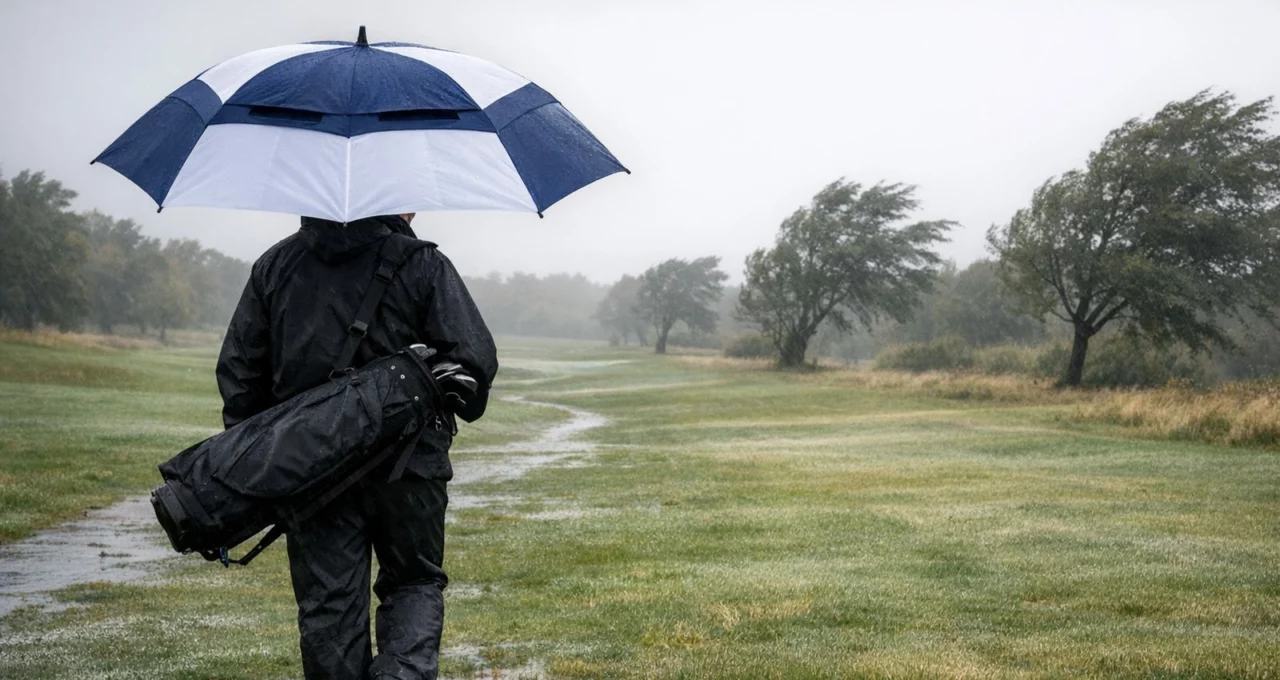
On a Saskatchewan or southern Alberta course in October, the wind does not gust so much as lean. It comes across the open grass at 40 km/h with nothing in the way, and a golfer who opens a big umbrella on the 9th tee finds out within a few seconds whether it was built for that. The same afternoon, more than 1,000 km to the west, a golfer in Nanaimo or Burnaby has the opposite problem: almost no wind, a fine rain that has not stopped since breakfast, and grips that will be slick by the 12th hole unless something keeps them covered. The same product is sold for both rounds. It is rarely the right one for both.
This page looks at three golf umbrellas on sale in Canada this fall, priced from C$34.99 to C$129.99 before tax in November 2026, with what each maker publishes, what golfers say about umbrellas of this type, and which Canadian conditions each one fits. Panxis Golf did not open, carry or hold any of these umbrellas in the wind. Everything below comes from makers’ descriptions and public opinion, not from a test.
Two jobs that pull in opposite directions
Golf umbrellas are sold by arc, the length of the canopy measured over the top from one tip to the opposite one. The usual figures in Canada are 60, 62, 64 and 68 inches, which is roughly 152 to 173 cm. Arc is not the same as the circle of dry ground underneath, which is noticeably smaller, but it is the number every listing uses, so it is the one to compare.
A larger arc keeps more of you and your bag dry. It also turns the umbrella into a sail. The force of wind on a canopy grows with its area and much faster with the wind speed, so a gust that a 62-inch umbrella shrugs off can bend a 68-inch one hard enough to snap a rib or flip the canopy. Coverage and wind resistance trade against each other, and no frame removes that trade entirely. A good frame only moves the point at which it bites.
That is why the question to ask is not “which umbrella is best” but “what kind of weather do I actually play in.” A West Coast golfer who walks with a carry bag in steady drizzle and a Prairie golfer who rides a cart in a crosswind need different things, and a golfer in Ontario who wants shade on a 31°C July afternoon needs something else again.
Reading the label: what is worth checking
Umbrella listings are short, and the useful details are often missing. These are the ones to look for, roughly in order of how much they matter in a Canadian wind.
- Vents. A vented or double canopy has a gap in the fabric, covered by a second, overlapping layer. Air pushing up from below escapes through it instead of turning the canopy inside out. Most golfers who keep an umbrella for years point to this as the feature that saved it. A single canopy with no vent is lighter and cheaper, and much more likely to invert in an exposed spot.
- Rib material. Fibreglass bends and comes back. Steel holds its shape until it is pushed too far, then stays bent. Carbon fibre is light and stiff and turns up on some premium models. If the listing says only “wind resistant” without naming the material, treat that as a gap, not a feature.
- Anti-inversion details. Some makers mention reinforced struts or stretchers designed to resist flipping. When it is there, it is worth noting; when it is not, nothing is promised.
- The handle and the cart. A rubber or foam handle stays grippy in a wet glove. If you use a push cart or a riding cart, the shaft and handle diameter decide whether it will sit in the umbrella holder, and that decides whether you can play with both hands free.
- Manual or automatic. A push-button opener is quick when a shower arrives, but it adds a spring and a catch. Most tour-style golf umbrellas open by hand.
- Published figures. Weight, wind ratings and UV ratings are often left out. When a maker does publish a wind figure, it is a claim measured in a steady airflow chosen by the brand, not a guarantee in a swirling Prairie gust.
Sun Mountain Golf Umbrella, Manual 68-inch (2025)
Sun Mountain is best known for its carry bags and push carts, and its umbrellas are designed to work with them. This 68-inch manual model is the plain version in the current range; the brand also sells a Silver Series model with a reflective canopy.
- What the maker publishes, on its own Canadian site and as reproduced by a Canadian dealer: a 68-inch spread and a height of 40 inches; double-canopy construction; a nylon canopy with a fibreglass shaft and fibreglass ribs; a windproof spring; a rubber-covered, slip-resistant handle that the maker says fits the umbrella holder on Sun Mountain carts; manual opening. Neither page read for this article lists a weight, a UV rating, a wind figure or a warranty term, so none is given here.
- Who it suits: a golfer who already pushes a Sun Mountain cart and wants a full-size umbrella that clips into it, with a frame that is fibreglass from top to bottom.
It is one of the few listings among the three that names the material of both the shaft and the ribs, which is the detail that matters most in wind.
Price: C$89.99, read in November 2026 at a Canadian golf retailer, where it was shown as sold out on that date. The maker’s own Canadian online store listed it at C$100.00 the same day.
TaylorMade Tour Double Canopy Umbrella 68″
TaylorMade’s tour umbrella is the one its staff players carry, in the brand’s own colours. It is the most expensive of the three and the one whose description puts the most weight on resisting inversion.
- What the maker lists, as reproduced by a Canadian dealer: a 68-inch manual canopy that TaylorMade calls a “Vented Vortex Canopy,” described as engineered to resist windy conditions; a heavy-duty FRP fibreglass frame with anti-inversion struts; an ergonomic custom handle the brand calls V3. No weight, UV rating, wind figure, shaft material or warranty was listed on the page read for this article.
- Who it suits: a golfer who wants the full 68-inch size and plays on exposed courses, and who values a frame described as built to stop the canopy flipping.
“Anti-inversion struts” is a maker’s description, not a measured result. It does tell you that the brand designed the frame with wind in mind, which is more than many listings say.
Price: C$129.99, read in November 2026 at a Canadian golf retailer, where it was shown in stock. A second Canadian retailer listed the same price that day, with the umbrella shown as sold out.
ShedRain Windjammer Vented Golf Umbrella, 62″
ShedRain is an umbrella specialist rather than a golf brand, and the Windjammer is its long-running golf model. At 62 inches it is six inches smaller in arc than the other two, and by far the cheapest.
- What the maker lists, as reproduced by a Canadian dealer: a 62-inch arc, which the listing says can shelter three people; a vented double canopy; fibreglass construction, without saying which parts; a rubber grip; a matching fabric travel case. The page does not state the opening system, the weight, a wind figure or a UV rating. The Windjammer name is also used for manual and push-button versions in other markets, so check which one you are buying.
- Who it suits: a golfer on a windy course who would rather hold a smaller canopy low than wrestle a big one, or anyone who wants a spare for the trunk without spending much.
Price: C$34.99, read in November 2026 at a Canadian golf retailer, where it was shown as sold out on that date.
The three side by side
| Umbrella | Arc | Canopy | Frame, as published | Handle | Price, Nov. 2026, before tax |
|---|---|---|---|---|---|
| Sun Mountain Manual 68-inch (2025) | 68 in., 40 in. tall | Double, nylon | Fibreglass shaft and ribs, windproof spring | Rubber, fits Sun Mountain cart holders | C$89.99 (sold out that day) |
| TaylorMade Tour Double Canopy 68″ | 68 in. | Vented, manual | FRP fibreglass, anti-inversion struts | Ergonomic V3 | C$129.99 |
| ShedRain Windjammer Vented 62″ | 62 in. | Vented double | “Fibreglass construction,” parts not specified | Rubber grip | C$34.99 (sold out that day) |
None of the three publishes a weight or a wind rating on the Canadian pages read. Two of them name fibreglass for the ribs or the frame; the third says fibreglass without saying where. If wind is the main concern, those gaps are worth a question in the shop.
What golfers are saying
Few golfers write long reviews of umbrellas, and fewer still separate one model from another. The points below come from owner reviews on retailer pages, published buyer’s guides and golf forum threads, and they describe what keeps coming up about vented golf umbrellas in this size range rather than a verdict on any of the three above.
In their favour:
- The vent earns its keep. Owners of vented and double-canopy umbrellas often say theirs has stayed right side out through days that flipped a friend’s single-canopy umbrella, and some say they would not buy another without one.
- Fibreglass that bends and recovers. Players describe the canopy folding sharply in a gust and snapping back to shape, where an older steel-framed umbrella stayed crooked.
- A full-size canopy keeps the grips dry. Golfers who walk with a carry bag value a 68-inch umbrella mostly for what it does to the bag: dry grips and a dry towel on the back nine.
Against them:
- Joints and stretchers fail before ribs. The most frequent complaint is a small joint near the runner or a stretcher arm breaking after a season or two, which leaves one panel sagging and is hard to repair.
- Too big for the cart holder. Owners say some 68-inch umbrellas do not sit well in a push-cart or riding-cart holder, either because the handle is too thick or because the canopy hits the driver’s head or the player’s shoulder.
- Heavy in a crosswind. Holding a full-size umbrella steady into the wind for an entire round is described as tiring, and some players switch to a smaller model for that reason alone.
- Wind claims meet real gusts. Buyers who chose an umbrella for its “windproof” label sometimes report it inverting anyway when a gust came from an unexpected angle, a reminder that marketing words and lab figures are not promises.
Independent golf media such as MyGolfSpy have published reviews and buyer’s guides on golf umbrellas, including Sun Mountain’s 68-inch manual model. Their findings are theirs; read them there.
Where Canadians open an umbrella: Prairie wind, coastal drizzle and Ontario storms
The Canadian golf season is short, and much of it is played at its edges, in April, May, September and October, when the weather is least settled. Umbrella needs change a lot from one region to the next.
The Prairies. From Winnipeg to Calgary, open courses where a 400-yard par 4 may not have a single tree along it mean wind is the main enemy of an umbrella, more than rain. Chinook days in southern Alberta can bring strong, gusty winds off the mountains even in shoulder season. Here a vented canopy and a fibreglass frame matter more than the last few inches of arc, and a 62-inch umbrella you can hold low and angled into the wind often survives where a 68-inch one does not. Close it before you walk onto a raised tee box, not after the first gust has caught it.
The British Columbia coast. Around Vancouver, Victoria and the Fraser Valley, golf continues through much of the winter, and the challenge is fine, steady rain for hours rather than violent wind. This is where a full 68-inch canopy pays off, because it keeps the bag and the grips dry as well as the golfer. A handle that fits your push cart’s holder turns a wet November round into something tolerable.
Atlantic Canada. In Nova Scotia, PEI and Newfoundland, rain often arrives with wind off the water, and the two together are the hardest test for any umbrella. A vented canopy is close to essential on a seaside course, and so is the habit of tilting it into the wind rather than holding it straight up.
Ontario and Quebec in summer. July and August bring humid days in the high 20s and low 30s °C and afternoon thunderstorms that build quickly. On those days the umbrella is shade between shots as much as rain cover. When thunder can be heard, though, no umbrella is protection: Environment and Climate Change Canada’s advice is “When thunder roars, go indoors,” into a building or a hard-topped vehicle, and to wait 30 minutes after the last thunder before going back out. Holding a long fibreglass and metal umbrella on an open fairway is the opposite of that advice. If the course sounds its horn, leave.
Spring and fall everywhere. Cold rain at 6°C, wet leaves and short days make the shoulder season the time an umbrella is used most. A frame that dries open in the garage after the round, rather than folded wet in the bag, lasts noticeably longer.
Where to buy. Golf umbrellas are sold in four places in Canada. Most club pro shops carry them, often with the club’s own crest, and they are the easiest place to check that the handle fits your hand and your cart. A large golf specialty store lets you open several side by side and look closely at the joints and the runner. Online stores, both golf retailers and brands’ Canadian sites, have the widest choice and the best end-of-season prices, but stock runs thin by November, as several of the listings on this page showed. The used market is reasonable for umbrellas if the canopy opens and locks cleanly, the tips are not frayed and no stretcher is bent. Wherever you buy, ask about the return policy and whether the maker’s warranty covers a broken rib, and compare prices before tax, since GST, HST or QST changes the total from province to province.
The rule: you can hold it, nobody else can
Rule 10.2b(5) of the Rules of Golf, which Golf Canada applies across the country, is simple. You may hold an umbrella yourself while you prepare for and make a stroke, although few golfers manage a swing that way. What you must not do is make a stroke while your caddie, another player or an object you have deliberately set up is protecting you from rain, sun or wind. A partner holding an umbrella over you as you putt, or an umbrella stuck in the ground to shade your ball, costs you the general penalty: two strokes in stroke play, loss of the hole in match play. Have the umbrella moved away, or close it, before you play.
Before you pay
- Choose the arc for your weather. Steady rain and a carry bag point to 68 inches. Open, windy courses point to 62 inches or smaller.
- Insist on a vent. A vented or double canopy is the feature golfers credit most often with surviving a gust.
- Look for the rib material. Fibreglass or carbon fibre is what you want. If the listing does not say, ask, or assume the worst.
- Open it in the shop. The runner should slide and lock without force, and the joints near the shaft should look solid, not flimsy.
- Test it in your cart. If you push or ride, check that the shaft and handle fit your holder before you leave.
- Look after it. Dry it open, close it before a gust does it for you, and never carry it raised when thunder is in the air.
A Canadian golf umbrella has a short season and a hard one. Pick the size for the weather you actually play in, put your money into the frame and the vent rather than the logo, and remember that the best umbrella in a thunderstorm is the one folded in the trunk while you wait in the clubhouse.
How this page was put together
This is a presentation of products and a reading of public opinion, not a test. Nobody at Panxis Golf opened, carried or measured any of these umbrellas for this page. Features come from the makers’ published descriptions: Sun Mountain’s own Canadian product page and the description reproduced on a Canadian dealer page for the Sun Mountain Golf Umbrella, Manual 68-inch (2025); and the manufacturer descriptions reproduced on Canadian Pro Shop Online product pages for the TaylorMade Tour Double Canopy Umbrella 68″ and the ShedRain Windjammer Vented Golf Umbrella with Rubber Grip, 62″. Where a figure was not published on the pages read, such as weight for all three umbrellas, it is left out rather than estimated.
Prices were read on November 1, 2026, in Canadian dollars and before tax. The prices of the Sun Mountain (C$89.99) and ShedRain (C$34.99) umbrellas come from Canadian Pro Shop Online (canadianproshoponline.com), where both were shown as sold out that day; the Sun Mountain price of C$100.00 was read on the maker’s own Canadian online store (sunmountain.com, Canadian storefront). The TaylorMade price of C$129.99 comes from Niagara Golf Warehouse (niagaragolfwarehouse.com), where it was shown in stock, and matches the price shown at Canadian Pro Shop Online. The pages of Golf Town and Golf Avenue refused automated reading that day, so no price from those retailers appears here. No price was converted from another currency. Prices change often with promotions, colours and stock.
What golfers say was read in owner reviews on retailer product pages in Canada and the United States, in a MyGolfSpy review and in golf forum discussions, some only through search excerpts. Nobody is quoted by name, nothing has been counted, and no impression is presented as a statistic. The thunderstorm advice is Environment and Climate Change Canada’s, and the rule cited is Rule 10.2b(5) of the Rules of Golf as applied by Golf Canada. There is no commercial link on this page, no affiliate arrangement and no commission of any kind. If content on this site is ever paid for by a brand, it will carry an advertising label at the top of the page, before the first line.