Choosing a putter that aims where you look: a fitting guide for Canadian golfers
Nick Taylor's 72-foot eagle putt won the 2023 RBC Canadian Open, but club golfers win and lose their rounds from inside ten feet. Those putts depend on a putter you aim straight, set at the right length and lie, with a head that suits your stroke.
In brief
- Have your aim measured on two or three head shapes, and buy the one you aim straight.
- Many golfers set up better with a putter shorter than the 34 or 35 inches found on the rack.
- If the toe or heel sits in the air at address, ask a pro shop to bend the lie.
- Rule 10.1b bans anchoring against the body; arm-lock putters held against the forearm are allowed.
- Canadian greens change pace through the season, so fix three-putts with speed practice, not a purchase.
The most famous putt in recent Canadian golf was not about the putter. In June 2023, on the fourth playoff hole of the RBC Canadian Open at Oakdale Golf & Country Club in Toronto, Nick Taylor holed a 72-foot eagle putt to beat Tommy Fleetwood. He became the first Canadian citizen to win the national open since 1954. A putt that long is pure speed and nerve. But the putts that decide a club golfer’s score are much shorter, from three to ten feet, and those are decided mainly by one thing a putter can influence: whether the ball starts on the line you chose.
That is what a putter fitting is for. Not a new look, not a heavier head because it feels expensive, but a club that sits correctly, suits your stroke and aims where your eyes think it aims.
Aim first: the test that settles most arguments
Before length, lie or balance, find out whether you can aim the putter you own. Many golfers cannot, and never know it.
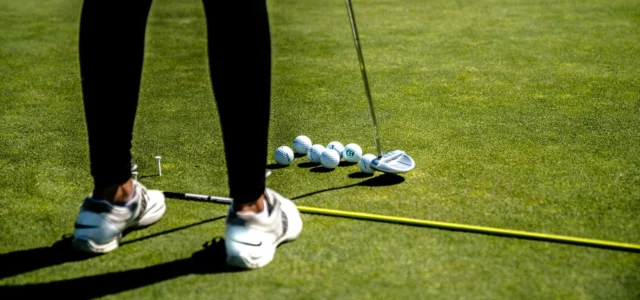
A fitter can check this with a laser attached to the face or a camera system. You set up to a hole about ten feet away as you normally would, and the device shows where the face actually points. Being off by a degree or two is enough to miss the hole from that distance without any fault in the stroke.
Then try two or three different head shapes: a simple blade with one sight line, a mid-size mallet, a large mallet with several lines. Aim is personal. Some golfers aim a plain blade perfectly and a big mallet badly; for others it is the reverse. Neither says anything about skill. Buy the shape you aim straight, whatever it looks like on the rack.
Length decides where your eyes are
Off-the-rack putters commonly come at 34 or 35 inches. Many golfers set up better with something shorter.
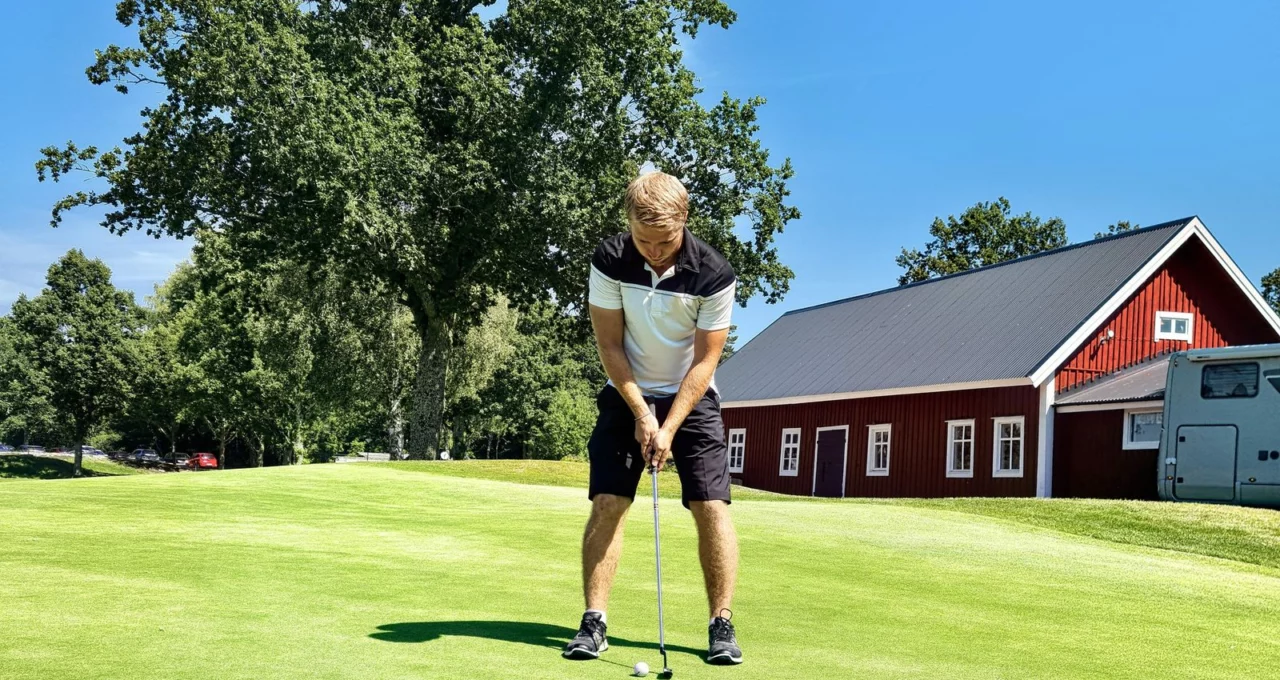
A putter that is too long pushes the hands away from the body, puts the eyes inside the ball-to-target line, and often makes the face aim left. You compensate with your hands through impact, and that compensation is the first thing to fail under pressure on a Saturday morning in a club match.
A quick check at home:
- Take your putting posture with the arms hanging naturally from the shoulders.
- Have someone measure from your hands to the floor.
- Drop a ball from between your eyes: it should land on or just inside the ball you are addressing.
If a shorter club gets your eyes into that position without reaching or crouching, that is roughly your length. Shortening an existing putter is usually a simple workshop job. Be aware that cutting it down makes the head feel lighter; a good fitter adds weight to the head to restore the feel.
Lie angle: look at the sole
Set the putter behind a ball in your normal address and have someone look at the sole from the side. If the toe is up, the face tends to point left; if the heel is up, it tends to point right. That is an equipment error practice cannot remove, and it grows on longer putts.
Many putters can be bent to a different lie. A fitter or a pro shop with a bending machine can often do it in minutes. As with iron fitting, adjusting the club you already own is frequently the cheapest improvement available.
Balance: which head suits your stroke
Rest the shaft across one finger a few inches below the grip:
- Face points to the sky: face-balanced. It suits strokes that move fairly straight back and through.
- Toe hangs towards the ground: toe-weighted, or with toe hang. It suits strokes with a natural arc.
Most golfers have some arc, because they stand bent forward and the shoulders turn around a tilted spine. A golfer with a strong arc who buys a face-balanced mallet because it looks stable will often fight it. A fitter can watch your stroke for a few minutes and tell you which family to try.
Grips, long putters and the anchoring rule
Thicker putter grips quiet the wrists and suit golfers whose hands take over under pressure. They also change the balance and feel, so try before you buy.
Long and arm-lock putters are allowed, with one limit. Rule 10.1b of the Rules of Golf, which Golf Canada applies, prohibits anchoring the club, either by holding the club or a gripping hand against the body, or by holding a forearm against the body as an anchor point. Holding the club against your own hand or forearm is allowed, which is how arm-lock putters work, and merely touching your body or clothing during the stroke is not a breach. If you want to try either style, have it fitted rather than simply cutting down or extending a putter you already own.
What a fitting will not do: speed
A fitted putter starts the ball on line. It does not decide how hard you hit it. Most three-putts come from poor distance control on the first putt, not from a bad line, so buying a putter to cure three-putting usually misses the point.
Speed is also where Canadian conditions make life harder. Greens change a great deal through a short season: slower and softer in the weeks after courses open, firmer and quicker in high summer, wetter on dewy autumn mornings. A few minutes of long putts on the practice green before every round, specifically to read that day’s pace, does more for three-putts than any purchase.
Where to get a putter fitted in Canada
Specialist golf stores often offer custom fitting by appointment. Ask when you book whether the session includes aim measurement and whether length and lie can be adjusted on the putter you already own, not only on a new one.
Your club’s pro shop is often the best first stop. Many professionals can check lie and length and bend or shorten a putter in the shop. Some keep demo putters you can take onto the course. A putter tried on your own greens, at their real speed, tells you more than a store mat. The PGA of Canada’s Find A Pro search helps you locate a professional nearby if you do not belong to a club.
Independent club fitters in larger cities often spend longer on aim and stroke analysis than a busy retail bay. They are worth considering if you have tried several putters and still miss short putts the same way.
Municipal practice greens are a free place to test a new putter at course speed. In Calgary, for instance, the city lists a practice green at Confederation Park, Lakeview, Maple Ridge and McCall Lake.
In winter, indoor putting surfaces let you work on aim and stroke, but they rarely match the speed or slopes of real greens. Use the off-season to settle length, lie, balance and head shape, and leave speed work for the first weeks outdoors.
Panxis Golf has no commercial relationship with any retailer, fitter or course mentioned here and earns no commission.
Five steps before you buy a putter
- Have your aim measured on your current putter and on two or three other head shapes.
- Check your length: arms hanging, eyes over or just inside the ball.
- Look at the sole at address; if toe or heel is in the air, ask about bending the lie.
- Balance the shaft on a finger and match the head to your stroke.
- Fix three-putting with speed practice on the day’s greens, not with your credit card.
Few golfers will ever face a 72-footer to win a national open. Every golfer faces a dozen putts inside ten feet each round, and a putter that aims where you look is what turns more of them into ones.