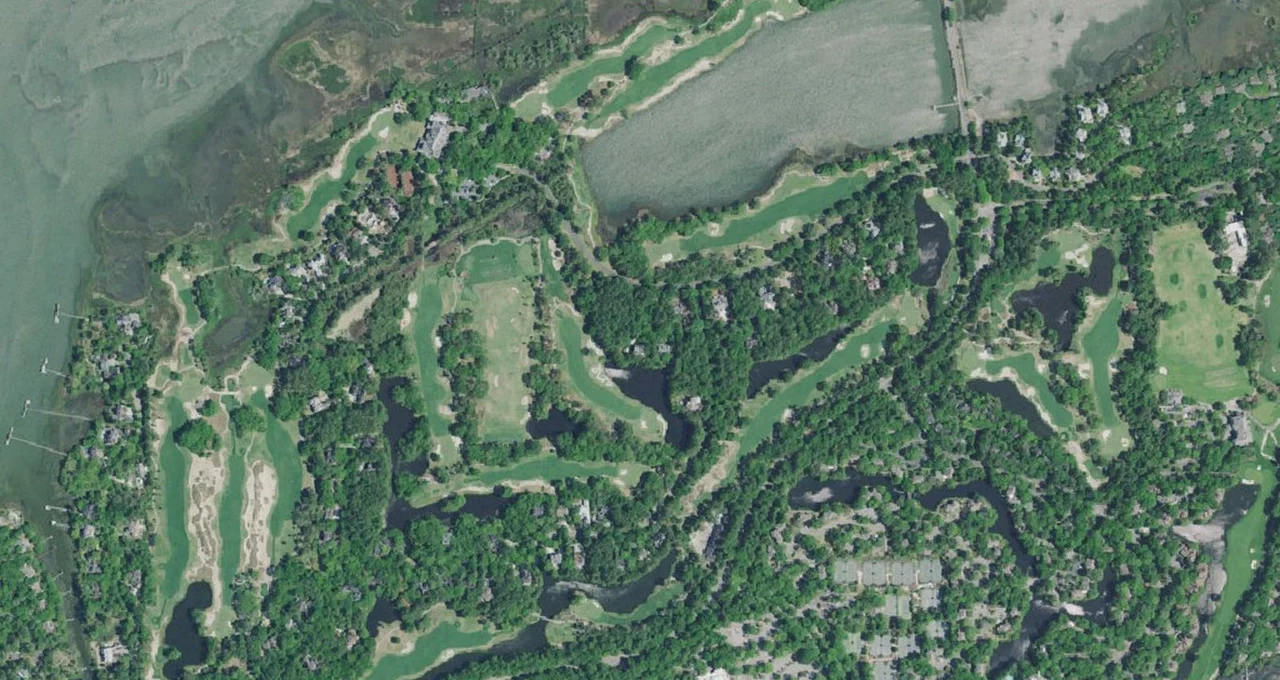
Kiawah Island Club, River Course from the air. Aerial imagery USGS, domaine public.
Kiawah Island Club, River Course
Holes
18
By
72 (club card); played as a par 71 for the 2009 U.S. Mid-Amateur and the 2023 U.S. Amateur Four-Ball
Length
7,119 yards from the Gold tees on the club's card (Blue 6,658, White 6,246, Green 5,508, Red 4,904); the club's overview page and GolfLink give 7,039 yards. Rating/slope from the back tees: 75.6/148 per Golf Course Gurus, 76.1/155 per GolfPass, 74.9/140 per GolfLink; the club publishes none
Green fee
—
Best season
—
The River Course is the older of the two private golf courses of the Kiawah Island Club, a members’ club on Kiawah Island, about twenty miles southwest of downtown Charleston, South Carolina. It lies on the landward side of the island, on the bank of the Kiawah River, and golf directories give its mailing address as Johns Island, the neighboring island through which the only road to Kiawah passes. Tom Fazio designed it, and the club opened it in 1995 as, in its own words, its “first golf course created exclusively for Members”. The club’s second course, Cassique, designed by Tom Watson, followed in 2000.
One point needs clearing up first, because it trips up maps and listings. Kiawah Island has two separate golf operations. The Kiawah Island Golf Resort runs the five public resort courses, among them the Ocean Course, host of the 1991 Ryder Cup and of two PGA Championships. The Kiawah Island Club is a different, private organization, and the River Course belongs to it. The club’s website, kiawahisland.com, states that Kiawah Island Club, Inc., the private club, and Kiawah Island Real Estate, LLC, the brokerage that shares the site, are separate companies. The OpenStreetMap outline of the course, however, links to the resort’s website and to the Wikidata entry for the Kiawah Island Golf Resort. Those links point to the wrong organization: the resort does not sell tee times on the River Course.
Members only, from the start
The club describes the River Course as “an exclusive enclave for Club Members”. Its membership material, read in search excerpts, says members are expected to own property on Kiawah Island or in a community developed by the club’s parent group, and that in some neighborhoods a club membership comes with the purchase of a home. The course is played by members and the guests they sponsor. There is no public tee sheet, no resort package and no daily fee. One online directory lists the River Course as open to daily fee play; every other source we read, starting with the club itself, says the opposite.
The course was noticed quickly. According to the club, Golf Digest placed it among its “Top Five New Private Courses in the Nation” in 1996, Golfweek has twice listed it among America’s best residential courses, and the South Carolina course rating panel ranked it in its top 50 in 2018. Two current rankings put it in the high teens in the state: 16th on the Top 100 Golf Courses list for South Carolina, and 18th in the ranking of the reviewer behind Golf Course Gurus.
Two renovations and two national championships
The course has been reworked twice since it opened. The first and larger project took place in the summer of 2006. Golf Course Industry magazine, in a February 2007 case study, reports that the course closed on May 22, after the member-guest tournament, and reopened on October 1. In four months, the contractor Frontier Golf regrassed every green with Champion ultradwarf Bermudagrass and every tee, fairway and collar with Emerald, a dwarf Bermudagrass from the same grower that had not been used on fairways before. Fazio’s firm came back to redraw several holes: the green on the 1st was moved closer to a lagoon, the 4th green was expanded to create a back pin position, the double green on the 5th was replaced by a single green, the 8th green was extended toward a pond, and the 11th green was restored to its original size, with a single pot bunker in place of the waste area that had wrapped around its front. The article names Andy Banfield, senior designer at Fazio, as lead architect of the original course in 1995 and of that rework.
The second renovation, again with Fazio’s firm, came in 2015. A Golf Course Architecture report of October 2015 and a club release of August 2015 describe new bunker construction with a gravel liner system, upgraded turf on fairways, tees and collars, re-established green perimeters, and ten new sets of forward tees that shorten the course by 460 yards for players who use them. “Golf courses are evolving landscapes and infrastructure needs to be monitored,” Fazio said at the time.
The River Course has hosted two USGA championships, both shared with Cassique. In 2009 it was the stroke-play co-host of the U.S. Mid-Amateur, the first USGA event held on Kiawah; the club’s hole-by-hole page notes that the 13th, a par 5 for members, was played as a par 4 that week. Nathan Smith won the title at Cassique, his second Mid-Amateur. In May 2023 the River Course again co-hosted the stroke play of the U.S. Amateur Four-Ball, which the USGA listed at 7,004 yards and par 71. The club also lists the Kiawah Children’s Hospital Classic among its events in 2000 and 2001.
The card
The club publishes a hole-by-hole card on its River Course page. It shows a par of 72 with five sets of tees: Gold 7,119 yards, Blue 6,658, White 6,246, Green 5,508 and Red 4,904 (our totals from the per-hole figures, which match the 7,119 yards the club quotes). The front nine measures 3,521 yards from the Gold tees and the back nine 3,598. There are four par 3s (the 3rd, 6th, 12th and 17th), four par 5s (the 2nd, 8th, 13th and 16th) and ten par 4s.
Not every source agrees. The club’s own Kiawah Island Club page, and its 2015 renovation release, call it a “7,039-yard” layout, and the directory GolfLink lists 7,039 yards from the longest tees with a rating of 74.9 and slope of 140. Golf Course Gurus gives a rating of 75.6 and slope of 148 from the 7,119-yard tees, while GolfPass, read only in a search excerpt, gives 76.1 and 155 for the Gold tees. The club does not publish ratings. A regional magazine page shows a much longer card, more than 7,500 yards, that matches no other source; we have left it aside. Read the ratings as indicative, and the 7,119-yard card as the club’s current one.
The club’s pages also differ on how much water you will see. The River Course page says six holes run along the river’s edge, the general club page speaks of eight holes along the waterways, and the regional magazine counts five along or over the tidal coastline. The count depends on what one calls the river: the ponds and lagoons inside the routing come into play on many more holes than the river itself.
What it asks of the golfer
This is low, flat Lowcountry ground. The reviewer at Golf Course Gurus notes the absence of rolling land or elevation change, and the club describes holes routed past marsh savanna, ponds and maritime forest of live oaks. With no slopes to work with, Fazio built the difficulty into the greens and the water. The club’s hole-by-hole notes mention a two-tiered green on the 1st, three-tiered greens on the 2nd and 8th, a center hollow on the 3rd, a “severely contoured” green on the 9th, and a spine running through the 17th. The one public review on Top 100 Golf Courses calls the greens more sloped and undulating than on most Fazio courses and the 16th “the wildest green” the reviewer had seen from him.
The fairways, by the same accounts, are generous; the question is the angle. Several holes bend around a pond or a waste bunker and reward the side of the fairway that opens the green. The wind off the river is the other constant: the club’s notes on the 3rd, 8th, 9th and 17th all begin with it. From the back tees, Golf Course Gurus adds, several forced carries and relatively deep bunkers come into play, which the forward tees added in 2015 were meant to soften.
A few holes give the measure of the course. The 5th, 343 yards from the Gold tees, is the short par 4 that the 2006 work turned into a single green. The club’s notes say a long hitter can try to drive it with a carry of about 280 yards, while everyone else plays about 220 up the left and around the water and the waste bunker, toward what the club calls one of the most severe greens on the course. The 7th, 482 yards, was originally a par 5, according to the club, and was made a par 4 to save a stand of oaks. The 13th, 516 yards, is the hole the club calls its signature: a par 5 that can be reached with a good drive, with a lake to lay up short of or across, and a green where everything short funnels toward the water on the right. The 18th, 440 yards, doglegs left past large live oaks to a green set beside the river in front of the clubhouse; the club says Fazio shaped its concave surface after A. W. Tillinghast.
The 17th, along the Kiawah River
The hole most outside writers single out is the 17th, a par 3 of 213 yards from the Gold tees and 168 from the Blue. It is the first point of the closing stretch where the Kiawah River comes fully into view. The reviewer at Golf Course Gurus names it the signature hole, with fescue and bunkers around a green that has the river behind it. The club’s notes give two pieces of advice that say a lot about the hole: the tee is sheltered while the green is one of the most exposed spots on the course, so “pay attention to the flag” rather than to the air on the tee; and the green, relatively flat, has a spine in the middle, so the side of the flag matters more than the distance. The club also notes that the back tee of the 15th can serve as a back tee for the 17th.
The 12th, 202 yards over water, is the other par 3 that reviewers single out, as the most beautiful one-shotter on the course. The club advises missing it short and left only if you must, since that is the hardest recovery.
What golfers say
Public reviews of a members’ club are scarce, and those we found come from a ranking site, a course review blog and the directory listings. What follows sums up the recurring themes, without names or counts.
On the plus side. The conditioning comes first: reviewers describe the course as immaculate and the club’s facilities as first class. The greens are praised as the heart of the course, more dramatic than the designer’s usual work. The par 5s are often called the best holes, with bunkering on both sides and difficult greens. The setting gets the rest: long views that make the course feel isolated, live oaks hung with Spanish moss, alligators in the ponds, and the river views of the closing holes. One reviewer finds the routing natural despite the man-made ponds.
On the minus side. Several reviewers find that the River Course plays second fiddle to Cassique within the club, and that Fazio has built more dramatic courses elsewhere; the flat terrain limits what the design can do. The par 3s strike one reviewer as too much alike, and some holes in the middle of the round are described as lacking character. The greens that draw praise also draw caution: their speed is hard to judge on several holes, and an approach that misses the right tier is punished. Balls in the Bermuda rough can sit down. And for a visitor, the main drawback is access: there is no way to play without a member.
Access and how to play it
The only way onto the River Course is through the Kiawah Island Club: as a member, or as a guest sponsored by a member. The club’s membership material, seen in search excerpts, says members may bring guests under the club’s rules, and that caddies or forecaddies are required for guests when they outnumber the members in a group and for any unaccompanied guest play. The club runs a caddie program through an outside firm. A travel article on GolfPass goes further and says caddies go out with every group; the club’s own wording is narrower. The Golf Learning Center, the club’s practice facility, is reserved for members and their guests.
Prospective members are directed to the club’s real estate sales office, since membership is tied to property. The club does not publish its membership costs on its pages, and we do not report them here.
If you are invited, the advice in the club’s own notes is consistent: favor the center of the greens over the flag on the tiered greens of the 2nd, 8th and 9th, keep the ball on the dry side of the hazards on the 5th, 6th and 12th, and watch the flags rather than the tee on the exposed holes by the river. On the 13th, decide before the drive whether you are going for the green; the club places the layup short of the water at about 125 yards.
The clubhouse
The River Course clubhouse sits on a bluff of live oaks between the Kiawah River and Bass Pond. The club dates it to 1996 and says it was expanded from 2010 to a design by McKellar Associates, with a 4,500-square-foot ballroom. It houses the River Room restaurant, a grill, a bar and a terrace. The Oyster Bar, a lounge with a pool table inside the men’s locker room, was named one of the “coolest spots in golf” by GOLF Magazine in 2019, according to the club. There is also a golf shop and a comfort station on the course. The club does not publish its season, its cart policy or a dress code on its public pages.
Getting there
Kiawah Island is reached from Charleston by Maybank Highway, River Road and the Kiawah Island Parkway across Johns Island; the island is a gated community, and the River Course lies inside it, on the river side of the island. Directories list the course at River Course Lane with the ZIP code 29455, though the house number varies between listings. Charleston International Airport is the nearest airport. Guests should arrange entry and directions with their host, since access through the gate depends on it. The club’s Member Services line, given on its website, is 843-768-6120.
How this page was made
This page is based on the Kiawah Island Club’s pages on kiawahisland.com (the River Course page with its hole-by-hole card, the club overview, the River Course clubhouse page and a 2022 hole-by-hole tour on the club’s blog), read on November 1, 2026; the Golf Course Industry case study of February 2007 on the 2006 renovation, as archived by Michigan State University; Golf Course Architecture (October 2015) and a club release published by Luxury Travel Magazine (August 2015) on the 2015 renovation; USGA and AmateurGolf.com reports on the 2009 U.S. Mid-Amateur and the 2023 U.S. Amateur Four-Ball; and the review sites Top 100 Golf Courses and Golf Course Gurus, plus a regional golf magazine. The OpenStreetMap outline of the course gives the map position.
GolfPass, Golf Digest and the USGA championship pages blocked automated reading; for them we relied on search excerpts, and so for the club’s membership FAQ, whose files were no longer online. Where sources disagree we say so: on the length (7,119 or 7,039 yards), the ratings and slopes, the number of holes along the water, the date the 5th green was consolidated (the club says 2007 on one page and 2005 on another, while the 2007 trade article describes the work in the summer of 2006), the Red tee total and the clubhouse address. The OpenStreetMap and Wikidata links that tie this course to the resort are wrong, as explained above. We found no published season, cart policy or official ratings. The opinion section summarizes public reviews; we report recurring themes, not individual voices. Nobody from Panxis has played or visited this course, and this page is no substitute for a round.
The Kiawah Island Club has not paid for this page, has not seen it before publication and has no say over its content. This page contains no commercial link and earns us no commission. If you know the course and something here is wrong or out of date, write to us and we will correct it.
Other courses nearby
Closest to this one in our United States directory:
- Congaree Golf Club — 53 mi
- Harbour Town Golf Links — 53 mi
- Augusta Municipal Golf Course — The Patch — 127 mi
- Augusta National Golf Club — 128 mi
The hole to know
A par 3 of 213 yards from the Gold tees (168 from the Blue) along the Kiawah River, with fescue and bunkers around a relatively flat green split by a central spine; the tee is sheltered while the green is exposed to the wind. The club itself calls the par-5 13th its signature hole.